Por qué la selección de bolardos de tráfico es una decisión de responsabilidad de las instalaciones, No es una compra de hardware
Vehículos chocan contra EE.UU.. edificios comerciales más de 100 veces todos los días. El Storefront Safety Council estima que estas colisiones matan hasta 2,600 personas y herir a tantas como 16,000 anualmente (Fuente: https://www.storefrontsafety.org/post/our-statistics). Detrás de esa estadística se esconde una decisión de adquisiciones que la mayoría de los directores de instalaciones subestiman: eligiendo lo correcto tipos de bolardos de tráfico para cada sitio en su cartera.
Esta guía trata la selección de bolardos como una decisión de responsabilidad., no es una compra de hardware. los tres primarios tipos de bolardos de tráfico - fijado, desmontable, y retráctiles: cada uno tiene perfiles de costos distintos, cargas de mantenimiento, y acceder a compensaciones. Elegir la categoría equivocada crea una brecha perimetral o una factura de mantenimiento que se agrava durante una década..
Las tres presiones en competencia: Acceso, Protección de activos, y costo operativo
Cada especificación de bolardo se encuentra dentro de un triángulo de compensación. El activo detrás de la línea exige protección. Cada sitio necesita acceso vehicular ocasional o frecuente.. Los presupuestos de mantenimiento y los costos laborales limitan lo que el equipo de operaciones puede sostener.. Ningún producto gana en los tres ejes. Una buena selección de bolardos significa decidir qué dos presiones son más importantes para cada sitio., luego especificando el bolardo que los protege.
En qué se diferencia esta matriz de decisión de una comparación de especificaciones estándar
Una hoja de producto estándar enumera las características. Esta matriz evalúa los tres núcleos tipos de bolardos de tráfico contra cinco lentes operacionales: costo de instalación, frecuencia de acceso, logística de almacenamiento, cadencia de mantenimiento, y exposición a responsabilidad. Cada lente se asigna a una partida real en el presupuesto operativo o registro de riesgos..
Definición de los tres tipos principales de bolardos de tráfico en entornos comerciales
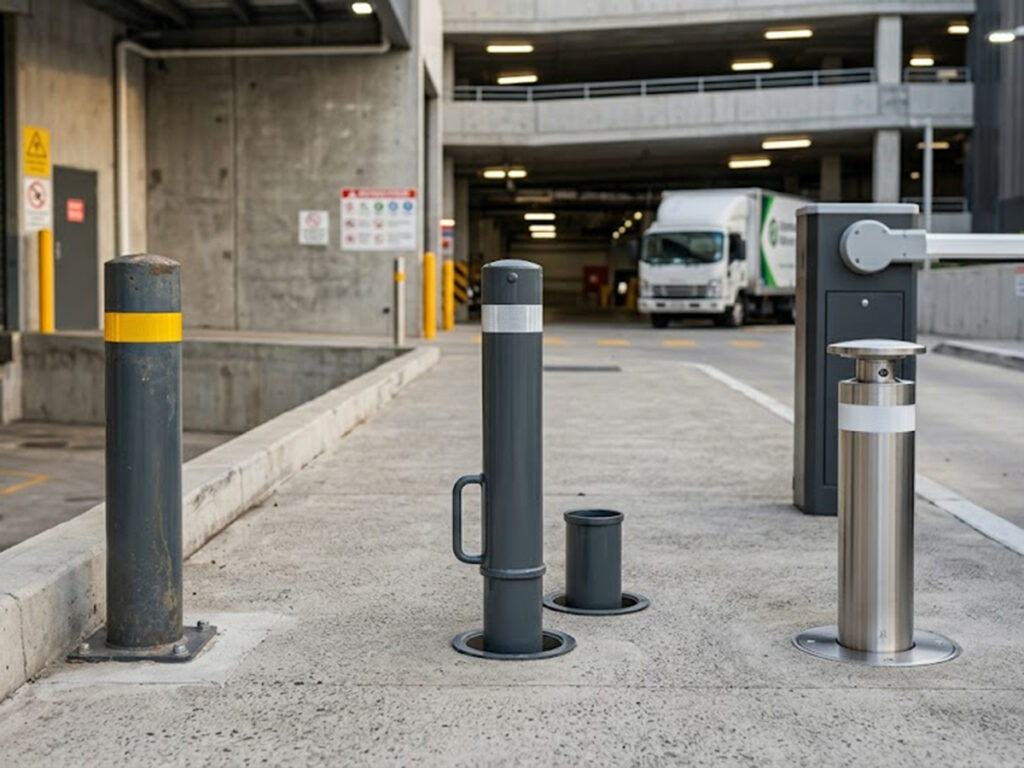
Bolardos de tráfico fijos: anclajes perimetrales permanentes
Los bolardos de tráfico fijos se anclan permanentemente en una base de hormigón.. El instalador perfora el pavimento y aplica lechada al poste., o atornilla una placa base sobre una losa de ingeniería. Estos bolardos no tienen partes móviles.. Nunca cambian el estado de acceso., no requiere almacenamiento, y exigen un mantenimiento continuo mínimo. Los bolardos de tráfico fijos se convierten en el valor predeterminado siempre que una línea perimetral no sea negociable: esquinas del muelle de carga, fachadas de edificios, y zonas peatonales adyacentes al tráfico.
Bolardos de tráfico extraíbles y desmontables: acceso manual bajo demanda
Los bolardos de control de tráfico extraíbles se levantan desde un zócalo receptor enterrado. Los operadores desbloquean el puesto., levántalo despejado, y guardarlo en otro lugar. Una vez separado, una tapa rasante o una placa base visible permanece en el pavimento. El mismo producto aparece en las especificaciones de Australia y el Reino Unido como bolardos de tráfico desmontables.. Cada bolardo de tráfico removible depende de una cerradura con llave o con llave para resistir la manipulación.. Un enchufe desbloqueado reduce el perímetro a una señal visual.
Bolardos de tráfico retráctiles: comodidad telescópica para sitios de alta frecuencia
Los bolardos de tráfico retráctiles se introducen en una carcasa de subrasante. Tres subtipos dividen la categoría por mecanismo operativo.:
- Las unidades manuales asistidas por resorte dependen de la fuerza del operador.
- Los modelos asistidos por gas reducen significativamente esa fuerza.
- Los bolardos de tráfico retráctiles hidráulicos o electromecánicos completamente automáticos bajan y suben cuando se les ordena, a menudo integrado con sistemas de control de acceso.
Los tres quedan al ras del suelo cuando están retraídos., lo que elimina el almacenamiento por completo.
La matriz de decisiones lado a lado: Costo, Acceso, Almacenamiento, y mantenimiento
La siguiente tabla condensa el perfil operativo de cada categoría.. Úselo como documento base para cualquier conversación sobre adquisiciones que involucre múltiples tipos de bolardos de tráfico.
| Criterio | Fijado | Desmontable | Retráctil |
| Método de instalación | Perforación central o revestimiento de base en hormigón | Toma de receptor enterrado | Carcasa excavada con drenaje. & zanjas |
| Mecanismo | Estacionario, cero partes móviles | elevación manual | Manual, asistido por gas, o hidráulica automática |
| Frecuencia de acceso adecuada | Nunca | Ocasional (semanal o menos) | Alto (varias veces al día) |
| Requisito de almacenamiento | Ninguno | Alto: se necesita almacenamiento seco y seguro | Ninguno: al ras del suelo |
| Costo de instalación (CapEx) | Bajo a moderado | Bajo a moderado | Alto (excavación, drenaje) |
| Aspecto del suelo | Presencia permanente | Placa base visible cuando se retira | Al ras cuando está retraído |
| Carga de mantenimiento | Mínimo | Moderado (servicio de cerradura, limpieza del enchufe) | Alto (limpieza de escombros, hidráulica) |
Fuente: Sintetizado a partir de la metodología de prueba ASTM F2656/F3016., BSI NO 68 presupuesto, y datos operativos del Storefront Safety Council
Comparación del método de instalación y la huella del suelo
Los bolardos de tráfico fijos se instalan en horas. Una placa base montada en superficie funciona donde la excavación está restringida. Los bolardos de tráfico fijos perforados requieren una base más profunda pero ofrecen un mayor rendimiento en caso de colisión. Los bolardos removibles necesitan un casquillo receptor moldeado en una losa: obra civil moderada, pero no requiere drenaje. Las unidades retráctiles exigen las obras civiles más pesadas. Sólo su carcasa puede asentarse 1.0 a 1.5 metros bajo rasante. El drenaje importa durante la instalación. Los sitios que escatiman en drenaje lo pagan cada invierno en averías mecánicas.
Bolardos fijos versus removibles: la compensación entre presupuesto y acceso
La decisión entre bolardos fijos y removibles generalmente se resume en una sola pregunta: ¿Es necesario abrir este punto de acceso?? Ambas categorías se ubican en la banda CapEx de baja a moderada.. La divergencia operativa es grave. Los bolardos fijos ofrecen flexibilidad de acceso cero pero un costo continuo casi nulo. Los bolardos extraíbles abren el perímetro según demanda pero introducen logística de almacenamiento, horarios de servicio de cerraduras, y riesgo de manipulación manual.
Bolardos retráctiles versus removibles: cuando la automatización se amortiza sola
La comparación de bolardos retráctiles y removibles es fundamentalmente un cálculo de equilibrio. Las unidades retráctiles generan un mayor CapEx pero comprimen la mano de obra operativa hacia cero. Las unidades removibles conllevan un CapEx más bajo, pero facturan al equipo de operaciones en tiempo del personal y levantan el riesgo en cada ciclo.. Como regla general, Los sitios que necesitan acceso más de una vez al día normalmente recuperan la prima retráctil dentro de 24 a 36 meses. El acceso semanal o mensual sigue siendo mejor con unidades extraíbles.
Hacer coincidir el tipo de bolardo con el caso de uso del sitio y la frecuencia de acceso
Las especificaciones técnicas importan, pero el razonamiento basado en escenarios cierra la mayoría de las decisiones de adquisiciones.. Traducir la matriz de compensaciones en casos de uso brinda a los directores de instalaciones una respuesta defendible para cada sitio.
Cuando los bolardos fijos son la única opción defendible
Elija bolardos de tráfico fijos para inflexibles, protección permanente de activos. El principio se aplica siempre que la vulnerabilidad de los activos sea alta., y el requisito de acceso es realmente cero. Las aplicaciones comunes incluyen fachadas de edificios que dan a carreteras muy transitadas., Protección de cajeros automáticos y escaparates, islas de bombas de combustible, y patios exclusivos para peatones. Las tiendas de conveniencia se encuentran entre los tipos de edificios más afectados en la base de datos del Storefront Safety Council, y los bolardos de tráfico fijos siguen siendo la contramedida estándar.
Cuando los bolardos removibles resuelven el problema del acceso ocasional
Elija bolardos de tráfico extraíbles para un uso económico, acceso ocasional al sitio. Lugares para eventos, puntos de acceso al carril de bomberos, zonas de carga semanal, y pasillos de mantenimiento cerrados se ajustan a este perfil. Una advertencia domina cada especificación removible: el costo no es el bolardo, es el trabajo. El personal que manipula postes de acero expone diariamente al empleador al riesgo de lesiones por esfuerzo excesivo, la principal causa de lesiones laborales graves en los Estados Unidos durante 25 años consecutivos. Los sitios que requieren remoción diaria deben especificar núcleos compuestos o de aluminio liviano., o actualizar a retráctil.
Cuando los bolardos retráctiles valen la prima de CapEx
Elija bolardos de tráfico retráctiles para el control de acceso de alta frecuencia, estética mejorada, y conveniencia. Patios de hotel, Calles CBD restringidas, entrega de valet, aparcamientos con acceso controlado, y las calles comerciales peatonales que admiten vehículos de reparto cronometrado se benefician. Las propiedades premium también obtienen una ventaja estética: la línea del suelo nivelada preserva la presentación del frente de una manera que ninguna otra categoría puede igualar..
| Tipo de bolardo | Principio operativo básico | Frecuencia de acceso óptima | Aplicaciones comerciales más adecuadas | Riesgo operativo primario / Compensación |
| Bolardos de tráfico fijos | Inflexible, protección permanente de activos donde la vulnerabilidad es alta y el acceso de vehículos es cero. | Nunca cambia | Escaparate & fachadas de edificiosATM & cajas de servicios públicosIslas para bombas de combustiblePatios exclusivos para peatones | Flexibilidad cero: Restringe todo acceso vehicular futuro; requiere una demolición costosa si cambia el diseño del sitio. |
| (Cerrado permanentemente) | ||||
| Bolardos de tráfico extraíbles | De presupuesto, control perimetral flexible para sitios que requieren acceso ocasional o estacional. | Baja frecuencia | Carriles de fuego & salidas de emergenciaPasillos de mantenimiento cerradosLugares para eventos & zonas de food trucks Muelles de carga semanales | Gastos generales de mano de obra & Responsabilidad: Levantar manualmente postes de acero pesados aumenta el riesgo de lesiones por esfuerzo excesivo del personal. Requiere almacenamiento seguro. |
| (Semanalmente, mensual, o estacional) | ||||
| Bolardos de tráfico retráctiles | Control de acceso de alta frecuencia que equilibra la estética premium con una comodidad perfecta. | Frecuencia alta | Patios de hotel & gotas valetCBD restringido & carriles urbanosAparcamientos corporativos con acceso controladoNodos de transporte & plazas universitarias | Gastos de capital premium: Mayor hardware inicial, excavación profunda, y costos de instalación de drenaje; requiere mantenimiento preventivo regular. |
| Patios de hotel & gotas de valet, CBD restringido & callejuelas urbanas, Aparcamientos corporativos con acceso controlado, Centros de tránsito & plazas universitarias |
Mapeo de estos escenarios con su propia cartera de sitios? Optsigns prepara hojas de especificaciones personalizadas sitio por sitio para operadores de múltiples propiedades, formateado como documentación de respaldo para presentaciones de gastos de capital. Solicite una llamada de alcance gratuita para estandarizar las especificaciones en toda su cartera.
Clasificaciones de accidentes, Espaciado, y cumplimiento normativo para cada tipo de bolardo
Estándares de prueba de choque: ASTM F2656, ASTM F3016, y Pas 68 Explicado
Tres estándares dominan la certificación global de bolardos. ASTM F2656 evalúa los bolardos contra impactos de vehículos hostiles a alta velocidad, clasificar el rendimiento por peso del vehículo (M30 para camiones de servicio mediano en 30 mph, M50 y 50 mph) y profundidad de penetración. ASTM F3016 apunta a la protección de escaparates a velocidades inferiores 30 mph: el rango al que se enfrentan la mayoría de los sitios comerciales. NO 68 es la especificación británica ampliamente adoptada internacionalmente para la mitigación de vehículos hostiles. Los fabricantes certifican los tres. tipos de bolardos de tráfico bajo estos estándares, aunque las unidades fijas dominan las clasificaciones de impacto más altas debido a su conexión estructural continua a los cimientos.
Espaciado de bolardo: El 1.2 a 1.5 Estándar del medidor
Espaciado de centro a centro de 1.2 a 1.5 Los medidores se alinean con los estándares australianos y la guía perimetral internacional.. Esta gama detiene los vehículos de pasajeros y la mayoría de los vehículos comerciales ligeros, preservando al mismo tiempo el flujo de peatones y sillas de ruedas.. El espaciamiento más estrecho impide la accesibilidad; un espacio más amplio admite vehículos angostos. El estándar de espaciado se aplica en todos tipos de bolardos de tráfico - fijado, desmontable, y retráctil.
Mecanismos de bloqueo y antimanipulación para postes removibles
Los bolardos removibles introducen una brecha de seguridad que fija, Las unidades retráctiles no. Los mecanismos de bloqueo con llave o con llave son elementos de especificación obligatorios.. Los modos de falla comunes incluyen la corrosión del casquillo por el ingreso de agua., llaves perdidas o duplicadas, y manipulación fuera de horario. Cada instalación de bolardos de control de tráfico extraíbles debe incluir un protocolo de gestión de claves documentado y una inspección anual de la cerradura..
Costo total de propiedad: mantenimiento, Mano de obra, y gastos operativos ocultos
El costo de capital rara vez cuenta la historia completa de las adquisiciones. Modelar el costo total de propiedad en un horizonte de siete a diez años (el período típico de planificación de instalaciones comerciales) revela dónde gana o pierde realmente cada categoría..
Cada uno de los tres tipos de bolardos de tráfico lleva una firma de mantenimiento distintiva:
- Fijado: Inspección visual, reparación cosmética menor, repintado ocasional. El costo recurrente sigue siendo mínimo.
- Desmontable: Limpieza trimestral de enchufes, mantenimiento anual de cerraduras, y reemplazo periódico de juntas y sellos.
- Retráctil: Limpieza mensual de escombros de la carcasa y del camino de drenaje., revisión anual del sistema hidráulico o del actuador, y reemplazo programado de sellos y sensores.
Las fallas retráctiles se agrupan alrededor del ingreso de escombros y fallas de drenaje.. Arena, hojas, arena, y el agua helada son los principales culpables. El mayor predictor del costo de vida útil del retráctil es si la instalación original especificaba un drenaje adecuado..
El costo laboral oculto de los bolardos removibles
Un poste removible de acero normalmente pesa 25 a 40 kilogramos. Levantar uno por día (o una fila de seis dos veces al día) produce exactamente el perfil de manejo manual que impulsa la categoría líder de vehículos serios de EE. UU.. lesión laboral. La Oficina de Estadísticas Laborales registró 568,150 Casos de días fuera del trabajo relacionados con esguinces., presiones, y lágrimas en 2024, y las lesiones de espalda representan por sí solas 248,180 casos (Fuente: https://laclinicasc.com/work-injury-pt/). Liberty Mutual 2025 El Índice de Seguridad en el Trabajo valoró el esfuerzo excesivo que involucra fuentes externas en $13.7 mil millones al año, el factor de costo número uno para 25 años consecutivos (Fuente: https://Riskandinsurance.com/understanding-the-58-billion-problem-how-the-top-10-workplace-injuries-impact-american-business/). Cualquier sitio que elimine publicaciones diariamente especifica núcleos livianos o actualiza la especificación.
Modelado del TCO a 10 años en los tres tipos de bolardos de tráfico
Los bolardos fijos cargan por adelantado casi todos los costos en CapEx. Las unidades removibles distribuyen el costo entre CapEx y mano de obra en curso. Las unidades retráctiles llevan el mayor CapEx pero reducen la mano de obra operativa a casi cero, siempre que el drenaje se haya especificado correctamente durante la instalación.. El drenaje no especificado sigue siendo la causa más común de pérdida de TCO en toda la categoría retráctil.
Construyendo un caso de adquisiciones defendible para su próxima revisión de capital
La conversación sobre adquisiciones normalmente no termina en el muelle de carga sino en el comité de finanzas.. Estructurar la recomendación para sobrevivir a esa revisión separa las especificaciones competentes de las defendibles..
Las cinco preguntas que debe responder antes de especificar
Cinco preguntas resuelven la mayoría tipos de bolardos de tráfico decisiones:
- ¿Cuál es la frecuencia de acceso realista en este punto, medida?, no estimado?
- ¿Cuál es la vulnerabilidad de los activos detrás de la línea??
- ¿Cuál es la máxima amenaza vehicular creíble? (masa y velocidad de aproximación)?
- ¿Cuál es la realidad del almacenamiento y manipulación manual de este sitio??
- ¿Cuál es el estándar estético y de marca para la fachada??
Cada respuesta reduce el campo. La alta frecuencia de acceso y la capacidad de almacenamiento nula apuntan a ser retráctil. La grave vulnerabilidad de los activos y el requisito de acceso nulo apuntan a una situación fija.. El acceso ocasional y un presupuesto ajustado hacen que sea desmontable.
Documentación que su junta esperará
Una presentación de capital de seguridad perimetral defendible incluye cinco artefactos: una evaluación de amenazas específica del sitio, certificación de clasificación de accidentes (ASTM F2656, F3016, no 68), un dibujo de cumplimiento de espaciado, una proyección del programa de mantenimiento, y un modelo de TCO de 10 años. Las juntas aprueban las presentaciones respaldadas por esta documentación establecida de manera mucho más confiable que aquellas que se basan únicamente en cotizaciones de proveedores..
Dónde encaja esta decisión en una estrategia de bolardo más amplia
La decisión entre fijo, extraíble y retráctil es una capa de un proceso de especificación más amplio.. Selección de materiales, estándares de acabado, integración de iluminación, y la evaluación comparativa de proveedores van junto a la decisión de categoría de acceso. Los equipos de instalaciones que se preparan para las revisiones del perímetro a nivel de junta deben consultar a nuestro Comparación del comprador de bolardos de tráfico completo, que recorre el marco de especificaciones más amplio de todos los principales fabricantes y niveles de clasificación de accidentes..
Preparando una revisión del perímetro para su próximo ciclo de gasto de capital? Solicite una evaluación perimetral gratuita en el sitio ahora! Optisigns proporciona recomendaciones de especificaciones escritas, documentación de clasificación de accidentes, y una proyección del TCO a 10 años formateada para revisión de la junta directiva.
Preguntas frecuentes sobre fijo, Desmontable, y bolardos de tráfico retráctiles
¿Cuál es la principal diferencia entre fijo?, desmontable, y tipos de bolardos de tráfico retráctiles?
Los bolardos fijos se anclan permanentemente sin partes móviles. Los bolardos extraíbles se levantan desde un zócalo enterrado para acceso ocasional. Los bolardos retráctiles se introducen telescópicamente en una carcasa de tierra para uso frecuente., acceso a menudo automatizado. La elección depende de la frecuencia de acceso., requisito de protección de activos, y carga de mantenimiento tolerada.
¿Con qué frecuencia se atascan los bolardos de tráfico retráctiles en condiciones reales??
La interferencia es abrumadoramente un problema de instalación, no es un defecto del producto. Drenaje inadecuado, sellos de escombros faltantes, o las carcasas de tamaño insuficiente causan la mayoría de las fallas. Los bolardos de tráfico retráctiles correctamente especificados funcionan de forma fiable para 10+ años. La limpieza mensual de desechos y el servicio hidráulico anual mantienen los mecanismos dentro de la tolerancia..
¿Los bolardos removibles son lo suficientemente fuertes como para detener un vehículo??
Sí, cuando está certificado según ASTM F2656 o PAS 68 e instalado con un enchufe receptor diseñado. La seguridad depende completamente de que la cerradura esté activada.. Un enchufe desbloqueado o desgastado reduce un bolardo de tráfico extraíble a una señal visual, no es una barrera fisica.
¿Cuál es el espacio correcto entre bolardos de tráfico??
El estándar aceptado en la orientación australiana e internacional es 1.2 a 1.5 metros de centro a centro. Esta gama detiene los vehículos de pasajeros estándar y la mayoría de los vehículos comerciales ligeros, al tiempo que preserva el acceso para peatones y sillas de ruedas.. Los sitios con perfiles de amenazas más altos pueden especificar espacios más ajustados junto con clasificaciones de fallas mejoradas.
¿Se pueden mezclar bolardos fijos y desmontables en el mismo perímetro??
Sí, muchos sitios comerciales de alto funcionamiento hacen exactamente esto. Un patrón común coloca bolardos fijos a lo largo de la línea continua protegida y reserva unidades extraíbles o retráctiles sólo para puntos de acceso definidos. (muelles de carga, rutas de emergencia, entradas de servicio). El enfoque híbrido equilibra la integridad del perímetro con la flexibilidad operativa.
¿Qué tipo de bolardo ofrece el coste total de propiedad más bajo en 10 años??
Para sitios con necesidades de acceso nulas o casi nulas, Los bolardos fijos ofrecen el TCO más bajo por un margen significativo. Donde se requiere acceso diario, Los bolardos retráctiles suelen ofrecer un coste total de propiedad más bajo que las unidades extraíbles una vez que se realiza la mano de obra., almacenamiento, y el riesgo de manipulación manual se calculan en, siempre que la instalación especifique un drenaje adecuado..
Referencias
- ASTM International, “Método de prueba estándar F2656 para pruebas de choque de barreras de seguridad de vehículos” y “Método de prueba estándar F3016 para pruebas sustitutas de dispositivos de protección contra impactos de vehículos a bajas velocidades.”
- Grupo BSI, “NO 68:2013 Especificaciones de pruebas de impacto para sistemas de barreras de seguridad de vehículos.”
- Libertad Mutua, “2025 Índice de seguridad laboral,” Grupo Mutual Libertad, Julio 2025.