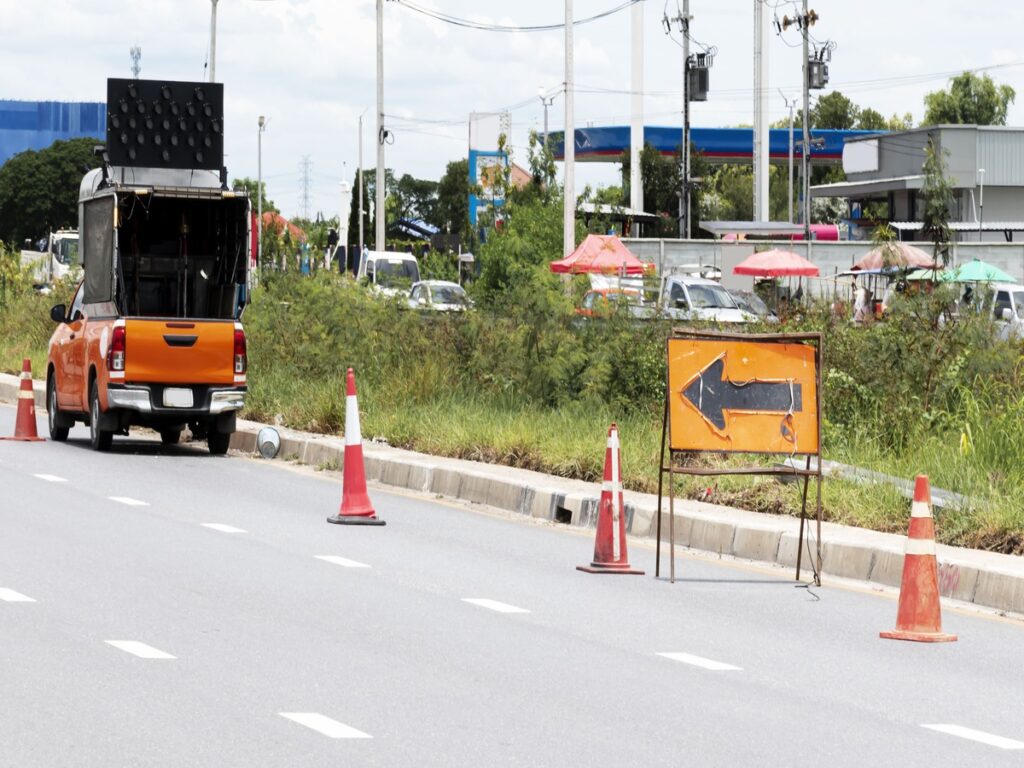
UM directional arrow sign and an electronic arrow board do the same basic job. Both tell drivers which way to move around a closure. No entanto, crews often default to whichever one is already on the truck, rather than the one the site actually needs. That choice matters more than it looks. The two devices work best under very different conditions.
Our team has reviewed work zone plans with this exact problem. Uma estática directional arrow sign went up on a high-speed, low-visibility approach. That approach really called for an illuminated arrow board instead. The sign was legible in daylight. No entanto, it became far less effective once traffic shifted to dusk and early-morning hours.
This guide covers three things. Primeiro, when a static directional arrow sign is enough. Segundo, when an electronic arrow board earns its extra cost. Terceiro, how to decide between the two for a specific site.
Takeaways -chave
- Static Signs Suit Short, Low-Speed Closures: A directional arrow sign works well where power isn’t available and visibility conditions are good.
- Arrow Boards Suit Higher-Speed, Longer-Duration Sites: Illumination and flash patterns matter more as speed and low-light exposure increase.
- Duration Changes the Cost Calculation: A short-term closure rarely justifies an arrow board’s setup and power requirements.
- Visibility Conditions Decide More Than Distance: Trabalho noturno, névoa, and glare all favor an illuminated device over a static sign.
- Mixing the Two Is Common on Longer Projects: A site can reasonably use static signs during daylight setup and switch to an arrow board for extended or overnight phases.
What Each Device Actually Does
UM directional arrow sign is a static, reflective panel. It shows drivers which direction to move around a closure. It has no moving parts and needs no power source, which makes it fast to deploy and simple to maintain.
An electronic arrow board adds illumination and, muitas vezes, selectable flash patterns. It’s built for situations where a static reflective panel isn’t enough to grab a driver’s attention quickly. This matters most at night or in poor visibility.
When a Static Sign Is Genuinely Enough
A static directional arrow sign performs well when three conditions line up:
- The closure is short-term, measured in hours rather than days or weeks.
- The approach speed is moderate, giving drivers reasonable time to see and react to a reflective sign.
- Visibility conditions are good, meaning daylight work with clear sightlines rather than fog, chuva forte, or nighttime shifts.
Under these conditions, an arrow board adds cost and setup time. It doesn’t add a meaningful safety benefit over a well-placed static sign.
When an Arrow Board Earns Its Cost
An electronic arrow board becomes the better choice as any of the following shifts:
| Doença | Sinal estático | Tabuleiro de Setas |
|---|---|---|
| Approach speed | Adequate at lower speeds | Better at highway speeds, where drivers need faster recognition |
| Duração | Fine for short-term work | Justifies setup cost on multi-day or overnight projects |
| Visibilidade | Works in daylight, clear conditions | Needed for night work, névoa, or low-sun glare |
| Power availability | None required | Needs a power source, typically solar or battery on trailer-mounted units |
The pattern here isn’t “arrow boards are always better.” Em vez de, the extra cost and complexity of an illuminated device only pays off once speed, duração, or visibility push past what a static sign can reliably communicate.
Why Crews Default to Whichever Device Is Already Available
The mismatch described earlier usually isn’t a judgment call made on purpose. Em vez de, it’s a logistics default. A crew that only has static signs on the truck uses static signs. This happens regardless of whether the site’s approach speed or visibility actually calls for something brighter. The reverse also happens. A crew hauls an arrow board to a short daytime job simply because that’s what was already loaded, adding setup time the job didn’t need.
Matching the Device to the Site, Not the Truck
Getting this choice right depends on one thing. Crews need to evaluate the site’s actual speed, duração, and visibility conditions before deployment. They shouldn’t default to whatever equipment happens to be available that day.
The Optraffic team supplies both static directional arrow signage and a full line of trailer-mounted solar-powered electronic arrow boards. Por aqui, crews can match the device to the site instead of the site to the device. That flexibility matters most on projects that shift from daytime setup to overnight phases. On those jobs, the right call can change partway through the same project.
Leitura Relacionada
- Pacotes de controle de tráfego de zona de trabalho: Sinais correspondentes, Cones, e canalizadores para o seu tipo de fechamento
- Sinais de fusão de rodovias: Regras de colocação para reduções temporárias de faixa em zonas de trabalho
- Guia de sinalização de fechamento de faixa única: Configuração do MUTCD & Cônico
- Luzes de farol LED vs.. Estroboscópios direcionais: Otimizando a Segurança da Frota
Perguntas frequentes
What is a directional arrow sign used for?
It shows drivers which direction to move around a closure, using a static, reflective panel rather than illumination. It works well for short-term, lower-speed closures in good visibility.
When should I use an electronic arrow board instead of a static sign?
Use one when approach speed is higher, the closure runs overnight or over multiple days, or visibility conditions like fog or glare make a static sign harder to see in time.
Does a longer work zone always need an arrow board?
Não necessariamente. Duration matters, but so does speed and visibility. A longer, low-speed daytime closure in good conditions can still work fine with static signage.
Can a work zone use both devices on the same project?
Sim. It’s common to use static signs during daytime setup phases. Crews then switch to an arrow board once a project extends into overnight or lower-visibility conditions.
Conclusão
Choosing between a directional arrow sign and an electronic arrow board comes down to one thing: matching the device to the site’s actual speed, duração, e visibilidade. It’s not about whatever happens to be loaded on the truck. That’s why the Optraffic team stocks both device types side by side. Por aqui, the decision follows the job, not the inventory on hand.