Sinais de estacionamento: Guia de conformidade do comprador
Um não conforme sem sinal de estacionamento não cria apenas um problema estético – cria uma responsabilidade legal. A Administração Federal de Rodovias (Fhwa) determina que todos os dispositivos de controle de tráfego em estradas abertas ao tráfego público estejam em conformidade com o Manual sobre Dispositivos Uniformes de Controle de Tráfego (MUTCD), agora em sua 11ª edição (2023). Proprietários de imóveis, diretores de instalações, e empreiteiros civis que instalam sinalização que esteja fora desses padrões correm o risco de anulação da citação, responsabilidade por disputa de reboque, e falhas de aplicação.
Este guia cobre toda a estrutura de conformidade para aplicações comerciais e regulatórias de proibição de estacionamento: dimensões do sinal, classes de folhas retrorrefletivas, requisitos de cor e legenda, especificações de montagem, e pontos de verificação de compras. Ele foi escrito especificamente para tomadores de decisão B2B responsáveis pela aprovação da conformidade de infraestrutura em áreas comerciais., industrial, e propriedades de uso misto.
O que o MUTCD realmente rege – e por que se aplica à sua propriedade
Federal versus. Jurisdição Estadual: Onde começa a autoridade MUTCD
O MUTCD exerce autoridade federal sob 23 Parte CFR 655 e serve como base nacional adotada por todos 50 estados. Estados individuais podem promulgar padrões suplementares – Califórnia, Texas, e a Flórida publicam, cada uma, suas próprias alterações MUTCD – mas nenhum padrão estadual pode ficar abaixo do mínimo federal. Os oficiais de compras que gerenciam carteiras de propriedades multiestaduais devem cruzar referências dos manuais estaduais aplicáveis antes de emitir um pedido de compra.
Como os operadores de propriedade privada ficam sob o alcance do MUTCD
O MUTCD governa diretamente todas as estradas abertas ao transporte público. Para estacionamentos privados acessíveis ao público, o padrão federal é fortemente recomendado e frequentemente exigido pela legislação local. A maioria dos municípios condiciona a autoridade de fiscalização de reboque à sinalização compatível com MUTCD - o que significa um padrão abaixo do padrão sem sinal de estacionamento pode tornar um reboque legalmente inexequível. Para uma análise detalhada do aplicabilidade de restrições de estacionamento publicadas de forma privada, incluindo como as leis locais determinam se os sinais privados têm peso legal, os operadores devem consultar esse recurso dedicado.
O 2023 Mutcd 11ª edição: Principais atualizações que as equipes de compras devem saber
A 11ª Edição introduz requisitos atualizados de gerenciamento de retrorrefletividade na Seção 2A.08, agora impondo cronogramas documentados de inspeção e substituição aos proprietários de sinalização - não apenas aos órgãos públicos. Especificações de aquisição escritas antes 2023 pode fazer referência a classes de chapas substituídas ou orientações dimensionais desatualizadas. Qualquer programa de compra de sinalização ativo deve ser auditado em relação aos padrões atuais da 11ª Edição antes do próximo ciclo de pedidos.
Decodificando MUTCD Parte 2B: Padrões de sinalização regulatória para aplicações de proibição de estacionamento
MUTCD Seção 2B.46: O Código Governante para Sinais de Proibição de Estacionamento
A Seção 2B.46 do MUTCD é a principal referência regulatória para todos sem sinal de estacionamento aplicações. Ele exige uma legenda vermelha e uma borda em um fundo retrorrefletivo branco, texto maiúsculo em alfabetos padrão FHWA, e configurações de seta específicas para delineamento de limites de zona. Três designações principais se aplicam em contextos comerciais:
- R7-1 (Proibido Estacionar): Usado quando restrições se aplicam durante horários ou dias específicos — sempre combinado com um painel de restrição de tempo suplementar.
- R7-2 (Sem estacionamento a qualquer momento): Usado para incondicional 24/7 restrições — a designação correta para pistas de incêndio, rotas de acesso de emergência, e áreas de entrega de uso contínuo.
- Série R7-200: Placas suplementares que fornecem restrições personalizáveis de horário e dia — essenciais para zonas de carregamento com restrição de tempo em centros de entrega comercial.
Cor, Lenda, e especificações de fundo retrorrefletivo
A Tabela 2A-4 do MUTCD rege os padrões de cores para todos os sinais regulatórios. As combinações federais de fundo vermelho e branco devem atender às taxas mínimas de contraste de cores sob condições diurnas e noturnas retrorrefletivas. Pintado liso, sinais não retrorrefletivos não são compatíveis em qualquer estrada aberta ao tráfego público. Isto não é uma recomendação – é um mandato codificado com implicações diretas de aplicabilidade.
Requisitos de seta e limite de zona para aplicações em campus comerciais
Grandes campi comerciais, instalações industriais, e parques logísticos com vários edifícios devem usar setas direcionais compatíveis com MUTCD para delinear o início, continuação, e fim das zonas proibidas de estacionamento. Conjuntos combinados de sinalização de legenda e restrição de tempo são permitidos de acordo com as diretrizes do MUTCD. Operadores na Califórnia, Texas, e a Flórida também devem revisar as leis locais que podem impor requisitos suplementares de legenda bilíngue, que afetam o dimensionamento do painel.
A matriz de tamanho de sinalização comercial de proibição de estacionamento: Requisitos dimensionais do MUTCD por aplicação
Requisitos de tamanho de sinalização padrão para estradas convencionais e estacionamentos
O tamanho padrão do sinal de proibição de estacionamento para baixa velocidade, ambientes de baixo volume – incluindo estacionamentos privados de superfície e estradas de acesso sob 25 mph - é 12 em x 18 de acordo com a orientação da Tabela 2B-1 do MUTCD. Para postagem em estradas comerciais convencionais 25 para 45 Limites de velocidade MPH, incluindo perímetros de shopping centers e rotas de acesso a parques de escritórios, o padrão aumenta para 18 em x 24 em. O 18 em x 24 no formato é o padrão de aquisição de fato para diretores de instalações que gerenciam locais comerciais de uso misto.
Grandes requisitos de sinalização de proibição de estacionamento para zonas comerciais de alto tráfego
Grandes sinais de proibição de estacionamento - definidos como 24 em x 30 igual ou superior – torna-se obrigatório para vias arteriais com múltiplas faixas, corredores de entrega comercial, e entradas de instalações industriais de alto volume. Seção 2A.11 do MUTCD sobre tamanho e legibilidade dos sinais, combinado com julgamento de engenharia padrão, requer essas dimensões para ambientes com tráfego de caminhões pesados, distâncias de visão restritas, ou velocidades publicadas acima 45 km/h. Os contextos de aplicação incluem centros logísticos, estradas de acesso ao centro de distribuição, perímetros de instalações portuárias, e estruturas de estacionamento comercial de alta densidade.
Padrões de altura de montagem e folga lateral
A Seção 2A.18 do MUTCD estabelece uma altura mínima de montagem de 7 pés do solo até a parte inferior da placa em distritos comerciais e residenciais. Em estacionamentos onde não existe conflito de pedestres, o mínimo cai para 5 ft. A folga lateral requer um mínimo 2 pés de separação da face do meio-fio até a borda próxima da sinalização - uma especificação que afeta diretamente a aquisição de postes e hardware.
Matriz de tamanho de sinalização de proibição de estacionamento MUTCD por contexto de aplicação
| Contexto do aplicativo | Tamanho padrão | Grau de cobertura | Referência MUTCD |
| Estacionamentos privativos de superfície (baixa velocidade) | 12 em × 18 em | Grau de engenharia (Por exemplo) | Tabela MUTCD 2B-1 |
| Estradas comerciais, 25–45 mph (parques de escritórios, shoppings) | 18 em × 24 em | Alta intensidade prismática (QUADRIL) | MUTCD Seção 2A.11 |
| Vias arteriais de múltiplas pistas, centros de entrega comercial | 24 em × 30 em | Alta intensidade prismática (QUADRIL) | MUTCD Seção 2A.11 |
| Arteriais de alta velocidade ≥ 45 km/h, corredores industriais | 24 em × 30 em ou maior | Grau de diamante (Dg) | MUTCD Seção 2A.08 |
Fonte: Mutcd 11ª edição (2023), Fhwa
Padrões de retrorefletividade: Selecionando a classe de cobertura correta para 24/7 Conformidade
Por que todo sinal de proibição de estacionamento exige cobertura retrorrefletiva
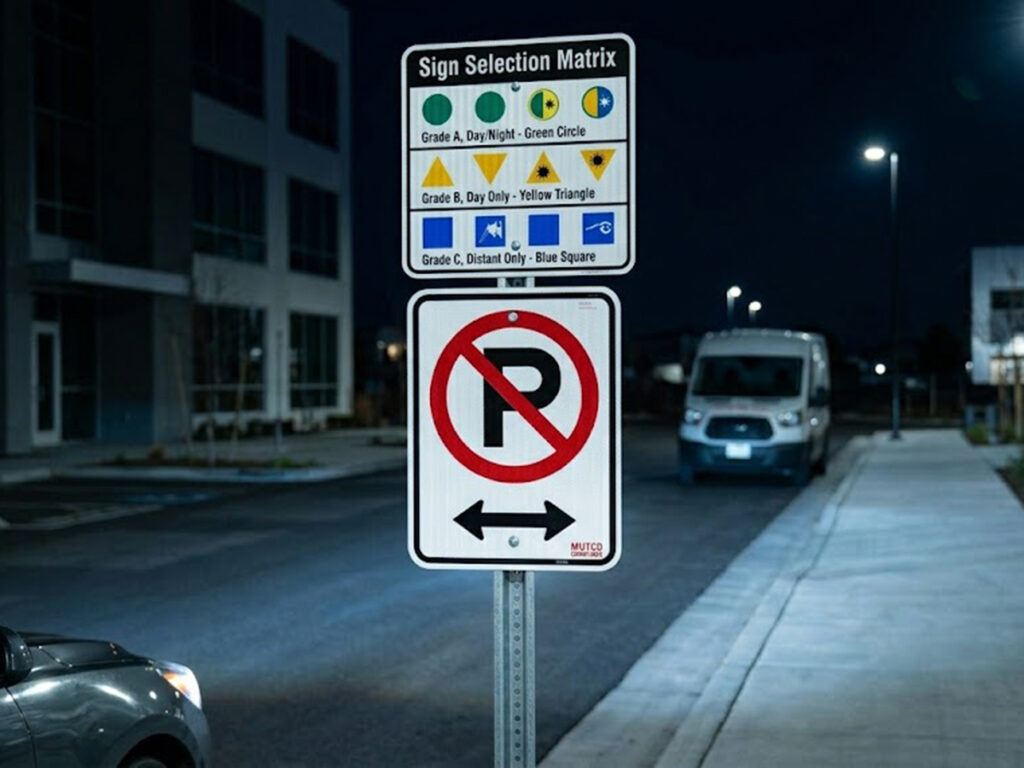
MUTCD Seção 2A.08 e a Regra Final da FHWA sobre Padrões Mínimos de Retrorrefletividade estabelecem um requisito de retrorrefletividade mantido para todos os sinais regulamentares. Os FHWA 2012 Regra Final - ainda em vigor na 11ª Edição - define valores mínimos de coeficiente para sinais da série R7: um fundo branco deve manter pelo menos 7 cd/lx/m² e uma legenda ou borda vermelha pelo menos 2 CD/LX/M², conforme referenciado em ASTM E1709 e MUTCD Tabela 2A-3. A palavra crítica é mantida – a sem sinal de estacionamento deve manter esses valores durante toda a sua vida útil instalada, não apenas na instalação inicial.
Grau de Engenharia vs.. Prismático de Alta Intensidade vs.. Grau de diamante: Um guia de especificações
Três classes de películas retrorrefletivas reconhecidas pelo MUTCD aplicam-se a aplicações comerciais sem estacionamento:
- Grau de engenharia (Por exemplo / Tipo I.): Atende aos limites mínimos de retrorrefletividade. Adequado para baixa velocidade, lotes privados com acesso controlado. Custo mais baixo; vida útil de 7 para 10 anos. Apropriado para aplicações em armazéns internos ou lotes de superfície onde a aplicação policial noturna não é crítica.
- Alta intensidade prismática (QUADRIL / Tipo III-IV): O padrão comercial para aplicações externas. Entrega 3 para 4 vezes a retrorrefletividade do EG. Recomendado para todas as aplicações arteriais e adjacentes a estradas públicas. Vida útil de 10 para 12 anos — o grau preferido para diretores de instalações que gerenciam perímetros e estradas de acesso de entrega.
- Grau de diamante (Dg / Tipo IX-XI): A opção de maior desempenho. Prática obrigatória de engenharia para arteriais de alta velocidade em ou acima 45 mph e grandes sinais de proibição de estacionamento em corredores comerciais de várias faixas. Conquistas 7 para 10 vezes a retrorrefletividade do EG; vida útil de 12 ou mais anos.
Comparação de graus de cobertura retrorrefletiva
| Grau de cobertura | Retorreflectividade (CD/LX/M²) | Vida de serviço | Melhor Aplicação |
| Grau de engenharia (Por exemplo / Tipo I.) | ≥ 7 (branco) | 7–10 anos | Baixa velocidade, lotes privados com acesso controlado |
| Alta intensidade prismática (QUADRIL / Tipo III-IV) | 3–4× GE | 10–12 anos | Estradas arteriais, perímetros comerciais |
| Grau de diamante (Dg / Tipo IX-XI) | 7–10× GE | 12+ anos | Corredores de alta velocidade, centros industriais |
Fonte: ASTM D4956 / Tabela MUTCD 2A-3
Para um aprofundamento técnico nos coeficientes de desempenho de filmes prismáticos, Classificações de cobertura ASTM D4956, e critérios de seleção de grau de refletividade específicos do local.
Construindo um Programa de Gerenciamento de Retrorrefletividade
MUTCD Seção 2A.08 exige que grandes operadores imobiliários e órgãos públicos implementem um método documentado de gerenciamento de retrorrefletividade. As opções compatíveis incluem inspeção visual noturna, medições de retrorrefletômetro calibradas em relação aos mínimos ASTM E1709, agendamento de substituição de vida útil esperada, ou programas de substituição geral. As equipes de aquisição devem enquadrar a seleção do tipo de chapa como uma decisão de custo do ciclo de vida – os materiais HIP e Diamond Grade reduzem a frequência de substituição e a exposição a responsabilidades, produzindo um custo total de propriedade mais baixo do que o Engineering Grade em um horizonte de 15 anos.
Pólo, Publicar, e hardware de montagem: Especificações de conformidade além da face do sinal
Requisitos de poste de separação em conformidade com MUTCD para sinais adjacentes à estrada
A Seção 2A.20 do MUTCD determina que os sinais instalados dentro da zona livre de uma rodovia usem suportes separatistas ou cedentes projetados para desabar com o impacto do veículo. Este requisito se aplica diretamente a sem sinal de estacionamento instalações em perímetros de estacionamento adjacentes aos corredores de acesso. Os tipos de postes compatíveis incluem canal em U de aço de 2 lb/pé, tubo de aço quadrado com hardware separatista certificado, e postes de madeira dimensionalmente especificados. Postes decorativos não separáveis — comuns em empreendimentos de varejo e uso misto — exigem uma barreira física ou recuo suficiente para alcançar a conformidade com o MUTCD e estão entre as violações mais frequentemente citadas em auditorias de sinalização comercial.
Postagem única vs.. Montagem suspensa para locais comerciais de alta densidade
A montagem padrão de poste único é adequada para a maioria das aplicações em estacionamentos de superfície. Estruturas de estacionamento comercial e áreas de entrega cobertas podem exigir montagem com fio suspenso ou braço cantilever. A Seção 2A.16 do MUTCD rege o ângulo de instalação para estradas curvas, exigindo que as faces dos sinais sejam orientadas perpendicularmente à direção do tráfego que se aproxima. Os conjuntos de montagem suspensa exigem aprovação da engenharia estrutural na maioria das jurisdições - inclua isso no projeto antecipadamente para evitar atrasos no cronograma.
Resistência ao vandalismo e especificações de substrato para ambientes de alto risco
MUTCD Seção 2A.06 determina que os rostos dos sinais permaneçam limpos e legíveis. Sinais danificados ou obscurecidos criam uma obrigação ativa de conformidade de manutenção. Substrato padrão para permanente sem sinal de estacionamento instalações é .080-Alumínio do medidor. Ambientes de alto vandalismo podem exigir aço de alto calibre; ambientes costeiros ou corrosivos se beneficiam de substratos HDPE. Os sobrelaminados anti-graffiti aplicados dentro das especificações do fabricante não afetam o desempenho da retrorrefletividade e representam uma opção de proteção compatível.
Lista de verificação de conformidade de aquisições: Como especificar sinais compatíveis com MUTCD em escala
Os sete pontos de especificação obrigatórios para cada pedido de compra de sinalização de proibição de estacionamento
- Código de designação de sinal (R7-1, R7-2, ou série R7-200 por contexto de aplicação)
- Especificação dimensional (12 em x 18 em, 18 em x 24 em, ou 24 em x 30 dentro ou maior por classificação de estrada)
- Grau de cobertura (Por exemplo, QUADRIL, ou DG de acordo com o limite de velocidade publicado e condições de iluminação ambiente)
- Material do substrato e medidor (.080 mínimo de alumínio para instalação permanente ao ar livre)
- Confirmação de fonte dos alfabetos padrão FHWA – não são permitidas fontes substitutas sem serifa
- Configuração de seta (nenhum, direção única, ou layout de dupla direção por zona)
- Especificação de hardware de montagem (tipo de postagem separatista, altura de montagem, e folga lateral)
Critérios de qualificação de fornecedores: O que verificar antes de emitir uma ordem de compra
Os oficiais de compras devem verificar o seguinte antes de fazer qualquer pedido de sinalização rodoviária de proibição de estacionamento:
- Confirme a conformidade com ASTM D4956 (padrão de cobertura retrorrefletiva) e ASTM D523 (brilho especular para substrato de sinalização).
- Verifique se as películas retrorrefletivas são provenientes de fabricantes reconhecidos pela FHWA, como 3M ou Avery Dennison.
- Solicite certificação documentada do grau de cobertura – apenas uma descrição do produto é insuficiente.
- Para pedidos comerciais de alto volume, confirmar ISO 9001 ou certificação equivalente do sistema de gestão da qualidade.
Gerenciamento de portfólio multisite: Padronizando especificações em propriedades comerciais
As equipes de compras que gerenciam portfólios multi-site enfrentam o desafio de diversos suplementos estaduais do MUTCD. A abordagem recomendada é criar um documento de especificação mestre que atenda ao padrão estadual aplicável mais restritivo como a linha de base da empresa. Combine isso com o agendamento de substituição em fases vinculado ao rastreamento da vida útil da retrorrefletividade para cada local.
Gerenciando sinalização em diversas instalações? Solicite uma consulta de conformidade para construir uma especificação MUTCD padronizada para todo o seu portfólio de propriedades.
Alinhando seu programa de sinalização comercial com todo o espectro de padrões de proibição de estacionamento
Conformidade com MUTCD para um sem sinal de estacionamento o programa não é uma decisão de compra única – é uma obrigação operacional contínua. Este guia cobriu o escopo da jurisdição legal sob MUTCD Parte 2B, requisitos dimensionais por classificação de estrada, seleção de grau de cobertura retrorrefletiva, padrões de montagem de montagem, pontos de verificação de especificações de aquisição, e protocolos de remediação de auditoria. Cada elemento dessa estrutura traz implicações diretas de aplicabilidade e responsabilidade para os operadores de propriedades comerciais.
O custo de um sistema totalmente compatível com MUTCD sem sinal de estacionamento programa é insignificante em relação à exposição criada por uma única disputa de reboque, citação municipal, ou reivindicação de responsabilidade por acidente enraizada em sinalização não conforme. Para administradores de propriedades, diretores de instalações, e oficiais de compras responsáveis pela sinalização em portfólios comerciais inteiros, o argumento operacional para conformidade proativa é inequívoco.
Tomadores de decisão que precisam de uma estrutura estratégica mais ampla — cobrindo todo o escopo do controle de acesso a estacionamentos comerciais, delimitação de zona, e requisitos regulamentares de postagem - devem fazer referência ao ponto a ponto estrutura completa de conformidade de sinalização comercial de proibição de estacionamento para uma visão abrangente de como os sinais regulatórios individuais se enquadram em um programa de sinalização local totalmente integrado.
Perguntas frequentes: MUTCD Conformidade com sinalização de proibição de estacionamento para compradores comerciais
Qual é o padrão federal exigido sem tamanho de sinalização de estacionamento para um estacionamento comercial versus uma via pública?
A Tabela 2B-1 do MUTCD e a Seção 2A.11 fornecem tamanhos mínimos por aplicação. Para estacionamentos privados fora da rua, o padrão mínimo de tamanho de sinal de proibição de estacionamento é 12 em x 18 em. Para vias públicas convencionais com velocidades anunciadas de 25 para 45 km/h, o padrão é 18 em x 24 em. Para vias arteriais com múltiplas faixas ou estradas com velocidades acima 45 km/h, julgamento de engenharia e orientação MUTCD direcionam um mínimo de 24 em x 30 em. Os diretores de instalações que gerenciam locais que abrangem lotes privados e vias públicas devem especificar o padrão mais elevado aplicável à estrada em todo o perímetro para manter a aplicabilidade uniforme.
O MUTCD exige sinais reflexivos de proibição de estacionamento em um estacionamento privado?
Mandato de retrorrefletividade do MUTCD sob a Seção 2A.08 aplica-se diretamente a estradas abertas ao transporte público. Para lotes privados puramente com acesso controlado, o mandato federal é tecnicamente consultivo. No entanto, a resposta prática de conformidade para operadores comerciais é sim - a maioria das leis municipais de reboque condicionam a autoridade de fiscalização à conformidade com o MUTCD (retrorrefletivo) sinalização independentemente da propriedade do lote. Alta intensidade prismática (QUADRIL) a cobertura é o grau mínimo recomendado para todas as aplicações comerciais externas onde a aplicabilidade noturna é um requisito.
Qual é a diferença entre as designações R7-1 e R7-2, e que se aplica a um 24/7 restrição de carregamento comercial?
A designação R7-1 se aplica quando nenhuma restrição de estacionamento é limitada no tempo. Sempre requer um painel de restrição de hora/dia suplementar da série R7-200. O R7-2 (Sem estacionamento a qualquer momento) designação aplica-se a incondicional 24/7 restrições. Para pistas de incêndio, rotas de acesso de emergência, e áreas de entrega de uso contínuo que devem permanecer sempre limpas, R7-2 é a designação correta. Usando R7-1 sem painel de tempo em um 24/7 contexto de restrição constitui uma não conformidade codificável sob MUTCD Seção 2B.46.
Com que frequência os operadores comerciais devem substituir os sinais de proibição de estacionamento para manter a conformidade com a retrorrefletividade do MUTCD?
MUTCD Seção 2A.08 não exige um intervalo de substituição universal, mas exige que os proprietários dos sinais implementem um método documentado de gerenciamento de retrorrefletividade. Vida útil esperada padrão da indústria por classe de cobertura: Grau de Engenharia — 7 para 10 anos; Prismático de Alta Intensidade — 10 para 12 anos; Grau Diamante — 12 ou mais anos. As equipes de compras devem incorporar a programação de substituição nos modelos de custo do ciclo de vida no momento da especificação inicial.
Um gerente de propriedade pode instalar grandes placas de proibição de estacionamento com cores personalizadas ou fontes de marca?
Não. MUTCD Seção 2A.06 rege explicitamente o design de todos os sinais regulamentares. Cor da legenda, cor de fundo, fonte (Alfabetos padrão FHWA), e especificações de fronteira são obrigatórias. Cores personalizadas ou fontes fora do padrão em um sem sinal de estacionamento não criam apenas um desvio estético – eles tornam o sinal legalmente não regulamentado, retirando sua aplicabilidade sob a maioria dos códigos estaduais de veículos. Os gestores de propriedades devem limitar a marca exclusivamente à orientação e sinalização direcional não regulamentada.
Referências
FHWA - Manual sobre Dispositivos Uniformes de Controle de Tráfego (MUTCD) 11ª Edição (2023)
FHWA – Regra Final: Níveis Mínimos de Retrorrefletividade para Sinais de Trânsito
ASTM Internacional — D4956: Especificação padrão para coberturas retrorrefletivas para controle de tráfego
Código de Regulamentações Federais - 23 Parte CFR 655 (Dispositivos de controle de tráfego)
Tribunais da Califórnia - Centro de autoajuda (Reclamações Civis & Disputas de reboque)