Les gestionnaires d’installations de décision en matière de visibilité nocturne ne peuvent pas se permettre de se tromper
La visibilité nocturne entraîne une part mesurable de la responsabilité des biens. Les données annuelles de la NHTSA sur les décès sur les routes publiées en 2026 a rapporté que 39,254 des personnes sont mortes dans des accidents de la route dans tout le pays, les piétons restant confrontés à des risques disproportionnés. Tandis que la Governors Highway Safety Association (GHSA) a signalé un résultat positif 11% baisse du nombre de piétons tués au premier semestre 2025 par rapport à l'année précédente, le nombre total de décès de piétons reste bien supérieur aux niveaux de référence d’avant la pandémie. Surtout, le profil de risque à long terme n’a pas changé: les données historiques confirment que les accidents mortels de piétons la nuit ont augmenté de plus de 80% depuis 2010, dépassant de loin les incidents diurnes. Terrains commerciaux, Docks de chargement, et les places à usage mixte s’inscrivent parfaitement dans ce profil de risque. (Source: https://aashtojournal.transportation.org/ghsa-big-year-over-year-drop-in-pedestrian-fatalities/)
Les données sur le lieu de travail racontent la même histoire. Selon le Bureau des statistiques du travail (Bls) et Conseil national de sécurité (NSC) suivi de la sécurité industrielle, des incidents impliquant des piétons impliquant des véhicules terrestres motorisés ont entraîné 369 décès de travailleurs et plus 15,520 Jours-là, Restrictions, et transferts (DARD) cas chaque année. Bornes de signalisation réfléchissantes remédier directement à cette exposition en rendant les chemins de circulation et les limites des piétons visibles la nuit tombée. (Source: https://www.bls.gov/news.release/cfoi.nr0.htm)
Pourquoi la faible visibilité entraîne des réclamations en responsabilité dans les terrains commerciaux
Les gestionnaires immobiliers sont confrontés à un problème aggravant. Les faisceaux des phares atteignent environ 160 pieds sur feux de croisement et 500 pieds sur les feux de route, Pourtant, la plupart des luminaires des parkings projettent des flaques de lumière qui s'estompent au-delà du bord de l'asphalte.. Un conducteur qui scrute un trajet de service sombre a besoin d'un signal passif qui apparaît au moment où les phares le touchent.. Bornes de signalisation réfléchissantes délivrez ce signal sans consommer un seul watt.
Réfléchissant ou éclairé: Un cadrage rapide
Deux technologies dominent le marché. Les unités réfléchissantes renvoient les faisceaux ambiants et les phares aux conducteurs à l'aide d'une feuille rétroréfléchissante technique.. Les unités lumineuses génèrent leur propre lumière grâce à des luminaires LED câblés ou à énergie solaire.. Les deux technologies améliorent la visibilité. Un seul évite les tranchées, permis d'électricité, et une facture d'énergie sur 20 ans.
Comment les bornes rétroréfléchissantes font rebondir les phares sur les conducteurs
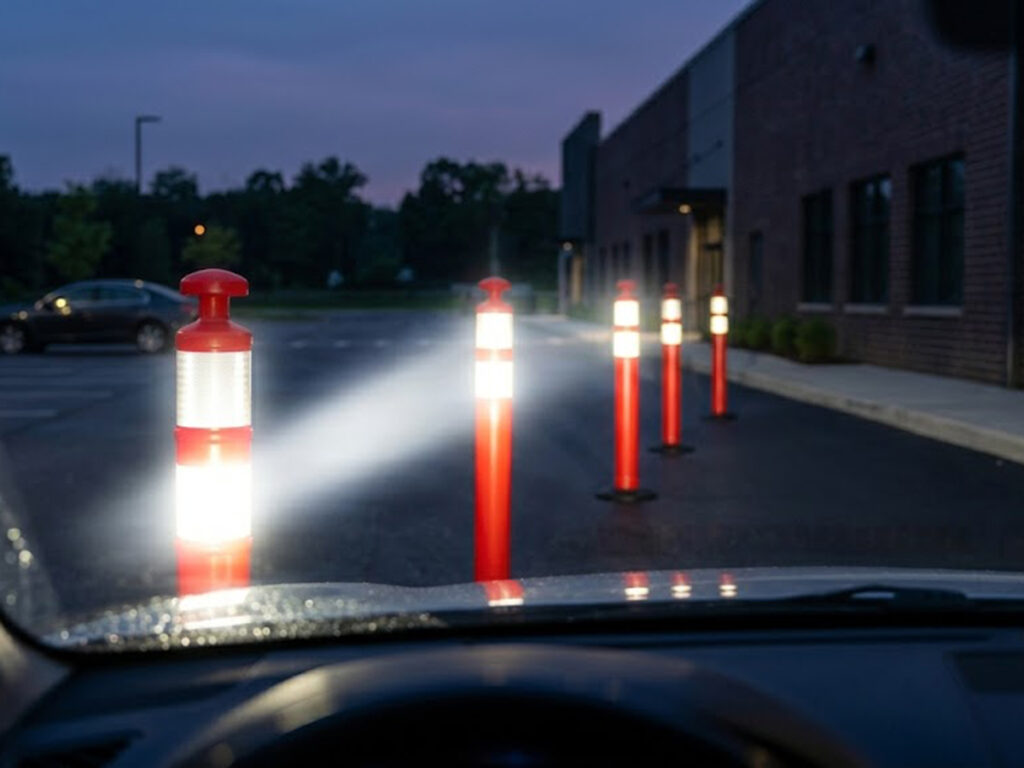
Le mécanisme derrière bornes de signalisation réfléchissantes est précis, pas générique. Les feuilles rétroréfléchissantes renvoient la lumière le long du même chemin d'où elle est arrivée. La peinture diffuse diffuse la lumière dans toutes les directions; un film rétroréfléchissant le redirige vers la source du phare, et donc vers les yeux du conducteur.
La physique des feuilles micro-prismatiques
Les feuilles micro-prismatiques contiennent des milliers de prismes cubiques d'angle par pouce carré. Chaque prisme fait rebondir les photons entrants à travers trois surfaces réfléchissantes et ressort par la même face dans laquelle ils sont entrés.. Le résultat est un retour lumineux sous des angles d'observation que les conducteurs expérimentent réellement au volant.. Une borne de signalisation rétroréfléchissante enveloppée dans ce matériau se lit comme une colonne lumineuse au moment où les faisceaux d'un véhicule la traversent..
Qualités de feuilles ASTM D4956 Type IV vs Type IX
ASTM D4956 régit les feuilles rétroréfléchissantes pour le contrôle de la circulation à l'échelle nationale. Deux qualités dominent les spécifications des bornes:
- Type IV – prismatique à haute intensité. Commun pour les périmètres à trafic moyen et la délimitation standard.
- Type IX — prismatique de très haute intensité. Préféré pour les longues lignes de visibilité, approches rapides, et des conditions météorologiques défavorables.
La spécification du type ASTM correct est l'élément le plus important lors de l'achat d'une borne de signalisation réfléchissante.. Les équipes d'approvisionnement doivent écrire le type directement dans les spécifications de l'offre..
Portée de visibilité sous l'éclairage des phares standard
Le manuel sur les dispositifs de contrôle de la circulation uniformes (Mutcd) établit une norme claire en matière de réflectivité des bornes: les délinéateurs doivent rétroréfléchir la lumière provenant 1,000 pieds sous l'éclairage des feux de route. Qualité bornes de signalisation réfléchissantes le respect des spécifications de type IV ou de type IX offre au conducteur une visibilité entre 400 et 700 pieds dans des conditions typiques de feux de croisement à feux de route. Météo, âge de la feuille, et l'alignement du faisceau décale cette plage, mais la marge de sécurité contre la portée des feux de croisement reste importante.
Comment les bornes lumineuses génèrent leurs propres lignes de visibilité à 360 degrés
Les bornes lumineuses gagnent leur place dans des scénarios spécifiques. Comprendre quand ils gagnent – et quand ils dépensent trop – protège le budget.
Systèmes LED câblés et exigences de boucle d'alimentation
Une borne de signalisation lumineuse et câblée tire un courant continu du panneau du bâtiment. Chaque unité a besoin d'un conduit, une boîte de jonction, un circuit, et une approbation de l'inspecteur. Multipliez cela par 30 unités dans un terrain de stationnement, et la discussion en panel devient son propre exercice d'ingénierie. Tirage mensuel des services publics, bien que modeste par unité, évolue linéairement avec le nombre d'installations.
Bornes lumineuses à énergie solaire: Avantages et mises en garde
Les variantes solaires suppriment la tranchée mais introduisent l'économie de la batterie. Une borne de signalisation solaire typique fonctionne 8 à 12 heures par nuit sur une cellule complètement chargée. Latitude, ombrage de la canopée, et l'angle du soleil saisonnier dictent les performances réelles. Les batteries doivent généralement être remplacées tous les deux à quatre ans – un coût de main-d'œuvre récurrent qui s'aggrave discrètement..
La taxe de tranchée: Combien coûte réellement l’installation d’un éclairage câblé
La taxe de tranchée est le poste que la plupart des gestionnaires d'installations sous-estiment lors de l'approvisionnement..
Décomposition de la prime d'installation par pied linéaire
Les tranchées seules fonctionnent $5 à $12 par pied linéaire po 2026 prix. Un conduit électrique souterrain en ajoute un autre $4 à $12 par pied linéaire. Permis de pile ($50 à $500), travail d'électricien agréé, mises à niveau du panneau ($1,000 à $3,000), et réparation d'asphalte, et la prime d'installation tout compris grimpe à environ $50 à $150 par pied linéaire pour les systèmes lumineux câblés. Un périmètre de 200 pieds peut facilement dépasser $20,000 avant qu'un seul luminaire de borne soit expédié. Cette équation du coût d’installation des bornes de signalisation à elle seule fait souvent basculer la décision d’achat..
| Composant coût | 2026 Gamme (par pied linéaire ou projet) |
| Tranchée | $5 - $12 par LF |
| Conduit souterrain | $4 - $12 par LF |
| Câblage (cuivre) | $1.50 - $5 par LF |
| Permis et inspections | $50 - $500 par projet |
| Mise à niveau du panneau/compteur | $1,000 - $3,000 par projet |
| Réparation d'asphalte ou de béton | Dépend du site, souvent $10+ par LF |
Source: Entrer 2026 Données sur le coût des tranchées et Rumi Electric 2026 Coûts d’installation électrique souterraine
Perturbation opérationnelle: Fermetures de lots, Perte de revenus, et plaintes des locataires
Les tranchées ne s’arrêtent pas à la ligne budgétaire. Les centres commerciaux perdent des heures d'ouverture. Les établissements de santé réacheminent le trafic des ambulances. Les sites industriels bouclent les aires de chargement. Les coûts indirects d'un travail de tranchée de trois jours dépassent souvent la facture directe de construction.
Comment les bornes réfléchissantes contournent complètement la pile de câblage
Bornes de signalisation réfléchissantes sont installés en quelques minutes par unité. Des plaques de base à montage en surface ou des boulons d'ancrage peu profonds complètent le travail. Aucune conduite, pas d'inspecteur, pas de mise à niveau du panneau, pas de frais récurrents de kilowattheure. Les gestionnaires d'installations multisites peuvent déployer des centaines d'unités sur un trimestre sans aucune portée électrique..
Planification d'un déploiement multi-lots? Demander un devis d'aménagement de sécurité personnalisé pour vos installations pour modéliser côte à côte les coûts d'installation par rapport à votre superficie réelle et aux modèles de trafic.
Coût total de possession sur un horizon de 5 ans
CapEx raconte la moitié de l'histoire. Le TCO dit le reste.
CapEx vs OpEx: Les chiffres qui pèsent sur le budget
Bornes de signalisation réfléchissantes ont un prix unitaire inférieur à celui des alternatives lumineuses câblées dans la plupart des catégories de produits. Au-delà du prix de la vignette, le delta OpEx s’élargit encore:
| Catégorie de coût | Réfléchissant | Câblé Lumineux | Solaire éclairé |
| Installation par unité | Faible (minutes) | Haut (tranchée) | Moyen (pas de tranchée) |
| Permis électrique | Aucun | Requis | Limité |
| Coût énergétique annuel | 0 | Consommation de kWh par unité | 0 |
| Remplacement de la batterie | Aucun | Aucun | Tous les 2 à 4 ans |
| Durée de vie (élément de visibilité) | 7–10+ ans (tasserie) | 3–5 ans (Pilote LED) | 2–4 ans (batterie) |
Source: Spécifications des feuilles ASTM D4956 et Rumi Electric 2026 données sur les coûts d'installation
Durabilité et récupération d’impact dans des conditions réelles
De haute qualité bornes de signalisation réfléchissantes utilisent souvent des polymères flexibles de récupération d'impact qui rebondissent après une collision avec un véhicule à vitesse de stationnement. Les boîtiers lumineux rigides nécessitent généralement le remplacement complet du luminaire après un choc. Le remplacement d'une feuille sur une unité réfléchissante endommagée coûte une fraction du prix d'un nouveau luminaire. La sélection des matériaux est à l'origine d'une grande partie de cet écart de durabilité - explorez les compromis entre le polymère et l'acier dans notre répartition des cas d'utilisation de bornes en plastique et en acier.
Fréquence de maintenance: Actualisation des feuilles et panne de lampe
Une borne de signalisation réfléchissante haut de gamme conçue selon la norme ASTM D4956 Type IX (ou Type XI) la feuille micro-prismatique offre un 7 jusqu'à 10 ans de durée de vie sans entretien, même sous une forte exposition aux UV et aux intempéries. En contraste frappant, les alternatives éclairées introduisent une responsabilité OpEx continue: les batteries solaires et les pilotes de LED tombent généralement en panne en un temps record. 3 au cycle de 5 ans.
Conformité, Normes, et un langage de spécification qui résiste à l'examen des offres
Pour un gestionnaire d'établissement, chaque panne de luminaire déclenche une fuite financière en cascade, nécessitant une main d'œuvre électrique spécialisée, permis de sécurité pour les fermetures de voies, et temps d'arrêt sur le terrain. Il s’agit des angles morts opérationnels que les feuilles de calcul d’approvisionnement initiales en CapEx standard ne parviennent absolument pas à modéliser..
Classification ASTM D4956 pour les prescripteurs
ASTM D4956 reconnaît actuellement 11 types distincts de feuilles rétroréfléchissantes et 5 cours de support adhésif. Généraliser “réfléchissant” dans une demande de proposition (Appel d'offres) invite à enchérir à bas prix, substitutions de qualité commerciale sous-performantes. Pour pare-balles une spécification, les responsables des achats doivent mandater soit la norme ASTM D4956 Type IV (Prismatique de haute intensité) pour contrôle par terminal standard ou Type IX / Type XI (Microprismatique de très haute intensité) pour les environnements à forte luminosité. Le verrouillage de ces types précis garantit que le pool de soumissionnaires est limité aux produits de qualité industrielle., traduire directement en vérifiable, luminance à long terme au niveau de la chaussée.
Mutcd, Fhwa, et considérations relatives au code au niveau du site
Sous la 11e édition du MUTCD, les délinéateurs routiers et les éléments rétroréfléchissants doivent maintenir des niveaux de rétroréflexion minimaux spécifiques pour être visibles à une distance de prévisualisation standard de 1,000 pieds sous la géométrie des feux de croisement ou des feux de route. Alors que les parkings commerciaux purement privés sont techniquement exemptés des mandats fédéraux MUTCD, les tribunaux et les assureurs considèrent le MUTCD comme la norme de diligence universelle de facto dans les poursuites en responsabilité civile des locaux. L'intégration des directives de rétroréflectivité minimale MUTCD et FHWA dans les spécifications des sites privés fournit un bouclier juridique inattaquable aux avocats civils lors des dépositions de biens après l'incident..
Choisir la bonne solution par type de site et profil de trafic
Différents sites nécessitent des réponses différentes.
Environnements dominés par les véhicules: Chantiers logistiques, Voies de circulation, Tabliers entrepôt
Les phares garantissent l'éclairage dans ces zones. Bornes de signalisation réfléchissantes devenir la valeur par défaut efficace. L'écoute de type IX convient aux vitesses d'approche supérieures 25 mph; Le type IV gère la circulation de stationnement à basse vitesse. Données BLS montrant 84 décès de travailleurs liés aux chariots élévateurs 2024 souligne la valeur d’une délimitation sans équivoque dans les environnements industriels.
Zones mixtes piétons/véhicules: Soins de santé, Vente au détail, Écoles
Ces environnements ont besoin d'une visibilité à plusieurs niveaux. Bornes de signalisation réfléchissantes chemins de véhicules du canal; l'éclairage du site et les luminaires destinés aux piétons gèrent les zones de circulation piétonnière. La conception complète du périmètre combine souvent des bornes avec des garde-corps et des barrières — notre analyse des implantations de garde-corps et de bornes pour piétons parcourt la stratégie de séparation homme-véhicule.
Places réservées aux piétons et applications d'orientation
Ici, les bornes lumineuses gagnent leur prime. Pas de phares signifie pas de rétroréflexion. Les variantes solaires offrent une voie médiane lorsque la lueur ambiante est importante et que le creusement de tranchées n'est pas négociable..
| Environnement | Matrice d'éclairage | Solution de borne recommandée | Spécifications techniques & Repères de conformité | Objectif ROI du gestionnaire d'installations |
| Environnements dominés par les véhicules | Zone de phares élevés | Prime Bornes de signalisation réfléchissantes | Vitesses ≥ 25 mph: Feuille ASTM D4956 Type IX/XI | Économies maximales sur le coût total de possession |
| (Chantiers logistiques, Quais de chargement, Tabliers entrepôt) | Exposition active continue des phares du véhicule; zéro circulation piétonnière non organisée la nuit. | Vitesses < 25 mph: Feuille ASTM D4956 Type IV | Élimine les coûts coûteux de tranchée et de câblage ($50–150$/pied linéaire); les polymères flexibles à fort impact résistent aux éraflures industrielles. | |
| Atténue les risques liés aux véhicules industriels et aux chariots élévateurs à chenilles BLS. | ||||
| Zones mixtes piétons/véhicules | Champ visuel hybride | Bornes réfléchissantes + Barrières physiques | Conforme aux exigences de distance de prévisualisation de 1 000 pieds de MUTCD 11e édition. | Responsabilité & Atténuation des risques |
| (Établissements de santé, Places de vente au détail, Campus scolaires) | Coexistence des phares des véhicules et de l'éclairage d'ambiance zénithal/zone de chantier. | Intégrer dans une stratégie de séparation homme-véhicule. | Établit une norme de diligence inattaquable contre les réclamations en responsabilité des locaux; protège les allées vulnérables. | |
| Places réservées aux piétons | Zone sans phare | Actif éclairé / Bornes solaires | 360-degré d'éclairage LED actif continu. Les variantes solaires atténuent les OpEx en cours là où la lumière du soleil est suffisante. | Esthétique architecturale & Façon d'orientation |
| (Allées paysagères, Zones sans voiture, Tabliers construction) | Absence totale de phares venant en sens inverse, ce qui signifie que la feuille rétroréfléchissante ne peut pas être déclenchée. | Allie l'orientation de sécurité à l'architecture paysagère; CapEx initial plus élevé justifié par la permanence architecturale. |
Faire correspondre la technologie aux contraintes réelles de votre installation
La décision nécessite rarement une évaluation de trente pages. Une courte liste de contrôle résout la plupart des questions d'approvisionnement.
Un cadre de décision rapide
- Les phares des véhicules sont-ils présents la nuit? Bornes de signalisation réfléchissantes gagner.
- La zone est-elle strictement piétonne la nuit tombée ?? Évaluer l'éclairage solaire.
- La perturbation des tranchées est-elle inacceptable? Le câblage n'est plus à l'ordre du jour.
- L'approvisionnement est-il multisite ou échelonné? Les échelles réfléchissantes évoluent le plus rapidement.
Bornes réfléchissantes dans la catégorie des bornes plus larges
La sélection d’une borne implique bien plus que la technologie de visibilité. Matériel, hauteur, cote d'impact, et le style de montage interagissent tous. Pour un paysage côte à côte complet sur des supports fixes, amovible, rétractable, et options de réflexion, travailler à travers notre comparaison complète des types et des spécifications des bornes de signalisation.
Gérant 25+ unités ou un déploiement multi-sites? Réservez une consultation sur les achats groupés pour garantir des prix de volume et un calendrier d'installation progressif qui évite les fermetures de lots.
Foire aux questions
À quelle distance les conducteurs peuvent-ils réellement voir une borne réfléchissante la nuit?
Bornes de signalisation réfléchissantes répondant aux spécifications ASTM D4956 Type IV ou Type IX fournissent 400 à 700 pieds de visibilité grâce aux phares dans des conditions typiques. Météo, âge de la feuille, et l'alignement du faisceau modifie la portée.
Les bornes réfléchissantes sont-elles conformes au code où les bornes lumineuses sont généralement spécifiées?
Oui, pour la plupart des délimitations commerciales et industrielles privées, à condition que la spécification indique le type de feuille ASTM D4956 et les valeurs minimales de rétroréflexion. Les zones réservées aux piétons du domaine public peuvent toujours favoriser l’éclairage actif.
Quelle est la différence réaliste de coût d'installation entre les bornes lumineuses réfléchissantes et câblées?
Les systèmes lumineux câblés ajoutent environ $50 à $150 par pied linéaire dans les tranchées, conduit, câblage, permettre, et travaux de panneaux avant le luminaire lui-même. Bornes de signalisation réfléchissantes éliminer toute cette pile.
À quelle fréquence les feuilles rétroréfléchissantes doivent-elles être remplacées?
Les feuilles de type IX offrent 7 à 10+ années de service sous exposition normale. Le remplacement concerne uniquement l'emballage en feuilles, pas le corps complet de la borne, ce qui maintient les coûts de maintenance prévisibles.
Les bornes éclairées par l’énergie solaire sont-elles un juste milieu viable?
Oui pour les zones réservées aux piétons et fortement exposées au soleil. Prévoyez le remplacement de la batterie tous les deux à quatre ans, et vérifiez les conditions d'ombrage et de latitude avant de spécifier.
Les bornes réfléchissantes peuvent-elles mieux survivre à l'impact d'un véhicule que les unités lumineuses rigides?
De haute qualité bornes de signalisation réfléchissantes construit à partir de polymères flexibles récupérant les impacts, rebondissant lors de frappes à basse vitesse. Les boîtiers lumineux rigides nécessitent souvent le remplacement complet du luminaire après un choc.
Références
- ASTM International, “Spécification standard D4956 pour les feuilles rétroréfléchissantes pour le contrôle de la circulation.“
- Fhwa, “Exigences minimales de rétroréflectivité des panneaux.“
- Guide de la politique d'ingénierie du MoDOT, “Délinéateurs (MUTCD Chapitre 3G).”
- Rumi Électrique, “2026 Coûts d’installation électrique souterraine.“