Un véhicule non autorisé au mauvais endroit peut arrêter une grue, bloquer une coulée de béton, ou empêcher une ambulance d'atteindre un travailleur blessé. Sur les chantiers de construction commerciale actifs, le contrôle du stationnement n'est pas un détail administratif — c'est un élément critique pour la sécurité, exigence opérationnelle juridiquement exécutoire.
Chantier de construction aucun panneau de stationnement constituent l'épine dorsale de ce système d'application. Ils créent des documents, visible, préavis légalement suffisant pour les sous-traitants, chauffeurs-livreurs, Et le grand public. Sans signalisation conforme, les chefs de projet perdent leur pouvoir d'exécution et exposent le projet à des poursuites, retards dans les horaires, et sanctions réglementaires.
Ce guide couvre le cycle de vie complet du déploiement: normes de signalisation fédérales et étatiques, spécifications du substrat et de la réflectivité, sélection du matériel de montage, ingénierie de placement, et coordination de l'application - tout ce dont un chef de projet ou un responsable de la sécurité du site a besoin pour déployer chantier de construction aucun panneau de stationnement ça marche vraiment.
Le coût opérationnel des violations de stationnement sur le chantier
Les violations de stationnement sur les chantiers de construction actifs entraînent des conséquences en cascade. Un seul véhicule bloquant une route de transport peut retarder un camion de bétonnage, qui se transforme en une coulée retardée, une location de grue prolongée, et un planning aval compressé.
Échecs d’accès qui arrêtent la dynamique du projet
Les équipements lourds fonctionnent selon des tolérances spatiales strictes. Les rayons de pivotement du contrepoids de la grue sur chenilles peuvent s'étendre 15 à 30 pieds du centre du mât. Les rampes de pompes à béton nécessitent des voies de triage dégagées. Une camionnette d'un sous-traitant stationnée à l'intérieur de ces couloirs de dégagement oblige les opérateurs à interrompre le travail et à résoudre l'obstruction avant de continuer : chaque minute d'arrêt de la grue coûte des centaines de dollars..
OSHA 29 CFR 1926 La sous-partie C impose un accès d'urgence à tous les chantiers actifs à tout moment.. Un couloir d’urgence bloqué n’est pas seulement un problème d’horaire. Il s'agit d'un déclencheur d'événement enregistrable par l'OSHA qui expose l'entrepreneur général à des citations, amendes, et suspension potentielle du projet.
L’écart de responsabilité lorsque les instructions verbales remplacent les panneaux affichés
Les chantiers multi-métiers accueillent régulièrement 20 ou plusieurs équipes sous-traitantes sans protocole de briefing partagé. Les instructions verbales de stationnement données lors de la discussion matinale sur la boîte à outils ne créent pas d'avis juridiquement exécutoire.. Chantier de construction aucun panneau de stationnement faire.
La signalisation physique affichée établit un avis constructif documenté. Lorsqu'un opérateur de remorquage ou un agent d'application de la loi arrive, le panneau affiché est une preuve de la restriction. Sans, le remorquage est légalement inopposable, peu importe ce qui a été communiqué verbalement.
Normes fédérales et étatiques régissant les panneaux d'interdiction de stationnement dans les zones de construction
Tout panneau d'interdiction de stationnement de chantier placé sur ou à proximité d'une emprise publique doit être conforme à un cadre réglementaire établi.. Les panneaux non conformes ne peuvent être appliqués et peuvent exposer la responsabilité du GC si un véhicule est remorqué sur leur base..
Série FHWA R7: La norme de conception réglementaire fédérale
La série R7 de la Federal Highway Administration régit la signalisation réglementaire d'interdiction de stationnement dans le cadre du Manuel sur les dispositifs uniformes de contrôle de la circulation. (Mutcd). Les modèles R7-1 et R7-8 spécifient un fond blanc, bordure noire, texte noir, et un cercle rouge avec une barre oblique au-dessus de la lettre P — le symbole d'interdiction universel reconnu dans toutes les juridictions.
Texte supplémentaire tel que “Pas de stationnement pour les travaux de construction” est autorisé sous le panneau réglementaire, à condition que la palette de couleurs standard et les spécifications de réflectivité soient préservées. Ce supplément clarifie les restrictions pour les équipes de sous-traitants sans violer le cadre de conception FHWA..
Toute construction temporaire panneau d'interdiction de stationnement placée à l'intérieur ou à proximité d'une emprise publique doit être conforme à la série R7.. La signalisation intérieure du site est régie par le plan de sécurité du site et l'OSHA. 1926, mais les normes MUTCD restent la référence en matière de conception et de visibilité.
COMME MUTCD, Suppléments DOT d’État, et stratification régionale
Le MUTCD fédéral fixe le plancher national. Les DOT des États publient des suppléments qui renforcent les exigences en fonction des conditions locales. Partie CA MUTCD de Californie 6 impose des spécifications strictes sur la densité de placement des panneaux, distances de préavertissement, et réflectivité nocturne pour les zones temporaires de contrôle de la circulation.
Les chefs de projet opérant dans plusieurs États doivent auditer le supplément DOT applicable pour chaque adresse de projet.. Une configuration de panneau conforme au Texas peut ne pas répondre aux exigences de CA MUTCD sur un chantier californien.. Les permis d'empiétement municipaux - tels que ceux requis par le Bureau of Engineering de Los Angeles - ajoutent un troisième niveau de conformité au-dessus de la norme de l'État..
Signalisation des voies d'incendie dans le périmètre de construction
Les routes d'accès désignées aux appareils d'incendie dans les périmètres de construction actifs doivent afficher des panneaux avec du texte rouge sur un fond blanc réfléchissant. “VOIE D'INCENDIE — STATIONNEMENT INTERDIT — ZONE DE REMORQUAGE” ou langue équivalente. Code de prévention des incendies de Californie, section D103.6 (miroir de la section D103.6 de la SFI) établit cette spécification pour les environnements de construction partout où une route d'accès aux appareils d'incendie a été désignée par l'autorité compétente (AHJ).
Les inspecteurs de l'AHJ croisent la voie d'incendie désignée sur le plan de sécurité du site approuvé avec l'emplacement physique des panneaux lors des visites sur le site.. Les écarts entre le plan et l'installation sur le terrain peuvent déclencher des ordres d'arrêt des travaux. Pour une conformité permanente des couloirs coupe-feu, une fois qu'une installation atteint son occupation, les normes de déploiement diffèrent des exigences temporaires de la phase de construction.
Spécifications de substrat et de réflectivité pour les environnements de construction actifs
Tous les panneaux ne survivent pas à un environnement de construction. Poussière de béton en suspension dans l'air, gaz d'échappement diesel, vibrations de l'équipement, et le lavage à haute pression détruit les substrats de qualité inférieure en quelques semaines. La spécification du bon matériau est une décision d'achat ayant des conséquences directes en matière de sécurité et d'application..
Jauge en aluminium: La norme minimale pour la durabilité des chantiers
Substrat standard de l'industrie pour chantier de construction aucun panneau de stationnement est en aluminium antirouille de 0,080 pouce. Cette jauge résiste aux vibrations mécaniques des compacteurs et des batteurs de pieux, résiste à la déformation lorsqu'il est monté sur des panneaux de clôture à mailles losangées sous la charge du vent, et survit au cycle de vie opérationnel d'une phase de construction commerciale typique sans déformation ni fissuration.
Plastique ondulé (coroplaste) se dégrade sous l'exposition aux UV et échoue sous les vibrations du chariot élévateur. L'aluminium mince de 0,040 pouce se déforme lorsqu'il est monté sur une clôture et exposé au cisaillement du vent soutenu des camions qui passent.. Aucun des deux matériaux ne répond à la norme de durabilité pour les zones de construction actives. Tout panneau monté sur un poteau en U enfoncé dans un remblai compacté ou de l'asphalte doit présenter une face en aluminium rigide pour satisfaire aux exigences d'interface de charge de vent de l'AASHTO..
Classes de réflectivité ASTM D4956 pour les sites de nuit
Les chantiers de construction actifs fonctionnent fréquemment en plusieurs équipes. Les panneaux d'interdiction de stationnement pour les travaux de construction temporaires doivent rester lisibles lors des arrivées des entrepreneurs avant l'aube et des contrôles nocturnes.. ASTM D4956 définit la hiérarchie des feuilles rétroréfléchissantes applicable à la signalisation des zones de construction:
| Classe de réflectivité | Type ASTM D4956 | Application |
| Grade d'ingénieur | Type I | À basse vitesse, sites privés intérieurs uniquement; pas d'opérations de nuit – insuffisant pour la plupart des sites commerciaux |
| Prismatique de haute intensité | Type III | Minimum pour les panneaux de passage public et tout site avec des opérations de nuit |
| Prismatique à très haute intensité | Type IV | Requis pour la partie CA MUTCD 6 zones; panneaux adjacents aux routes 35 mph+; éclairage temporaire inadéquat |
Source: Spécification standard ASTM D4956 pour les feuilles rétroréfléchissantes pour le contrôle de la circulation
Le revêtement HIP de type III offre des performances rétroréfléchissantes nettement supérieures à celles de qualité technique à faible angle de phare.. Le type IV est la spécification correcte pour les grands projets commerciaux à proximité des artères., et pour tout projet nécessitant une pièce CA MUTCD 6 conformité.
Image de marque personnalisée et configuration du panneau de signalisation spécifique à la phase
Les conceptions de panneaux conformes au MUTCD peuvent accueillir des panneaux d'identification supplémentaires de l'entrepreneur — numéro de projet, contact d'urgence, ou marque GC - dans l'en-tête ou le pied de page sans violer les exigences de formatage de la FHWA. Les entrepreneurs généraux gérant des campus comportant plusieurs bâtiments ou des développements par étapes bénéficient de jeux de panneaux à code couleur ou estampillés par un numéro de projet pour éviter toute confusion entre les phases parmi les équipes de sous-traitants en rotation..
L'achat en gros d'ensembles de panneaux de signalisation présélectionnés conformes à la norme MUTCD avec des spécifications de substrat et de réflectivité cohérentes élimine le risque de substitution sur le terrain qui se produit lorsque les équipes s'approvisionnent en panneaux de remplacement auprès des quincailleries générales..
Gestion de plusieurs phases ou d'un site multi-métiers? OPTSigns fournit des ensembles de panneaux d'interdiction de stationnement en vrac conformes aux normes MUTCD avec des en-têtes spécifiques au projet et une réflectivité ASTM D4956 confirmée.. Demander un devis de projet groupé.
Matériel de montage: Publications, Supports de clôture, et bases temporaires
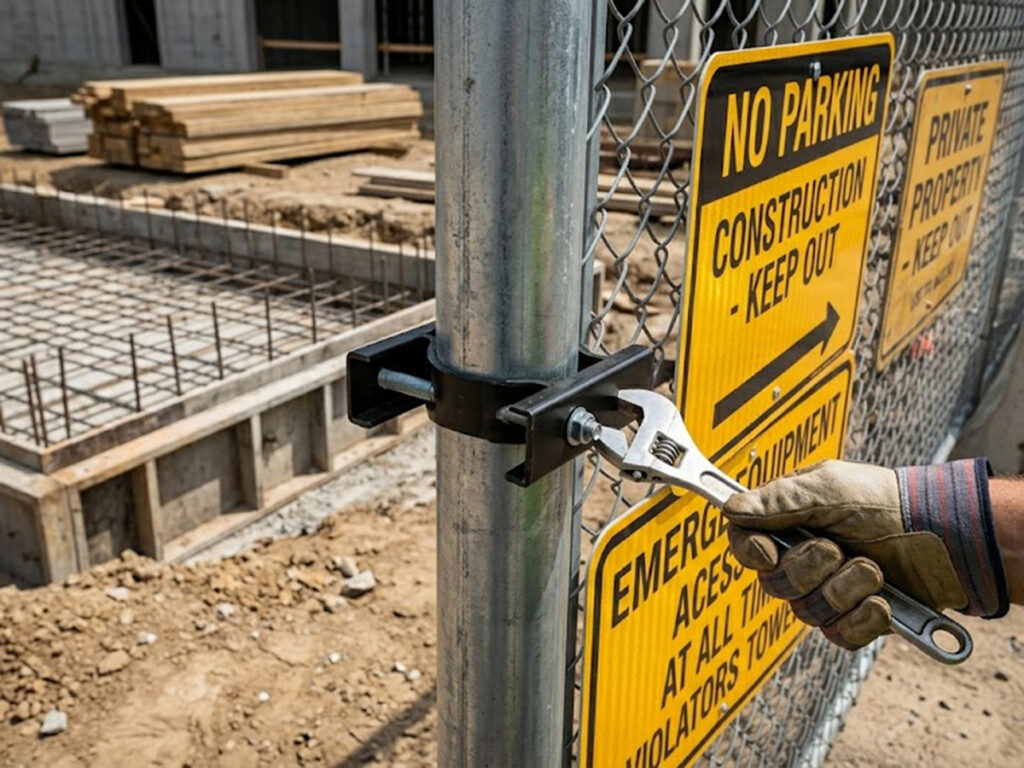
Le panneau de signalisation est aussi efficace que son système de montage. Les environnements de construction soumettent le matériel de montage à des contraintes mécaniques qui détruisent les installations grand public en quelques jours. Faire correspondre la solution de montage à l'état du site est une décision essentielle en matière d'approvisionnement..
Poteaux en U en acier pour la signalisation semi-permanente des zones de construction
Les poteaux standard en U pour les applications dans les zones de construction spécifient 2 lb/pi d'acier, 8 à 10 longueur totale en pieds, conduit 2 à 3 pieds en pente pour atteindre 5 à 7 pieds de hauteur libre jusqu'au centre du panneau. Les poteaux enfoncés dans une sous-couche compactée ou dans de l'asphalte nécessitent un enfonce-pieux (et non un outil d'installation standard), ce qui les rend appropriés pour chantier de construction aucun panneau de stationnement qui restera en place pendant des semaines, voire des mois, tout au long d'une phase de construction complète.
Des poteaux en U séparables conformes à la norme NCHRP 350 sont requis dans de nombreuses juridictions du DOT pour les panneaux de contrôle de la circulation temporaires placés dans la zone dégagée de l'emprise publique.. Les chefs de projet doivent spécifier des poteaux résistants aux chocs lorsque l'emplacement du panneau se situe dans la zone dégagée en bordure de route définie par la norme DOT de l'État applicable..
Montage de support de clôture à mailles de chaîne pour signalisation périmétrique
Le montage d'une clôture périphérique est la méthode d'installation la plus courante pour chantier de construction aucun panneau de stationnement. Des supports de clôture galvanisés robustes avec fixation par boulons (et non du matériel à attaches zippées uniquement) sont nécessaires pour résister au cisaillement du vent dû aux camions et aux équipements qui passent.. Les installations à attaches zippées échouent en quelques jours sous une charge latérale soutenue.
Les panneaux installés sur une clôture périphérique font face à l’extérieur, vers la route ou la surface de stationnement adjacente.. Ils doivent être conformes aux exigences de hauteur MUTCD même lorsqu'ils sont montés sur une clôture: le centre de signalisation doit s'asseoir 5 à 7 pieds au-dessus de la surface de la route adjacente, et le fond doit être dégagé 7 pieds dans toute zone où les piétons et les véhicules partagent la circulation.
Bases lestées temporaires pour zones sans pénétration du sol
Zones de dalle en post-tension, couloirs de services publics souterrains, et les zones de perturbation restreintes par l'AHJ interdisent la pénétration du sol. Chantier de construction aucun panneau de stationnement dans ces zones nécessitent des bases lestées temporaires. Bases lourdes remplies de caoutchouc (minimum 50 lbs pour la résistance au vent en site ouvert) ou des bases de ballast remplissables à l'eau adaptées à la surface au vent du panneau de signalisation sont la spécification standard.
Pour les déploiements sur plusieurs semaines, bases lestées par chaîne ou par câble aux panneaux de clôture adjacents pour empêcher le déplacement des opérateurs d'équipement et pour dissuader le vol de panneaux en aluminium, qui ont une valeur de ferraille documentée dans des environnements de construction actifs.
Ingénierie de placement: Hauteur, Espacement, Revers, et angle
Le placement correct des panneaux est aussi important que la spécification correcte des panneaux. Un panneau de signalisation ASTM D4956 Type IV monté à la mauvaise hauteur ou à un mauvais angle échoue à la validation d'application.. Les erreurs de placement sont également la raison la plus courante pour laquelle les organismes chargés de l'application des lois refusent d'autoriser le remorquage..
Hauteur de montage, Angle, et autorisation pour les piétons
Le MUTCD précise que le centre d'un panneau de signalisation doit se trouver 5 à 7 pieds au-dessus de la route ou de la surface de circulation adjacente. Dans les zones à usage mixte où les travailleurs et les véhicules partagent la circulation – zones de rassemblement, gares de triage, portes d'entrée du site — le bas du panneau doit être dégagé 7 pieds pour respecter le seuil de passage au plafond des piétons.
Monter des panneaux à 30 degrés vers le trafic venant en sens inverse, pas parallèle à la clôture ou au poteau. Une installation parallèle à plat réduit l'efficacité rétroréfléchissante jusqu'à 40 pour cent à des angles de phares faibles - l'angle auquel les conducteurs s'approchant d'une route d'accès sombre à un chantier de construction ont le plus besoin de voir un panneau de restriction.
Normes d'espacement: Intervalles de zone d’interdiction de stationnement et maximums de voies d’incendie
Espace de construction temporaire aucun panneau de stationnement tous les 25 à 75 pieds en fonction de la longueur de la zone et du nombre de points d'entrée potentiels des véhicules. Pour les couloirs d'accès aux appareils d'incendie désignés dans le périmètre du site, un intervalle d'espacement maximum de 50 pieds s'applique - plus strict que les zones générales d'interdiction de stationnement.
Une formule d'espacement pratique pour les chefs de projets: divisez la superficie linéaire totale de la zone réglementée par l'intervalle maximum autorisé pour calculer le nombre minimum de panneaux requis. Ajouter un emplacement à tous les coins, Changements de qualité, et angles morts créés par la mise en scène des matériaux — piles de bois, paquets de barres d'armature, et les remorques d'équipement créent des ruptures visuelles qui nécessitent des panneaux supplémentaires au-delà du calcul de l'intervalle standard.
Zones tampons de retrait de bordure et de dégagement d’équipement
Ensemble chantier de construction aucun panneau de stationnement 12 à 18 à quelques centimètres de la face du trottoir. Ce dégagement empêche les panneaux de signalisation d'être heurtés par les portes battantes des camions., rétroviseurs à grande capacité, ou contrepoids d'équipement rotatif - contact qui fait tourner le panneau de manière non conforme et annule la restriction affichée.
Sur les routes de transport non améliorées dans le périmètre du site, augmenter la marge de recul à un minimum de 24 pouces du bord de la voie de circulation. Les engins de chantier tout-terrain fonctionnent avec une enveloppe latérale plus large que les véhicules routiers standard, et un panneau heurté par le rétroviseur d'un camion de transport ne satisfait plus à l'exigence d'affichage.
Protocoles de préavis et coordination de l’application de la loi
Un correctement spécifié, construction correctement montée panneau d'interdiction de stationnement inapplicable si le protocole de préavis n'a pas été suivi. Les chefs de projet qui sautent cette étape ne découvrent l'écart que lorsqu'un remorqueur refuse d'accrocher un véhicule non autorisé..
Le 24 à une fenêtre de publication anticipée de 72 heures
L'application temporaire du stationnement dans la zone de construction exige l'affichage de panneaux 24 à 72 heures avant que la restriction n'entre en vigueur pour fournir un avis public légalement suffisant. De nombreuses municipalités exigent un délai d'affichage minimum de 48 heures à l'avance pour les restrictions affectant les emprises publiques adjacentes aux chantiers de construction actifs.. La fenêtre spécifique doit être confirmée par rapport à l’ordonnance locale et à toutes conditions attachées au permis d’empiétement du projet..
Documentez immédiatement l'installation: photographiez chaque panneau avec un horodatage immédiatement après sa publication. Conserver ces enregistrements dans le dossier de permis. Des photographies horodatées servent de preuve de préavis si le propriétaire du véhicule conteste un remorquage.
Coordination avec les forces de l'ordre et les opérateurs de remorquage
Le remorquage depuis les voies publiques bordant le site nécessite une autorisation préalable de la division de la circulation du service de police local dans la plupart des juridictions.. Avant de commencer tout remorquage, enregistrer la date et l'heure d'installation du panneau, conserver les photographies horodatées, confirmer le nom et le numéro de permis de l'opérateur de remorquage attribué, et obtenez un numéro de dossier ou de référence auprès du PD local.
Le remorquage sur une propriété privée – à l'intérieur du périmètre du site – est généralement régi par le code de la propriété de l'État et ne nécessite pas la même autorisation préalable municipale.. Le contrôle du stationnement dans les zones de construction sur les emprises publiques et sur les terrains privés doit être géré dans des cadres juridiques distincts.. La confusion des deux est une erreur d’application courante qui annule l’autorité de remorquage.
Protocole de présentation quotidienne de l'intégrité des panneaux
Un panneau qui a été déplacé, obscurci, ou retiré n'est plus légalement affiché - l'application est nulle jusqu'à ce que le panneau soit restauré et documenté à nouveau. Intégrer une liste de contrôle quotidienne de l'intégrité des panneaux dans la procédure pas à pas standard de sécurité du matin:
- Les panneaux ne sont pas masqués par du bois empilé, paquets de barres d'armature, matériaux palettisés, ou chariots élévateurs stationnés
- Les panneaux restent d'aplomb et à la bonne hauteur de montage après des vibrations de l'équipement ou des vents.
- Les faces des panneaux sont propres et réfléchissantes – elles ne sont pas recouvertes de béton pulvérisé., boue, ou poussière
- Tous les panneaux affichés sont pris en compte : les panneaux en aluminium ont une valeur de ferraille documentée et constituent une cible de vol sur les sites actifs.
Stratégie de signalisation de chantier multizone: Périmètre des routes d’accès intérieures
Les grands projets de construction commerciale nécessitent une approche systémique du déploiement des panneaux d'interdiction de stationnement sur les chantiers de construction., pas une solution à un seul emplacement. Trois zones distinctes nécessitent des stratégies de signalisation différenciées.
Cartographie des trois zones critiques d'interdiction de stationnement
La zone tampon de l’emprise publique – la zone immédiatement adjacente au site le long des rues publiques – est la plus complexe en matière de réglementation.. Les panneaux dans cette zone nécessitent des permis d'empiétement, doit répondre aux normes MUTCD, et déclencher le 24 à l'exigence de publication 72 heures à l'avance. La clôture périphérique et les points d'entrée/sortie du site constituent la principale zone de contrôle pour le trafic d'arrivée des sous-traitants.. Routes de transport intérieures, patins de grue, et les zones de rassemblement des équipements à l'intérieur de l'empreinte active sont régies par le plan de sécurité du site et par l'OSHA. 1926, avec MUTCD fournissant la référence en matière de conception.
Couloirs de dégagement des équipements et restrictions temporelles
Rayons de pivotement du contrepoids de la grue sur chenilles (15 à 30 pieds du centre du mât), files d'attente de triage de camions en béton, et les itinéraires de livraison de structures à grande charge nécessitent une signalisation dédiée interdisant le stationnement concernant les autorisations opérationnelles spécifiques. Panneaux de planification – “PAS DE STATIONNEMENT 5H-9H — ACCÈS À LA LIVRAISON” — gérer les fenêtres d'accès sensibles au facteur temps sans restreindre la journée opérationnelle complète.
Selon les données du Bureau of Labor Statistics, Les incidents impliquant des collisions restent la deuxième cause de décès dans le secteur de la construction aux États-Unis., représentant environ 10 Pourcentage de tous les décès dans le secteur de la construction chaque année. Les véhicules non autorisés à l’intérieur des couloirs de dégagement des équipements élèvent directement cette catégorie de risque.
Construction progressive: Mise à jour de la signalisation à chaque étape du projet
Une phase 1 le plan du site achemine la circulation à travers des zones qui deviennent des zones réglementées dans la phase 2. Chantier de construction aucun panneau de stationnement doit être mis à jour à chaque étape majeure du projet: mobilisation des chantiers, fondation terminée, structure complétée, MEP brut-in, et enceinte extérieure. L'achat d'ensembles de panneaux par lots alignés sur les phases plutôt que par une seule commande groupée initiale permet des désignations de zones spécifiques à chaque phase et réduit le gaspillage de signalisation..
De la phase de construction à l’occupation permanente: Améliorer la conformité du stationnement
Chantier de construction aucun panneau de stationnement servir le cycle de vie du projet – et non l’installation occupée. Une fois qu'un bâtiment atteint le certificat d'occupation, les panneaux de construction temporaires de la série R7 doivent passer à une infrastructure permanente de contrôle du stationnement commercial conforme au MUTCD.
Les poteaux détachables temporaires et le matériel de montage des supports de clôture ne conviennent pas aux installations permanentes occupées.. La transition nécessite des poteaux permanents en U en acier ou des panneaux indicateurs sur pieds en béton conformément aux normes d'installation permanentes.. Le fait de laisser les panneaux de construction temporaires en place après le CO crée une autorité d'application ambiguë : les panneaux peuvent ne pas correspondre au plan de site permanent approuvé par l'autorité locale de la circulation..
Les projets de remplissage urbain et de réaménagement commercial partagent souvent des limites avec les commerces de détail occupés, bureau, ou des locataires industriels qui ont leurs propres exigences en matière de contrôle du stationnement. Les activités de construction peuvent temporairement compromettre les propriétés voisines’ restrictions affichées lorsque la clôture obscurcit les lignes de visibilité des panneaux ou que les livraisons de matériaux bloquent la signalisation adjacente. Un audit de signalisation avant la construction des limites de la propriété adjacente documente les conditions de signalisation existantes et protège le GC contre les réclamations en responsabilité des propriétaires fonciers voisins..
Pour un cadre complet couvrant le contrôle du stationnement dans les propriétés commerciales pour tous les types d'actifs - des installations occupées aux sites de réaménagement actifs - le guide d'application de la signalisation des propriétés commerciales d'OPTSigns couvre l'ensemble du spectre de déploiement et relie les protocoles de chantier à la stratégie d'application permanente à l'échelle de la propriété..
FAQ: Panneaux d'interdiction de stationnement sur les chantiers de construction – Questions techniques et de conformité
Quelle série de panneaux MUTCD régit l'interdiction de stationnement sur les chantiers de construction actifs?
La série FHWA R7 régit la signalisation réglementaire d'interdiction de stationnement, y compris la zone de construction aucune demande de stationnement. Les conceptions R7-1 et R7-8 sont les formats standards — fond blanc, bordure noire, cercle rouge/barre oblique au-dessus du symbole P. Supplémentaire “Pas de stationnement pour les travaux de construction” le texte est autorisé sous le panneau réglementaire à condition que la palette de couleurs et les spécifications de réflectivité soient conservées. Les panneaux sur ou à proximité d'une emprise publique doivent être conformes au supplément DOT de l'État applicable au MUTCD fédéral. (Par exemple, Partie CA MUTCD 6 en Californie).
Quel niveau de réflectivité les panneaux d'interdiction de stationnement sur les chantiers de construction exigent-ils pour les opérations de nuit?
ASTM D4956 Type III Prismatique haute intensité (HANCHE) la bâche est la spécification minimale pour les chantiers de construction avec des opérations de nuit ou des panneaux adjacents à la voie publique. Un prismatique à très haute intensité de type IV est requis dans le cadre de la partie CA MUTCD 6 pour les zones avec des limites de vitesse égales ou supérieures à 35 mph, ou lorsque l'éclairage temporaire du site est inadéquat. Les bâches standard de type I de qualité technique ne répondent pas aux exigences de visibilité nocturne pour les environnements de construction commerciale active.
Combien de temps à l’avance des panneaux temporaires d’interdiction de stationnement doivent-ils être installés avant que le remorquage ne soit autorisé?
La plupart des juridictions exigent que des panneaux temporaires d'interdiction de stationnement soient affichés. 24 à 72 heures avant qu’une restriction de stationnement ne devienne exécutoire. De nombreuses municipalités imposent un délai d'affichage minimum de 48 heures à l'avance pour les restrictions sur les emprises publiques adjacentes aux chantiers de construction.. L'ordonnance locale applicable et les conditions du permis d'empiétement déterminent la fenêtre exacte. Les panneaux doivent être documentés avec des photographies horodatées immédiatement après l'installation pour établir une preuve de préavis en cas de litige de remorquage..
Les panneaux de construction interdisant le stationnement peuvent-ils être installés sur une clôture périmétrique à mailles losangées?
Oui. Le montage d’une clôture périmétrique en mailles de chaîne est une pratique courante pour chantier de construction aucun panneau de stationnement. Des supports de clôture galvanisés robustes avec fixation par boulons sont nécessaires ; le montage à attaches zippées uniquement échoue sous le cisaillement du vent provenant des camions et des équipements qui passent.. Les panneaux installés sur une clôture faisant face à une emprise publique doivent répondre aux exigences de hauteur du MUTCD: centre de signalisation 5 à 7 pieds au-dessus de la surface de la route, avec le bas du panneau dégagé 7 pieds dans n'importe quelle zone partagée par les piétons.
Quel est l'espacement maximum entre les panneaux d'interdiction de stationnement dans une voie coupe-feu dans une zone de construction?
Les couloirs d'accès aux appareils d'incendie à l'intérieur du périmètre de construction ne nécessitent aucun panneau de stationnement espacé d'au plus 50 à pied. Autorisation temporaire générale de zones de stationnement interdites jusqu'à 75 pieds entre les panneaux en fonction de la longueur de la zone. L'intervalle plus étroit des voies d'incendie découle de la section IFC D103.6 et de ses équivalents d'État tels que le California Fire Code D103.6., s'assurer que le couloir restreint est affiché sans ambiguïté à chaque point de décision qu'un conducteur qui approche pourrait rencontrer.
Références
- Administration des routes fédérales (Fhwa). Manuel sur les dispositifs de contrôle de la circulation uniformes (Mutcd), Partie 6
- Département des transports de Californie. Partie CA MUTCD 6 — Contrôle temporaire de la circulation.
- Code international des incendies (IFC) Article D103.6 — Marquage routier d'accès aux appareils d'incendie.
- Administration de la sécurité et de la santé au travail (OSHA). 29 CFR 1926 Sous-partie C
- Bureau des statistiques du travail. Recensement des accidents du travail mortels (CFOI) — Industrie du bâtiment, 2023 Données
- Association américaine des responsables de l'autoroute et des transports d'État (Aashto). Spécifications standard pour les supports structurels pour les panneaux routiers, Luminaires, et feux de circulation.
- Programme national de recherche sur la route coopérative (Nchrp) Rapport 350 — Procédures recommandées pour l'évaluation des performances de sécurité des éléments routiers.