Pourquoi les quais de chargement bloqués coûtent des milliers d’entrepôts par heure – et comment la signalisation y remédie
La congestion des quais a un prix mesurable. Selon l'Institut américain de recherche sur les transports (ATRI), la détention des camions coûte environ aux transporteurs $32.75 par heure de conducteur – mais les pertes au niveau des installations augmentent fortement en cas d'inactivité 8 les camions bloquent les voies de transit actives. Un seul panneau de zone de chargement interdit de stationnement, positionné correctement, élimine la cause fondamentale de la plupart des empiètements de véhicules non autorisés avant qu'ils n'atteignent le tablier du quai.
Les véhicules de tourisme sont les principaux contrevenants. Employés, entrepreneurs, et les chauffeurs-livreurs se garent régulièrement dans les zones de transit du fret car rien ne les interdit clairement. Un semi-remorque de 53 pieds nécessite environ 55 pieds de dégagement pour exécuter une manœuvre de recul. Une berline mal garée à l'intérieur de cet arc force une approche interrompue, un retard de repositionnement, et échecs de planification en cascade en aval.
Ce guide s'adresse spécifiquement aux environnements de quai pour marchandises lourdes - Classe 8 mise en scène de camion, verges à crochet et à crochet, et installations industrielles multi-baies.
Les enjeux du débit: Combien coûtent réellement les zones de chargement non contrôlées
L'effet cascade sur le timing de la chaîne d'approvisionnement
Une porte de baie bloquée déclenche une réaction en chaîne. Association des normes volontaires de commerce interindustriel (VICS) évalue le temps de séjour moyen à quai entre 90 et 120 minutes pour les installations non contrôlées, contre moins de 60 minutes pour les installations dotées de protocoles de gestion de zone actifs. Les Bobtails et les remorques vides laissés dans les zones de transit actives aggravent le problème : les installations à haut débit perdent 15 à 25 % de leur capacité de triage utilisable lorsque des équipements non autorisés occupent des corridors de fret actifs..
Visible, des panneaux de zone de chargement interdits de stationnement conformes comblent cet écart en établissant des limites de zone que les conducteurs respectent avant d'entrer dans la gare de marchandises. Le calcul opérationnel est simple: le temps de quai récupéré se traduit directement par une réduction des coûts de détention des transporteurs.
Le problème des véhicules de tourisme
Une classe standard 8 le tracteur nécessite environ 55 pieds de dégagement latéral pour une manœuvre de recul côté aveugle. Lorsqu'un véhicule non autorisé se gare dans cet arc, le conducteur ne peut pas terminer l'approche en toute sécurité. OSHA 29 CFR 1910.178 régit le dédouanement des camions industriels motorisés, et la clause de devoir général (Section 5(un)(1)) étend la responsabilité de l'employeur à tous les risques liés à la circulation des véhicules dans les zones industrielles.
L’exposition à la responsabilité du conducteur augmente lorsqu’un camion entre en contact avec un véhicule stationné non autorisé. Les installations sans signalisation affichée font face à des réclamations d'assurance composées, exposition réglementaire, et des relations avec les transporteurs endommagées.
La signalisation comme infrastructure d’application passive
De nombreuses installations s'appuient uniquement sur des instructions verbales ou sur du ruban adhésif au sol.. Ni l’un ni l’autre ne crée un dossier d’application défendable. Les panneaux de zone de chargement commerciale conformes au MUTCD établissent la trace écrite réglementaire pour l'autorisation de remorquage par un tiers dans la plupart des codes de véhicules de l'État.. Un déploiement correctement panneau de zone de chargement interdit de stationnement applique les politiques d'accès au quai 24 heures par jour sans avoir recours à un agent humain.
Conformité MUTCD R7-6: Décoder la norme
Spécifications du panneau R7-6
La désignation MUTCD R7-6 définit le panneau de zone de chargement interdit de stationnement: fond rétroréfléchissant blanc, frontière rouge, et légende du texte rouge en gras. MUTCD Partie 2B régit tous les panneaux de restriction de stationnement et d'arrêt. Les options de légende standard incluent “Pas de zone de chargement de stationnement,” “ZONE DE REMORQUAGE,” et des légendes combinées avec des restrictions de temps telles que “7 SUIS - 6 PM MON–SAT.”
La typographie suit la série E(M) ou police d'autoroute série C conformément à la section 2A.11 du MUTCD. Les polices décoratives ou condensées ne répondent pas aux exigences de conformité. Un minimum 3:1 le rapport de contraste entre la légende et l'arrière-plan gère la lisibilité diurne; les feuilles rétroréfléchissantes gèrent automatiquement les performances nocturnes.
Dimensions standard des panneaux d'interdiction de stationnement pour les environnements de fret
La sélection des dimensions améliore la lisibilité aux vitesses d'approche opérationnelle. Le tableau ci-dessous mappe la taille du panneau à l'application recommandée:
| Taille du panneau | Application recommandée | Vitesse d'approche |
| 12″ × 18″ | Cours privées à basse vitesse | < 10 mph |
| 18″ × 24″ | Approches de quai standard avec circulation de camions | 10–20 mph |
| 24″ × 30″ | Entrées de cour à grande vitesse ou à grand volume | > 20 mph |
Selon MUTCD Tableau 2A-3, une hauteur de lettre de 6 pouces permet une lisibilité à environ 175 pieds – critique pour une classe 8 conducteur prenant une décision d'approche à 15 mph. Surdimensionné 24″ × 30″ des panneaux s'appliquent lorsque les approches du quai dépassent 200 pieds de ligne de vue dégagée.
Exigences relatives aux mots d'en-tête OSHA et ANSI Z535
OSHA 29 CFR 1910.145 et ANSI Z535.2 régissent les mots d'en-tête des panneaux de sécurité supplémentaires dans les environnements industriels. La hiérarchie des mots d'en-tête s'applique à la signalisation de sécurité adjacente à une zone installée à proximité d'un panneau de zone de chargement interdit de stationnement grappe:
- DANGER (panneau rouge): Risque de mort ou de blessures graves — réservé aux risques de bord de quai et de points de pincement
- PRUDENCE (panneau jaune): Blessures mineures potentielles – approprié aux zones d'interface chariot élévateur-piéton
- AVIS (panneau bleu): Directive opérationnelle sans blessure — appropriée pour “Aire de chargement – Véhicules autorisés uniquement” signalisation
La lisibilité du message principal nécessite une lisibilité d'un minimum de 5 pieds pour signalisation de quai à proximité. Échelle de la hauteur des lettres vers le haut pour les distances d'approche des véhicules.
Recherche de panneaux de zone de chargement conformes à la norme MUTCD R7-6 pour une installation à quais multiples? OPTSigns propose des panneaux R7-6 préconfigurés en grandes quantités avec des légendes de restriction de temps personnalisées. → Demandez un devis groupé sur optsigns.com
Spécifications des matériaux et du matériel pour les environnements industriels
Normes de substrat et de feuilles
Les panneaux de zone de chargement commerciale déployés dans les gares de marchandises nécessitent de l'aluminium de gros calibre au minimum .080 jauge (environ 2 mm). Ce substrat résiste à la déformation due à la pression du vent, contact latéral mineur avec un chariot élévateur, et cyclage thermique dans les chantiers navals exposés. Standard .063-L'aluminium pour autoroute à jauge ne résiste pas aux charges de vent au bord du quai dans la classe 8 environnements.
La sélection des feuilles réfléchissantes détermine 24/7 performance:
- 3M Prismatique haute intensité (HANCHE), ASTM D4956 Type IV — norme minimale pour les opérations de fret actives; fournit une rétroréflexion à des angles de phares plus larges que ceux de qualité technique
- Grade de diamant (Type IX) — spécifié pour les installations adjacentes à une borne, bords de rampe de quai, et entrées de cour à grande vitesse d'approche
Évitez les composites plastiques (Dégradation des UV en 18 à 24 mois dans les climats à UV élevé) et acier peint (propagation de la rouille dans les environnements humides des quais).
Matériel de montage pour les installations de quai
Deux configurations principales servent les environnements de quai de chargement:
- Poteaux en acier à profilé en U (2″ × 2″ galvanisé): Convient aux panneaux de signalisation autoportants dans les zones de rassemblement ouvertes. Sélectionnez des conceptions télescopiques ou détachables là où le risque de collision avec le véhicule est élevé. Placer les poteaux à une profondeur minimale de 36 pouces dans des semelles en béton.
- Supports de montage mural (acier robuste avec revêtement en poudre): Préféré pour les panneaux apposés directement sur les murs extérieurs du quai adjacents aux portes de baie. Le matériel inviolable empêche tout retrait non autorisé.
Pour l'ASCE 7-22, la signalisation adjacente au quai dans les chantiers industriels ouverts relève des charges de vent de la catégorie d'exposition C. Spécifiez le matériel conçu pour 90 équivalents de vitesse du vent en mph minimum. Appliquer du frein-filet (Par exemple, Loctite 243) sur toutes les installations à boulons dans les environnements de quai à fortes vibrations.
Lettrage d'identification de quai personnalisé
Panneaux de numérotation des baies (Par exemple, “QUAI 1,” “QUAI 12”) sont un complément opérationnel essentiel à la signalisation des zones de chargement des camions. Ils permettent au logiciel de gestion de chantier de coordonner les affectations de quai en temps réel. Précisez la même chose .080 substrat en aluminium de calibre élevé avec noir sur jaune ou noir sur blanc à contraste élevé. Hauteur minimale des lettres: 4 pouces pour un montage mural à courte portée; 6+ pouces pour les panneaux lisibles à partir de la hauteur de la cabine (à environ 8 à 9 pieds du sol).
Placement stratégique: Ingénierie de la mise en page de la classe 8 Maniabilité
Intervalles d'espacement, Hauteurs de montage, et angles de vue
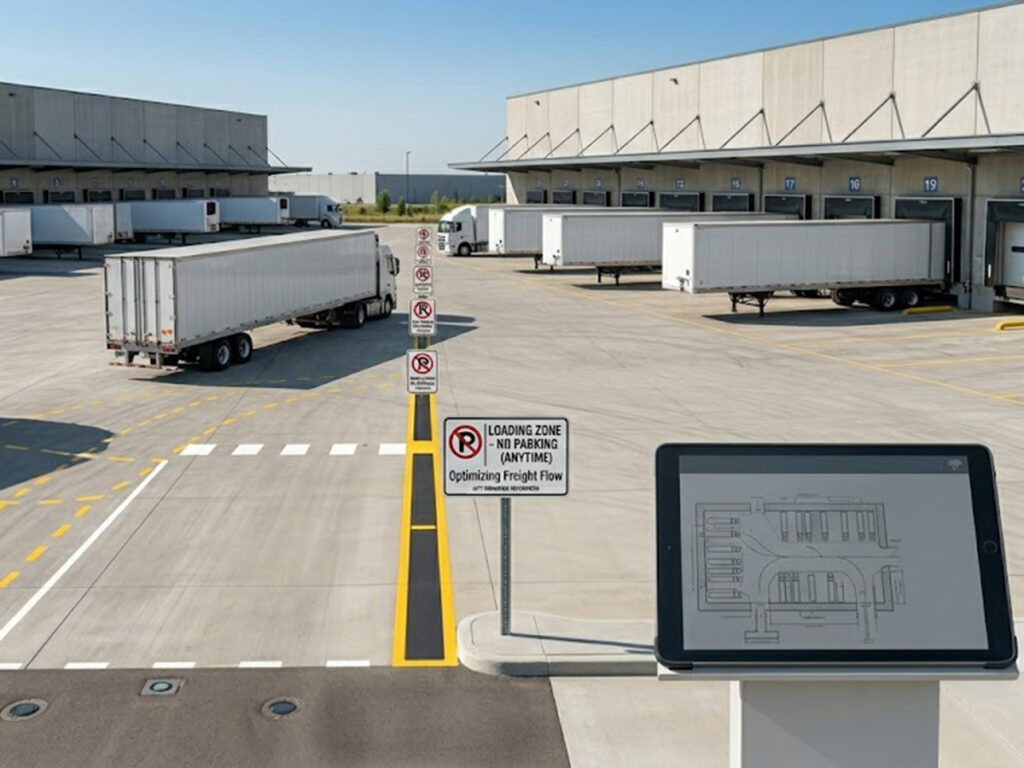
La norme de l'industrie du fret pour les espaces de désignation de zone de chargement continue a panneau de zone de chargement interdit de stationnement chaque 30 pieds le long de la face active du quai. La plage opérationnelle acceptable s'étend de 25 à 75 pieds en fonction de la longueur du périmètre de la cour et des distances de visibilité d'approche.
Montez les panneaux à au moins 7 pieds du sol jusqu'au bas du panneau. Cette hauteur dépasse les hauteurs de mât de chariot élévateur standard (5–6 pieds abaissés), dégagement pour piétons, et avions miroirs pour tracteurs de chantier. Positionnez les panneaux à un angle de 30 à 45 degrés par rapport au flux de trafic entrant pour permettre aux chauffeurs de camion de les lire. panneau de zone de chargement interdit de stationnement pendant qu'il était encore 50+ pieds du tablier de la baie, avant de s'engager dans une démarche d'accompagnement.
À la porte de l’installation ou aux points d’entrée dans la cour, déployer surdimensionné 24″ × 30″ “ZONE DE CHARGEMENT À L'AVANT — PAS DE STATIONNEMENT NON AUTORISÉ” panneaux pour intercepter les véhicules de tourisme avant qu'ils ne pénètrent dans la gare de marchandises.
Gestion des flux de triage et zones arrière aveugles
Les opérations de largage et d'accrochage nécessitent des zones de préparation dédiées, séparées des quais de chargement dynamique. Signez le périmètre avec “EXÉCUTION AUTORISÉE UNIQUEMENT — AUCUN VÉHICULE DE PASSAGERS” panneaux pour éviter tout empiètement lors des échanges de remorques à haute fréquence.
Le dossier côté aveugle présente le plus grand risque de blessure dans les environnements de cour industrielle. Le Bureau of Labor Statistics a enregistré 79 décès liés à des incidents de transport dans les opérations d'entreposage et de stockage en 2023, les conflits de manœuvres de soutien étant cités comme l'un des principaux facteurs contributifs. Position “ZONE D'ARRIÈRE - RESTEZ CLAIRE” panneaux au coin du tablier du quai où les conducteurs perdent la visibilité sur la queue de leur remorque.
Signalisation à sens unique — “ENTRÉE CAMION UNIQUEMENT,” “SORTIE UNIQUEMENT,” “NE PAS ENTRER” — co-déployé avec le panneau de zone de chargement interdit de stationnement le système établit un flux de triage en boucle qui élimine les conflits frontaux entre les observateurs et les camions entrants.
Zones de rassemblement de Bobtail et de remorques vides
Les Bobtails et les largages de remorques vides encombrent les files d'attente actives lorsqu'ils sont mélangés à des voies de chargement rapide. Désigner une zone de rassemblement physiquement séparée pour les bobtails et signée avec “STATIONNEMENT BOBTAIL UNIQUEMENT — PAS DE REMORQUES CHARGÉES.” Les lots de remorques vides nécessitent “STAGE DE REMORQUE VIDE — 72 HEURES MAXIMUM” panneaux périmétriques pour empêcher l’accumulation de remorques abandonnées.
J.J. La signalisation d'enregistrement Keller conforme à l'OSHA ajoute une couche de protocole documentée: “TOUS LES CONDUCTEURS DOIVENT S'ENREGISTRER AU GARD HOUSE AVANT DE PROCÉDER AU QUAI.” Cette signalisation établit une chaîne de traçabilité pour le placement de la remorque et crée un dossier d'application pour les incidents de stationnement non autorisés..
Contrôles visuels complémentaires: Marques de chaussée, Barrières, et application
Spécifications du marquage de la chaussée
Les hachures jaunes définissent les limites de la zone de chargement au niveau du sol. Spécifiez une peinture alkyde ou époxy à base d'eau de qualité routière avec diffusion de billes de verre rétroréfléchissantes conformément à la norme ASTM D1155 au minimum. 4 chargement de billes lb/gal. Les hachures rouges s'appliquent aux zones les plus restreintes, directement devant les portes des baies, où toute obstruction crée un arrêt opérationnel immédiat..
Largeur de ligne minimale: 4-bandes en pouces pour les périmètres de zone standard; 6-bandes en pouces à l'intersection des chariots élévateurs et des piétons. Les marquages thermoplastiques sur la chaussée prolongent la durée de vie de 3 à 5 ans contre 12 à 18 mois pour les marquages peints dans les gares de marchandises actives.
Intégration des barrières physiques
Bornes en acier — 4″ ou 6″ programme de diamètre 40 tuyau en acier, rempli de béton, installés sur des semelles augurées — prévoient une exclusion physique permanente des véhicules de tourisme des zones de l'aire de trafic du quai. Peindre les bornes de sécurité en jaune (Norme fédérale 595 Couleur 33538). Placer des bornes en bordure du couloir d’accès des camions, pas dans l'enveloppe de support.
Petit “PARKING INTERDIT / ZONE DE CHARGEMENT” les pancartes montées sur les capuchons des poteaux de borne renforcent le panneau de zone de chargement interdit de stationnement message au niveau du bord du quai — une deuxième couche de contrôle visible du niveau des yeux du conducteur d'un véhicule stationné.
Langue de l'autorisation de remorquage et exigences légales
La plupart des États-Unis. les codes des véhicules de l'État exigent une autorisation de remorquage affichée avant de remorquer légalement un véhicule depuis une propriété commerciale privée sans le consentement du propriétaire. Section du code des véhicules de Californie 22658 et section du code des transports du Texas 684 mandater une langue spécifique et des tailles de caractères minimales.
Langue requise du panneau de remorquage: “LES VÉHICULES STATIONNÉS DANS LA ZONE DE CHARGEMENT SERONT REMORQUÉS AUX FRAIS DU PROPRIÉTAIRE — 24 HEURES PAR JOUR / 7 JOURS PAR SEMAINE — [Nom et numéro de téléphone de l'entreprise de remorquage].” CVC de Californie 22658 impose le nom et le numéro de téléphone de l'entreprise de remorquage en lettres d'au moins 1 pouce.
Montez les panneaux d'autorisation de remorquage en tant que cluster colocalisé avec le R7-6 principal panneau de zone de chargement interdit de stationnement — point d'installation unique, signal d'application unifié, une documentation claire à des fins d'assurance et à des fins juridiques.
Flux de travail de déploiement: Élaboration d'un plan de mise en œuvre de la signalisation multi-quai
Réalisation d'un audit du site de signalisation de la zone de chargement
Un audit structuré produit un plan d'installation exploitable en quatre étapes:
- Cartographie du chantier: Documenter toutes les portes de baie actives, zones de rassemblement, beaucoup de bobtail, et zones de dépôt de remorques avec un plan de parcelle d'installation dimensionné.
- Analyse vectorielle d'approche: Parcourez chaque chemin d'approche des camions et identifiez les espaces de visibilité là où la signalisation manque, obstrué, ou sous-dimensionné.
- Évaluation des écarts de conformité: Comparez la signalisation installée avec la spécification MUTCD R7-6, OSHA 29 CFR 1910.145 Exigences relatives aux mots d'en-tête, et la langue d'autorisation de remorquage du code national du véhicule applicable.
- Zonage prioritaire: Classer les zones par urgence d’application – quai en premier, puis périmètre de mise en scène, entrée de cour, et lot bobtail – pour séquencer les phases d’installation dans le respect des contraintes budgétaires.
Matrice de quantité de panneaux par empreinte d'installation
| Type d'installation | Nombre de baies | Panneaux R7-6 recommandés | Espacement |
| Petit locataire unique (<50K pieds carrés) | 2–4 baies | 4–8 panneaux (18″ × 24″) | 30 ft |
| DC de taille moyenne (50K–200 000 pieds carrés) | 8–20 baies | 12–20 panneaux (18″×24″ ou 24″×30″) | 30 ft |
| Grand CD régional / cross-dock (>200K pieds carrés) | 20+ baies | Périmètre complet, Grade de diamant | 25 ft |
Source: https://mutcd.fhwa.dot.gov
Intervalles de maintenance et recertification de conformité
Les feuilles HIP ont une durée de vie nominale de 10 ans selon ASTM D4956. Planifiez un remplacement proactif tous les 7 à 8 ans pour maintenir les performances rétroréfléchissantes dans les limites de la marge de garantie.. Des inspections visuelles trimestrielles doivent vérifier les dommages causés par l'impact, décoloration, desserrage du matériel, et lignes de visibilité obstruées.
Les déclencheurs de réaudit de conformité incluent: agrandissement des installations, reconfiguration du quai, changement de locataire, Citation d'inspection de l'OSHA, ou exigence de la compagnie d'assurance. Tenir un journal d'installation des panneaux - type de panneau, emplacement, date d'installation, spécification matérielle, et nom de l'installateur — pour des raisons de défense réglementaire.
Connecter la signalisation de la zone de chargement à la stratégie de contrôle du stationnement à l'échelle de l'installation
Comment la signalisation de la zone de chargement s'adapte à un système complet de contrôle de la propriété
UN panneau de zone de chargement interdit de stationnement gère le débit des quais de fret. Une stratégie complète de contrôle des propriétés commerciales doit également tenir compte des stationnements périmétriques., espaces visiteurs, zones d'employés, et couloirs de véhicules d’urgence – chacun régi par des autorités de réglementation distinctes.
Dégagement des voies d'incendie (NFPA 1, IFC), Application des lots conforme à l'ADA, et la gestion des zones de chargement de fret relève de différentes autorités de code et ne doit pas partager l'infrastructure de signalisation.. Les traiter comme interchangeables crée des écarts de conformité dans les trois zones simultanément.
Pour les directeurs des opérations qui gèrent le contrôle du stationnement sur l'ensemble du périmètre des propriétés commerciales - des voies d'incendie aux parkings pour visiteurs - OPTSigns’ ressource complète sur propriété commerciale application des panneaux de zone de stationnement interdit.
Coordonner la signalisation de la zone de chargement et de la zone de dégagement d’urgence sans chevauchement
Une erreur d'installation fréquente: placer des panneaux de zone de chargement dans des positions qui entrent en conflit avec les couloirs d'accès des véhicules d'urgence, créant une ambiguïté en matière d'application et des violations potentielles du code de prévention des incendies. Les panneaux de signalisation en cas d'incendie régissent l'accès des véhicules d'urgence en vertu de la NFPA 1 et le Code international de prévention des incendies. Les panneaux de zone de chargement régissent les opérations quotidiennes de fret et de véhicules commerciaux sous MUTCD R7-6. Les deux types de panneaux ne doivent jamais partager la même zone désignée.
Pour les installations où les quais de chargement et les couloirs d’accès aux véhicules d’urgence partagent le même périmètre, le blog Fire Lane Enforcement de cette série explique comment délimiter correctement les zones de dégagement d'urgence sans restreindre les opérations de fret.
Mise à l'échelle sur plusieurs emplacements d'installations
Opérateurs multi-sites — 3PL, distributeurs nationaux, et les FPI industrielles : bénéficiez d'avantages en matière d'approvisionnement et de conformité en normalisant les spécifications des panneaux de zone de chargement sur tous les sites.. Un manuel de normes de signalisation d'entreprise spécifiant la désignation MUTCD approuvée, jauge de substrat, qualité de feuille, niveaux de taille de panneau, et le matériel approuvé élimine les variations d'un emplacement à l'autre.
Les commandes en volume selon une spécification verrouillée réduisent le coût unitaire et garantissent que chaque panneau de zone de chargement interdit de stationnement l'installation dans l'ensemble du portefeuille répond aux mêmes critères rétroréfléchissants, de construction, et norme dimensionnelle.
De la case à cocher de conformité à l’avantage du débit compétitif
Le modèle d'application à trois niveaux – conforme à MUTCD panneau de zone de chargement interdit de stationnement installation, marquage au sol, et barrières physiques – crée un système d’infrastructure passif qui protège le flux de marchandises 24 heures sur 24. Chaque couche renforce les autres: la signalisation établit l'autorité légale, les marquages définissent les limites visuellement, et les bornes les renforcent physiquement.
Chaque heure de quai récupérée suite à un déplacement non autorisé d'un véhicule se traduit directement par une réduction des coûts de détention du transporteur et par l'évitement des pénalités de surestaries.. Aluminium de qualité HIP panneaux de zone de chargement interdits de stationnement avoir une durée de vie nominale de 10 ans selon ASTM D4956 — faisant de l'installation une dépense d'investissement unique avec une décennie de retours opérationnels conformes.
La signalisation de la zone de chargement n'est pas un élément de maintenance des installations.. C'est une infrastructure de débit.
Foire aux questions
À quoi ressemble un panneau de zone de chargement interdit de stationnement conforme au MUTCD, et où est-ce nécessaire?
La désignation MUTCD R7-6 spécifie un fond rétroréfléchissant blanc, frontière rouge, et lecture de texte rouge en gras “AUCUNE ZONE DE CHARGEMENT DE STATIONNEMENT.” Il s'applique partout où une installation commerciale ou industrielle désigne une zone exclusive de fret adjacente aux quais de chargement., portes en baie, ou zones de rassemblement des camions. MUTCD Partie 2B régit son utilisation sur toute route ou parking accessible au public; La clause de service général de l'OSHA étend la recommandation aux chantiers industriels privés.
Quelle est la hauteur de montage correcte pour les panneaux de zone de chargement dans un environnement de quai d'entrepôt?
Les panneaux sont installés à un minimum de 7 pieds du sol jusqu'au bas du panneau - dégagement des hauteurs de mât de chariot élévateur, zones de dégagement pour piétons, et avions miroirs pour tracteurs de chantier. Les panneaux adjacents aux portes de baie doivent être placés à la hauteur ou au-dessus de la hauteur du tablier du niveleur de quai. (4–5 pieds) mais sous la ligne de l'auvent du quai pour préserver les lignes de visibilité de la cabine. Les installations de bannières aériennes au-dessus des entrées de quai nécessitent un dégagement minimum de 14 pieds sous le panneau pour un dégagement standard à la hauteur du nez de la remorque..
De quel matériau les panneaux de zone de chargement commerciale devraient-ils être fabriqués pour un 24/7 opération de fret?
Aluminium épais au minimum .080 la jauge sert de substrat - elle résiste à la charge du vent, contact mineur avec l'équipement, et cyclage thermique. La feuille réfléchissante doit être conforme aux normes prismatiques haute intensité 3M (HANCHE), ASTM D4956 Type IV minimum, pour la rétroréflectivité sous de grands angles de phares pendant les opérations de fret de nuit. Le matériel nécessite de l'acier galvanisé ou thermolaqué avec un composé frein-filet dans les environnements de quai à fortes vibrations.
À quelle distance les panneaux de stationnement ne doivent-ils pas être espacés le long du périmètre d'un quai de chargement?
La norme de l'industrie du fret espace la zone de chargement commerciale et signe chaque 30 pieds le long de la face active du quai. La plage opérationnelle acceptable s'étend de 25 à 75 pieds en fonction de la longueur du périmètre de la cour et des distances de visibilité d'approche. Les nœuds de placement critiques — indépendamment de l'espacement des intervalles — incluent chaque porte de baie active, tous les points d'entrée dans la cour, et chaque coin du périmètre de la zone de rassemblement.
Le langage d'autorisation de remorquage est-il légalement requis sur les panneaux de la zone de chargement commerciale?
La plupart des États-Unis. les codes des véhicules de l'État exigent un avis d'autorisation de remorquage affiché avant qu'un véhicule puisse être légalement remorqué depuis une propriété commerciale privée sans le consentement du propriétaire. Les éléments requis incluent généralement le nom de l’entreprise de remorquage, numéro de téléphone, et une déclaration selon laquelle les véhicules seront remorqués aux frais du propriétaire. CVC de Californie 22658 impose une hauteur de lettre minimale de 1 pouce pour les coordonnées de l'entreprise de remorquage. Montez les panneaux d'autorisation de remorquage en tant que cluster colocalisé avec le panneau principal de zone de chargement interdit de stationnement R7-6 pour créer un système unifié., groupe d'application juridiquement défendable.
Références
- Institut américain de recherche sur les transports (ATRI). Une analyse des coûts opérationnels du camionnage: 2023 Mise à jour.
- Administration de la sécurité et de la santé au travail (OSHA). 29 CFR 1910.178 — Camions industriels motorisés.
- Bureau des statistiques du travail. Recensement des accidents du travail mortels (CFOI) — Entreposage et stockage, 2023.
- Société américaine des ingénieurs civils. ASCE 7-22: Charges minimales de conception et critères associés pour les bâtiments et autres structures.
- J.J. Keller & Associés. Conformité OSHA: Sécurité des quais de camions.
- Informations législatives de Californie. Section du code des véhicules de Californie 22658 — Retrait des véhicules d'une propriété privée.
- ASTM International. ASTM D4956 — Spécification standard pour les feuilles rétroréfléchissantes pour le contrôle de la circulation.