Pourquoi l'approvisionnement intelligent en panneaux de sécurité protège votre main-d'œuvre et votre budget
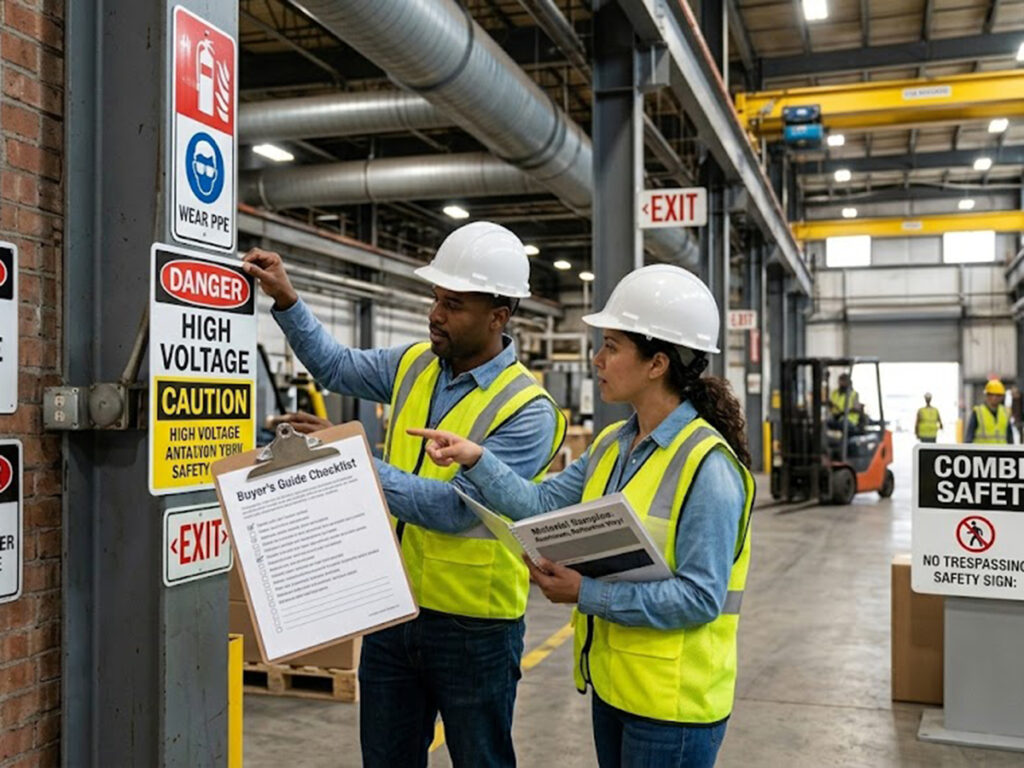
Les États-Unis. Bureau of Labor Statistics enregistré 5,070 accidents mortels du travail en 2024 et 2.5 millions de cas non mortels dans le secteur privé (Source: https://www.bls.gov/iif/). Visible, une signalisation durable se dresse entre chacun de ces travailleurs et un danger évitable. Pourtant, la plupart des établissements considèrent encore la signalisation comme un achat de marchandise.. Ce Guide d'achat des panneaux de sécurité les changements qui approchent.
Agents d'approvisionnement, ingénieurs d'usine, et les responsables EHS sont confrontés aux trois mêmes problèmes: choisir des fournisseurs dignes de confiance, spécifier des matériaux qui survivent aux conditions réelles, et chronométrer les remplacements avant que les panneaux ne tombent en panne. Ce Guide d'achat des panneaux de sécurité parcourt chaque décision en clair, termes pratiques. Les lecteurs repartiront en sachant comment trouver des signes qui durent 7 à 10 ans au lieu de 18 mois - et comment défendre chaque achat contre un paysage de pénalités de plus en plus serré de l'OSHA.
Comprendre les catégories de panneaux de sécurité et les normes de conformité
La conformité définit le fondement de chaque programme de signalisation. Avant le début des achats, les acheteurs doivent savoir quelles normes s'appliquent à leur installation.
OSHA, ANSI Z535, et ISO 7010 Normes expliquées
OSHA 29 CFR 1910.145 gouverne les États-Unis. conception des panneaux sur le lieu de travail – y compris les couleurs d’en-tête, signale les mots, et hauteurs minimales des lettres. ANSI Z535.2 étend ces spécifications avec une hiérarchie de dangers à cinq couleurs: rouge (Danger), orange (Avertissement), jaune (Prudence), bleu (Avis), et vert (Sécurité). Les installations ayant des opérations internationales suivent également la norme ISO 7010 normes de pictogrammes. La règle générale citée par chaque fiche technique: un pouce de hauteur de lettre par 25 pieds de distance de vision.
Danger contre. Avertissement contre. Signes de prudence: Quand chacun est requis
Les mots d’avertissement correspondent à la gravité du danger. Le danger signale une menace immédiate de mort. Un avertissement signale un risque de blessure grave. L'avertissement signale une blessure mineure ou modérée. Une mauvaise étiquetage d'un danger expose les employeurs aux citations de l'OSHA et à la responsabilité civile en cas de blessure..
Exigences de signalisation spécifiques à l'industrie
Usines de fabrication, chantiers de construction, établissements de santé, et les transformateurs de produits chimiques fonctionnent chacun selon des règles qui se chevauchent. Les zones de travail suivent également les spécifications MUTCD de la Federal Highway Administration. Un complet Guide d'achat des panneaux de sécurité prend en compte chaque couche applicable avant de spécifier les produits. Sauter cette étape est l’erreur d’approvisionnement la plus courante – et la plus coûteuse lorsqu’un audit arrive. Utilisez ceci Guide d'achat des panneaux de sécurité comme cadre, puis vérifiez les addenda au niveau de l'État avant de passer une commande.
Comment choisir le bon fabricant de panneaux de sécurité
Le choix du fabricant détermine l’essentiel des performances des enseignes à long terme. Ce Guide d'achat des panneaux de sécurité traite le sourcing comme une démarche délibérée, processus axé sur les documents.
Fabricant vs. Revendeur: Pourquoi la distinction est importante
Les vrais fabricants contrôlent l’approvisionnement en substrats, impression, et contrôle qualité sous un même toit. Les revendeurs ajoutent une majoration de 30 à 60 % et garantissent rarement les spécifications des matériaux. L'approvisionnement direct accélère également les commandes personnalisées et les demandes de garantie.. Pour les responsables des achats achetant à grande échelle, les mathématiques privilégient les relations directes. Lisez l'étude approfondie sur s'approvisionner en panneaux de sécurité directement auprès des fabricants pour le manuel de vérification complet.
Questions de vérification critiques avant de passer une commande
Les acheteurs intelligents vérifient l'ISO 9001 attestation, capacité d'impression en interne, transparence du substrat, et les conditions de garantie par écrit. Des réponses vagues signalent souvent des courtiers commerciaux plutôt que de véritables fabricants. Le cadre de vérification complet se trouve dans la pièce complémentaire, 10 questions à poser à vos fabricants de panneaux de sécurité.
Drapeaux rouges qui signalent un fabricant de mauvaise qualité
Trois panneaux d’avertissement font rapidement surface: aucune garantie publiée, refus de partager les fiches techniques des matériaux, et délais tournants. Chacun de ces éléments transforme une économie à court terme en une crise de conformité lorsque les panneaux s'estompent ou se décollent en un an..
Évaluation des fournisseurs et des distributeurs de panneaux de sécurité
Les fournisseurs jouent un rôle important pour les installations qui ont besoin de commandes mixtes, réapprovisionnement rapide, ou des volumes plus petits. Ce Guide d'achat des panneaux de sécurité sépare les distributeurs forts des plus faibles.
Ce qui différencie les fournisseurs de premier plan des fournisseurs moyens 2026
Les fournisseurs solides disposent de stocks importants, publier les SLA d'exécution, et proposer des flux de travail d'épreuves avant l'impression. Le 2026 le paysage des fournisseurs récompense la transparence et la rapidité. Le cadre complet d'évaluation des fournisseurs apparaît dans le guide sur comment choisir les meilleurs fournisseurs de panneaux de sécurité en 2026.
Panneaux de sécurité combinés: Maximiser la valeur par unité
Les panneaux combinés consolident plusieurs messages sur un seul substrat. Les plantes réduisent souvent le nombre global de signes de 30 à 40 %, économie sur la main d'œuvre d'installation et l'encombrement visuel. Voir la répartition de panneaux de sécurité combinés provenant de fournisseurs de confiance.
Économie des achats en gros pour les usines et les installations
Les niveaux de volume s'interrompent généralement à 50, 100, 500, et 1,000+ unités. Les usines qui achètent au niveau de 500 unités débloquent souvent des économies unitaires de 15 à 25 %. Pour les équipes d'approvisionnement qui effectuent des déploiements complets d'usines, le guide d'achat en gros de panneaux de sécurité en usine cartographie le playbook étape par étape.
Choisir les bons matériaux de signalisation de sécurité pour votre environnement
La sélection des matériaux détermine la durée de vie plus que tout autre facteur. Un solide Guide d'achat des panneaux de sécurité force une adéquation délibérée entre le substrat et l’environnement.
Aluminium vs. Plastique VS. Magnétique: Une comparaison des performances
| Matériel | Durée de vie en plein air | Meilleur cas d'utilisation | Indice des coûts |
| .080 Aluminium | 10+ années | Extérieur permanent | $$$ |
| .063 Aluminium | 7–10 ans | Extérieur standard | $$ |
| Plastique rigide | 3–5 ans | Intérieur / temporaire | $ |
| Magnétique | 2–4 ans | Réutilisable / véhicule | $$ |
Source: Panneaux de sécurité en aluminium, en plastique et magnétiques
Matériaux spécialisés pour les températures élevées, Corrosif, et des environnements poussiéreux
Le vinyle standard tolère environ 150°F. Les stratifiés en polyester dépassent les 300 °F. Les environnements corrosifs exigent des revêtements résistants aux produits chimiques. La plongée profonde sur matériaux de signalisation de sécurité durables pour les environnements difficiles couvre chaque scénario en détail.
Qualités de feuilles réfléchissantes et protection UV
Grade d'ingénieur (Type I) bénéficie d'une garantie de 7 ans. Prismatique à haute intensité (Type IV) s'étend à 10 années. Grade de diamant (Type XI) atteint 12 années et 650+ réflectivité candéla. La signalisation extérieure de sécurité routière nécessite pratiquement au minimum le type IV.
Méthodes de montage qui maximisent la durée de vie des panneaux
Même le meilleur panneau échoue s’il est mal monté. Ce Guide d'achat des panneaux de sécurité considère le montage comme faisant partie de la décision d'achat, pas une réflexion après coup.
Options matérielles: Boulons, Baguage, Adhésif, et montage sur poteau
Les fixations en acier inoxydable durent plus longtemps que celles galvanisées dans des environnements corrosifs. Trous pré-percés (1/4″ ou 3/8″) simplifier l'installation sur le terrain. Les adhésifs fonctionnent à l’intérieur mais perdent leur adhérence en cas de variations de température. Le sélection des matériaux et méthodes de montage pour les panneaux de sécurité routière le guide détaille chaque méthode que les acheteurs devraient connaître.
Charge de vent et considérations structurelles pour les panneaux extérieurs
Les calculs de charge de vent de référence MUTCD commencent à 90 mph. Publications sur la chaîne U sur 2 signes standard de combinaison lb/ft; 3 les poteaux lb/pi acceptent des panneaux plus grands. Les installations en bordure de route nécessitent également du matériel de sécurité pour limiter les dommages causés par les impacts..
Erreurs d'installation qui annulent les garanties
Trois erreurs reviennent lors des audits: perçage qui fissure le substrat, mélanger des métaux différents (corrosion galvanique), et un dégagement insuffisant des sources de chaleur. Chacun peut annuler une garantie fabricant de 10 ans en un seul après-midi.
Panneaux de sécurité routière vs. Panneaux de sécurité en usine: Principales différences en matière d'approvisionnement
Les chantiers industriels brouillent souvent les panneaux de sécurité routière et la signalisation de sécurité des usines. Ce Guide d'achat des panneaux de sécurité sépare clairement les deux afin que les équipes d'approvisionnement spécifient le bon produit du premier coup.
Différences réglementaires: MUTCD contre. Exigences de l'OSHA
MUTCD régit les routes et les zones de travaux. L'OSHA régit les lieux de travail. Les quais de chargement et les intersections de triage relèvent souvent des deux autorités. Les acheteurs doivent vérifier quelle autorité s'applique avant de spécifier les niveaux de rétroréflectivité ou les méthodes de montage..
Normes de matériaux et de réflectivité pour la signalisation de sécurité routière
La plupart des États exigent .080-calibre minimum en aluminium pour les panneaux de sécurité routière. Demande de références de visibilité nocturne 250+ candela pour un placement à côté de l'autoroute. Le remplacement d'un substrat plus léger pour réduire les coûts déclenche souvent le rejet du DOT lors de l'inspection..
Attentes en matière de durée de vie: Pourquoi les panneaux de signalisation échouent souvent plus rapidement
L’exposition en bordure de route aggrave le rayonnement UV, sel de déneigement, échappement du véhicule, et l'impact physique. La plupart des panneaux de sécurité routière doivent être remplacés tous les 7 à 12 ans.. Le guide de durabilité et d'entretien des panneaux de sécurité routière parcourt les données.
Calendriers de maintenance et cycles de remplacement qui évitent les écarts de conformité
L'achat de la bonne enseigne ne couvre que la moitié de l'équation d'approvisionnement. Le maintenir couvre l’autre moitié.
Création d'une liste de contrôle d'inspection des panneaux de sécurité
Une liste de contrôle de travail couvre les inspections visuelles trimestrielles, test de réflectivité annuel, et une documentation complète pour les audits OSHA. Les inspections devraient enregistrer la décoloration, peeling, lisibilité à distance, et dommages superficiels.
Quand remplacer les panneaux conformes à l'OSHA: Déclencheurs de durée de vie
Le déclencheur fonctionnel est un 50% règle de fondu ou toute baisse de lisibilité à la distance de visualisation requise. Le Guide de remplacement des panneaux de sécurité OSHA décompose chaque déclencheur avec des photos de terrain.
Protocoles de maintenance par temps extrême
Les tempêtes accélèrent la dégradation. Neige, glace, et les vents violents plient les poteaux et déchirent les adhésifs. Les inspections post-événement protègent la conformité — voir le panneaux de sécurité dans la zone de travail dans le guide des conditions météorologiques extrêmes pour les protocoles exacts.
Coût total de possession: Calcul du véritable retour sur investissement des panneaux de sécurité
Une enseigne haut de gamme coûte rarement plus cher sur une décennie complète. Ce Guide d'achat des panneaux de sécurité se termine avec les besoins des équipes d'approvisionnement en mathématiques.
Prix unitaire vs. Coût du cycle de vie: Les mathématiques cachées
Un $8 panneau en plastique remplacé trois fois en dix ans $24 plus trois cycles de travail. UN $20 une enseigne en aluminium qui dure toute une décennie coûte souvent moins de la moitié. Multipliez sur une installation de 500 panneaux et les économies s'étendent jusqu'à six chiffres.
Coûts de main-d'œuvre de remplacement et de réinstallation
La main d'œuvre d'installation coûte entre 45 $ et 85 $ par heure dans la plupart des États-Unis.. marchés. Chaque cycle de remplacement aggrave ces coûts par rapport au prix d'achat initial.
Évitement des coûts de conformité et implications en matière d’assurance
Les sanctions de l'OSHA ont atteint des niveaux records en 2026. Les violations graves sont désormais maximales à $16,550, et les violations volontaires ou répétées atteignent $165,514 par citation (Source: https://www.osha.gov/penalties). Une citation évitée paie souvent la mise à niveau de la signalisation d’un établissement entier.
Construire une stratégie d'approvisionnement en panneaux de sécurité qui dure une décennie
Un discipliné Guide d'achat des panneaux de sécurité rembourse plusieurs fois. Les équipes d'approvisionnement doivent examiner les fabricants avec des critères documentés. Ils doivent choisir des fournisseurs pour l'inventaire et la transparence, pas seulement le prix global. Ils doivent adapter les matériaux aux conditions environnementales réelles. Ils devraient établir une cadence de maintenance qui détecte les échecs avant l'OSHA.. Installations qui suivent Guide d'achat des panneaux de sécurité réduisent généralement les coûts du cycle de vie de 30 à 50 % tout en renforçant leur posture de conformité. La prochaine étape est simple: demander un devis personnalisé, auditer l'inventaire actuel de la signalisation, ou parlez à un spécialiste des spécifications spécifiques à l'installation.
Foire aux questions sur l'achat de panneaux de sécurité
À quelle fréquence les panneaux de sécurité doivent-ils être remplacés?
Les panneaux extérieurs doivent généralement être remplacés tous les 7 à 10 ans.. Les panneaux intérieurs durent souvent plus longtemps. Le déclencheur doit être fonctionnel: remplacer tout panneau indiquant 50%+ disparaître, illisibilité à la distance de visualisation requise, ou délaminage visible.
Quel est le meilleur matériau pour les panneaux de sécurité extérieurs?
.080-L'aluminium de calibre supérieur avec une feuille prismatique haute intensité de type IV offre le meilleur équilibre en matière de durabilité., visibilité, et coûter. Cela dure généralement 10+ ans dans la plupart des États-Unis. climats.
Dois-je acheter directement auprès d'un fabricant ou via un fournisseur?
Les achats directs auprès du fabricant permettent d'économiser 30 à 60 % à grande échelle et améliorent le contrôle de la personnalisation. Les fournisseurs ont du sens pour les commandes mixtes, volumes plus petits, ou réapprovisionnements rapides. La plupart des établissements utilisent les deux canaux de manière stratégique.
Les panneaux de sécurité en aluminium ou en plastique sont-ils meilleurs pour les environnements industriels?
L'aluminium l'emporte pour un placement permanent ou extérieur et dure 7 à 10 ans. Le plastique convient à une utilisation temporaire en intérieur, où un cycle de 3 à 5 ans est acceptable.
Quelles normes OSHA s'appliquent à l'achat de panneaux de sécurité?
La norme fédérale fondamentale est 29 CFR 1910.145. ANSI Z535 ajoute des spécifications de conception. ISO 7010 couvre les pictogrammes internationaux. Les panneaux de signalisation extérieurs suivent également le MUTCD de la Federal Highway Administration.
Comment puis-je réduire le coût total de possession des panneaux de sécurité?
Trois mouvements éprouvés: associer des matériaux haut de gamme à l'environnement, consolider les commandes pour atteindre les niveaux de volume, et documenter les inspections pour détecter rapidement les défaillances. Suite à une démarche structurée Guide d'achat des panneaux de sécurité aide également les équipes d'approvisionnement à justifier l'investissement initial auprès des partenaires financiers.
Références
NOUS. Bureau des statistiques du travail — Blessures et maladies professionnelles déclarées par l'employeur, 2023–2024
NOUS. Bureau des statistiques du travail — Recensement national des accidents du travail mortels 2024
OSHA- 29 CFR 1910.145 Spécifications relatives aux panneaux et étiquettes de prévention des accidents
Administration fédérale des routes — Manuel sur les dispositifs de contrôle de la circulation uniformes (Mutcd)