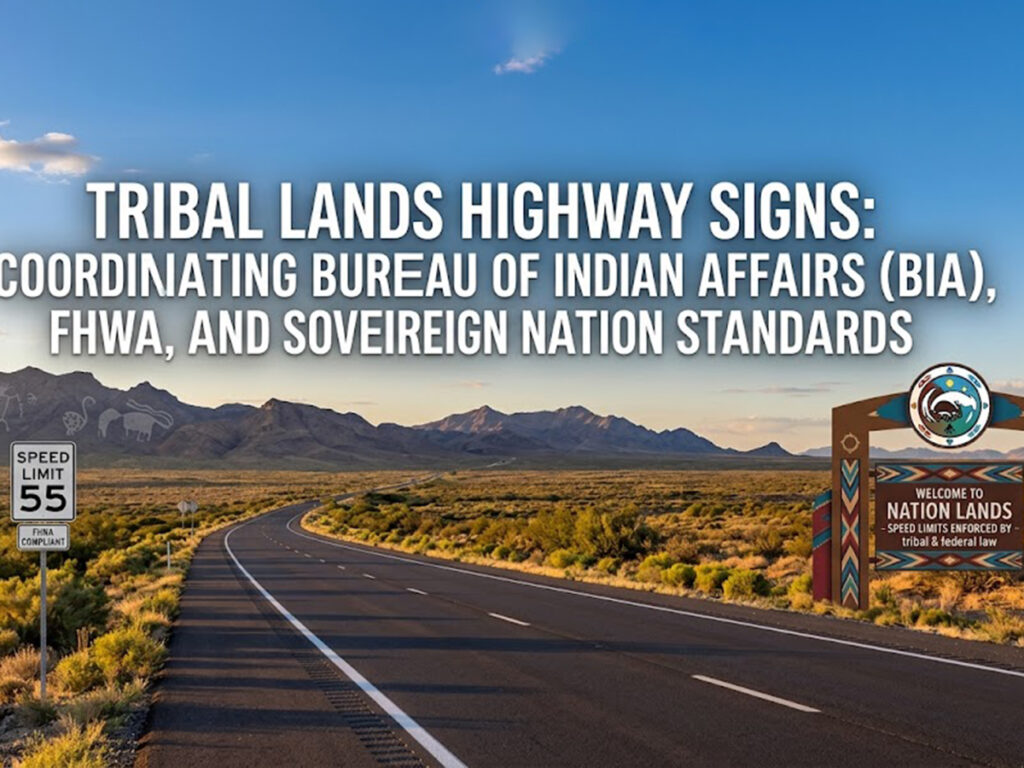
Why Signage Compliance on Tribal Lands Is Uniquely Complex
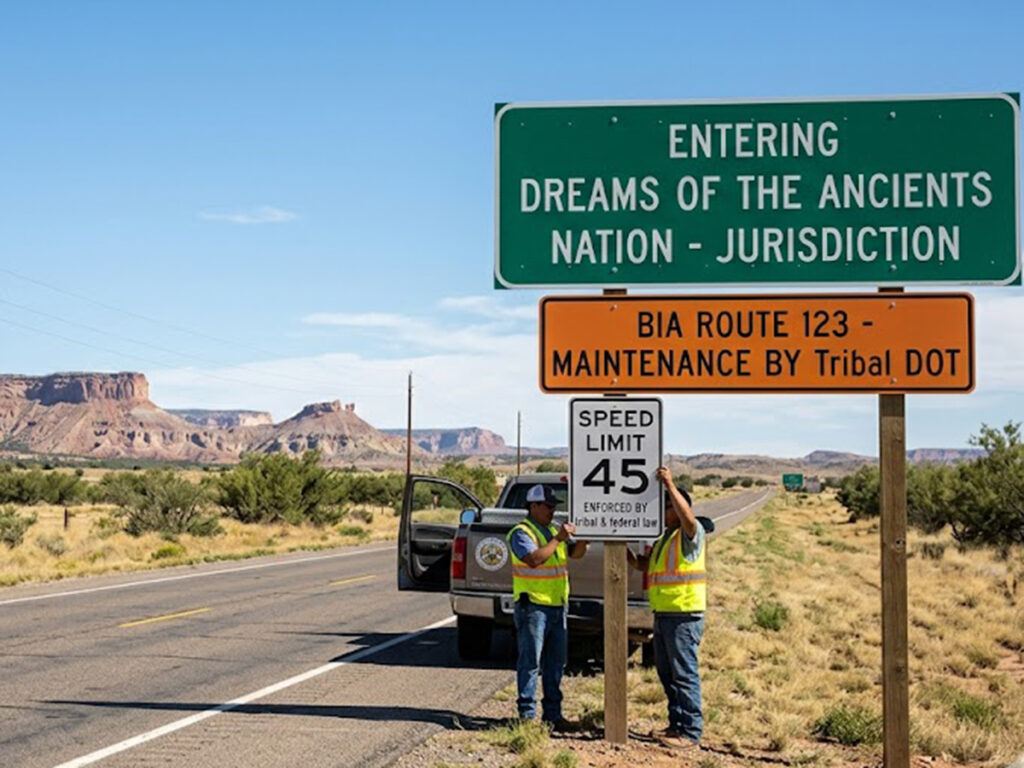
Picture a 20-mile drive across a reservation. The route crosses a state highway, a county road, a BIA system road, and a tribal-owned local road. Each segment falls under a different signage authority. Each carries different compliance requirements. A single Tribal Transportation Director must coordinate them all.
This jurisdictional reality sits at the intersection of federal, estado, and sovereign authority. Tribal lands occupy a distinct position within the broader framework of global highway road signage standards. Three regulatory layers operate at once: Estándares FHWA, BIA program rules, and tribal sovereign authority.
Hay mucho en juego. Native Americans recorded a traffic fatality rate of 28.51 por 100,000 population in 2021. The national rate that year stood at 13.02 (Fuente: https://www.nhtsa.gov/speeches-presentations/national-transportation-indian-country-conference). CDC data shows motor vehicle death rates among American Indian and Alaska Native adults run up to seven times higher than those of other racial groups. Compliant signage remains one of the most cost-effective tools to reduce these numbers.
Funding makes coordination urgent. The IIJA authorized roughly $1.1 billion annually for tribal transportation programs through FY2026 (Fuente: https://www.congress.gov/crs-product/IF12129). That total represents an 80% increase over the prior law. Every Tribal Transportation Director administers a slice of these funds. Compliance protects access to them.
The Three-Layer Authority Stack: Federal, Estado, and Tribal
Three regulatory sources govern signage on tribal lands. FHWA enforces national standards through the MUTCD and 23 CFR. BIA administers the Tribal Transportation Program under 25 Parte CFR 170. Tribes exercise sovereign authority over roads they own and operate. These layers do not stack neatly. They overlap. Sometimes they conflict. A skilled Tribal Transportation Director learns to navigate all three.
This guide serves Tribal Transportation Directors, BIA engineers, state DOT tribal liaisons, and consulting engineers. The Jurisdictional Matrix in Section 4 functions as the core operational tool.
The Federal Regulatory Foundation: MUTCD and 23 CFR
Federal MUTCD tribal lands compliance starts with one clear rule. 23 CFR 655.603 adopts the MUTCD as the national standard. The 11th Edition took effect in 2023 and governs current procurement decisions.
MUTCD Application on Federal-Aid and Federal Lands Projects
Federal-aid roads must comply fully. Tribal Transportation Program projects qualify as federal-aid. So do most state route improvements that touch tribal lands. The MUTCD specifies exact dimensions for regulatory signs.
Key MUTCD specifications every Tribal Transportation Director should reference:
- R1-1 STOP sign: 30″×30″ minimum on conventional roads; 36″×36″ on expressways
- Altura de montaje: 7-foot minimum to the bottom of the sign in rural areas (Section 2A.18)
- Letter legibility: 50 feet of distance per inch of capital letter height
- Warning sign placement: distances scaled by approach speed (Table 2C-4)
FHWA Office of Federal Lands Highway (FLH) Oversight
FHWA-FLH administers federal lands programs. The Office of Tribal Transportation oversees TTP funding distribution. FLH reviews design plans for federal-aid eligibility. It also approves the Tribal Transportation Improvement Program submitted by each tribe. A Tribal Transportation Director typically interacts with FLH at three points: TTIP approval, project agreement execution, and final reimbursement review.
Retroreflectividad, Sheeting Grades, and Material Standards
Material specification drives sign performance. ASTM D4956 defines retroreflective sheeting types I through XI. Tipo I (engineer grade) carries a 7-year service life. Tipo XI (prismático de alta intensidad) extends to 12 años o más. MUTCD Table 2A-3 sets minimum maintained retroreflectivity values. White-on-green guide signs require 120 cd/lx/m² mínimo. White-on-red regulatory signs require 35 cd/lx/m² mínimo. A Tribal Transportation Director should specify Type IV or higher for new installations. Higher grades reduce replacement frequency and improve nighttime visibility on rural reservation roads.
BIA Authority and 25 Parte CFR 170 Explained
25 Parte CFR 170 codifies the Tribal Transportation Program. It governs eligibility, funding distribution, planning, y diseño. Most signage decisions flow from this regulation.
BIA System Roads and the National Tribal Transportation Facility Inventory
The NTTFI catalogs all roads eligible for TTP funding. Each Tribal Transportation Director submits inventory data through an electronic portal jointly maintained by BIA and FHWA. Accuracy matters. Inventory mileage drives the funding formula directly. Indian Reservation Roads is the legacy term. The IRR program preceded TTP. Older RFPs and grant documents still use IRR language. The current term is Tribal Transportation Facilities. Both refer to the same network.
Self-Governance Compacts and Public Law 93-638 Contracting
Two pathways exist for tribal program administration. Under a Public Law 93-638 contract, the tribe runs the program, but BIA retains technical review. Under a Title IV Self-Governance compact, tribal authority broadens and BIA review narrows. This distinction matters for procurement. A Tribal Transportation Director operating under a compact has stronger authority to approve BIA-approved road signs without a separate BIA sign-off. Under a 638 contract, BIA technical review may still apply. Vendors should ask which model governs the project.
BIA Design Standards and Where They Defer to Tribal Authority
BIA adopts AASHTO and MUTCD as baseline standards. The agency permits tribal supplements where Self-Governance authority applies. A Tribal Transportation Director may add culturally specific signage, language requirements, or modified speed transitions. Federal compliance survives as long as MUTCD legibility and retroreflectivity standards remain intact.
Sovereign Nation Authority and Tribal MUTCD Adoption
Tribal authority is concurrent with federal authority on shared roads. On tribal-owned roads, tribal authority is primary. Executive Order 13175 reinforces this principle by requiring meaningful federal-tribal consultation.
How Tribes Adopt, Modify, or Supplement MUTCD
Three patterns dominate tribal MUTCD adoption in practice:
- Adopción completa: Tribe references MUTCD by tribal council resolution; no modifications
- Adoption with supplement: Tribe publishes a tribal supplement covering bilingual signs, sacred site markers, or place names
- Independent standard: Tribe develops a complete signage manual; MUTCD serves as a reference only
Adoption-with-supplement dominates because it preserves driver expectation while allowing cultural and linguistic additions. Each Tribal Transportation Director should document the chosen pattern formally. Obtención, litigation defense, and federal audit all benefit from clear documentation.
The Jurisdictional Matrix: Four Road Types, One Reservation
Four road types commonly cross a single reservation. Each carries distinct authority. The matrix below maps the operational answers.
| Tipo de carretera | Owner | Standard Applies | Approval Authority | Installer |
| State Route | Punto de estado | Muescato + State Supplement | Punto de estado (with tribal consultation) | Punto de estado |
| County Road | County | Muescato + County Spec | County (per IGA terms) | County or Tribe (per IGA) |
| BIA System Road | BIA / Tribe | Muescato + Tribal Supplement | Tribe (compacto) or BIA (638) | Tribe or contractor |
| Tribal-Owned Road | Tribe | Tribal Standard | Tribal Council | Tribe or contractor |
Fuente: https://highways.dot.gov/federal-lands/tribal
State Routes Crossing Tribal Lands
The state DOT retains primary signage authority. EO 13175 y 23 CFR 450.210(b) require formal tribal consultation on federal-aid projects. Public Law 280 estados (California, Minnesota, NE, O, Wisconsin, AK) adds enforcement complexity affecting regulatory sign authority. Coordination agreements increasingly specify bilingual signage and culturally appropriate place names. A Tribal Transportation Director engaging on a state route project should request the state DOT tribal liaison early in the design phase.
County Roads Through Tribal Lands
County roads form the murkiest category. The county is the signage authority on paper. En la práctica, Intergovernmental Agreements often shift maintenance and replacement authority to the tribe. Disputes over damaged sign replacement arise frequently. Always verify the controlling IGA before assuming jurisdiction. A Tribal Transportation Director should keep IGA copies in the project file.
BIA System and Tribal-Owned Roads
BIA system roads use MUTCD as the federal floor under 23 CFR 655.603. Tribal supplements apply under Self-Governance authority. Tribal-owned non-system roads represent the broadest tribal authority. Most tribes adopt MUTCD substantially for litigation defense and driver expectations. Custom signage—sacred site warnings, treaty boundary markers, language preservation signage—remains fully legitimate and increasingly common.
Bilingual and Culturally Appropriate Signage
Bilingual signage is a growing procurement category. TTP funds may cover it when MUTCD legibility standards remain intact. Native language signs serve safety, sovereignty, and cultural preservation simultaneously.
Native Language Road Signs and Legibility Requirements
Native language road signs must meet MUTCD letter height standards in both languages. The 50-feet-per-inch legibility rule applies independently to each language on the panel. The sign panel size grows accordingly. Syllabary languages such as Cherokee require different layout calculations than Latin-alphabet languages such as Diné Bizaad (Navajo). A Tribal Transportation Director should request mockups before final approval.
Dual-Language Regulatory Signs: Compliance Considerations
Dual-language regulatory signs maintain MUTCD compliance through two patterns. Pattern one keeps the English text at MUTCD-standard size, with the second language on a supplemental panel below. Pattern two enlarges the primary panel so both languages meet legibility standards. FHWA permits both patterns on federal-aid projects when documentation supports the standards.
Sitio sagrado, Treaty Boundary, and Cultural Place Name Signage
Tribal authority is broadest for non-regulatory signage. Sacred site advisory signs, treaty boundary markers, and restored place names fall in this category. Bilingüe highway signage tribal lands programs increasingly include cultural place name restoration—Denali and Bears Ears stand as well-known examples. These signs use custom panels and warrant longer procurement lead times. A Tribal Transportation Director should plan 12–16 weeks for custom fabrication and approval.
Procurement and Compliance Workflow for Tribal Signage Projects
A clear workflow protects the project. The steps below convert regulatory analysis into operational procurement guidance.
Pre-Procurement: Confirming Jurisdiction and Standard
The first task identifies road type and ownership. Pull the NTTFI inventory record. Pull the relevant IGA if a county road is involved. Confirm the tribal supplement to MUTCD if one exists. Identify the approval authority—Tribal Council, BIA, FHWA-FLH, or state DOT. A Tribal Transportation Director who completes this checklist before issuing an RFP avoids most compliance disputes downstream.
Specifying Compliant Signs: A Checklist for RFPs
The RFP must specify:
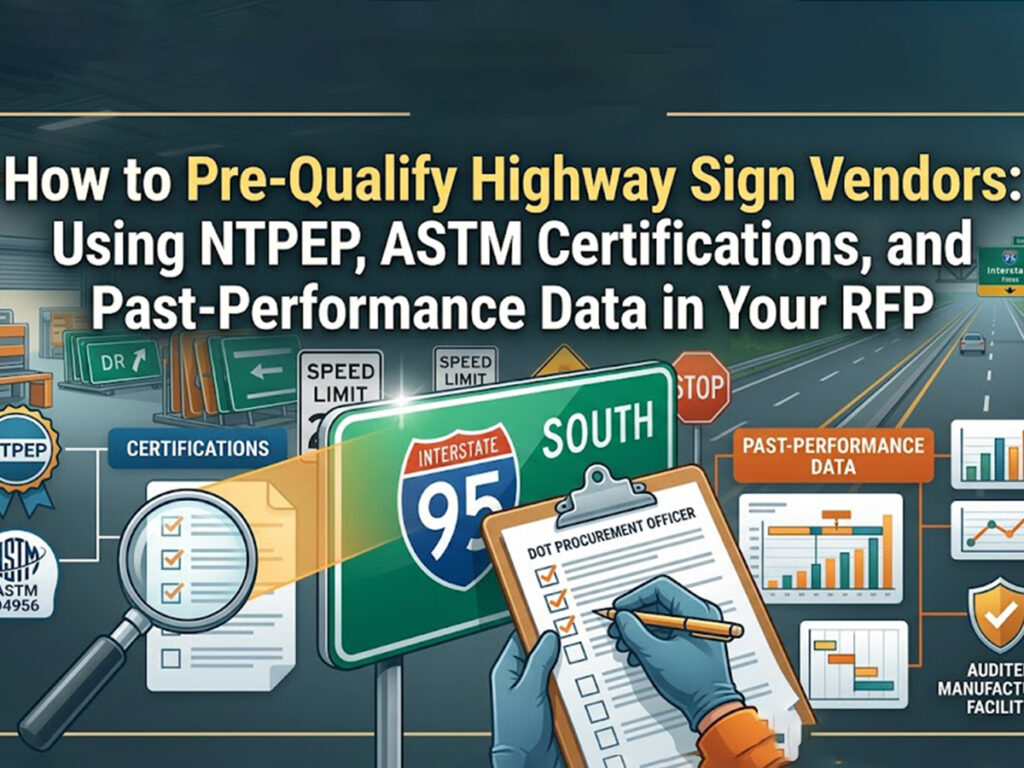
- Tipo de lámina ASTM D4956 (Type IV or higher recommended)
- MUTCD edition compliance (currently 11th Edition, 2023)
- Retroreflectivity certification at delivery
- Mounting hardware per the AASHTO Roadside Design Guide breakaway requirements
- Warranty term matched to sheeting type (7–12 years typical)
- Tribal cultural or language requirements (si corresponde)
- Buy Indian Act preferences under 25 USC 47
Documentation for Federal-Aid Reimbursement
TTP-funded projects require audit-ready documentation. A Tribal Transportation Director should retain material certifications, installation photographs with GPS coordinates, retroreflectivity test reports, and engineer-of-record certifications. The Tribal Transportation Program Safety Fund is authorized up to $25.1 million in FY 2026 (Fuente: https://highways.dot.gov/federal-lands/tribal/safety/funds). Documentation discipline directly affects future eligibility for these competitive funds.
Building a Compliance-Ready Tribal Signage Program
The jurisdictional labyrinth becomes manageable when a Tribal Transportation Director maps the four road types and three authority layers correctly. Strong programs protect tribal sovereignty by documenting tribal authority formally. They protect federal funding by maintaining audit-ready compliance. They protect public safety by maintaining MUTCD-grade standards.
A Tribal Transportation Director ready to formalize a compliance-ready program should request a Jurisdictional Coordination Worksheet. The worksheet walks each project through ownership, estándar, approval authority, and documentation requirements before procurement begins.
Frequently Asked Questions on Tribal Highway Signs
Are tribes required to follow MUTCD?
Yes on federal-aid and BIA system roads, bajo 23 CFR 655.603. On tribal-owned non-system roads, tribes hold sovereign authority to adopt, modify, or supplement MUTCD. Most tribes adopt MUTCD substantially as a baseline for driver expectation and litigation defense.
Who approves sign installation on a state route through tribal land?
The state DOT retains primary authority. EO 13175 requires meaningful tribal consultation on federal-aid projects. A Tribal Transportation Director should engage the state DOT tribal liaison early to document consultation in the project record.
Can TTP funds cover bilingual or culturally specific signage?
Sí. TTP permits funding for signage that meets safety standards. This includes bilingual signs and culturally specific signage when MUTCD legibility and compliance requirements remain intact.
¿Cómo funciona un 638 contract differ from a Self-Governance compact for signage authority?
Under a Public Law 93-638 contract, BIA retains technical review of signage standards. Under a Title IV Self-Governance compact, tribal authority broadens, and BIA review narrows. Procurement requirements differ accordingly.
Do native language road signs require separate FHWA approval?
No, provided the sign meets MUTCD standards for size, color, retroreflectividad, y legibilidad. FHWA permits bilingual regulatory signs on federal-aid projects when the project file documents compliance.
How often must tribal road inventory be updated for TTP eligibility?
The NTTFI requires annual update submissions to the BIA Division of Transportation per 25 Parte CFR 170, Subpart C. Inventory accuracy directly drives funding allocation.
Referencias
- NHTSA. National Transportation in Indian Country Conference Remarks. https://www.nhtsa.gov/speeches-presentations/national-transportation-indian-country-conference
- Centros para el Control y la Prevención de Enfermedades. Tribal Road Safety: Acerca de. https://www.cdc.gov/tribal-road-safety/about/
- Congressional Research Service. Tribal Highway and Public Transportation Programs (IF12129). https://www.congress.gov/crs-product/IF12129
- eCFR. 25 Parte CFR 170, Subpart C — Tribal Transportation Program Funding. https://www.ecfr.gov/current/title-25/chapter-I/subchapter-H/part-170/subpart-C
- FHWA. Tribal Transportation Program Safety Fund. https://highways.dot.gov/federal-lands/tribal/safety/funds
- FHWA. Tribal HPP Program. https://highways.dot.gov/federal-lands/tribal/tribal-hpp-program
- Registro Federal. Executive Order 13175: Consultation and Coordination with Indian Tribal Governments. https://www.federalregister.gov/documents/2000/11/09/00-29003/consultation-and-coordination-with-indian-tribal-governments
- FHWA. Manual en dispositivos de control de tráfico uniformes, 11décima edición (2023). https://mutcd.fhwa.dot.gov/