Why Highway Sign Vendor Qualification Defines Procurement Success

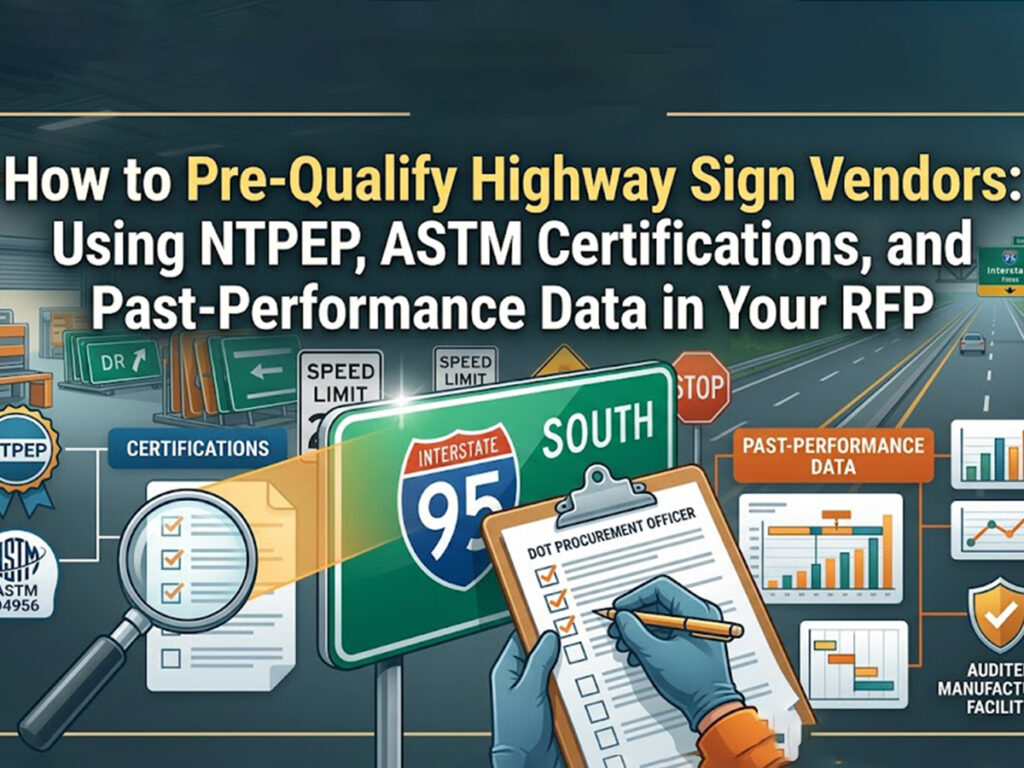
State DOT and municipal procurement officers face a hard truth in 2026. A single failed sign vendor can derail a multi-million-dollar contract. It can also expose the agency to bid protests, MUTCD compliance audits, and federal-aid funding clawback. Fuerte highway sign vendor qualification prevents these outcomes before solicitation begins. This guide fits inside the broader DOT and municipal procurement playbook for highway signs and focuses on the upstream gate that decides who deserves to bid.
The Government Accountability Office reported 1,688 bid protests filed in fiscal year 2025. The sustain rate hit 14%, and the overall effectiveness rate held at 52% (Fuente: https://www.gao.gov/products/gao-26-900695). Top sustained protest grounds included unreasonable technical evaluation and unreasonable rejection of the proposal. Both root causes trace back to weak pre-qualification documentation. Procurement officers who treat highway sign vendor qualification as risk management cut their protest exposure significantly.
The Real Cost of a Non-Compliant Vendor Award
A $2 million sign contract can produce $4–6 million in lifecycle costs when a vendor delivers Type IV sheeting that fails at year 6 instead of year 12. Replacement labor, control de tráfico, liability claims, and re-procurement fees compound fast. Defensible upstream screening reverses that risk equation.
How Pre-Qualification Differs from Bid Evaluation
Pre-qualification screens the capability. Bid evaluation screens price and responsiveness. The first gate decides who may bid. The second decides who wins. LEJOS 9.104-1 and most state equivalents require contracting officers to make an affirmative responsibility determination before any award.
The Triple-Tier Framework for Highway Sign Vendor Qualification
Eficaz highway sign vendor qualification rests on three non-negotiable pillars. Para oficiales de adquisiciones, these pillars provide the technical defensibility needed in a vendor pre-qualification checklist RFP:
- Material Certifications: Technical proof of product durability using NTPEP sign sheeting evaluation and AASHTO sign material standards.
- Cumplimiento regulatorio: Verification that products meet MUTCD compliance for highway signs and FHWA sign retroreflectivity requirements.
- Past Performance: Documented evidence of a supplier’s ability to meet high-volume contract demands, aligning with responsibility determination FAR 9.104 para proyectos de ayuda federal.
By requiring documentation under all three pillars, agencies move beyond “oferta más baja” and toward long-term asset reliability.
Material and Product Certifications (Leveraging NTPEP & Astm)
Independent, data-driven evidence is the anchor of this pillar. A robust highway sign vendor qualification process must move beyond manufacturer claims.
Procurement teams should utilize the NTPEP DMS (Datamine) for traffic signs to verify how materials perform under real-world exposure. Además, RFPs must explicitly require ASTM D4956 retroreflective sheeting compliance. Specifying the correct grade—such as Type IV vs Type XI sheeting compliance—is critical; Type XI may be necessary for high-speed corridors, while Type IV serves as a versatile standard for municipal routes. This ensures all materials are on the state DOT qualified products list (QPL) before a bid is even considered.
Regulatory Compliance Verification (Muescato & 23 CFR)
Federal regulations are the baseline for safety, and compliance is non-negotiable on federal-aid highway projects. Bajo 23 CFR 655 estándares de signos, all signage must adhere strictly to the latest MUTCD standards.
During the highway sign vendor audit, officers should verify that the manufacturer’s quality assurance program includes specific checks for color chromaticity and legend spacing. Failure to verify these standards during the qualification phase can lead to costly rejections and safety liabilities after installation.
NTPEP Sign Sheeting Evaluation: The Gold Standard for Material Validation
The National Transportation Product Evaluation Program operates under AASHTO. NTPEP sign sheeting evaluation runs three-year outdoor weathering at multiple test decks across the United States — including Florida, Pensilvania, and Texas.³ The program measures retained retroreflectivity, color stability, and shrinkage. State DOTs use this data to populate their Qualified Products Lists.
How to Read an NTPEP Sheeting Test Report
Procurement officers should focus on five fields:
- Initial coefficient of retroreflection (REAL ACADEMIA DE BELLAS ARTES) values in cd/lx/m²
- Percent retained RA at 24 y 36 meses
- Color coordinates per the CIE chromaticity diagram
- Shrinkage measurements
- Manufacturer lot identification
Reports below 80% retained RA at 36 months should trigger questions, regardless of sheeting type.
Using NTPEP DMS (Datamine) for Traffic Signs
The NTPEP DMS (Datamine) for traffic signs portal hosts data for over 5,000 evaluated products and 1,000 audited facilities.⁴ Procurement officers can access it at data.ntpep.org and verify any vendor’s product claims independently. The check takes minutes. AASHTO has expanded access beyond state DOT members to municipal agencies.
NTPEP Limitations Procurement Officers Should Know
While NTPEP is the gold standard, it is important to remember its scope: NTPEP tests materials, not the fabricator’s final assembly process. A vendor may use NTPEP-listed sheeting but still deliver a substandard product due to poor application or substrate preparation. Por lo tanto, an effective qualification must combine NTPEP data with a sign manufacturer’s quality assurance program and a thorough past-performance review.
ASTM and AASHTO Standards: The Specification Backbone
ASTM D4956 retroreflective sheeting is the master specification. It defines 11 tipos de láminas (Types I through XI) with distinct optical and durability requirements. AASHTO sign material standards mirror much of D4956 — most relevantly AASHTO M 268. DOTs typically reference both in specs.
Type IV vs Type XI Sheeting Compliance
Type IV vs Type XI sheeting compliance is one of the most common specification questions. The two compare for white sheeting at observation angle 0.2°/-4° as follows:
| Parámetro | Tipo IV (CADERA) | Tipo XI (DG³) | Notas |
| mín.. initial RA (blanco) | 250 CD/LX/m² | 580 CD/LX/m² | Per ASTM D4956 |
| Typical service life | 10 años | 12+ años | Field-observed |
| Solicitud | Roadside ≤55 mph | Arriba, autopista | MUTCD-aligned |
| Cost premium | base | +30–50% | Market average |
Type XI delivers superior performance at high entrance angles. That makes it the right choice for overhead guide signs on freeways.
Other Critical AASHTO Sign Material Standards
Procurement officers should reference the full materials stack:
- AASHTO M 268 — retroreflective sheeting
- AASHTO M 247 — glass beads (donde se aplica)
- ASTM B209 — aluminum substrate
- ASTM A653 — galvanized steel posts
Writing ASTM/AASHTO Requirements into Your RFP
Use precise language: “All retroreflective sheeting shall conform to ASTM D4956, Tipo [incógnita], and shall appear on the [Estado] DOT Qualified Products List as of the bid opening date.” Tying QPL listing to a specific date prevents vendors from substituting expired products mid-contract.
Cumplimiento regulatorio: Muescato, FHWA, y 23 CFR 655
El 23 CFR 655 sign standards are the legal backbone of US traffic control, formally adopting the Manual on Uniform Traffic Control Devices (Muescato) as the national standard for all federal-aid highways. Para oficiales de adquisiciones, this isn’t just about safety—it’s about financial protection. Non-compliance can jeopardize federal funding reimbursement and increase the agency’s exposure to tort liability in the event of an accident.
Verifying MUTCD Compliance: The 11th Edition Transition
MUTCD compliance for highway signs now centers on the 11th Edition, which introduced significant updates to sign design, pedestal requirements, and pedestrian safety symbols. Published in December 2023 and effective as of January 18, 2024, the transition period for states to adopt this edition (or a conforming state supplement) concluded on January 18, 2026.
What to Audit in 2026:
- Version Check: Ensure the vendor is no longer using 2009 design templates. Check for updated symbols in the Standard Highway Signs (shs) suplemento.
- Design Software: Confirm that the vendor’s CAD/design software has been updated to the 11th Edition standards for font spacing (Clearview vs. Carretera gótica) and border dimensions.
- Suplementos estatales: If your state has a specific supplement (P.EJ., California’s CAMUTCD), verify the vendor is qualified for those specific deviations.
FHWA Sign Retroreflectivity Requirements (Sección 2A.22)
Maintaining visibility at night is a federal mandate. The FHWA sign retroreflectivity requirements are detailed in MUTCD Table 2A-5 (11décima edición), which establishes minimum R_A values for different sign colors and sheeting types.
Technical Prequalification Criteria:
To meet these requirements, a highway sign vendor qualification package should demand evidence of:
- Measurement Protocols: The vendor must demonstrate that they use an approved “assessment” o “management” method as defined by FHWA.
- Calibrated Equipment: Vendors should provide calibration logs for their annular or point-geometry retroreflectometers to ensure field measurements are accurate.
- Fabrication QA: Documentation proving that the sheeting application process does not damage the microprisms, which can lead to “hot spots” o “dead zones” in the sign’s reflectivity.
State DOT Qualified Products List (QPL) as a Shortcut
The state DOT qualified products list (QPL) is the single most efficient pre-qualification mechanism for under-resourced municipalities. caltrans, TxDOT, FDOT, and PennDOT all publish QPLs. Smaller agencies can require: “Vendor shall appear on at least one of the following state QPLs within the past 12 months…” That language borrows the testing investment of larger agencies. For more on bulk solicitation strategy, ver how DOT agencies structure bulk sign solicitations.
Federal-Aid Project Considerations under FAR 9.104
Responsibility determination FAR 9.104 applies to federal-aid projects. Vendors must demonstrate:
- Adequate financial resources
- Ability to comply with the delivery schedule
- A satisfactory past performance record
- Integrity and business ethics
- Necessary technical and production capacity
Procurement officers should map each FAR 9.104 element to specific pre-qualification documentation.
Building Your Vendor Pre-Qualification Checklist for the RFP
A defensible vendor pre-qualification checklist RFP structure organizes documentation around the three pillars and the FAR 9.104 elementos.
Core Checklist Items Every RFP Should Include
- NTPEP product listing references with current DataMine link
- ASTM D4956 type certification letters from the sheeting manufacturer
- State QPL listings dated within 12 meses
- ISO 9001:2015 or equivalent quality management certification
- Audited financial statements, last three fiscal years
- Bonding capacity letter from a surety
- Manufacturing facility location, ownership, and floor area
- Key personnel resumes (production manager, QC manager, PE if applicable)
Supplier Qualification Questionnaire Template Sections
A complete supplier qualification questionnaire template covers seven sections:
- Company profile and ownership
- Manufacturing capability and capacity
- Quality management systems
- Material certifications (NTPEP, Astm, Aashto)
- Past performance references
- Financial capacity
- Compliance attestations (Muescato, EEO, debarment)
Past-Performance Data: Turning History into Predictive Risk Signal
This pillar of highway sign vendor qualification often receives the least rigor — and produces the most surprises. Federal contractors leverage CPARS records. State DOTs vary widely. Some maintain internal databases (NCDOT, MnDOT). Others rely on reference checks alone.
What to Ask in Past-Performance Reference Checks
Reference checks need structure. Procurement officers should request specific quantitative data:
- Project value and sign quantity delivered
- Tasa de entrega a tiempo (objetivo: ≥95%)
- Defect or rejection rate (objetivo: ≤2%)
- Non-conformance report (NCR) count and resolution time
- Warranty claim frequency
- “Would you re-hire?” yes/no
Cross-Referencing Performance Across Multiple State DOTs
A vendor’s execution on a TxDOT bulk contract is often the most reliable predictor of their performance on similar Ohio (ODOT) or Florida (FDOT) proyectos. To move beyond self-reported references, procurement officers should mandate a comprehensive list of all state DOT contracts held within the last five years.
The Verification Process:
- Database Cross-Checking: Use publicly available bid award databases and State Qualified Products Lists (QPL) to verify the vendor’s active status in other jurisdictions.
- Identifying Red Flags: Significant discrepancies—such as a vendor claiming national reach but having a “Delisted” o “Conditional” status in a neighboring state—serve as a high-priority risk signal.
- Capacity Assessment: Cross-referencing data reveals if a vendor is over-leveraged; a manufacturer currently fulfilling three massive interstate re-signing projects may lack the bandwidth to meet your municipality’s emergency turnaround requirements.
Documenting Past-Performance Disputes for Defensibility
A vendor disqualified on past performance must see specific, documented incidents in the record — not subjective opinion. The FY2025 GAO data flagged “unreasonable rejection of proposal” as a top sustained protest ground.¹ Strong documentation defeats that risk.
Building a “Protest-Proof” Registro:
- Specific Incident Logging: Instead of noting “poor quality,” document specific instances of ASTM D4956 non-compliance, such as a shipment of 500 signs failing a random retroreflectivity spot-check.
- Corrective Action Reports (CAR): Maintain records of whether the vendor successfully resolved past issues. A history of ignored CARs provides a robust legal basis for a “non-responsible” determination under FAR 9.104.
- El “Rule of Three”: Aim for at least three documented instances of performance failure (P.EJ., late deliveries, material defects, or administrative non-responsiveness) to establish a clear pattern of risk that can withstand judicial or administrative review.
Conducting a Highway Sign Vendor Audit Before Award
For high-value contracts, on-site or virtual audits form the final gate in highway sign vendor qualification. Procurement officers should require audits when the contract value exceeds $1 millón, when the vendor is new, or when a prior NCR exists.
Sign Manufacturer Quality Assurance Program Review
A complete sign manufacturer quality assurance program review checks documented QC procedures, retroreflectometer calibration records, sheeting application controls (squeeze-roller pressure, temperatura, dwell time per ASTM D4956 §6), incoming material inspection logs, and corrective action history.
Highway Sign Vendor Audit Checklist Highlights
A focused highway sign vendor audit verifies seven items in person:
- Substrate cleaning and preparation per ASTM B449
- Sheeting application environment (temperature/humidity controls)
- Legend application method (screen print, digital print, cut vinyl)
- Calibrated retroreflectometer at the inspection station
- Lot traceability from raw sheeting to finished sign
- Packaging and shipping QC procedures
- Documented training records for production staff
Virtual Audit Alternatives for Smaller Agencies
Municipal agencies without travel budgets can accept third-party ISO 9001 surveillance audit reports, video walkthrough protocols, and notarized self-attestation packages. That approach keeps highway sign vendor qualification rigorous without breaking small-agency budgets.
Common Pre-Qualification Pitfalls and How to Avoid Them
Even seasoned procurement officers can fall into procedural traps that lead to project delays or legal challenges. Identifying these early is key to a robust highway sign vendor qualification proceso.
The QPL Trap
A QPL listing covers materials, not the fabricator. One of the most frequent mistakes is assuming that a State DOT Qualified Products List (QPL) status is a blanket approval.
The Reality: A QPL listing typically validates the raw material (P.EJ., the sheeting) but not the fabricator’s assembly process. A vendor can source QPL-compliant ASTM D4956 sheeting and still deliver a substandard sign due to improper substrate cleaning or poor thermal bonding.
La solución: Always combine QPL verification with a mandatory sign manufacturer quality assurance program audit. Require proof that the fabricator is “Certificado” by the sheeting manufacturer (P.EJ., 3M or Avery Dennison) to process those specific materials.
Avoiding Anti-Competitive Criteria
Pre-qualification criteria must relate to contract performance and remain proportionate to scope.
El riesgo: Drafting overly narrow criteria—such as requiring a specific proprietary manufacturing patent that only one vendor holds—invites “restrictive specification” protests under federal-aid competition rules.
La solución: Use functional performance requirements (P.EJ., “must meet Type XI sheeting compliance and 10-year durability”) rather than prescriptive brand-name requirements. This ensures a competitive bidding environment while maintaining high safety standards.
Accepting Stale NTPEP Data
Technical data has a shelf life. Accepting outdated reports is a major vulnerability in highway sign vendor qualification.
El problema: Using NTPEP sign sheeting evaluation data that is five or six years old fails to account for changes in the manufacturer’s chemical formulations or updated MUTCD 11th Edition requirements.
La solución: Establish a strict recency mandate. Require all RFP submissions to reference NTPEP DMS (Datamine) entries updated within the last 12 a 24 meses. Stale data undermines the legal credibility of your qualification decision and increases the risk of premature material failure in the field.
Bringing It Together: Your Highway Sign Vendor Qualification Workflow
un completo highway sign vendor qualification workflow runs in seven steps:
- Define scope and sign types
- Set certification thresholds (ASTM type, NTPEP currency)
- Cross-reference state QPLs
- Issue qualification questionnaire
- Verify past performance
- Conduct an audit if applicable
- Document responsibility determination
Sample Pre-Qualification Timeline
Realistic budgeting: 30–45 days from questionnaire issuance to qualified vendor list publication.
Documentation Agencies Must Retain
Federal-aid retention rules under 2 CFR 200.334 require agencies to retain pre-qualification records for three years post-final payment. Many state schedules require longer.
Closing Thoughts: Pre-Qualification as Strategic Risk Management
Fuerte highway sign vendor qualification is a leverage. Hours invested upfront save months of remediation later. Procurement officers who build defensible processes around NTPEP data, ASTM certifications, QPL cross-references, and rigorous past-performance review reduce protest exposure, lower lifecycle costs, and protect federal-aid funding.
Frequently Asked Questions on Highway Sign Vendor Qualification
What is the difference between an NTPEP listing and a state QPL?
NTPEP is the national product test data. A state QPL is an agency-specific approved-products list that uses NTPEP data plus state-specific testing. A product can hold NTPEP data without appearing on every state QPL.
How often should agencies requalify highway sign vendors?
Best practice is annual recertification of certifications and financial data, with full re-qualification every three years. Highway sign vendor qualification should also reset whenever a major non-conformance occurs.
Can a small municipality use another state DOT’s QPL?
Sí. Reference the QPLs of one or more neighboring or comparable state DOTs. That approach leverages their testing investment without duplicating effort.
What is the minimum past-performance look-back period?
Three years is the federal standard for responsibility determination. Five years works better for sheeting durability claims, since premature failures often emerge in years three through five.
Is ISO 9001 required for highway sign manufacturers?
Federal rules do not require it. Many DOT specifications now expect it, sin embargo. Strong alternatives include third-party audit reports plus a documented internal QMS.
How should agencies handle a lapsed NTPEP listing mid-contract?
The contract should specify required actions — notification, replacement product data, contract modification — upfront. RFP boilerplate language should address this contingency before bid opening.
How do agencies defend a vendor disqualification against a bid protest?
Maintain contemporaneous documentation: the specific criterion failed, the dated evidence, and the responsibility determination memo. The FY2025 GAO data confirms documentation depth wins protests.
Referencias
- A NOSOTROS. Government Accountability Office (2025). Bid Protest Annual Report to Congress for Fiscal Year 2025 (GAO-26-900695). https://www.gao.gov/products/gao-26-900695
- Federal Acquisition Regulation, 48 CFR 9.104-1, “General standards.” https://www.acquisition.gov/far/9.104-1
- Code of Federal Regulations, 23 CFR 655.601, “Purpose.” https://www.ecfr.gov/current/title-23/chapter-I/subchapter-G/part-655/subpart-F/section-655.601
- Administración Federal de Carreteras (2023). Manual en dispositivos de control de tráfico uniformes, 11décima edición. https://mutcd.fhwa.dot.gov/kno_11th_edition.htm