Introduction: The Global Standard for Construction Road Work Signs
For international contractors and procurement managers, sourcing construction road work signs is not a “one size fits all” process. A sign that keeps you safe in New York could get your site shut down in London.
The difference lies in two distinct regulatory bibles: the US MUTCD (Manual on Uniform Traffic Control Devices) and the UK Chapter 8 (Traffic Signs Manual). While both aim to protect workers and guide drivers, they use completely different visual languages—shapes, colors, and terminology.
Mixing these standards is dangerous. A driver trained to look for an orange diamond may react too slowly to a red triangle. This article breaks down the essential differences in construction road work signs between the US and UK markets, ensuring your project remains compliant on either side of the Atlantic.
Global Manufacturing: Optraffic produces both MUTCD-compliant signs (North America) and Chapter 8-compliant signs (UK/Europe). Contact us to specify your regional requirements.
Visual Standards for Construction Road Work Signs: Orange vs. Red
The most immediate difference when comparing construction road work signs is the color palette and geometry.
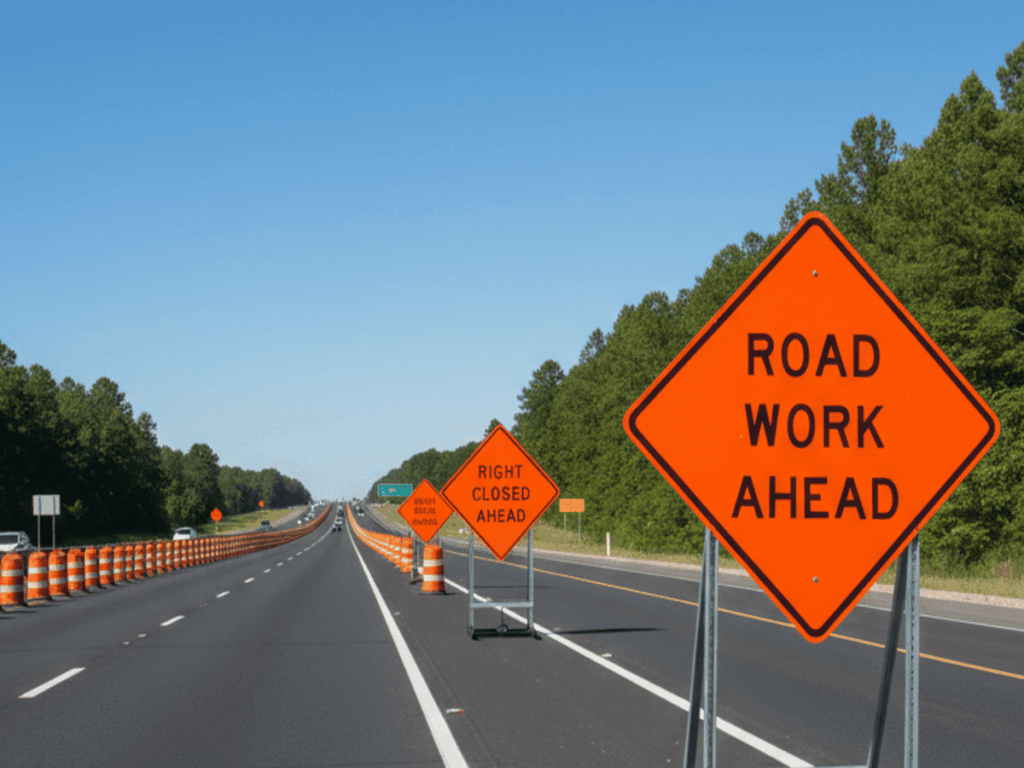
1. US Standard (MUTCD): The Orange Diamond
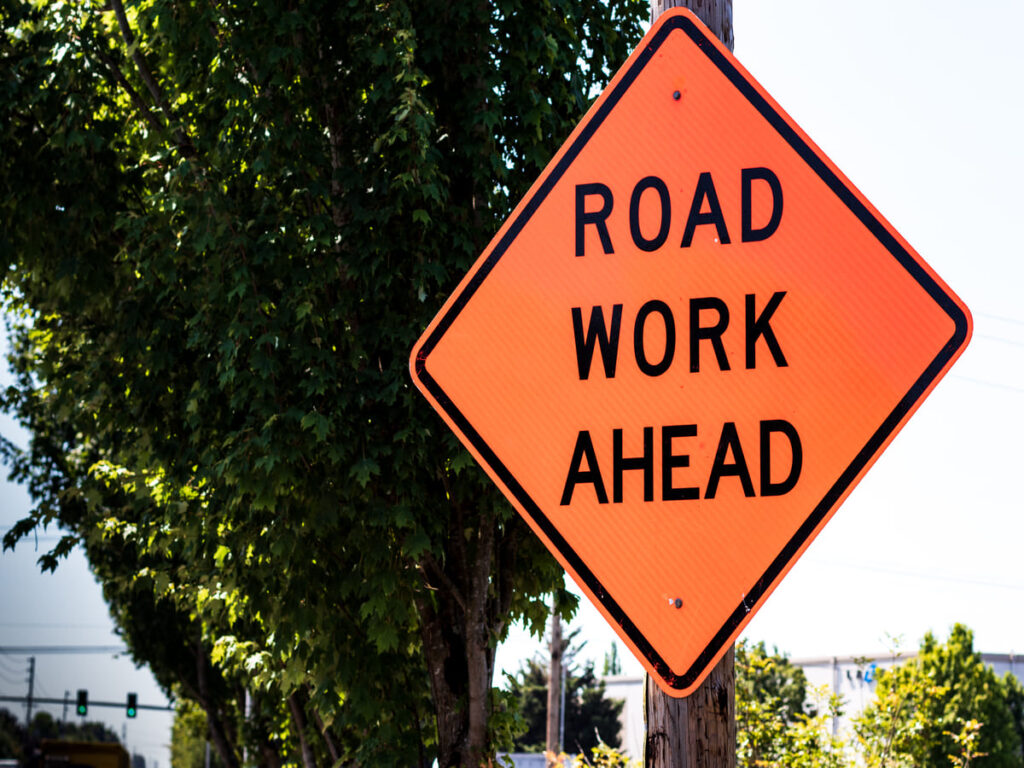
In the United States, construction road work signs are defined by high-visibility Fluorescent Orange.
- Shape: Diamond (Rhombus).
- Color: Orange background with black legends/symbols.
- Philosophy: Text is heavily used (e.g., “Road Work Ahead,” “Be Prepared to Stop”).
- Material: Must meet ASTM D4956 Type IV (High Intensity Prismatic) or Type XI (Diamond Grade) retroreflectivity.
For reflectivity and placement basics, see the full Road Work Ahead Sign Guide.
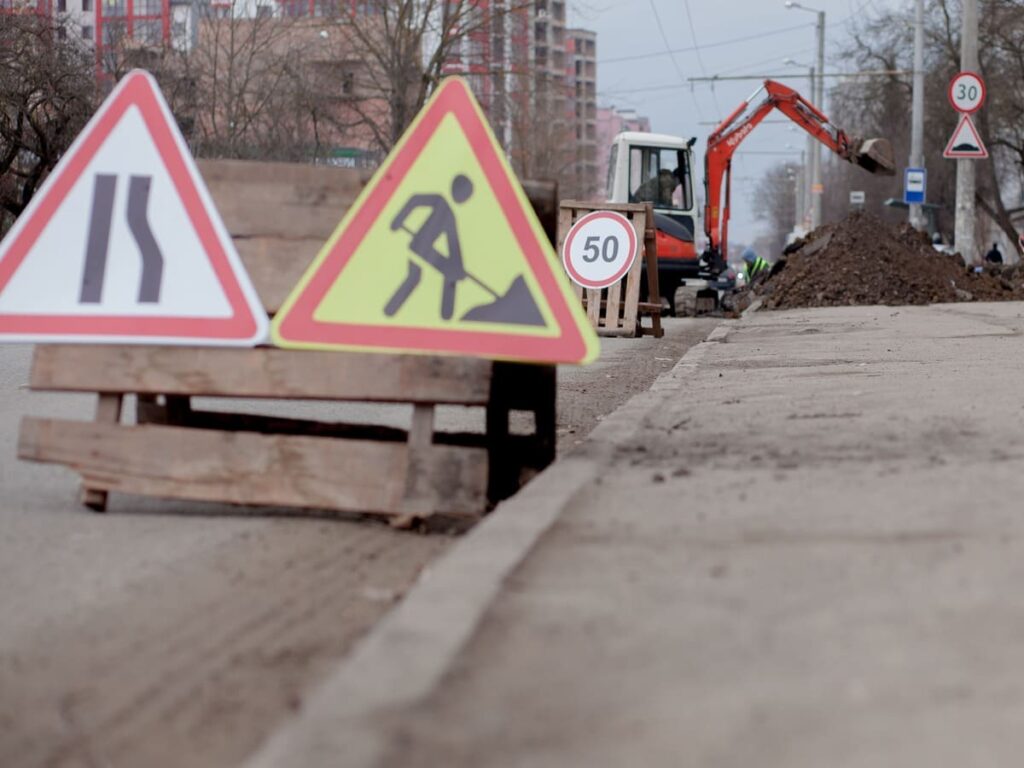
2. UK Standard (Chapter 8): The Red Triangle
In the United Kingdom, construction road work signs follow the European convention.
- Shape: Equilateral Triangle (point up).
- Color: White background with a broad Red Border and black symbols.
- Philosophy: Symbols are prioritized to overcome language barriers. Supplementary text plates (rectangular) are added below the triangle if needed.
- Material: Must meet BS EN 12899-1:2007 Class RA1 or RA2 standards.
Terminology on Construction Road Work Signs: “Work” vs. “Works”
One of the most confusing aspects of ordering construction road work signs is the terminology. The difference of a single letter—”s”—can render a sign non-compliant in its respective region.
1. US: Road Work Ahead (W20-1)
The primary construction road work sign in the US is the Road Work Ahead sign.
- Singular: The US uses “Work” (singular) to describe the condition of the roadway.
- Design: A text-only orange diamond.
- Usage: Placed 100 to 1,000 feet in advance of the workspace.
2. UK: Road Works Ahead (Diagram 7001)
The primary construction road work sign in the UK is the Road Works symbol.
- Plural: The UK uses “Works” (plural) to describe the engineering activities taking place.
- Design: A red triangle featuring a “Man Digging” symbol.
- Text Plate: Often accompanied by a rectangular yellow or white plate reading “Road Works” or “End of Road Works.”
Key Takeaway: If you search for construction road work signs with the text “Road Works Ahead” in the US, you are using British terminology. If you order “Road Work Ahead” for a UK site, it will be rejected by the safety inspector.
Navigational Road Work Signs: Detour vs. Diversion
When a road is closed, you must provide an alternative route. However, the construction road work signs used to guide traffic differ radically in color and logic between the US and the UK.
1. US Standard: Detour Signs
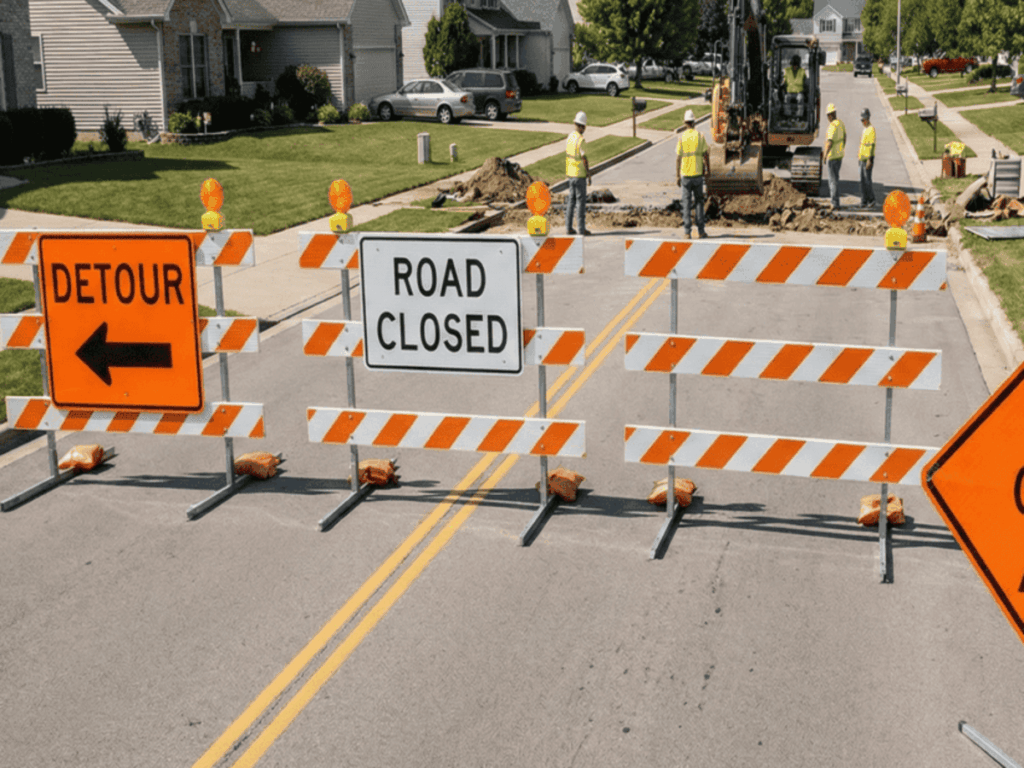
In the US, navigational construction road signs are almost exclusively text-based and color-coded Orange.
- The Term: “Detour”.
- Visuals: An orange rectangle with a black arrow and the word “DETOUR” (M4-9).
- Logic: Drivers follow a trail of text signs (e.g., “Detour Ahead,” “End Detour”).
- Hardware: These are often mounted on wood posts or temporary skids.
2. UK Standard: Diversion Signs (Geometric Symbols)
In the UK, the term is “Diversion,” and the system relies on Geometric Symbols rather than text to reduce visual clutter.
- The Term: “Diversion”.
- Visuals: A Yellow rectangular sign with a black symbol (Solid Circle, Hollow Diamond, Triangle, or Square).
- Logic: Instead of reading “Turn Left,” drivers are told to “Follow the Solid Circle.” This prevents confusion when multiple diversions overlap in a dense city like London.
- Compliance Trap: If you order orange construction road work signs for a UK diversion route, they will be rejected. You must use the specific yellow-backed symbol signs defined in Chapter 8.
Construction Traffic Control Signs: Flagger vs. Stop/Go
The signs warning of human traffic control are critical for worker safety. The terminology and the hardware for these construction road work signs are completely distinct.
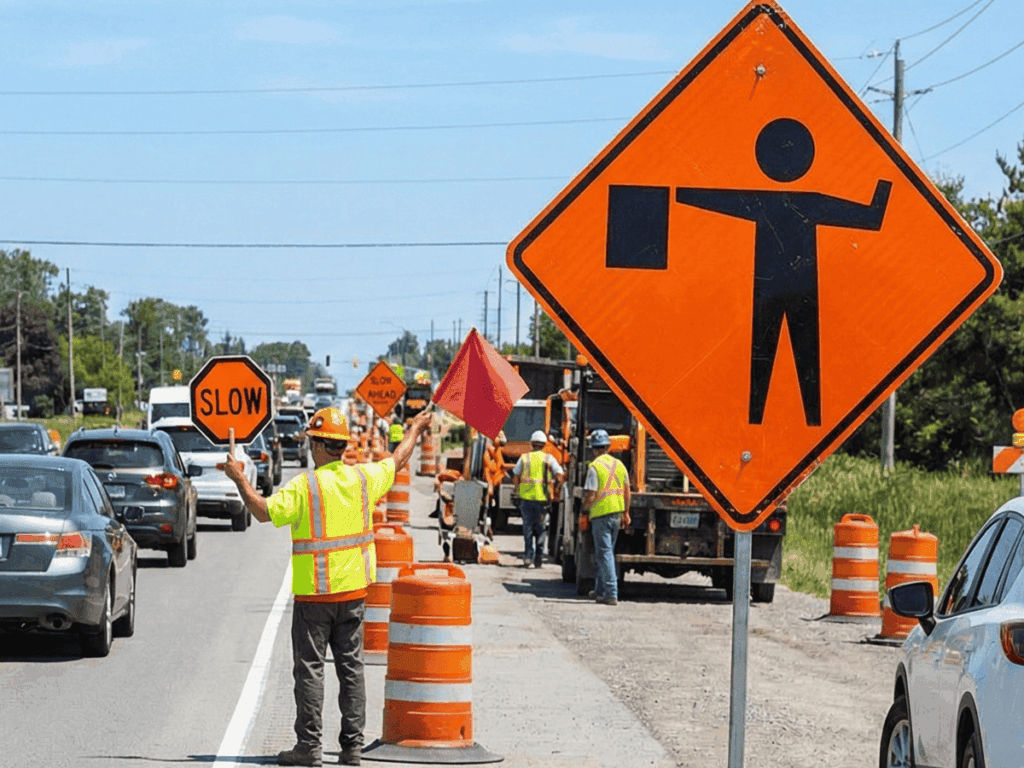
1. US Standard: Flagger Ahead
- The Sign: The Flagger Ahead sign is an orange diamond featuring a symbol of a person holding a flag or paddle.
- The Device: The human controller is called a “Flagger.” They use a Stop/Slow Paddle.
- Placement: The sign is placed in the “Advance Warning Area,” typically 500 feet before the flagger station.
2. UK Standard: Traffic Control Ahead (Diagram 7010.1)
- The Sign: The UK uses a red triangle with a “Man with Stop Sign” symbol. The supplementary plate reads “Traffic Control Ahead” or “Stop/Go Boards.”
- The Device: The human controller is often called a “Marshal” or “Operative.” They use a Stop/Go Board—a rotating disc on a pole (Green “Go” on one side, Red “Stop” on the other).
- The Difference: You cannot sell a US-style Stop/Slow paddle to a UK contractor; they require the rotating Stop/Go board mechanism.
Channelizing Devices for Construction Road Work Signs: Barricades vs. Cones
Beyond the warning signs themselves, the hardware used to physically block lanes differs significantly. If you try to sell US-style plastic drums to a UK site, they will be rejected.
1. US Standard: Type III Barricades & Drums
In the US, construction road work signs are often mounted on or accompanied by massive channelizing devices.
- The “Type III” Barricade: A large frame with three horizontal orange-and-white striped rails (8-12 feet wide). This is the standard for physically closing a road.
- Plastic Drums: The US heavily uses large, orange plastic drums (barrels) for highway tapers.
- Mounting: Construction road work signs (like “Road Closed”) are frequently bolted directly onto these Type III Barricades.
To understand why crews rely on Type III systems for visibility and lane control, read Why Contractors Choose Type III Barricades for Complex Construction Needs.
2. UK Standard: Traffic Cones & Cylinders
In the UK, the philosophy is “less bulk, more frequency.”
- The Traffic Cone: The UK relies almost exclusively on 750mm or 1000mm traffic cones with retroreflective sleeves (BS EN 13422).
- No Drums: You will rarely see US-style plastic drums. Instead, the UK uses narrow Traffic Cylinders (Delinators) for separating lanes in counter-flow systems.
- Barrier Fencing: For pedestrian safety, the UK uses continuous interlinked barrier fencing rather than standalone Type I or II barricades.
Termination: End of Road Work Signs
Every zone must have an end. However, the specific wording and color of the construction road work signs used to terminate the zone are distinct.
1. US Standard: End Road Work (G20-2)
- The Sign: A rectangular Orange sign with black text reading “END ROAD WORK.”
- Placement: Placed 500 feet past the end of the workspace.
- Function: It legally restores the speed limit and signals the end of the double-fines zone.
2. UK Standard: End of Road Works
- The Sign: A rectangular sign, but often with a White background (not yellow or orange) and black text reading “End of road works” (or just “End”).
- Supplementary Plate: It is often attached as a small plate below a “Road Clear” or “National Speed Limit Applies” sign.
- The “Road Works” Plural: Again, the UK strict adherence to the plural “Works” applies even at the end of the zone.
Conclusion: Global Sourcing for Construction Road Work Signs
Whether you are bidding on a highway project in California or a motorway maintenance contract in Manchester, the requirement is the same: absolute compliance.
Using non-compliant construction road work signs is not just a regulatory risk; it is a liability trap. A US-style orange diamond deployed in a UK diversion route could lead to site shutdowns, massive fines, and voided insurance policies in the event of an accident.
Optraffic is one of the few global manufacturers capable of producing construction road work signs to both standards simultaneously:
- For North America: We supply MUTCD-compliant fluorescent orange diamond signs.
- For UK/Europe: We supply Chapter 8-compliant red triangle signs, quick-fit frames, and BS EN 12899 reflective materials.
FAQ: Common Questions on Road Work Signs
No. They reference different industrial standards.
US (MUTCD): Requires ASTM D4956 standards. Most construction road work signs on highways must use Type IV (High Intensity Prismatic) or Type XI (Diamond Grade) sheeting.
UK (Chapter 8): Requires BS EN 12899-1 standards. The equivalent classes are Class RA1 (Engineering Grade) for low-speed roads and Class RA2 (High Intensity) for high-speed motorways. You cannot mix these certifications.
This is the biggest visual difference besides color.
US: Construction speed limits are Rectangular signs with a white background and black text (e.g., “WORK ZONE SPEED LIMIT 45”).
UK: Mandatory speed limits are Circular signs (Roundels) with a white background and a Red Border (e.g., a number “30” inside a red circle). A rectangular sign in the UK is for information only, not enforcement.
US: The bottom of the sign must be 1 foot (rural) or 7 feet (urban) above the ground to clear pedestrians.
UK: Signs are typically mounted on “A-frames” or “Quick-fit frames” closer to the ground (450mm clearance), but must ensure they do not obstruct pedestrian “footways” (sidewalks).
Generally, no.
US: Uses Type A/B Flashing Warning Lights (Yellow) attached to construction road work signs.
UK: Uses Road Works Lamps (steady amber) for delineation. Flashing lights are reserved for specific hazards or lead-in tapers.