Unmanaged vehicle access costs commercial property owners more than they calculate. Blocked loading docks delay freight. Occupied fire lanes trigger municipal fines and unsafe emergency responses. Contested towing events without proper sign documentation result in wrongful-towing lawsuits that property owners lose.
The foundation of every defensible enforcement program is a properly specified no-parking zone sign. Not a generic printed placard—a MUTCD-compliant, retroreflective, statutorily complete enforcement instrument. This guide gives commercial facility managers, logistics directors, and corporate property executives the technical, legal, and operational framework to build that program in 2026.
Why Parking Enforcement Is a Liability Issue, Not a Convenience Issue
Commercial properties face compounding risks when parking zones go unenforced. The National Safety Council reported in 2024 that parking lot incidents account for roughly 60,000 injuries annually in the United States, many involving pedestrian-vehicle conflicts in poorly marked zones. (Source: https://www.nsc.org/road/safety-topics/parking-lot-safety)
Premises liability law holds property owners to a duty-of-care standard for foreseeable hazards. An absent or non-compliant no parking area sign in a fire lane or loading corridor creates exactly the foreseeable hazard that courts use to establish negligence. Insurance underwriters increasingly review parking sign compliance during commercial general liability (CGL) policy renewals, and sign deficiencies directly affect premium classifications.
Facility managers who treat parking enforcement as an administrative function miss the risk-management dimension entirely. Every unenforceable no parking zone sign is a documented liability gap.
MUTCD R7-Series: The Federal Specification Every Facility Manager Must Know
The Manual on Uniform Traffic Control Devices (MUTCD), maintained by the Federal Highway Administration, governs no parking sign specifications on all roads open to public travel—including private commercial roads accessible to the public. The R7-series covers no parking, no standing, and tow-away zone signs.
The core variants facility managers deploy most frequently are:
| Sign Variant | Designation | Primary Use Case |
| No Parking Any Time | R7-1 | Open lots, corporate campuses, driveway corridors |
| No Parking – Tow-Away Zone | R7-200 | Active enforcement zones with towing authority |
| No Parking – Loading Zone | R7-series + time panel | Dock approach lanes, freight staging corridors |
| No Parking in Driveway | R7-1 variant | Private access gates, yard entry points |
Source: FHWA MUTCD 2023 Edition, Section 2B
Retroreflectivity and Nocturnal Visibility: The Standard That Determines Towing Legality After Dark
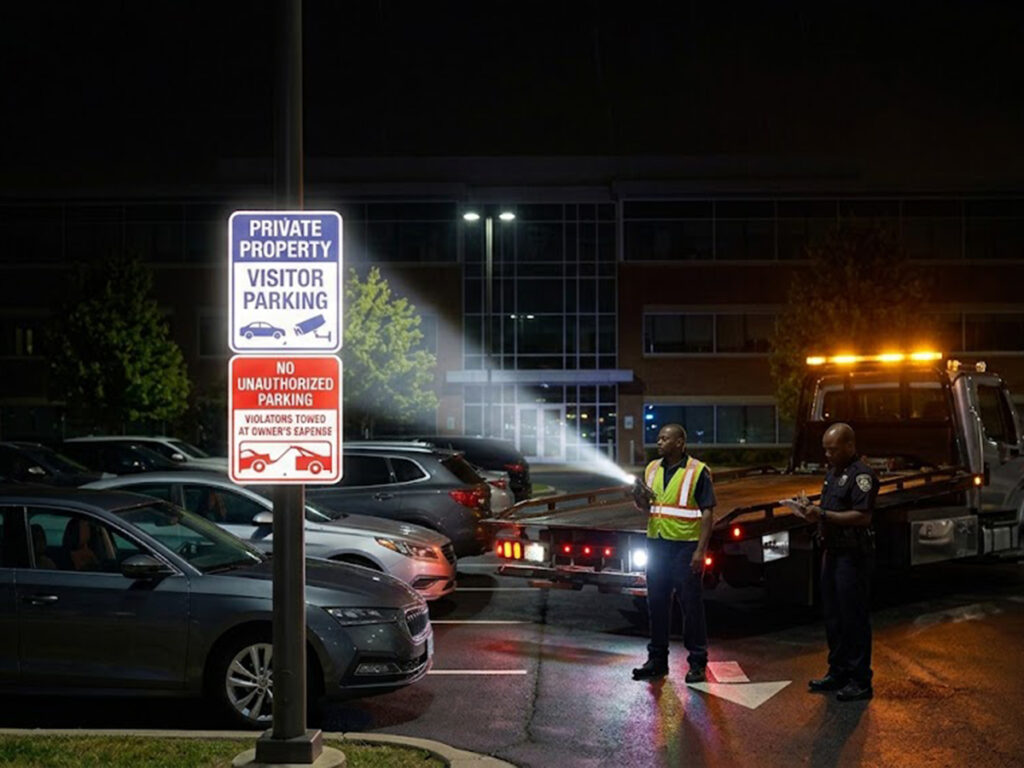
Retroreflective sheeting grade is not a procurement preference—it is a legal threshold. Courts in multiple states have ruled against property owners in contested towing cases specifically because nighttime sign visibility could not be established. The evidentiary requirement is documented retroreflectivity, not visual impressions.
ASTM D4956 classifies retroreflective sheeting into Types I through XI. For commercial parking enforcement, the operative comparison is:
| Sheeting Type | Min. Coefficient (cd/lux/m²) | Enforcement Application |
| Type I – Engineer Grade | ≥70 at 0.2° obs. angle | Minimum MUTCD standard; adequate for low-speed private lots |
| Type III – High Intensity | ≥180 at 0.2° obs. angle | Standard for 25–45 mph zones; recommended baseline |
| Type IV – High-Intensity Prismatic | ≥250 at 0.2° obs. angle | Recommended for 24-hour towing enforcement zones |
| Type IX – Diamond Grade | ≥300 at 0.2° obs. angle | High-speed ingress roads, large industrial campuses |
Source: ASTM D4956-23a Standard Specification for Retroreflective Sheeting
Type IV High-Intensity Prismatic sheeting is the defensible minimum for any no parking zone sign in a 24-hour commercial towing enforcement program. Facilities that cannot produce retroreflectivity field measurement records when challenged in court face a near-impossible evidentiary position.
To translate this into an operational execution matrix, the FHWA’s Maintaining Traffic Sign Retroreflectivity Guide (Report No. FHWA-SA-12-027), when paired with the statutory mandates of MUTCD 11th Edition (2023), Section 2A.22, establishes that hand-held retroreflectometer field measurements form the primary defensive protocol over arbitrary age-based schedules.
Building Legal Towing Authority: Statutory Disclosures on the No Parking Zone Sign Assembly
A no parking anytime sign that lacks specific statutory disclosure language cannot authorize towing in most U.S. jurisdictions. Private property towing rights are governed by state statute, and as of 2026, 41 states have enacted statutory mandates defining explicit signage text as an absolute prerequisite to legal non-consensual vehicle removal. (For facility managers, this necessitates a localized statutory text matrix across all cross-border regional portfolios).
According to California Vehicle Code § 22658(a)(1) (2026 Edition), signs measuring at least 17 by 22 inches must be posted at each entrance to the property. While state law mandates entrance posting, local municipal codes across various California jurisdictions frequently overlay a continuous enforcement variance requiring internal spacing not exceeding 35 feet within parking structures.
Texas Occupations Code § 2308.251 through § 2308.253 (Subchapter G) rigidifies the exact layout, color contrast, and mandatory ‘TOWING ENFORCED’ text required for the sign matrix. Additionally, to survive a legal challenge under § 2308.255, the owner’s designated towing operator must strictly coordinate with local law enforcement within 30 minutes of vehicle removal.
The most operationally efficient solution is a composite sign assembly: an R7-200 header panel paired with a subordinate disclosure panel carrying all mandatory statutory text. This consolidates the enforcement architecture into a single installation and eliminates the documentation gaps that arise from separate placard clusters.
Traffic Flow Psychology: How Sign Positioning Changes Driver Behavior Before Enforcement Is Needed
The most cost-effective parking enforcement program is the one that prevents violations rather than responding to them. Research in environmental psychology and wayfinding design demonstrates that sign placement, color contrast, and spatial sequencing trigger driver decisions before a vehicle fully enters a restricted zone.
The 3-Sign Cascade Protocol applies this research to commercial facility entrances. It positions enforcement cues at three decision points:
- Advance Warning Sign — placed at the last safe turning point (150–300 feet from the restriction), priming the driver for the upcoming constraint
- Transition Sign — positioned at the entry throat, confirming the restriction and reinforcing the compliance expectation
- Boundary Confirmation Sign — mounted at the physical restriction start, functioning as the legally operative no parking zone sign
This sequence reduces the cognitive load on drivers unfamiliar with the facility and creates documented advance notice—which strengthens the property owner’s position in any towing dispute. Facilities that deploy only boundary signs record significantly higher violation rates than those using a cascade approach.
Color contrast optimization further amplifies compliance. The standard MUTCD R7-series black-on-white scheme meets minimum legibility thresholds. Adding a red border (MUTCD-permitted as an enhancement) increases conspicuity by approximately 40% in high-clutter visual environments, according to FHWA sign legibility research.
Stall Allocation Ratios for Industrial Docks, Loading Zones, and Corporate Visitor Lanes
Every no parking zone sign system operates within a stall allocation architecture. Without defined allocation ratios, enforcement creates conflicts between vehicle classes competing for the same surface area.
The Institute of Transportation Engineers (ITE) Parking Generation Manual, 5th Edition, provides the foundational generation rates for commercial and industrial uses. Key benchmarks for facility managers:
| Facility Type | ITE Vehicle Generation Rate | Recommended No Parking Zone Buffer |
| Distribution Center / Warehouse | 0.38 vehicles/1,000 sf (peak) | 30 ft clear zone per dock door; full apron prohibited |
| Corporate Office Campus | 2.84 vehicles/1,000 sf (peak) | 15 ft fire lane clear; visitor lane 2-hr limit zones |
| Industrial Manufacturing | 1.10 vehicles/1,000 sf (peak) | 25 ft dock approach; forklift egress zones signed |
| Multi-Tenant Retail / Mixed-Use | 3.76 vehicles/1,000 sf (peak) | Loading court signed separately from retail lot |
Source: ITE Parking Generation Manual, 5th Edition
A no parking loading zone sign matrix for a multi-dock industrial facility must specify time-of-day enforcement windows, vehicle class restrictions (prohibiting passenger vehicles in Class 6–8 freight lanes), and queue zone boundaries. Embedding these specifications directly into the sign text—via MUTCD-compliant time panel additions—eliminates the ambiguity that generates tenant and operator disputes.
ADA accessible route adjacency creates a mandatory no parking zone sign obligation at every accessible stall perimeter. ADA Standards for Accessible Design (2010, Section 502.3) require that access aisles be marked and physically enforced. Failure to post and enforce these zones exposes the property owner to DOJ Title III enforcement action.
Fire Lane Enforcement: Life Safety Compliance Integrated Into the No Parking Sign Matrix
Fire lane no parking enforcement sits at the intersection of parking management and life safety code compliance. NFPA 1 Chapter 18 and IFC Section 503.3 require that fire apparatus access roads carry approved no parking designations—enforced by posted signs, painted curbs, or both.
The fire lane no parking zone sign specification exceeds standard R7-series requirements in several dimensions:
- Minimum 12-inch uppercase legend height
- Text: ‘FIRE LANE—NO PARKING—TOW AWAY ZONE’ (exact phrasing varies by Authority Having Jurisdiction)
- Red reflective background or border in many jurisdictions
- While IFC Section 503.3 (2024 Edition) mandates that roads be identified with approved signs, local Authorities Having Jurisdiction (AHJs) frequently enforce a structural variance standard: posting intervals not to exceed 50 linear feet, coupled with a minimum 12-inch uppercase legend height.
- Minimum retroreflectivity: Type III or Type IV sheeting required for 24-hour enforcement
Local fire marshals enforce fire lane sign compliance during annual occupancy inspections. Non-compliant signage triggers occupancy certificate holds and municipal fines—separate from any towing liability exposure. Fire lane sign deficiencies account for a disproportionate share of occupancy renewal failures in distribution and manufacturing facilities.
Active logistics environments face the highest compliance pressure: fire lanes must stay clear during peak delivery operations when staging pressure is greatest. Facilities that pre-brief delivery personnel with site fire lane maps and display no parking anytime sign assemblies at dock entry points see measurably lower violation rates during peak periods.
Eplore more on Clearing the Emergency Corridor: How to Deploy Fire Lane No Parking Signs for Facility Safety.
Signage Lifecycle Auditing: Maintaining Continuous Legal Enforceability
A no parking zone sign that passed inspection at installation may fail enforcement standards 18 months later. Retroreflectivity degrades through UV exposure, physical impact, and surface abrasion. Color shift can render the sign non-compliant before visible damage appears.
The FHWA recommends a minimum-retroreflectivity management program for all agencies and large facility operators. The core annual audit protocol covers three assessment layers:
- Retroreflectivity Field Measurement — hand-held retroreflectometer readings compared against ASTM D4956 minimum thresholds for the installed sheeting type; readings below threshold trigger immediate replacement
- Damage Classification Assessment — each sign graded against a four-tier matrix from Class I (cosmetic only) to Class IV (structural failure, immediate replacement); Class III (retroreflectivity failure) voids nocturnal towing authority
- Compliance Documentation Log — GPS-tagged installation photos, retroreflectometer readings, damage classifications, and replacement records compiled into a chain-of-evidence file for insurance and litigation purposes
Facilities that cannot produce documented audit records when challenged in a towing dispute face a significantly weakened evidentiary position. The documentation log is not administrative overhead—it is the property owner’s primary defense exhibit.
Annual audit cycles aligned with insurance renewal periods maximize the compliance evidence available at the moment it is most likely to be requested.
Driveway Access Control: Deploying a No Parking in Driveway Sign as an Enforcement Instrument
Commercial driveway and yard access points require a distinct enforcement configuration. A no parking in driveway sign that lacks statutory authority text functions as advisory signage only—it cannot authorize towing under most state private property towing statutes.
Conversely, a correctly specified no parking driveway sign—carrying R7-200-compliant tow-away disclosure text, posted within the property boundary, and documented in the facility’s enforcement record—creates full towing authority at the access point. The distinction in sign text between these two outcomes is minor. The distinction in legal consequence is substantial.
Industrial campuses with five or more access points benefit from a coordinated multi-point sign matrix: consistent sign specifications across all entries, maintenance tagging on each sign for annual audit tracking, and a recorded enforcement boundary map that documents the sign program’s geographic scope. This level of documentation is increasingly expected by insurance underwriters managing large commercial property portfolios.
Dive Deep: Securing Commercial Driveways: Heavy-Duty No Parking Signage for Asset Protection
Building a Future-Proof Commercial Parking Sign Program: Implementation Roadmap and Strategic Resources
A Four-Phase Roadmap for Defensible Parking Enforcement
A defensible commercial parking enforcement program requires four sequential development phases:
- Phase 1: Audit existing signs against MUTCD R7-series standards and applicable state towing statutes.
- Phase 2: Remediate non-compliant signs in active towing zones and fire lanes as the highest-liability priority.
- Phase 3: Complete the zone-design sign matrix across loading docks, driveway access points, visitor lanes, and ADA adjacency zones.
- Phase 4: Implement the annual lifecycle audit and documentation protocol that maintains continuous enforceability.
Each phase generates compliance evidence that strengthens the property’s insurance position and litigation readiness. Facility managers who execute all four phases operate within a closed-loop enforcement system—one where no parking zone sign deployment, legal authority, and documented maintenance form a single defensible asset.
Stakeholder Alignment and Multi-Jurisdictional Strategy
Cross-functional stakeholder alignment accelerates program approval. The facility manager’s role is to translate sign compliance into three distinct corporate languages simultaneously:
- Legal Teams: Respond to liability exposure data.
- Insurance Teams: Respond to premium reduction projections.
- Operations Teams: Respond to freight throughput and emergency access metrics.
For organizations building or expanding their no parking sign compliance framework across multiple jurisdictions, a comprehensive understanding of MUTCD regulatory pathways, multi-state variance management, and the full commercial sign product selection matrix provides the upstream regulatory context that every facility-level program requires.
References
- National Safety Council – Parking Lot Safety
- FHWA MUTCD 2023 Edition, Part 2B – Regulatory Signs
- ASTM D4956-23a – Standard Specification for Retroreflective Sheeting
- FHWA Retroreflectivity Management Guidance (FHWA-SA-12-027)
- ITE Parking Generation Manual, 5th Edition
- NFPA 1 Fire Code, Chapter 18 – Fire Apparatus Access Roads