Aluminum sign blanks form the foundation of nearly every traffic, highway, and wayfinding sign installed across the United States. Procurement teams, sign fabricators, and DOT contractors specify them by the millions each year. Yet the technical decisions behind each blank carry serious safety and financial consequences.
The stakes have grown sharply in 2026. The Federal Highway Administration published the 11th Edition of the MUTCD in December 2023. States now face a January 18, 2026, adoption deadline under 23 CFR Part 655. Procurement officers across all 50 states are auditing inventory and rewriting bid specifications.
This guide gives B2B buyers, fabricators, and distributors a practical reference on aluminum sign blanks. It covers thickness selection, alloy choice between 5052-H38 and 6061-T6, ASTM B209 and ASTM D4956 compliance, MUTCD requirements, custom fabrication options, and wholesale procurement. The goal is straightforward: help your team specify the right product, vet suppliers efficiently, and avoid the costly mistakes that surface six months after installation.
What Are Aluminum Sign Blanks? A B2B Definition
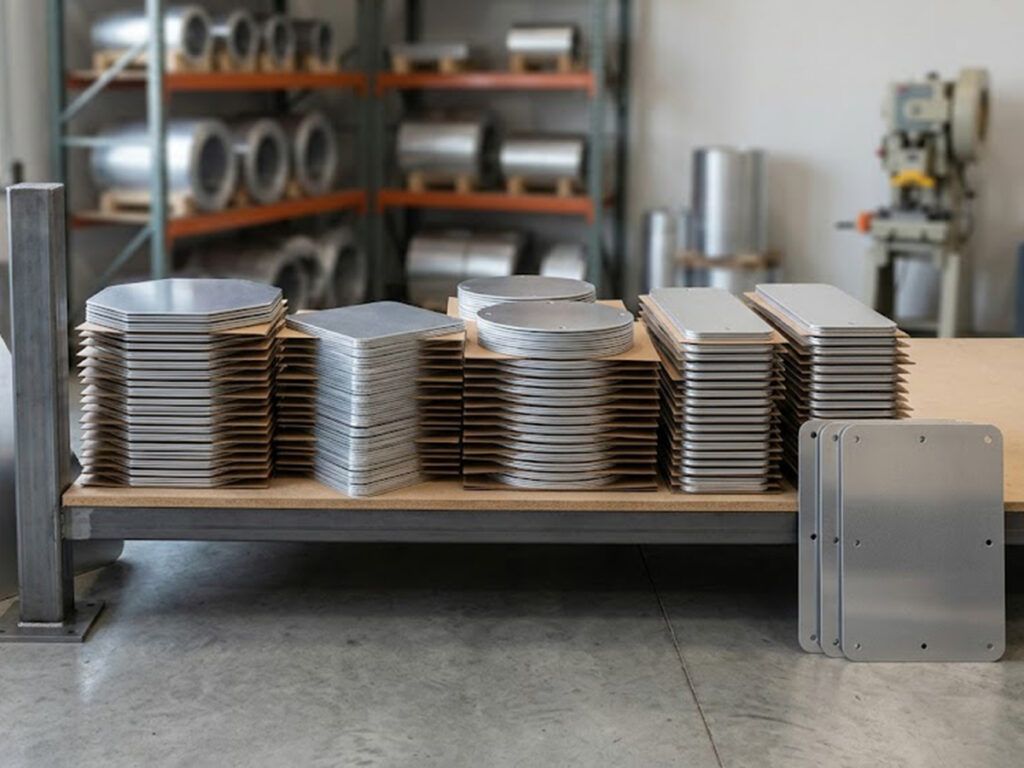
These are flat aluminum substrates manufactured to industry specifications and supplied to sign fabricators, distributors, and DOT contractors. Each blank receives reflective sheeting, graphics, and mounting hardware downstream to become a finished traffic sign.
Three properties make aluminum the dominant substrate in the traffic signage supply chain:
- Corrosion resistance — aluminum forms a protective oxide layer that resists rust without painting or coating.
- Strength-to-weight ratio — it carries highway-grade wind loads at a fraction of steel’s weight.
- Recyclability — it supports closed-loop manufacturing aligned with green procurement policies.
These properties explain why DOT specifications across all 50 states default to aluminum for permanent sign installations.
Aluminum Sign Blank Specifications: Thickness, Gauge & Dimensions
Thickness is the first specification any procurement officer must lock in. The U.S. industry uses decimal-inch gauges, and four thicknesses cover roughly 95% of traffic signage applications.
| Thickness | Common Use | Typical Size Range |
| 0.040″ | Small parking and regulatory signs | Up to 18″ × 18″ |
| 0.063″ | Standard regulatory and warning signs | 18″ × 24″ to 24″ × 30″ |
| 0.080″ | Highway-grade and MUTCD work zones | 24″ × 30″ to 48″ × 48″ |
| 0.125″ | Large guide signs and overhead panels | 48″ × 48″ and above |
Source: Federal Highway Administration, Manual on Uniform Traffic Control Devices, 11th Edition.
It provides adequate stiffness against wind-induced flutter on signs up to 48″ × 48″, while remaining cost-efficient for high-volume rental fleets. Corner radius matters as much as thickness; specifically, optimized thickness and corner radius configurations for wind load resistance reduce stress concentration and prevent cracking under repeated environmental stress.
Aluminum Alloy Selection: 5052-H38 vs 6061-T6 for Sign Blanks
The North American traffic signage industry standardizes on alloy 5052 in temper H38. ASTM B209 governs both the chemistry and the mechanical properties of this alloy. [2] Sign-grade aluminum sheet in 5052-H38 delivers three measurable advantages:
- High formability for corner punching and edge trimming
- Excellent corrosion resistance in marine and de-icing environments
- Smooth, defect-free surface that bonds reliably with retroreflective sheeting
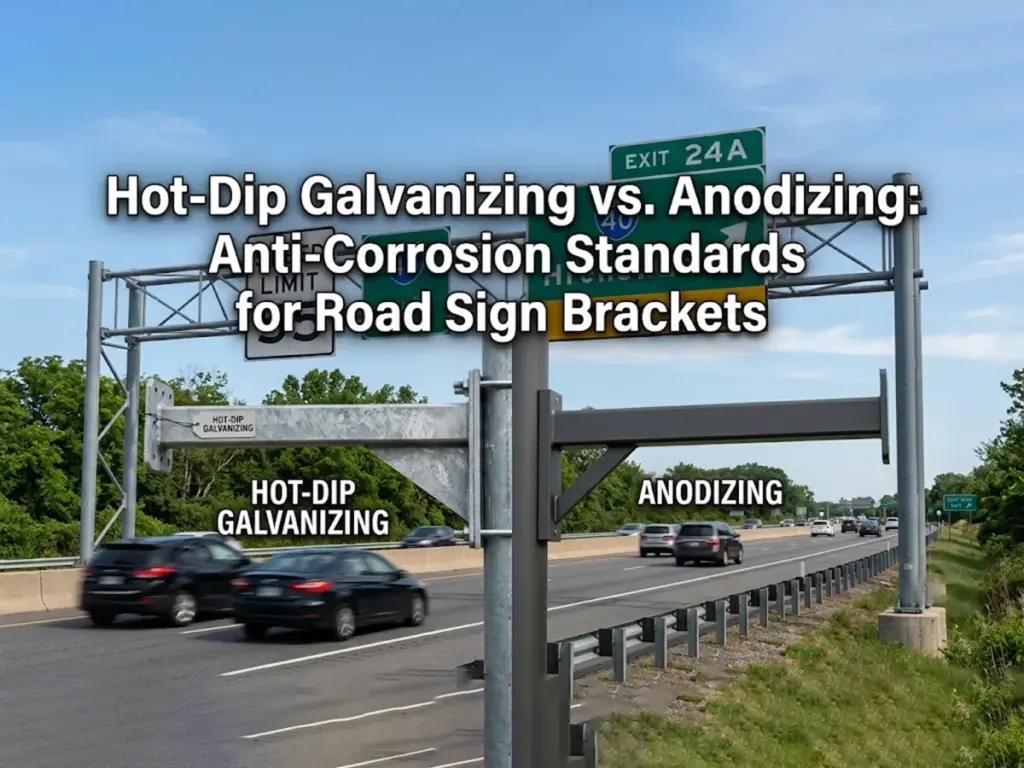
6061-T6 occupies a different niche. It offers higher tensile strength but lower formability, and it requires post-fabrication anodizing to match 5052’s corrosion performance. Most sign blank manufacturers specify 6061-T6 only for structural panels, post brackets, or signs subject to repeated mechanical stress.
When deciding between these materials, our comprehensive technical analysis of 5052-H38 vs. 6061-T6 aluminum alloy for sign blanks provides a side-by-side breakdown of mechanical properties and application suitability.
| Property | 5052-H38 | 6061-T6 |
| Tensile strength (min) | 39 ksi (270 MPa) | 42 ksi (290 MPa) |
| Yield strength (min) | 32 ksi (220 MPa) | 35 ksi (240 MPa) |
| Elongation | 0.04 | 0.08 |
| Corrosion resistance | Excellent | Good (treatment required) |
| Formability | Excellent | Moderate |
| Typical sign use | Standard traffic signs | Structural / overhead |
ASTM, MUTCD & AASHTO Standards Governing Aluminum Sign Blanks
Three standards bodies define the regulatory framework for aluminum sign blanks in U.S. traffic applications.
ASTM B209 — The Material Specification
ASTM B209 sets the chemical composition, tensile strength, yield strength, and elongation requirements for sheet and plate. Every U.S. mill that produces sign-grade aluminum certifies its product to B209. Procurement specifications should require mill certification on every shipment.
MUTCD 11th Edition — The Compliance Mandate
The MUTCD governs sign dimensions, retroreflectivity, and placement. The FHWA published the 11th Edition on December 19, 2023, with a federal effective date of January 18, 2024 (Source: https://catsip.berkeley.edu/news/new-release-11th-edition-mutcd-now-available). States must conform by January 18, 2026, under 23 CFR Part 655. Federally funded work zones already operate under the new edition.
ASTM D4956 & AASHTO M268 — Retroreflective Sheeting
ASTM D4956 classifies retroreflective sheeting into Types I through XI, ranging from Engineer Grade beaded sheeting to Diamond Grade microprismatic. Type III is the practical floor for most regulatory applications. Type IX or Type XI typically serve overhead and high-speed roadway signs. AASHTO M268 offers a performance-based parallel specification used by many state DOTs alongside D4956.
Tip for procurement: always request mill certifications, sheeting compatibility statements, and lot traceability documents. These records protect both your agency and the supplier when questions arise about field performance.
For a technical breakdown of what these quality markers mean for regulatory approval, refer to our guide on ASTM B206 and its role in defining sign blank quality for MUTCD.
Surface Finish, Pre-Treatment & Custom Fabrication Options
Each blank ships with one of three surface finishes:
- Mill finish — bare aluminum, suitable when reflective sheeting will cover the full face
- Chemical pretreatment (alodine or conversion coating) — improves adhesion of inks, paints, and sheeting
- Anodized — anodic oxide layer for premium architectural or wayfinding applications
For high-volume traffic projects, chemical pretreatment is the dominant choice. It passivates the surface and dramatically improves the bond with ASTM D4956 sheeting. Integrating pre-treatment and custom drilling during the initial manufacturing phase ensures the substrate is optimized for maximum sheeting adhesion and long-term durability.
Custom fabrication options vary by manufacturer, but typically include:
- Pre-drilled mounting holes (5/16″ or 3/8″ diameters, 1″ or 1-1/2″ from edge)
- Custom corner radius (3/8″, 1/2″, 1-1/2″)
- Non-standard sizes for legacy or international projects
- Edge deburring and chamfering for safer handling
Custom aluminum sign blanks that arrive pre-drilled and pre-treated reduce fabrication labor by an estimated 20-30% versus blank stock requiring secondary processing — a meaningful efficiency gain for high-volume B2B operations.
Wholesale Aluminum Sign Blanks: Procurement, MOQ & Lead Times
Wholesale procurement of aluminum sign blanks differs significantly from retail buying. Distributors and large fabricators face MOQ thresholds, tiered pricing, lead-time commitments, and logistics constraints that one-off buyers never encounter.
Typical wholesale procurement variables
- MOQ (Minimum Order Quantity): 500 to 2,000 pieces per SKU is common; alloy and thickness combinations may carry separate minimums.
- Tiered pricing: Volume breaks usually trigger at 1,000, 5,000, and 10,000 pieces.
- Lead time: 2-4 weeks for stocked specifications, 6-10 weeks for custom orders.
- Logistics: Pallet quantities, container shipping, and direct-to-jobsite delivery options.
Supplier vetting checklist for B2B buyers
- ISO 9001 certification or equivalent quality system
- Mill certification on each shipment
- ASTM B209 and ASTM B449 compliance documentation
- References from state DOT or federal contractors
- In-house pretreatment and finishing capability
- Production capacity to meet your peak seasonal demand
The 2026 MUTCD adoption deadline has tightened lead times across the industry. Procurement teams that locked in 2026 contracts during Q4 2025 reported average lead times 30-40% shorter than spot orders placed in early 2026.
Quality Control & Inspection of Aluminum Sign Blanks
A consistent inbound inspection protocol catches defective aluminum sign blanks before they enter your fabrication line. The cost of catching a defect at receiving is measured in cents; the cost of catching it after sheeting application can run hundreds of dollars per unit.
Inspection checklist for incoming aluminum sign blanks:
- Dimensional accuracy (length, width, thickness within tolerance)
- Surface defects (pitting, scratches, white rust, oil contamination)
- Edge quality (no burrs, clean shear, square corners)
- Bow and twist (flatness within ±0.030″ per linear foot)
- Hole pattern accuracy (if pre-drilled)
- Mill certification cross-reference against the purchase order
Industrial buyers running high-volume work zone programs face real consequences when blanks fail in the field. The National Work Zone Safety Information Clearinghouse recorded an estimated 101,000+ work zone crashes in 2023, resulting in over 40,000 injuries (Source: https://workzonesafety.org/work-zone-data/). A non-compliant or degraded sign in those conditions exposes contractors to both liability and federal funding clawbacks.
Conclusion: Specifying Aluminum Sign Blanks for Long-Term Performance
Aluminum sign blanks sit at the intersection of materials science, regulatory compliance, and B2B procurement strategy. Buyers who treat them as a strategic specification — not a commodity purchase — capture real competitive advantage. They lock in MUTCD compliance ahead of the January 2026 deadline. They reduce fabrication waste through proper alloy and pretreatment selection. They build supplier relationships that survive the next decade of standards revisions.
Whether you are a fabricator scaling production, a distributor managing inventory turns, or a contractor sourcing for federally funded work zones, the right aluminum sign blanks specification protects both your project performance and your bottom line.
Ready to source compliant aluminum sign blanks for your next project? Contact our B2B specification team for a wholesale quote and material certifications.
Frequently Asked Questions About Aluminum Sign Blanks
What gauge of blank is best for highway use?
0.080″ gauge is the U.S. standard for highway-grade traffic signs up to 48″ × 48″. Larger overhead panels typically require 0.100″ or 0.125″.
Are aluminum sign blanks rust-proof?
They are corrosion-resistant, not rust-proof. Aluminum can develop “white rust” (hydroxide oxidation) under prolonged moisture exposure. Chemical pretreatment and proper storage prevent this.
What is the difference between ASTM B209 and ASTM B449?
B209 covers the aluminum sheet itself. B449 covers the chemical pretreatment (chromate or non-chromate conversion coating) applied to that sheet for sign and decorative use.
How long do aluminum sign blanks last in service?
Properly specified and installed, the substrate itself can exceed 15 years. Reflective sheeting typically degrades first. Most agencies plan replacement around the sheeting warranty (7-12 years, depending on type).
Can aluminum sign blanks be recycled at the end of life?
Yes. Aluminum is infinitely recyclable. End-of-life sign blanks recover near-virgin scrap value, supporting circular procurement programs.
References
Federal Highway Administration. Manual on Uniform Traffic Control Devices (MUTCD), 11th Edition. U.S. Department of Transportation. https://mutcd.fhwa.dot.gov/
California Active Transportation Safety Information Pages (UC Berkeley). New Release: 11th Edition of the MUTCD Now Available, December 20, 2023. https://catsip.berkeley.edu/news/new-release-11th-edition-mutcd-now-available
Federal Highway Administration. Nighttime Visibility — Sign Retroreflectivity Frequently Asked Questions. https://highways.dot.gov/safety/other/visibility/nighttime-visibility-sign-retroreflectivity-frequently-asked-questions
National Work Zone Safety Information Clearinghouse. Work Zone Data, NHTSA FARS 2023 Annual Report File. https://workzonesafety.org/work-zone-data/
National Highway Traffic Safety Administration. Traffic Fatalities Decreased in the First Quarter of 2025, July 2025. https://www.nhtsa.gov/press-releases/traffic-fatalities-decreased-first-quarter-2025