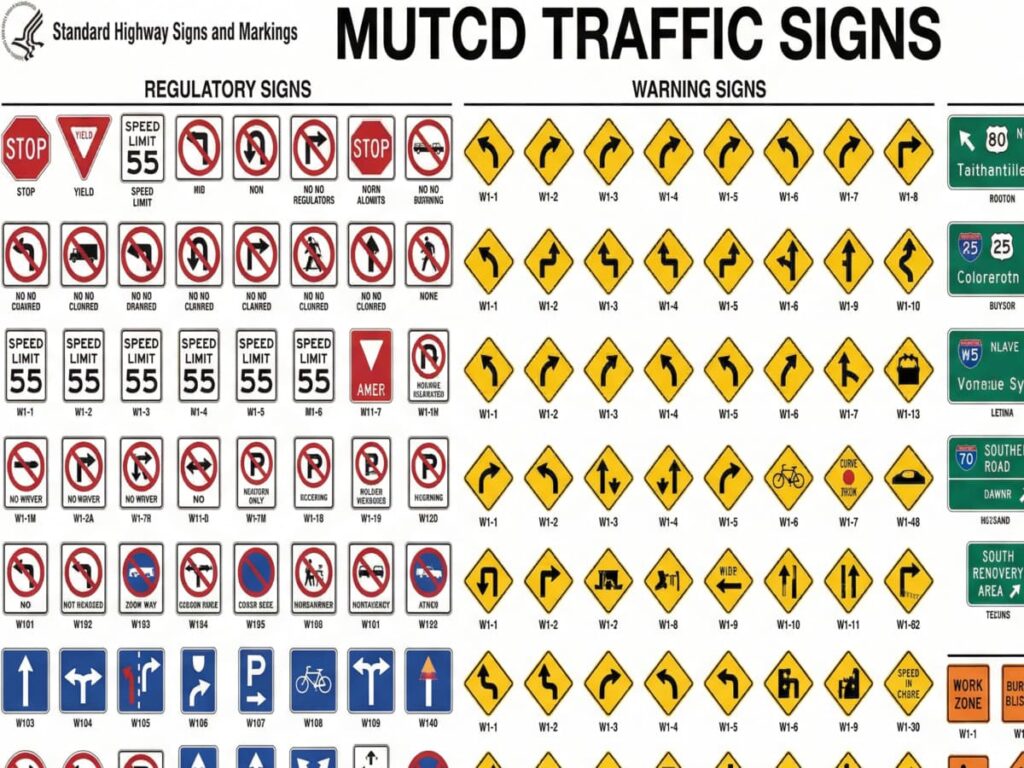
MUTCD traffic signs — the standardized devices defined by the Manual on Uniform Traffic Control Devices — govern every work zone your rental fleet supports. On December 19, 2023, the FHWA published the 11th Edition as a Final Rule in the Federal Register, setting an effective date of January 18, 2024. As a result, states must bring their own standards into substantial conformance with the 11th Edition by January 18, 2026 under 23 CFR Part 655.
For traffic sign rental companies, these dates carry direct commercial weight. Contractors and municipalities are already writing 11th Edition compliance into rental bid requirements, and federally funded work zones have operated under the new standard since early 2024. In other words, if your fleet inventory still reflects 10th Edition-era specifications, you are already behind on federally funded projects.
This guide explains exactly what changed in MUTCD signs, how those changes affect rental fleet decisions, and what steps you need to take to maintain compliance — with specific section references throughout.
What Changed in MUTCD Signs: 11th Edition vs. 10th Edition
Before diving into fleet implications, it helps to understand the scope of the update. The 11th Edition supersedes the 2009 10th Edition and its 2012 Revision 3 supplement — the first complete overhaul in over a decade. Across the four areas below, the changes directly affect rental fleet inventory and operations.
1. Retroreflectivity Management — Sections 2A.21 and 2A.22
The most important thing to understand about MUTCD retroreflectivity requirements is that the standard does not simply prescribe a sheeting type. Instead, Section 2A.22 requires that agencies and operators use an active assessment or management method designed to maintain sign retroreflectivity at or above the minimum luminance coefficient values set out in Table 2A-5.
In practice, that means your rental operation must do one of the following:
- Conduct visual nighttime inspections by trained inspectors from a moving vehicle.
- Measure sign retroreflectivity directly using a retroreflectometer.
- Track expected sign life by installation date and replace signs before they fall below minimum values.
- Apply blanket replacement intervals based on known degradation rates for your sheeting material.
Why does this matter for rental fleets specifically? Because the sheeting type you stock determines how quickly signs degrade below the Table 2A-5 minimums. Higher-grade sheeting — such as ASTM D4956 Type III High Intensity Prismatic compared to Type I Engineering Grade — degrades more slowly and maintains compliant retroreflectivity over a longer service life. As a result, fleets running primarily Type I sheeting face more frequent replacement cycles and higher aggregate inspection burden to demonstrate compliance.
In short: the 11th Edition does not ban Type I sheeting outright, but it makes maintaining compliance with Type I significantly more operationally demanding than with higher-grade materials.
Section reference — MUTCD 11th Edition Section 2A.21: Retroreflectivity and illumination standard for regulatory, warning, and guide signs.Section 2A.22: Assessment and management method requirements; Table 2A-5 minimum maintained retroreflectivity levels by sign color and application.Full text: mutcd.fhwa.dot.gov
2. Work Zone MUTCD Signage — Part 6 Revisions
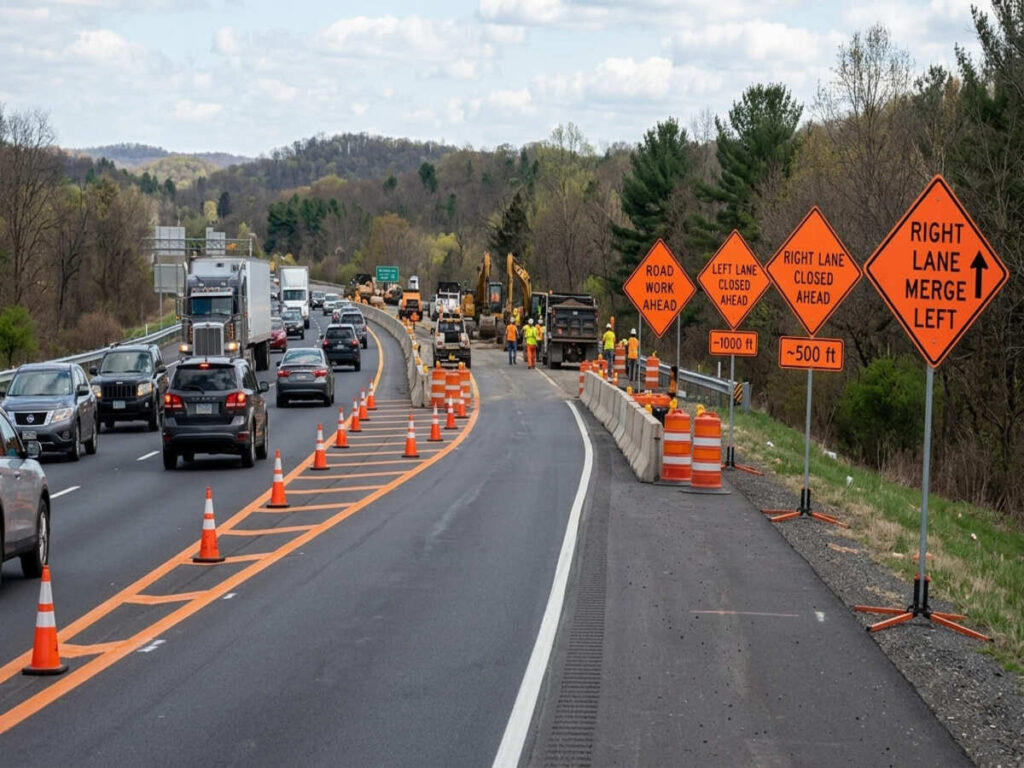
Part 6 (Temporary Traffic Control) received substantial restructuring in the 11th Edition. Several changes here affect how rental companies assemble and deliver job packages:
- Advance warning sign placement distances now vary by posted speed limit with updated thresholds — pre-packaged job kits built to 2009 Edition spacing tables are likely out of date.
- Sign sequencing requirements for lane closures and road work ahead scenarios have been revised; the logical order of signs in a taper must now follow updated Part 6 sequences.
- Night-time work zones carry stronger retroreflectivity expectations, effectively raising the practical floor for sheeting quality on overnight deployments.
- New provisions address portable changeable message signs (PCMS) and other electronic devices that rental companies increasingly carry alongside static signs.
3. MUTCD Sign Size Requirements — Sections 2B, 2C, and Part 6
Minimum sign dimensions for W-series warning signs and R-series regulatory signs were revised in several speed-zone categories. Notably, diamond warning signs on roadways posted above 45 mph now require larger minimum sizes than the 2009 Edition mandated. Consequently, a rental fleet that stocks a uniform 48×48 inch format for all W-series applications may be undersized for a portion of its current deployments.
Work Zone Traffic Signs Requirements: Rental Company Liability Exposure
Understanding the liability framing is essential before starting a fleet audit. When contractors or municipalities rent signs from your operation, they depend on you to supply equipment that meets current federal standards. Although end users bear responsibility for proper sign placement and deployment, rental companies that knowingly supply non-compliant inventory enter a shared liability position if an incident occurs at a non-compliant work zone.
Furthermore, FHWA retroreflectivity guidance notes that agencies operating roads open to public travel — which includes most work zone environments where rental signs are deployed — face potential denial of Federal-aid funding if they are not in compliance. That pressure flows upstream to rental operators through contract requirements.
Here is how the compliance timeline breaks down as of 2026:
| Jurisdiction / Project Type | Applicable Standard | Status as of 2026 |
| Federally funded projects (all states) | MUTCD 11th Edition (eff. Jan 18, 2024) | ✅ In effect — full compliance required |
| State-funded projects | State MUTCD adoption (23 CFR Part 655) | ⚠️ Varies — state deadline Jan 18, 2026 |
| Private construction referencing MUTCD | Contractual — depends on bid specs | ⚠️ Check contract language |
| Washington State (example) | State adopted Oct 27, 2025 | ✅ In effect |
| California (example) | CA MUTCD 2026 draft in progress | ⚠️ Adoption in progress |
The practical takeaway is this: even where state adoption is still in progress, contractors are increasingly specifying 11th Edition compliance in rental bids regardless of funding source. Consequently, waiting for a formal state mandate before auditing your fleet carries real commercial risk — not just regulatory risk.
For current adoption status by state, see our state-by-state signage compliance guide for rental operators.
Retroreflective Traffic Signs: MUTCD Minimum Levels and Sheeting Implications
Because retroreflectivity is the most operationally significant compliance area for rental fleets, it deserves a closer look at the numbers. Table 2A-5 of the 11th Edition sets minimum maintained retroreflectivity levels measured in candelas per lux per square meter (cd/lx/m²), varying by sign color and application.
The table below shows key values for sign colors most common in work zone rental inventory, along with how sheeting grade affects your ability to meet and sustain those values:
| Sign Color / Application | Min. Retroreflectivity (cd/lx/m²) | Type I EngGrade — Service Life | Type III Hi-Int — Service Life | Practical Implication |
| Black on orange (TTC / work zone) | 50 cd/lx/m² | 3–7 years (degrades faster) | 7–12 years | Type I requires more frequent replacement |
| White on red (STOP / regulatory) | 35 cd/lx/m² | 3–7 years | 7–12 years | High-cycle rental signs benefit from Type III |
| Black on yellow (warning) | 50 cd/lx/m² | 3–7 years | 7–12 years | Type I may fail faster in field conditions |
| White on green (guide) | 15 cd/lx/m² | Varies by use | Longer | Lower threshold but field wear applies |
Key nuance for rental operators
The MUTCD does not mandate a specific sheeting type. Rather, it mandates that you maintain retroreflectivity above Table 2A-5 minimums using a documented method. In practice, however, Type I Engineering Grade sheeting degrades faster — especially under frequent field handling, UV exposure, and cleaning cycles typical of rental operations. As a result, most rental operators find that stocking Type III or higher is the most cost-effective path to sustained compliance.
Reference: MUTCD 11th Edition, Section 2A.22 and Table 2A-5.
For a full technical breakdown of ASTM D4956 sheeting grades and fleet stocking recommendations, see our guide on retroreflective sheeting grades: Type I vs III vs IX vs XI.
MUTCD Sign Size Requirements: Key Changes for Rental Inventory
Beyond retroreflectivity, sign dimensions represent the second most common compliance gap in rental fleets transitioning from the 10th to 11th Edition. The key changes affect W-series warning signs and R-series regulatory signs used in temporary traffic control.
| Sign Series | MUTCD Section | 10th Ed. Minimum (common) | 11th Ed. Minimum (updated) | Rental Fleet Action |
| W-series warning (45+ mph roads) | Section 2C / Part 6 | 48×48 in | 48×48 in minimum; 60×60 in for higher-speed categories | Audit high-speed deployments |
| R-series regulatory (TTC zone) | Section 2B / Part 6 | Varies by sign type | Revised upward in several sub-categories | Cross-check current stock vs. Table 6F-1 |
| TTC advance warning | Part 6 | Spacing per 2009 tables | Updated spacing per speed zone | Review pre-packaged job kit spacing sheets |
To determine whether your current inventory meets 11th Edition dimension requirements, cross-reference your standard stock sizes against Section 2B, Section 2C, and the Part 6 Table 6F-1 size matrix. For a complete reference table organized by sign type and speed zone, see our standard traffic sign sizes and MUTCD dimensions guide.
Sourcing MUTCD Compliant Traffic Signs for Fleet Replacement
Once you have identified non-compliant inventory through an audit, sourcing replacement signs to the correct specification prevents the same problem from recurring. Below is a practical specification checklist for ordering MUTCD compliant traffic signs:
- Sheeting grade and ASTM D4956 certification: Request written confirmation that sheeting meets ASTM D4956 Type III (High Intensity Prismatic) or higher, depending on application. For overhead and high-speed applications, specify Type IX or Type XI (diamond-grade prismatic).
- Substrate: Specify .080″ aluminum for standard ground-mounted rental signs. While roll-up fabric signs are permitted under MUTCD for certain temporary applications, aluminum provides longer service life under rental handling cycles.
- Sign face dimensions: Confirm against 11th Edition dimension tables before placing bulk orders — particularly for W-series and Part 6 TTC signs.
- ISO 9001 manufacturing certification: An ISO 9001-certified manufacturer operates under documented quality management processes. For bulk fleet orders where unit-by-unit inspection is impractical, this certification reduces the risk of receiving out-of-specification signs.
- Supplier documentation: Request ASTM D4956 test certificates and, where applicable, CE marking documentation as a quality indicator for internationally sourced material (note: CE marking is not a US legal requirement, but it does indicate quality process documentation).
For a deeper look at supplier evaluation criteria, minimum order considerations, and sourcing documentation requirements, see our guide on sourcing wholesale traffic signs for a rental fleet.
OPTRAFFIC’s range of MUTCD-compliant traffic control signage includes Type III and high-intensity sheeting options built to 11th Edition specifications, with bulk fleet SKUs and sourcing documentation available. Browse Safety Signage →
MUTCD Signage and OSHA 29 CFR 1926.200: Understanding the Overlap
MUTCD signage compliance and OSHA compliance are two separate regulatory obligations that frequently overlap at the same job site — and rental companies sit at the intersection of both.
Under OSHA 29 CFR 1926.200, employers at construction sites must use accident prevention signs and tags that conform to ANSI Z35.1 specifications, and they must place signage wherever work creates hazards for workers or the public. This standard applies to the construction site environment, whereas the MUTCD governs the public roadway. However, most rental sign deployments occur precisely at that intersection — a temporary traffic control zone that is simultaneously a roadway and a construction environment.
As a result, rental companies face a compounded compliance picture:
- A sign that meets MUTCD dimensions and retroreflectivity standards but is physically damaged, faded below minimum levels, or incorrectly positioned can still generate an OSHA 29 CFR 1926.200 citation.
- Conversely, a sign that satisfies OSHA’s hazard communication purpose but fails MUTCD geometric or retroreflectivity requirements is non-compliant on the roadway side.
- Documented inspection records — showing that signs were assessed for condition and retroreflectivity before deployment — directly support your defensibility under both standards simultaneously.
Therefore, building a unified inspection and condition-grading process that addresses both MUTCD Section 2A.22 and OSHA 29 CFR 1926.200 is more efficient than treating them as separate compliance tracks. For a complete framework covering both standards in a rental context, see our OSHA and DOT signage requirements guide for rental operations.
Traffic Sign Compliance Audit: Four Steps for Rental Operators
With the compliance picture clear, here is a structured four-step audit process designed specifically for rental operations. Working through these steps systematically — starting with highest-utilization sign types — is more practical than attempting a complete fleet replacement at once.
Step 1 — Segment Fleet by Sheeting Grade and Retroreflectivity Status
First, pull your complete inventory and categorize signs by sheeting type using supplier documentation or sheeting grade markings. If records are unavailable for any unit, treat those signs as unverified — and therefore non-compliant — until you confirm their specification. For high-volume fleets, a retroreflectometer can accelerate this process by providing measured cd/lx/m² readings directly comparable to Table 2A-5 minimums.
Step 2 — Cross-Reference Sign Sizes Against 11th Edition Tables
Next, check your current stock dimensions against MUTCD 11th Edition Section 2B (Regulatory), Section 2C (Warning), and Part 6 Table 6F-1 (Temporary Traffic Control). Flag any sign type where your standard size falls below the 11th Edition minimum for the speed zone classification you typically serve. Pay particular attention to W-series signs deployed on roads posted above 45 mph.
Step 3 — Audit Pre-Packaged Job Kits
Subsequently, if you supply pre-assembled work zone sign packages — lane closure kits, road work ahead sequences, construction zone setups — test each package design against Part 6 sign placement sequences and updated spacing requirements. Many kits built to 2009 Edition spacing tables are now out of date, so document your update process for each kit type.
Step 4 — Establish a Documented Management Method
Finally, and critically for ongoing compliance, establish a formal retroreflectivity management method as required by Section 2A.22. Blanket replacement intervals based on sheeting grade and service life are the most operationally efficient approach for rental fleets — they eliminate the need to individually inspect every unit before each rental cycle. Integrate your chosen method into your condition grading and replacement cycle documentation. For a practical inspection framework, see our traffic sign condition grading and replacement cycle guide.
Summary: MUTCD Traffic Signs Compliance Checklist for Rental Fleets
To summarize, here are the key action items for bringing your rental fleet into 11th Edition compliance:
- Confirm effective and adoption dates: federal standard effective Jan 18, 2024; state deadline Jan 18, 2026 — check your state DOT’s current status.
- Audit full fleet: document sheeting grade for all units; flag unverified inventory as non-compliant until confirmed.
- Establish a Section 2A.22 management method: blanket replacement intervals are the most practical approach for rental operations.
- Cross-check sign sizes against MUTCD 11th Edition Sections 2B, 2C, and Part 6 Table 6F-1.
- Review all pre-packaged job kits for updated sign sequence and spacing compliance under Part 6.
- Confirm PCMS units against updated Part 6 electronic device provisions.
- When re-ordering, specify ASTM D4956 Type III or higher with written certification; request ISO 9001 documentation from suppliers.
- Build a unified inspection record covering both MUTCD Section 2A.22 and OSHA 29 CFR 1926.200 criteria.
Related articles in this series
- OSHA & DOT Signage Requirements for Traffic Control Rental Operations
- Retroreflective Sheeting Grades Explained: Type I vs III vs IX vs XI
- Standard Traffic Sign Sizes & MUTCD Dimensions Reference Guide
- Back to pillar: Traffic Signs for Rental Companies — Complete Fleet & Sourcing Guide
Frequently Asked Questions: MUTCD Traffic Signs for Rental Companies
No. Section 2A.22 requires a management method to maintain retroreflectivity above Table 2A-5 minimums — it does not ban Type I outright. However, Type I degrades faster under rental handling cycles, making Type III the more cost-efficient path to sustained compliance for most fleets.
The federal standard took effect January 18, 2024. States must adopt it by January 18, 2026 under 23 CFR Part 655. In practice, many contractors already require 11th Edition compliance in rental bids regardless of state adoption status — so the commercial deadline is earlier than the regulatory one.
Check three things: sheeting grade documentation against Table 2A-5 minimums, sign dimensions against Section 2C and Part 6 Table 6F-1, and whether you have a documented Section 2A.22 management method in place. All three must be confirmed simultaneously — physical spec alone is not sufficient.
Start with black-on-orange TTC signs — they carry a 50 cd/lx/m² minimum, face the heaviest rental handling, and appear in every work zone package. Then address W-series warning signs on high-speed deployments where size thresholds increased, followed by pre-packaged job kit spacing and sequence compliance under Part 6.