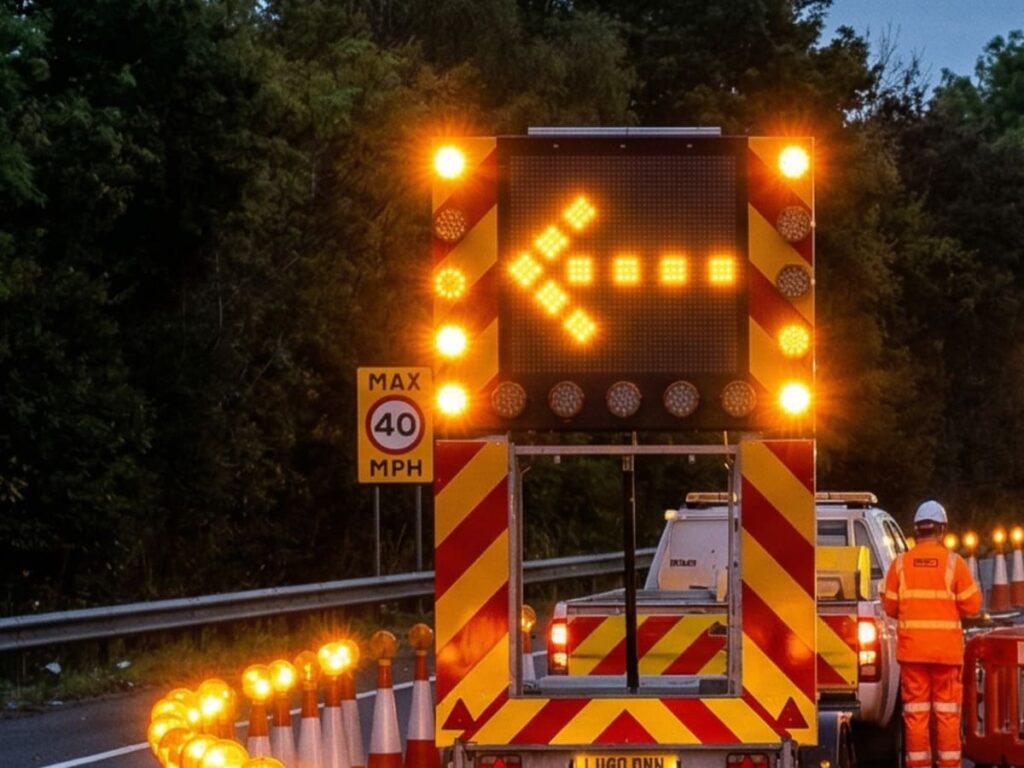
LED warning lights are the most purchased work zone safety device after signs and cones — and the one with the most procurement errors in international supply. A construction contractor in the US orders MUTCD Type B barricade lights for highway work. A UK roadworks company specifies EN 12352 Class 2 LED warning lights. A GCC infrastructure tender calls for CE-marked EN 12352 flashing warning lights. An Australian road authority wants AS 2080 Class 2 LED barricade lights. All four are specifying, in functional terms, the same product: a high-intensity amber flashing LED warning light for deployment on highway barricades at speeds above 45 mph. But MUTCD Type B, EN 12352 Class 2, and AS 2080 Class 2 are not legally equivalent certifications — and supplying the wrong one to a regulated project means non-compliant barricade lights that must be removed and replaced.
This guide maps LED warning light and barricade light specifications across five regulatory frameworks — MUTCD (USA), EN 12352 (EU and Middle East), BS EN 12352 (UK), AS 2080 (Australia), and GCC country-level specifications — for procurement managers, project engineers, and manufacturers sourcing or supplying LED warning lights internationally. Internal links throughout connect to detailed guides on specific applications.
Part 1: The Master Cross-Reference — LED Warning Light Standards Across Five Markets
Procurement decisions for LED warning lights and barricade lights typically come down to two questions: which type or class do I need to specify, and what certification does the product need to carry? The table below answers both — one row per decision dimension, one column per market.
| Dimension | 🇺🇸 USA | 🇬🇧 UK | 🇦🇺 Australia | 🌍 GCC | 🇪🇺 EU |
|---|---|---|---|---|---|
| Low intensity / night use only | Type A | Class 1 | Class 1 | Class 1 | Class 1 |
| High intensity / day + night | Type B ✓ | Class 2 ✓ | Class 2 ✓ | Class 2 ✓ | Class 2 ✓ |
| Steady burn mode | Type C | Class 1 (steady) | Class 1 (steady) | Class 1 (steady) | Class 1 (steady) |
| Highway minimum requirement | Type B | Class 2 | Class 2 | Class 2 | Class 2 |
| Daytime use permitted | Type B / C | Class 2 | Class 2 | Class 2 | Class 2 |
| Flash rate range | 55–75 /min | 55–150 /min | 55–150 /min | 55–150 /min | 55–150 /min |
| IP protection requirement | Not mandated | IP65 | IP65 | IP65 | IP65 |
| Certification model | ITE self-declaration | CE / UKCA (3rd party) | Supplier declaration | CE / GSO mark | CE marking (3rd party) |
For most highway work zone deployments, Type B (USA) and Class 2 (all other markets) are the correct specification. Type A and Class 1 are night-only, low-intensity devices — they are not suitable for highway barricades regardless of market.
Part 2: USA — MUTCD Type A, B, and C Barricade Lights
MUTCD Part 6 defines three types of LED warning lights and flashing warning lights for US work zone use, each with different intensity, mode, and permitted deployment conditions.
2.1 The Three MUTCD Types — What They Mean for Barricade Light Procurement
| Characteristic | MUTCD Type A | MUTCD Type B | MUTCD Type C | EN 12352 Class 1 | EN 12352 Class 2 |
| Intensity | Low | High | Low | Low | High |
| Mode | Flash only | Flash only | Steady burn only | Flash or steady | Flash or steady |
| Flash rate | 55–75 flash/min | 55–75 flash/min | N/A (steady) | 55–150 flash/min | 55–150 flash/min |
| Visibility distance (day) | ~300 m | ~500 m | ~200 m | ~300 m (Class 1) | ~500 m (Class 2) |
| Typical application | Channelizers, cones, low-speed work zones | Barricades, drums, highway work zones | Sign-mounted steady warning, pedestrian | Low-speed, low-risk temporary hazards | Highway barricades, high-risk work zones |
| Day use permitted? | No — night only | Yes — day + night | Yes — day + night | No — night only (Class 1 flash) | Yes — day + night (Class 2 high intensity) |
| Nearest US equivalent (for EN Class) | Type A ≈ Class 1 | Type B ≈ Class 2 | Type C ≈ Class 1 (steady burn) | Class 1 ≈ Type A | Class 2 ≈ Type B |
MUTCD Type B is the standard for highway barricade lights on US DOT-funded projects. Type A is for low-speed, low-volume, night-only applications. Type C provides steady burn for applications where a constant beacon rather than a flashing LED warning light is needed. Always verify against the project specification — some state DOTs specify Type B as the minimum for all work zones regardless of speed.
2.2 Type B Barricade Lights: The US Highway Standard
MUTCD Type B is the most widely specified barricade light on US highway projects. Type B LED warning lights are high-intensity, one-directional (they project light from one face only, with a back and hood to prevent glare from behind), and are rated for both daytime and nighttime use. The ITE Purchase Specification — the procurement reference standard for Type B barricade lights in the US — requires an amber lens, a photocell for automatic dusk activation, and a flash rate of 55–75 flashes per minute. Most Type B LED warning lights are battery-powered (typically D-cell) with photocell auto-on, though solar barricade lights are increasingly used for long-duration projects. For how Type B LED warning lights are deployed in specific US work zone scenarios, see the Highway One-Lane Two-Way Flagging Guide and the Extreme Weather Work Zone Signs Guide (fog and snow LED supplement thresholds).
2.3 The Amber Rule Near Railroad and LRT Tracks
MUTCD Part 8 (Railroad Grade Crossings) and Part 6 both specify that LED warning lights and flashing warning lights used adjacent to active railroad or LRT tracks must use amber (yellow) lenses only. Red LED warning lights must never be deployed within sight lines of active track — red is a stop signal in the rail context and may be interpreted as a track-side signal by train operators. Green LED warning lights are equally prohibited for the same reason. This amber-only rule applies in all five markets. For the full deployment SOP for LED warning lights adjacent to active rail, see the Railroad Warning Signs Work Zone TTC Guide.
Part 3: UK and EU — EN 12352 and CE Marking for LED Warning Lights
EN 12352:2006 is the harmonized European standard governing LED warning lights, barricade lights, and all flashing warning lights used for road traffic management. It applies to all EU member states and is the certification reference for LED warning lights in GCC markets. In the UK, the equivalent standard is BS EN 12352:2006, which became mandatory post-Brexit with UKCA marking from January 2025.
3.1 EN 12352 Class 1 vs Class 2: The Procurement Decision
EN 12352 defines two intensity classes for LED warning lights. Class 1 flashing warning lights are low-intensity, night-only devices equivalent to MUTCD Type A — suitable for temporary hazard marking at low speeds but not for highway barricade lights. Class 2 LED warning lights are high-intensity, day and night devices equivalent to MUTCD Type B — the standard specification for highway work zone barricade lights across EU, UK, and GCC markets. For highway supply, always specify Class 2 as the minimum. Class 1 LED warning lights are not compliant for highway barricade applications regardless of their CE marking.
3.2 IP65 Protection: The Most Commonly Missed EN 12352 Requirement
EN 12352:2006, Clause 4.3 mandates IP65 ingress protection — dust-tight and resistant to water jets from any direction (IEC 60529) — for all LED warning lights and barricade lights sold for road use in EU and UK markets. UKCA marking has been required for products placed on the Great Britain market since January 2025, per the UK Product Safety and Metrology etc. (Amendment etc.) (EU Exit) Regulations 2019; IP65 is equally mandatory under the equivalent BS EN 12352:2006.
By contrast, neither MUTCD Part 6 nor the ITE Purchase Specification for Type B barricade lights states a mandatory IP rating. The ITE spec addresses weatherproofing in general performance terms only. As a result, a barricade light that fully satisfies MUTCD Type B requirements may not meet IP65 — and without IP65, it cannot pass EN 12352 conformity assessment, cannot carry CE or UKCA marking, and cannot be legally placed on EU or UK road projects.
When specifying LED barricade lights for cross-market supply, verify the IP rating in the product data sheet before ordering. IP65 is the single most common gap between a MUTCD-compliant product and a CE-markable one.
3.3 Solar Barricade Lights Under EN 12352
Solar LED warning lights and solar barricade lights are explicitly covered by EN 12352. A solar barricade light that carries CE marking under EN 12352 Class 2 is compliant for highway deployment in EU and UK markets without any additional certification. MUTCD guidance on solar LED warning lights requires photocell auto-on at dusk and the same Type A/B/C classification as battery-powered units. For long-duration projects where battery replacement cost is a factor, solar barricade lights with CE marking and IP65 rating satisfy both EN 12352 and MUTCD-equivalent performance requirements.
Part 4: Australia and GCC — LED Warning Light Certification
4.1 Australia: AS 2080 and CE Marking
Australia’s primary standard for LED warning lights and barricade lights is AS 2080:1996. AS 2080 defines similar intensity class requirements to EN 12352 and is the reference for procurement on Australian state road authority projects. Compliance is demonstrated through supplier declaration — there is no mandatory CE-style third-party certification for LED warning lights in the Australian market. However, major infrastructure projects (particularly Transport for NSW, VicRoads, and Queensland TMR contracts) increasingly request CE-marked EN 12352 barricade lights as evidence of international quality standards. CE-marked EN 12352 Class 2 LED warning lights satisfy AS 2080 Class 2 requirements in practice for all major Australian infrastructure projects.
4.2 GCC / Middle East: CE Marking as the Standard Path
GCC markets broadly accept CE-marked EN 12352 LED warning lights and barricade lights. Individual country project specifications — UAE AHD, Saudi SASO / Ministry of Transport, Qatar QHDM — may add supplemental requirements, but CE-marked EN 12352 Class 2 LED warning lights are the standard procurement baseline across all GCC markets. For long-duration projects in Saudi Arabia, SASO product registration may be required as an additional step beyond CE marking — always verify against the project tender document.
As with LED warning lights near railroad tracks globally, GCC projects adjacent to metro, LRT, or freight rail infrastructure require amber-only flashing warning lights regardless of which country or standard governs the project.
Part 5: Procurement Cheat-Sheet — LED Warning Lights by Application and Market
The table below consolidates the recommended LED warning light specification for each application and market. Copy the relevant row into your project procurement document.
| Application / Scenario | Specify for USA | Specify for UK | Specify for Australia | Specify for GCC | Flash Rate |
| Urban work zone barricade lights (daytime) | Type C (steady) or Type B (flash, day-ok) | Class 2 (day-rated) | Class 2 (day-rated) | Class 2 (day-rated) | 55–75/min or steady |
| Urban work zone LED warning lights (night) | Type A or B | Class 1 or 2 | Class 1 or 2 | Class 1 or 2 | 55–75/min (Type A) or 55–150 (Class 2) |
| Highway barricade lights (any time) | Type B (high intensity) | Class 2 (high intensity) | Class 2 (high intensity) | Class 2 (high intensity) | 55–75/min (MUTCD) or 55–150 (EN) |
| Railroad / LRT adjacent flashing warning lights | Type B — amber ONLY (no red/green) | Class 2 — amber ONLY | Class 2 — amber ONLY | Class 2 — amber ONLY | 55–75/min |
| Fog / low visibility supplement on signs | Type B mounted on sign face (MUTCD) | Class 2 mounted sign (EN 12352 guidance) | Class 2 (AS / EN) | Class 2 (EN) | 55–75/min or faster |
| Solar LED warning lights (any scenario) | Photocell auto-on; follow Type A/B/C spec | EN 12352 CE-certified solar = compliant | AS 2080 / EN equiv; CE accepted | EN 12352 CE cert covers solar | Per type/class spec |
Flash rate note: MUTCD specifies 55–75 flashes per minute for all Type A, B, and C barricade lights. EN 12352 permits a wider range (55–150 flashes per minute) for Class 2. In practice, most quality LED warning lights operate at 60–70 flashes per minute, which satisfies both MUTCD and EN 12352 requirements. Verify the product data sheet flash rate against the specific standard for any project with a stated flash rate requirement.
5.1 Multi-Market LED Warning Light Procurement Strategy
The most efficient path to LED warning lights and barricade lights that satisfy all five markets simultaneously is a CE-marked EN 12352 Class 2 amber LED warning light with IP65 protection and a flash rate of 60–70 flashes per minute, from a manufacturer who also provides ITE Purchase Specification compliance documentation. This combination covers US Type B requirements (via ITE spec documentation), EU/UK requirements (via CE marking), GCC requirements (via CE marking), and Australian requirements (via CE marking accepted as AS 2080 equivalent). IP65 is the single most important specification to verify — it is often the difference between a barricade light that can carry CE marking and one that cannot.
OPTRAFFIC LED warning lights: amber LED barricade lights and solar barricade lights with CE marking, IP65 protection, EN 12352 Class 2 certification, and RoHS compliance. MUTCD Type B equivalent documentation available. Browse LED Warning Lights → | For project-specific procurement documentation, contact the OPTRAFFIC team.
Part 6: Certification Requirements — What Each Market Requires for LED Warning Lights
| Market | Required Cert | Testing Body | Product Marking | Key Standard | Notes |
| USA | ITE Purchase Specification (commercial — no mandatory cert) State DOT approval on some project types | Manufacturer self-certification | ITE spec label or state DOT list | MUTCD Part 6 ITE Purchase Spec | Large DOT projects: state-specific approved product list required |
| UK | CE marking (→ UKCA Jan 2025) | UK-approved notified body | CE / UKCA mark on device body | BS EN 12352:2006 | TSRGD governs deployment; BS EN governs product cert |
| Australia | AS 2080 compliance (supplier declaration); CE accepted on large infrastructure projects | Manufacturer or SAI Global | AS 2080 compliance statement; CE mark welcomed | AS 2080:1996 (under review) | CE-marked EN 12352 products accepted for major state road projects |
| GCC / Middle East | CE marking (typical); some countries add GSO registration layer | CE notified body | CE mark; GSO mark (if required) | EN 12352:2006 or country DOT spec | Saudi SASO may add national registration; always verify tender docs |
| EU | CE marking mandatory | EU notified body | CE mark + DoP | EN 12352:2006 | Applies to all LED warning lights sold for road use in EU member states |
UKCA note: From January 2025, the UK requires UKCA marking on new LED warning lights placed on the Great Britain market. Northern Ireland continues to accept CE marking under the Windsor Framework. Products CE-marked before January 2025 may have a transition period — verify with the UK Office for Product Safety and Standards.
Part 7: Five Common Specification Errors for LED Warning Lights
| Error | Why It Happens | Consequence |
| Supplying Type A (night-only) LED warning lights on a daytime work zone | Type A is the most common US barricade light; assumed to be usable day and night | MUTCD violation — Type A barricade lights are for night use only; daytime deployment requires Type B or C |
| Using red or green LED warning lights within sight of railroad / LRT tracks | Red = stop signal; green = proceed signal in rail context — color is globally recognised | Serious safety hazard; potentially causes train operator or driver signal confusion; amber is the only permitted color near tracks |
| Supplying ITE-certified LED warning lights to EU / GCC projects without CE marking | ITE spec is strong US domestic standard but carries no legal standing in EU markets | Product fails CE verification — LED warning lights cannot be legally deployed on EU or most GCC road projects |
| Assuming CE-marked LED warning lights are MUTCD-compliant for US DOT projects | CE marking covers EN 12352; US DOT projects specify MUTCD type classification separately | CE-marked EN Class 2 ≈ MUTCD Type B but not legally equivalent; US DOT projects may require ITE spec or state-approved list |
| Using Class 1 (low intensity) LED warning lights on highway barricades | Class 1 is less expensive and widely stocked; bought in bulk for all applications | Insufficient intensity for highway-speed detection; non-compliant with MUTCD Type B and EN Class 2 highway requirements |
Summary: LED Warning Light Procurement Across Five Markets
LED warning lights and barricade lights perform the same function across all five markets: provide a high-visibility amber flashing signal to alert drivers to work zone hazards at night and in poor visibility. The performance requirements for highway deployment (high intensity, amber, day/night rated, photocell operation) are broadly equivalent across MUTCD Type B, EN 12352 Class 2, and AS 2080 Class 2.
The certification requirements, IP protection mandates, and product marking requirements differ significantly by market. The key specification parameters for multi-market LED warning light procurement are: CE marking under EN 12352 Class 2, IP65 protection, amber lens, 60–70 flash/minute, and ITE Purchase Specification documentation for US DOT projects. A solar barricade light or battery-powered LED barricade light that carries all of these certifications can be deployed across all five markets without modification.
The one rule that applies identically in every market — with no exceptions — is the amber-only requirement near railroad and LRT tracks. This is not a market-specific regulation: it is a universal safety requirement. Red or green LED warning lights must never be deployed within sight of active rail infrastructure in any market.
Related Guides
From the OPTRAFFIC International Standards Series:
- Reflective Traffic Signs: ASTM vs EN vs AS Grade Guide (Series #1)
- Traffic Cone Standards: MUTCD, BS EN 13422, and AS 1742.3 Compared (Series #2)
- Construction Signs Color Standards: US vs UK vs Australia vs GCC (Series #3)
From the OPTRAFFIC Field Playbook Series:
- Work Zone Signs: Highway One-Lane Two-Way Flagging Guide (Type B barricade light deployment)
- Railroad Warning Signs: Rail-Adjacent Work Zone TTC Guide (amber-only LED rule)
- Work Zone Safety Signs: Extreme Weather Failure Guide (LED supplement in fog and snow)
- Road Closed Signs: Urban Intersection Short-Term Work Zone Guide (Type A/C barricade lights)
OPTRAFFIC LED warning light Library:
- LED Warning Lights for Road Safety: What to Know Before You Buy
- MUTCD Type A vs. Type C: Selecting the Right LED Barricade Light for Nighttime Safety
- Traffic Warning Light Colors: When to Use Amber LEDs
- Mastering IP67 Sealing Systems For Truck LED Warning Lights
- Select Perfect Patterns For LED Flashing Lights Today