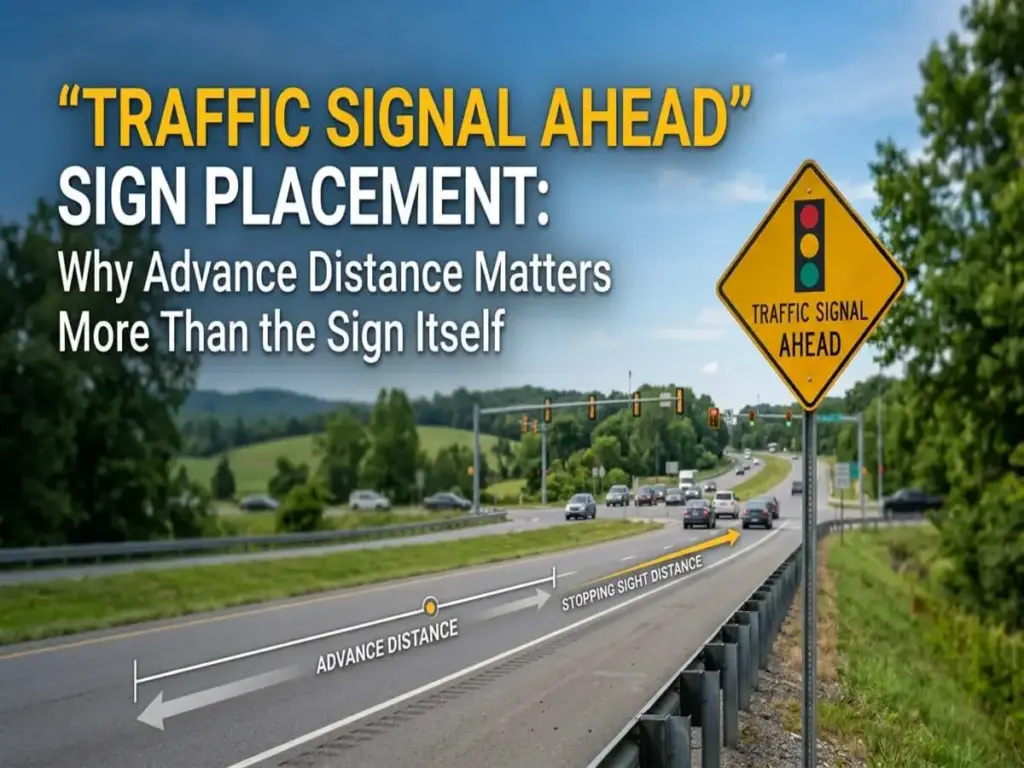
А traffic signal ahead sign shows up on almost every work zone that uses a portable signal to control one-lane, two-way traffic. Crews rarely get the sign itself wrong. Вместо, they get the placement wrong, and that’s actually the part that matters most.
Our team has reviewed sites with this exact problem. А traffic signal ahead sign sat right where the crew’s truck happened to stop that morning. It wasn’t placed at the distance the posted speed limit actually requires. On a higher-speed approach, that gap leaves drivers too little time to react before reaching the back of a queue at the signal. The sign was present. Однако, the compliance gap stayed invisible until a near-miss made it obvious.
В этом руководстве рассматриваются три вещи: what the sign is for, how advance placement distance scales with speed, and how to avoid the most common placement mistake on portable signal sites.
Ключевые выводы
- Sign Presence Isn’t Compliance: A traffic signal ahead sign posted at the wrong distance still fails to warn drivers in time.
- Speed Sets the Distance: Advance placement distance scales with approach speed, not a single fixed measurement.
- Portable Signals Change the Math: Temporary signal setups often sit closer to traffic than permanent signals, which shortens available reaction time.
- Pair It With the Right Companion Signs: A signal ahead sign works alongside queue warning and flagger signage, not as a standalone fix.
- Re-check When the Site Moves: Relocating the portable signal means re-measuring the sign’s placement, not just moving the sign the same distance.
What the Traffic Signal Ahead Sign Is For
The traffic signal ahead sign warns drivers of a signal ahead, in a place where they might not expect one. This matters most in work zones. Там, a portable signal replaces flagger control for one-lane, two-way traffic on a stretch that normally has none. Unlike a permanent intersection signal, drivers have no prior expectation that a signal is coming.
Why Advance Distance Matters More Than the Sign
Posting the sign is the easy part. Однако, getting the distance right is harder. It requires understanding how much room a driver actually needs. That room covers seeing the sign, processing it, and slowing down before reaching the signal.
That distance isn’t fixed. Вместо, it scales with approach speed:
| Скорость приближения | Typical Minimum Advance Placement | Почему |
|---|---|---|
| 25-35 миль в час | Shorter advance distance | Lower speed gives drivers more reaction margin per foot of roadway |
| 40-50 миль в час | Moderate advance distance | Stopping distance increases substantially at these speeds |
| 55+ миль в час | Longest advance distance | High-speed approaches need the most warning time before the queue |
Crews sometimes use one standard placement distance across every site, regardless of the posted speed. That default works fine on a 25 mph approach. Однако, it fails on a 55 mph one, where drivers simply don’t have enough distance left to slow safely once they see the sign.
Where Portable Signals Change the Calculation
A permanent traffic signal sits at a fixed, engineered location. It already has a matching advance sign distance built into the road’s design. В отличие, a portable signal in a work zone doesn’t have that luxury:
- The signal location moves as the project progresses. Как результат, the advance sign distance has to be re-measured each time, not assumed from the last setup.
- Portable signals often sit closer to a queue than drivers expect, especially where a work zone taper narrows sight lines before the signal comes into view.
- Queue length varies day to day on a portable signal. Как результат, the actual reaction distance drivers get can shrink even if the sign never moves.
Building a Placement Check Into Every Setup
The fix isn’t a bigger sign. Вместо, it’s simply re-measuring placement every time the setup changes.
- Confirm the posted or prevailing speed for the approach before placing the sign, rather than defaulting to a standard distance used on other sites.
- Measure advance distance from the sign to the back of the likely queue, not from the sign to the signal head itself.
- Re-check placement whenever the portable signal is relocated, since a shift in location changes both the queue point and the sight lines drivers have on approach.
- Pair the sign with queue warning devices where the queue can extend past the signal ahead sign itself, so drivers get a second warning if traffic backs up further than expected.
Stocking Signage That Matches the Actual Approach Speed
Getting this right depends on one thing. Crews need the right supplementary signage on hand for whatever approach speed a site presents. A single fixed kit used everywhere won’t cut it. A crew moving between a 30 mph collector road and a 55 mph rural highway, например, needs two different advance distances on the same trip.
The Optraffic team builds portable signal sign packages around this need. Each package pairs the traffic signal ahead sign with queue warning and flagger-ahead signage. Everything is sized for the actual site conditions, not a one-size default. That flexibility matters most for rental fleets moving between projects with different posted speeds week to week.
Связанное чтение
- Как флаггер предстоящие знаки повышают безопасность и эффективность движения на строительных площадках
- AFAD Stop Slow не заменяет лопастной знак Stop Slow
- Типы трафик: Ключевые функции и требования к управлению безопасной рабочей зоной
- Знак «Одна полоса впереди» против. Дорога сужается против. Конец переулка: Какой из них действительно нужен вашей рабочей зоне??
Часто задаваемые вопросы
What does a traffic signal ahead sign mean?
It warns drivers that a traffic signal controls the road ahead, in a location where they might not expect one. This is common in work zones using a portable signal for one-lane, two-way traffic.
How far in advance should a traffic signal ahead sign be placed?
The distance scales with approach speed. Higher-speed approaches need significantly more advance distance than lower-speed ones. Drivers simply need more room to see the sign, реагировать, and slow down safely.
Is a portable traffic signal different from a permanent one for sign placement purposes?
Да. A portable signal’s location can shift as a project progresses. Как результат, the advance sign distance needs to be re-measured each time, unlike a permanent signal’s fixed, pre-engineered placement.
What happens if the sign is placed too close to the signal?
Drivers approaching at speed may not have enough distance to slow down before reaching the back of a queue. Как результат, the risk of a rear-end collision at the signal goes up.
Заключение
A traffic signal ahead sign only does its job if it’s placed far enough back for the actual approach speed. Wherever the crew happened to stop isn’t good enough. Portable signals shift location as work progresses, and that means placement needs re-checking, not just repeating. Вот почему команда Optraffic строит traffic signal ahead signs into portable signal packages. Every package is sized for the site’s real approach speed, not a single default distance.