Why Material Composition Determines the Service Life of Your Cone Fleet
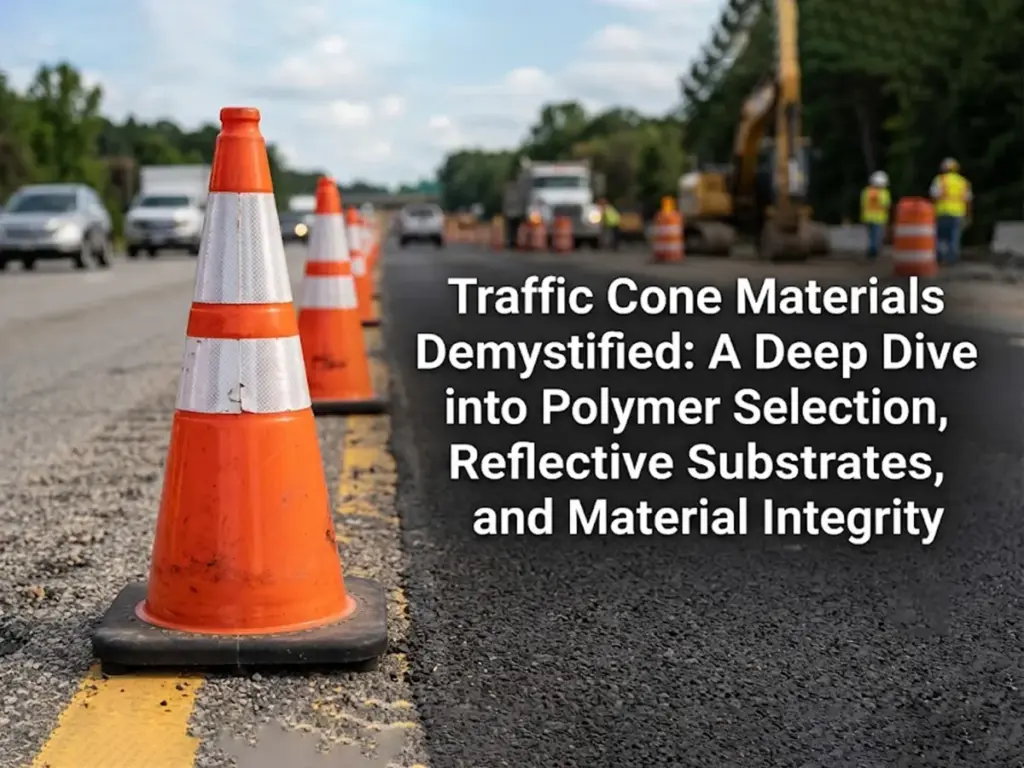
Your cones are failing before they’re hit. The bases are splaying on hot bitumen, the fluorescent orange has gone chalky pink, and the reflective bands are lifting at the edges — on units bought fourteen months ago. Meanwhile the replacement order sits on your desk again, and nobody in finance understands why a “consumable” line item keeps blowing its budget.
That’s not bad luck. It’s a specification problem, and it compounds: every prematurely retired cone carries hidden freight, хранилище, handling and disposal costs on top of unit price, plus the reputational exposure of running visibly degraded safety assets on a live worksite. Понимание traffic cone materials — the polymer, the plasticiser package, the reflective substrate and the bond between them — is what converts an unpredictable expense into a forecastable asset cycle. This guide breaks down each layer.
The Replacement Cycle Nobody Budgets For
Most Australian fleets don’t lose cones to impact. They lose them to degradation — UV chalking, base separation, and substrate delamination — and then replace them on an ad hoc basis rather than a planned one. The correct evaluation metric isn’t unit price but cost per service year: a cone at twice the price that lasts three times as long is a 33% reduction in annualised cost before you count the labour of reordering.
Что “Целостность материала” Actually Means in a Field Asset
Material integrity is measurable across four dimensions: dimensional stability under heat, impact recovery (whether the cone returns to shape after a strike), colour retention, and substrate adhesion. Each maps to a declarable value on a specification sheet — Shore A hardness under ASTM D2240, Vicat softening point, accelerated weathering hours under ISO 4892 or ASTM G154. If a supplier can’t produce those numbers, they’re selling you a shape, not a material.
The Australian Operating Envelope
Australia’s conditions are genuinely harsher than the markets most cone tooling was designed for. ARPANSA records summer UV Index values reaching 14 and above across northern Australia — well beyond the “extreme” threshold of 11 — and the Bureau of Meteorology’s Annual Climate Statement for 2024 placed the national mean temperature approximately 1.46 °C above the 1961–1990 average, the second-warmest year in the 115-year record. Add coastal salt exposure (КАК 4312 classifies marine frontage as C5, the most severe atmospheric corrosivity category) and abrasive dust in resources corridors, and European-specified stock underperforms locally as a matter of physics, не мнение.
The Core Polymer Families Used in Traffic Cone Manufacturing
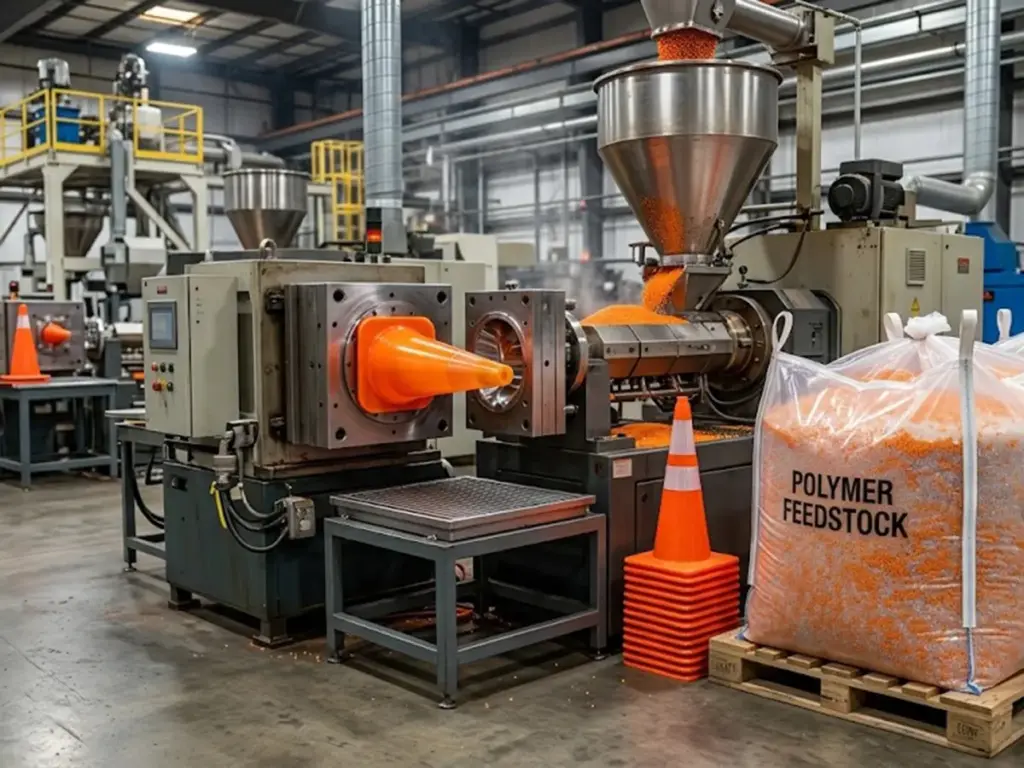
Traffic cone raw materials fall into three commercially relevant families in the Australian market, and the choice between them determines almost everything downstream.
Поливинилхлорид (ПВХ) — Flexibility, Memory, and Plasticiser Chemistry
Polyvinyl chloride is a thermoplastic produced by the polymerisation of vinyl chloride monomer; rigid on its own, it becomes flexible through the addition of plasticisers, typically phthalate or non-phthalate esters. That plasticiser loading is what gives a flexible PVC cone its shape memory — the ability to be flattened by a wheel and return to form. It’s also the material’s clock: plasticisers migrate outward over time, and as they leave, the cone stiffens, then cracks at the base radius. Higher-grade compounds use polymeric plasticisers with lower migration rates for exactly this reason.
Thermoplastic Rubber, Переработанная резина, and Elastomeric Blends
Rubber’s advantage is mass. A heavier base resists wind displacement without ballast. The trade-offs are thermal — rubber absorbs and retains heat, softening on hot surfaces — plus surface bloom, scuff transfer onto adjacent stacked units, and batch-to-batch variability where recycled feedstock is used. Recycled rubber cones are legitimate assets in static, low-visibility-demand applications; they are a poor choice where appearance and consistency matter.
Полиэтилен (LDPE/HDPE) and Injection-Moulded Alternatives
Polyethylene cones are light, дешевый, and rigid-walled. Under repeated flex or in cold conditions, they exhibit stress whitening and brittle fracture rather than elastic recovery. Moulding method matters as much as resin: injection moulding delivers tighter wall-thickness tolerance, while rotational moulding produces more variable sections that fail at the thin points. For a component-level view of how base, body and collar compounds are selected during manufacture, our breakdown of [the three foundational compounds behind every moulded cone] goes deeper than this section allows.
PVC vs Rubber: A Materials-Led Comparison for Australian Fleets
The table below compares PVC and rubber traffic cones across impact recovery, thermal behaviour, and handling efficiency — the three properties that govern fleet life.
| Свойство | Flexible PVC | Резина / ТПР |
| Impact recovery | Elastic rebound; returns to form | Gouges or takes permanent set |
| Thermal behaviour | Softens near Vicat point (~75–80 °C for flexible grades) | Retains heat; surface tack |
| Base mass | Умеренный; integrated or weighted | Высокий; strong wind stability |
| Nesting depth | Deep; efficient vehicle packing | Shallower; bulkier transport |
| Batch consistency | High with virgin compound | Variable with recycled feedstock |
| Colour retention | Good with UV stabiliser package | Prone to bloom and greying |
Impact Recovery and Deformation Memory
Recovery behaviour is the single strongest predictor of usable life. A polyvinyl chloride safety cone struck at low speed deforms and rebounds; a rubber unit tears or holds the dent, and once the profile is compromised, the cone reads as damaged to every inspector who walks past it.
Тепловые характеристики, Softening, and Slump
Sealed bitumen surfaces routinely run 20–30 °C above ambient air temperature in Australian summer conditions, which places surface temperatures in the 60 °C range on a 35 °C day. Approaching the softening point, bases spread and bodies lean — a failure mode that appears as “деформация” but is straightforward thermal slump against an under-specified compound.
Распределение веса, Умение обращаться, and Stacking Efficiency
Base-to-body mass ratio drives stability; nesting depth drives how many units fit in a ute tray. Deep-nesting PVC typically stacks 30–40% tighter than equivalent rubber, which is a direct reduction in vehicle trips for large deployments. To learn more about the hire-and-return economics, обратитесь к нашему руководству по why flexible PVC has become the default for high-turnover hire fleets. And our guide on what to check on a specification sheet before you commit to a PVC order sets out the declarable values worth insisting on.
Reflective Substrates Explained: Лист, Sleeves, and Bonding Systems
The reflective layer usually fails first, and it fails chemically rather than mechanically.
How Retroreflective Substrates Are Constructed
Retroreflection returns incident light toward its source. Three constructions dominate: enclosed lens (glass beads under a resin layer), encapsulated lens (beads in sealed air cells), and microprismatic (moulded prism arrays). AS/NZS 1906.1 classifies these materials for road traffic control use, and substrate class — not band width — is what determines night-time luminance. A wide band of low-class sheeting returns less light than a narrow band of prismatic material.
Adhesive Systems, Heat-Shrink Sleeves, and Mechanical Retention
Three retention methods exist: чувствительный к давлению клей, heat-applied sleeve, and mechanically clamped collar. Bonding to plasticised PVC is the hard problem, because the same plasticisers that keep the cone flexible migrate into the adhesive layer and soften it from behind. This is the root cause of edge lift on cones that have never been struck.
Common Substrate Failure Modes in the Field
Look for five signs during inspection: edge curl, расслаивание, moisture clouding, abrasion polishing, and yellowing of the topcoat. Each is visible at arm’s length, which makes substrate condition an auditable data point rather than a judgement call. Our detailed treatment of the substrate layer that determines whether a cone stays visible after two seasons expands on grade selection.
Reflective Strips Versus Full Sheeting: Interpreting the Material Trade-Offs
Coverage Area, Bonded Surface, and Failure Probability
More bonded area means more total adhesive exposed to plasticiser migration and more seam length subject to mechanical stress as the cone flexes. Continuous wraps deliver superior conspicuity and are more susceptible to progressive delamination; discrete bands isolate failures to a single collar.
Substrate Grade Versus Coverage Area
Given a fixed budget, upgrading substrate class generally returns more measurable performance than increasing coverage with a lower grade. Cleaning regime matters too: solvent-based degreasers strip topcoats on both configurations. For the full side-by-side, видеть our breakdown of banded versus continuous reflective configurations.
Raw Material Volatility and What It Means for Cone Quality
The Feedstock Chain Behind a Finished Cone
Every cone is resin plus plasticiser plus stabiliser plus pigment, each with its own upstream exposure to petrochemical feedstock and energy pricing. Australia’s dependence on imported compound adds freight and currency exposure on top — meaning input volatility lands here amplified, not dampened.
Where Cost Pressure Shows Up in the Material
When input costs rise, and the price point holds, something is removed. In order of frequency: increased calcium carbonate filler loading, reduced UV stabiliser and carbon black content, thinner wall sections, downgraded reflective substrate, and regrind contamination. Cheap stock isn’t a smaller margin — it’s a different material. The mechanics of this are set out in what upstream feedstock movements really do to budget-tier stock.
Reading a Spec Sheet Against a Sales Claim
Five values are worth arguing over: wall thickness at the base radius, total base mass, Твердость по Шору А, declared UV stabiliser presence, and reflective substrate class against AS/NZS 1906.1. Everything else is copy.
As a fully-integrated manufacturer, we control the chain from raw compound and reflective substrate through to custom printing — which is why we can issue material declarations rather than generic durability claims. Request the raw material spec sheets for your compound and compare them against your current supplier’s.
Degradation Pathways: How Cone Materials Actually Fail in Australian Conditions
УФ-излучение, Photo-Oxidation, and Colour Fade
Ultraviolet exposure drives photo-oxidation: polymer chains break, pigments degrade, and the surface chalks. Fluorescent orange fades well before structural failure, which is useful — chalking is an early-warning indicator that the stabiliser package is exhausted and the polymer is next. Under Australian UV loading, an unstabilised compound can visibly fade within a single summer.
Thermal Cycling, Abrasion, and Mechanical Fatigue
Daily heating and cooling cycles concentrate stress at the body-to-base junction. Combined with abrasion from grit and repeated stacking, this produces fatigue cracking at the seam — almost always the precursor to total failure. Inspect the base radius, not the tip.
Chemical Exposure — Fuels, Solvents, Соль, and Cleaning Agents
Hydrocarbons and aromatic solvents extract plasticisers from PVC, leaving brittle, tacky surfaces. Salt attacks metal inserts and fixings in C5 marine zones. And high-alkaline or solvent wash-bay chemistry removes reflective topcoats faster than sunlight does. Check chemical compatibility against your depot cleaning regime before you standardise.
Building a Material Specification That Survives Your Operating Environment
Matching Polymer and Substrate to Deployment Profile
Specify for the harshest use case in the fleet, не средний:
- Specify deep-nesting flexible PVC with polymeric plasticiser for high-churn hire and mobile works.
- Upgrade to prismatic substrate class where night deployment or high approach speeds apply.
- Increase base mass where wind exposure, not impact, is the dominant risk.
- Exclude metal inserts in C5 coastal frontage unless corrosion-protected.
- Confirm accelerated weathering hours for any unit deployed above the Tropic of Capricorn.
Inspection Criteria and Retirement Thresholds
Run a five-point material audit quarterly: substrate adhesion (thumb test at the band edge), colour against a retained reference sample, base integrity at the radius, deformation recovery, and surface chalking. Document it and retirement becomes defensible rather than discretionary.
Total Cost of Ownership as a Materials Decision
Unit price is typically the smaller half of lifetime cost once replacement labour, груз, хранилище, and disposal are counted. Model cost per service year instead, and the specification argument makes itself.
Frequently Asked Questions About Traffic Cone Materials
What materials are traffic cones actually made from?
Traffic cone materials are predominantly flexible PVC, rubber or thermoplastic rubber, и полиэтилен, combined with a retroreflective sheeting substrate and a weighted or moulded base. PVC dominates the mid-to-premium Australian segment because of its shape recovery after impact.
Are PVC or rubber traffic cones better for Australian conditions?
PVC performs better on impact recovery, colour retention and stacking efficiency. Rubber offers greater base mass for wind stability but retains heat, scuffs adjacent units, and varies more between production batches — particularly with recycled feedstock.
Why does reflective sheeting peel off traffic cones?
Plasticiser migration from flexible PVC into the adhesive layer weakens the bond and produces edge lift. Substrate grade, application method (adhesive versus heat-shrink sleeve) and cleaning chemistry all determine how quickly it occurs.
Is full reflective sheeting more durable than reflective strips?
Не автоматически. Durability follows substrate class and bonding method rather than coverage area, and larger continuous wraps carry more seam stress. Match the configuration to visibility demand and handling intensity.
How long should a traffic cone last before replacement?
Service life depends on compound and exposure, not a fixed interval. Well-stabilised PVC commonly delivers several years in Australian conditions; high-filler, low-stabiliser stock often degrades visibly within one summer.
Ссылки
ARPANSA — Ultraviolet Radiation Index
Bureau of Meteorology — Annual Climate Statement
Стандарты Австралии — AS/NZS 1906.1 Световозвращающие материалы и устройства для целей управления дорожным движением
ASTM D2240 Standard Test Method for Rubber Property—Durometer Hardness
ASTM G154 Standard Practice for Fluorescent UV Exposure of Nonmetallic Materials