The Strategic Procurement Case: Why Retroreflective Sheeting Is a Life-Safety Decision
Procurement managers and civil engineers evaluating traffic sign material selection rarely begin with a question of physics. They begin with a question of risk. Retroreflective sign sheeting sits at the intersection of regulatory compliance, road safety liability, and long-term asset performance — and the consequences of under-specification are measurable in both financial and human terms.
According to the World Health Organization’s Global Status Report on Road Safety 2023, road traffic crashes kill approximately 1.19 million people annually, with a disproportionate share occurring at night when sign visibility is critical. In Australia, the Australian Institute of Health and Welfare (AIHW) Road Safety Report 2024 confirms that 27% of fatal crashes occur between 6 PM and 6 AM — a window in which retroreflective sign sheeting performance directly influences driver decision-making.
For UK road authorities, Department for Transport Road Casualties Great Britain 2023 records 1,633 road deaths, with night-time driving contributing disproportionately to serious casualty rates on rural A-roads — precisely the environment where sign retroreflectivity is most critical.
Under Section 41 of the UK Highways Act 1980, highway authorities carry a statutory duty to maintain roads in a safe condition — a duty courts have interpreted to include the standard of roadside signing. Specifying inadequate retroreflective sign sheeting therefore, creates direct liability exposure, not merely a performance gap.
Total Cost of Ownership: The False Economy of Specifying Down
1.1 Total Cost of Ownership: The False Economy of Specifying Down
Many procurement managers face pressure to reduce unit costs on sign supply. A procurement decision driven by initial unit price, however, consistently produces a higher total cost of ownership (TCO) over the asset’s service life. Engineer Grade glass-bead sheeting — the lowest-performance category under both AS/NZS 1906.1 and BS EN 12899-1 reflective sheeting standards — carries an approximate field service life of five to seven years in temperate environments and as few as four years in high-UV Australian conditions.
Microprismatic retroreflective sign sheeting from Class 3 and above under AS/NZS 1906.1, or RA2 and RA3 under BS EN 12899-1, delivers service lives of ten to twelve-plus years under comparable conditions. When procurement managers factor in installation labour, traffic management costs for sign replacement, and compliance inspection frequency, the TCO differential between low-grade and high-performance sheeting routinely exceeds 40%.
Governing Standards Decoded: AS/NZS 1906.1, BS EN 12899-1, and Cross-Border Compliance
AS/NZS 1906.1: The Australian and New Zealand Framework
AS/NZS 1906.1:2007 (Retroreflective Materials and Devices for Road Traffic Control Purposes — Part 1: Retroreflective Sheeting) governs all retroreflective materials applied to traffic control devices across Australia and New Zealand. The standard defines performance through the Coefficient of Retroreflection (RA) — measured in candelas per lux per square metre (cd·lx⁻¹·m⁻²) — at specified observation angles of 0.2° and 0.5° and entrance angles ranging from −4° to +40°.
AS/NZS 1906.1 classifies retroreflective sign sheeting across seven performance classes — Class 1 (Engineer Grade glass bead) through Class RX (prismatic, highest performance). Each class carries minimum RA values per colour and angle combination, daytime luminance factor (β) requirements, and chromaticity coordinates that must fall within defined colour tolerances. Durability testing under this standard includes accelerated UV weathering per AS/NZS 1580.481.1.3, humidity resistance, and thermal cycling — all critical for Australian climatic conditions ranging from tropical Far North Queensland to alpine southern regions.
Procurement managers must require a current Certificate of Compliance (CoC) and supporting test report from a NATA-accredited laboratory (Australia) or IANZ-accredited laboratory (New Zealand) for every batch purchase. Product-type approvals are insufficient — batch-specific certification is the standard of diligence required under Austroads procurement guidelines.
BS EN 12899-1: The UK and European Compliance Framework
BS EN 12899-1:2007 (Fixed, Vertical Road Traffic Signs — Part 1: Fixed Signs) defines performance requirements for retroreflective sign face materials in the UK and across Europe. Under this standard, retroreflective sheeting is classified as RA1, RA2, or RA3 — minimum retroreflectance classes that correlate to sign category, road type, and night-time visibility requirements.
A critical procurement requirement in the UK context: National Highways and the majority of local authority framework contracts mandate that sign manufacturers hold National Highways Sector Scheme (NHSS) 12A accreditation — the industry quality assurance scheme covering the manufacture of permanent traffic signs. An unaccredited supplier, regardless of the inherent quality of their sheeting product, cannot legally supply into most UK public sector infrastructure programmes. Procurement managers must verify NHSS 12A certificate currency and scope as a non-negotiable vendor qualification step.
BS EN 12899-2 covers illuminated signs, and BS EN 12899-3 covers variable message signs — both are relevant for complex motorway signing schemes and should be cross-referenced when specifying signing assets beyond standard retroreflective face materials.
Cross-Standard Equivalency: The International Procurement Risk
Assuming equivalency between AS/NZS 1906.1 classes and BS EN 12899-1 RA classes is a documented procurement error on multinational infrastructure programmes. AS/NZS Class 1 (Engineer Grade glass bead) does not satisfy EN RA1 requirements across all colour and observation angle combinations. ASTM D4956 Type III microprismatic sheeting may exceed certain EN RA2 minimum values but fail to meet AS/NZS Class 2 requirements in specific entrance angle bands — creating a compliance gap invisible at the product specification stage but potentially evident during audit. The procurement complexities that arise when managing cross-border projects where AS/NZS and EN class equivalencies diverge are examined in detail in our guide to reflective sheeting class differences on international projects.
Retroreflective Sheeting Technology Types: A Performance Comparison for Procurement
Retroreflective sign sheeting achieves its light-return performance through one of two optical mechanisms: glass-bead retroreflection (older technology, lower RA values) or microprismatic retroreflection (corner-cube prism arrays, higher RA values and superior wide-entrance-angle performance). The procurement decision between these technologies is not primarily a question of optics — it is a question of road environment, climatic exposure, and service-life requirements.
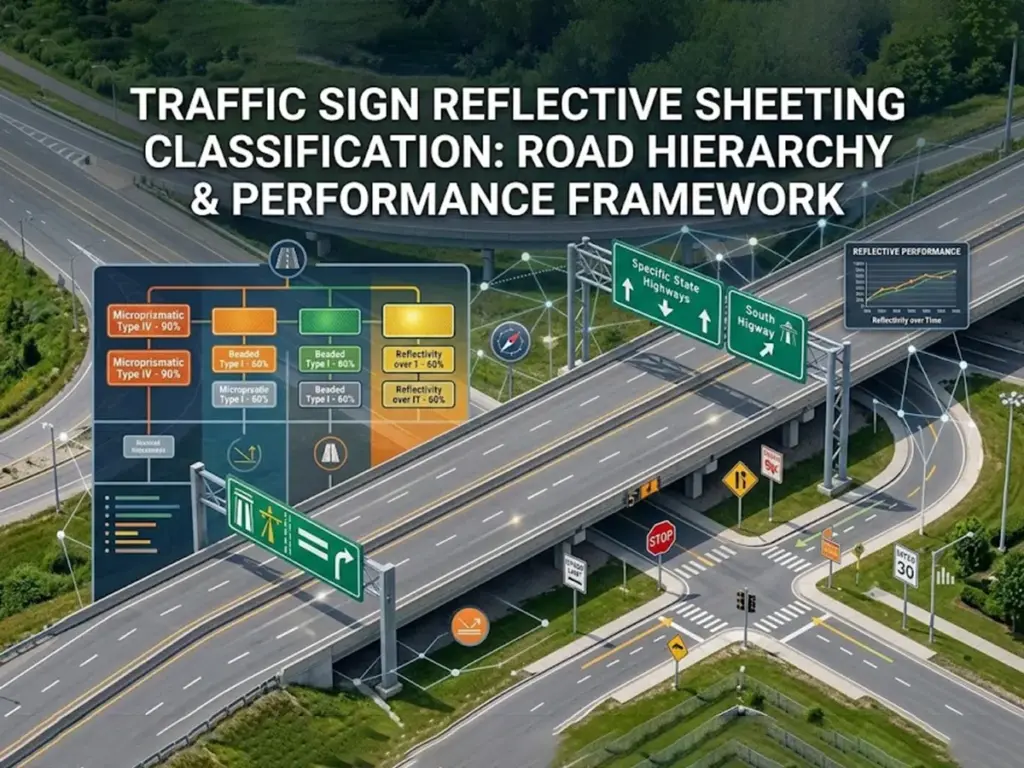
| Sheeting Class / Type | AS/NZS 1906.1 Designation | EN 12899-1 Class | Technical Structure | Service Life (Years) | 2026 Primary Application & Selection Guide |
| Engineer Grade (EG) | Class 100 (formerly Class 1) | RA1 (Class A) | Glass Bead / Basic Microprismatic | 5 – 7 | Phasing Out. Only used for non-critical internal logistics parks, low-speed parking lots, or temporary non-roadway informational signage. |
| High Intensity Prismatic (HIP) | Class 400 (formerly Class 2) | RA2 (Class B) | Encapsulated Microprismatic | 10 | Urban collector roads, general residential streets, and temporary traffic management (TTM) work zones. |
| Ultra/Super High-Performance | Class 900 (formerly Class 3) | RA3 (Class C) | Full-Cube Microprismatic | 12 | Motorways, freeways, rural national highways, high-risk warning zones, and overhead gantry signs. |
| Premium / Fluorescent Grade | Class 1100 (formerly Class RX) | RA3 + Fluorescent | Full-Cube Prismatic with Fluorescent Layer | 12+ | High-speed multi-lane interchanges, school zones, pedestrian crossings, sharp curves, and industrial SDS/toxic chemical signage. |
Source: Retroreflective materials and devices for road traffic control purposes, Part 1: Retroreflective sheeting,
Glass-bead sheeting — covering AS/NZS Classes 1 and 2 — delivers adequate performance for low-speed urban environments and temporary works where budgetary constraints justify a shorter replacement cycle. Microprismatic retroreflective sign sheeting from Class 3 upward delivers the wide-angle RA performance required on high-speed strategic roads, where a truck driver’s sightline to a sign approaches at a much shallower entrance angle than a passenger vehicle.
Procurement managers sourcing finished sign hardware — rather than raw sheeting rolls — must verify whether their fabricator applies sheeting in-house under controlled temperature and humidity conditions, or subcontracts application. Improper application voids retroreflective performance warranties and undermines the laboratory-certified RA values of even premium sheeting products.
Climatic Performance and Environmental Durability: Specifying for Australian and UK Field Conditions

UV Resistance and Thermal Cycling: Specifying for Australian Conditions
Australia presents the most extreme UV environment of any major road network globally. The Australian Radiation Protection and Nuclear Safety Agency (ARPANSA) UV Index data for 2024 documents annual UV indices exceeding 14 in Darwin, Cairns, and Alice Springs — a level that accelerates binder degradation in glass-bead retroreflective sign sheeting far beyond what AS/NZS 1906.1 accelerated UV weathering tests, calibrated to temperate test conditions, fully predict.
In direct solar exposure, aluminium sign substrate surface temperatures routinely exceed 70°C in central and northern Australian summer conditions. This thermal cycling stress causes differential expansion between the sheeting adhesive layer, the aluminium substrate, and the sheeting face — producing delamination at the sheeting-substrate interface that accelerates RA degradation independent of UV binder breakdown. Procurement managers specifying retroreflective sign sheeting for tropical or desert-zone projects must require field performance data from comparable AU climate zones, not laboratory certification alone.
Moisture, Freeze-Thaw, and Salt Spray Resistance: UK and High-Altitude Australian Applications
UK road environments impose a different but equally demanding durability challenge. UK Met Office Climate Data 2024 confirms that northern England and Scotland receive 1,200–3,000 mm of annual rainfall, combined with sustained periods below 0°C in upland areas — conditions that drive moisture ingress at the sheeting–substrate interface and freeze-thaw delamination cycles.
De-icing salt spray presents a co-specification challenge: salt accelerates corrosion of aluminium sign blanks beneath the sheeting layer, undermining adhesive bond strength from below. Procurement managers specifying retroreflective sign sheeting for UK motorway or A-road applications should co-specify a minimum salt spray resistance of 1,000 hours per ISO 9227 on the sign substrate aluminium, and confirm surface pre-treatment — typically chromate conversion or anodising — as part of the sign fabrication specification.
Australian high-altitude equivalents — the NSW Snowy Mountains, alpine Victoria, and the ACT tablelands — experience comparable freeze-thaw exposure to UK upland road environments. Traffic sign material selection for these zones must account for this, even within an otherwise subtropical national network.
Vendor Qualification: How to Evaluate Retroreflective Sign Sheeting Suppliers and Fabricators
The Accreditation and Certification Checklist
Vendor qualification for retroreflective sign sheeting supply goes significantly beyond price benchmarking. A structured qualification process reduces compliance risk, protects programme timelines, and satisfies both internal procurement governance and external audit requirements. The table below outlines the minimum qualification criteria procurement managers should apply.
| Qualification Criterion | What to Verify (Modern Compliance Mandates) | Modern Standard / Framework Baseline |
| AS/NZS 1906.1 & BS EN 12899-1 CoC | Certificate of Conformance (CoC) must reflect current $R_A$ performance brackets (Class 100/400/900/1100 for AU/NZ; RA1/RA2/RA3 for EU). Must be batch-specific and issued by a NATA/IANZ or UKAS accredited laboratory within the past 2–3 years. | AS 1906.1:2017 / BS EN 12899-1:2007 (with current National Annexes) |
| NHSS 12A / Sector Scheme Registration | Mandatory for any UK National Highways supply chain. Verify valid registration on the Schedule of Suppliers (Lantra database). Scope must explicitly cover permanent/temporary vertical signs. | Sector Scheme 12A/12B Modern Safety Mandates |
| ISO 9001:2015 QMS Integration | Audit scope cannot just cover “general sign manufacturing.” The QMS must explicitly cover controlled retroreflective sheeting application, substrate degreasing, and thermal/pressure bonding environments. | ISO 9001:2015 Third-Party Certified |
| Austroads Harmonized National Registration | Instead of checking isolated state registers, verify full compliance with the new Austroads ATS 4310 framework. Sign manufacturers must be on the unified national prequalification register recognized across all jurisdictions. | Austroads ATS-4310 (Released April 2026) |
| Controlled Application Facility Evidence | Evidence of Vertical Integration. The vendor must prove sheeting is applied via automated mechanical applicators in a dust-free, temperature-controlled environment ($18^\circ\text{C} – 24^\circ\text{C}$) to prevent premature delamination or bubbling. | Manufacturer-Sanctioned Converter Status |
| End-to-End Batch Traceability | Digital QR or barcodes affixed to the rear of the sign linking the finished sign serial number to the exact raw reflective sheeting roll batch number, application date, and operator ID. | Modern Asset Management Standards |
| Accelerated & Real-World Weathering Data | Verification of data proving structural integrity and color retention under high-UV / extreme climate conditions matching the installation zone (e.g., equatorial, temperate, or coastal/corrosive environments). | ASTM D4956 / Austroads Weathering Protocols |
Source: Austroads Technical Specifications (ATS-4310: Supply of Road Signs), UK National Highway Sector Schemes (NHSS) Information
Batch Consistency and Supply Chain Traceability
Retroreflective sign sheeting RA values vary between production batches from the same manufacturer — a variability that creates visible inconsistency across sign families on a single road corridor if batch management is not contractually mandated. Large-scale infrastructure programmes — motorway gantry signing upgrades, national highway signing standardisation projects — must specify that all signs within a visual corridor draw from a single documented production batch or matched batches with verified RA value alignment.
Procurement managers should contractually require a traceability documentation package per delivery: sheeting roll batch number, sheeting OEM manufacturer and product code, application date, application environment conditions (temperature and relative humidity at time of lamination), sign serial numbers, and QC inspection records. A vertically integrated manufacturer — one that applies sheeting in-house and fabricates finished sign hardware within a single controlled facility — can deliver this as a standard compliance package, eliminating the multi-supplier documentation chase that characterises distributed supply chains.
OPTsigns operates as a vertically integrated manufacturer of retroreflective sign sheeting and finished traffic sign hardware, supplying batch traceability documentation as standard on all programme orders. Contact the OPTsigns procurement team to discuss framework supply agreements, batch reservation for large programmes, and factory-direct compliance packages.
Lead Times, Programme Scheduling, and Supply Chain Risk
Retroreflective sign sheeting supply lead times carry programme-critical implications. Global sheeting OEMs — including 3M, Avery Dennison, and Orafol — supply through distribution channels that introduce scheduling uncertainty, particularly when premium microprismatic sheeting grades face constrained batch availability. Procurement managers on major infrastructure programmes should establish a framework supply agreement with a qualified fabricator before construction programme commencement — not at the point of sign schedule finalisation.
A vertically integrated sign manufacturer compresses the fabrication-to-delivery timeline by eliminating inter-company logistics handoffs, maintaining direct production scheduling control, and enabling real-time programme tracking. Late sign schedule content changes — a routine occurrence in infrastructure delivery — are far more efficiently accommodated within a single-source supply chain than across a multi-tier procurement model.
In-Service Performance, Inspection, and End-of-Life Replacement Strategy
Retroreflective sign sheeting performance degrades over its service life as UV exposure, moisture cycling, and mechanical weathering progressively reduce RA values. Highway authorities and road asset managers who lack an active sign asset register — tracking installation date, sheeting class, and projected end-of-service-life date — default to reactive replacement procurement. Reactive procurement consistently delivers higher unit costs, extended lead time exposure during emergency supply, and compliance risk when signs fall below minimum RA thresholds between inspection cycles.
The Austroads Guide to Road Design Part 6A: Paths for Walking and Cycling (2023) — and more directly, the Austroads Road Asset Management guidance — advocates for proactive signing asset management frameworks tied to sheeting class service life data. In the UK, Traffic Signs Manual Chapter 2 (2022 edition) provides maintenance inspection guidance for fixed road signs, including retroreflectivity assessment.
In-service retroreflectivity assessment uses either subjective night-time drive-through evaluation — common in local council highway authority practice — or portable retroreflectometer measurement (instruments such as the Delta LTL-X or Mirolux 30, per ASTM E1709 protocols). Procurement managers advising on asset management frameworks should advocate for retroreflectometer measurement on strategic and high-speed roads where quantified RA compliance records support regulatory and insurance requirements.
Factory-Direct Procurement: The Vertical Integration Advantage
The distinction between a retroreflective sign sheeting distributor and a vertically integrated sign manufacturer is commercially significant for large-scale procurement programmes. A distributor sources pre-fabricated components from multiple suppliers and assembles a finished product — introducing quality interface risks at each supply chain handoff. A vertically integrated manufacturer controls the complete production chain: substrate procurement, surface preparation, sheeting application under controlled environmental conditions, hardware fabrication, quality inspection, and dispatch documentation.
This integration translates to four material procurement benefits: first, quality control continuity across all production stages with no inter-supplier specification gaps; second, consolidated compliance documentation in a single package rather than aggregated across multiple sub-suppliers; third, lead time compression through unified production scheduling; and fourth, pricing transparency with BOM-level cost visibility available for framework contract negotiation.
OPTsigns’ engineering team works directly with procurement managers and project engineers to develop custom sign specifications for non-standard applications — including bespoke gantry signing, mine-site and port access road signing, and heritage conservation area requirements. Wind load calculations to AS/NZS 1170.2 (Australia) or BS EN 40-3 (UK), substrate grade selection, and retroreflective sheeting class confirmation are provided as part of a custom engineering consultation. Enquire with the OPT Signs procurement team to initiate a vendor qualification review or request a custom engineering consultation for your programme.
Pre-Procurement Decision Checklist: From Specification to Factory-Direct Supply
The following sequential checklist supports procurement managers in resolving the key specification and vendor selection decisions before issuing an RFQ or purchase order for retroreflective sign sheeting supply.
- Confirm applicable standard: AS/NZS 1906.1 (AU/NZ), BS EN 12899-1 (UK/EU), or dual-compliance for international projects
- Identify road classification and confirm required sheeting class per Austroads / NHSS / applicable state road authority specification
- Confirm climatic zone and select sheeting technology (glass-bead vs microprismatic) appropriate to UV, moisture, and freeze-thaw exposure
- Specify substrate aluminium grade, thickness, surface treatment, and minimum salt spray resistance hours per ISO 9227
- Confirm sign legend content, regulatory approval status, and any bespoke design requirements
- Define batch traceability and compliance documentation requirements in the contract specification
- Confirm NHSS 12A accreditation requirement (UK) or Austroads/state approved supplier register (AU)
- Establish programme delivery milestones, lead time requirements, and late-change accommodation provisions
- Define in-service inspection frequency and end-of-life replacement obligations if within a maintenance contract scope
Frequently Asked Questions — Retroreflective Sign Sheeting Procurement
What is the difference between AS/NZS 1906.1 and BS EN 12899-1, and can a sign manufactured to one standard be used on a project requiring the other?
AS/NZS 1906.1 and BS EN 12899-1 reflective sheeting standards use different performance classification systems — AS/NZS Classes 1 through RX versus EN RA1 through RA3 — with different minimum RA values, test methodologies, and colour chromaticity requirements. Direct equivalency cannot be assumed. Signs manufactured to one standard must be independently verified against the other before acceptance on a project requiring dual compliance. For detailed class equivalency mapping across AS/NZS, EN, and ASTM D4956 frameworks, refer to our international procurement guide.
How should retroreflective sheeting class be specified for a mixed road hierarchy contract covering both motorway and local road signing?
A mixed-hierarchy contract requires a sign schedule that maps each sign type to its road category and the applicable sheeting class. Austroads and NHSS-aligned specifications require microprismatic sheeting (Class 3+ or EN RA2+) for high-speed strategic routes, while lower performance classes may be appropriate for local council roads. Batch management across different sheeting classes within a single contract is critical — classes must be clearly segregated, documented, and traceable to individual sign serial numbers.
What documentation should procurement managers require for a government audit or project compliance review?
The minimum compliance documentation package for retroreflective sign sheeting supply includes: current AS/NZS 1906.1 or BS EN 12899-1 product test certificates from NATA/IANZ or UKAS-accredited laboratories (dated within 12 months), batch-specific sheeting roll certificates traceable to individual sign serial numbers, substrate aluminium material test certificates, fabrication QC inspection records, NHSS 12A accreditation certificate (UK), and ISO 9001:2015 certification. A vertically integrated manufacturer supplies this as a consolidated package per delivery, significantly reducing procurement team administrative burden.
What are the most common retroreflective sign sheeting field failures in Australian and UK conditions?
Three primary field failure modes recur across both markets. First, RA degradation below minimum threshold caused by UV breakdown of the sheeting binder — mitigated by specifying microprismatic sheeting with AS/NZS UV weathering certification appropriate to the climate zone. Second, delamination at the sheeting–substrate interface resulting from surface preparation failure during application — mitigated by requiring factory application under controlled environmental conditions with ISO 9001-documented process controls. Third, substrate corrosion undermining sheeting adhesion — mitigated by specifying marine-grade aluminium alloy (5052 or 5083) with appropriate surface treatment for the project’s exposure classification.
What lead times should procurement managers plan for bulk retroreflective sign sheeting orders?
For standard sign schedules supplied from an established product range, a vertically integrated fabricator typically delivers within four to eight weeks from confirmed order, subject to batch availability and production scheduling. Complex custom-engineered gantry signs or non-standard sign types typically require eight to fourteen weeks. Procurement managers on major infrastructure programmes should establish a framework supply agreement — with agreed pricing, batch reservation rights, and production slot commitments — at least twelve weeks before the first scheduled sign delivery requirement to avoid programme-critical delays.
References
World Health Organization. (2023). Global Status Report on Road Safety 2023.
Australian Institute of Health and Welfare. (2024). Road Safety in Australia.
Department for Transport, UK. (2024). Road Casualties Great Britain: Annual Report
UK Met Office. (2024). UK Climate Averages
Department for Transport, UK. (2022). Traffic Signs Manual Chapter 2: Informatory Signs
International Organization for Standardization. (2017). ISO 9001:2015 — Quality Management Systems
ASTM International. (2020). ASTM D4956-20 — Standard Specification for Retroreflective Sheeting for Traffic Control.