Uma placa de rua cai durante uma tempestade de vento. Dentro de uma hora, 911 o despacho está encaminhando as equipes de emergência por um corredor sem endereço visível - e seu diretor de obras públicas já está ao telefone com um advogado. O hardware que falhou não foi feito de forma barata. Foi especificado incorretamente. Essa distinção é extremamente importante quando o Manual sobre Dispositivos Uniformes de Controle de Tráfego da FHWA (MUTCD) requer permanente, colocação de sinalização legível e seu município terá exposição direta à responsabilidade por cada lâmina com falha.
Este modo de falha é totalmente evitável. Tudo se resume a uma decisão de especificação upstream: entender quando colchetes extrudados para nomes de ruas são a escolha estruturalmente apropriada em relação ao hardware de tampa plana padrão. Este guia oferece aos engenheiros de tráfego e aos diretores de compras uma estrutura técnica baseada em dados para tomar decisões com precisão e sem suposições..
Quando o hardware de suporte se torna uma decisão de engenharia estrutural
Um padrão 9″ × 36″ lâmina de sinalização de alumínio – comum em todo o condado 911 abordando implantações - apresenta aproximadamente 2.25 m². ft. da área de superfície do vento projetada. Sob ASCE 7-22 critérios de carga em um 90 mph projeto velocidade do vento (Categoria de exposição C), que gera cerca de 18–22 libras. da força lateral na interface suporte-poste. Para uma lâmina dupla 911 conjunto, essa força quase dobra – indo muito além do que o hardware de nível residencial é classificado para resistir em um período sustentado, base cíclica.
Essa aritmética é precisamente a razão pela qual selecionar colchetes extrudados para nomes de ruas para instalações pesadas é uma decisão de engenharia estrutural, não é uma otimização de compra de item de linha.
O perfil de carga física de uma lâmina de sinalização de rua para serviços pesados
No momento em que uma especificação exige um 9″ × 36″ lâmina, um conjunto de lâmina dupla, ou folhas retrorrefletivas Diamond Grade – cada uma adicionando 0,3–0,5 lbs. por metro quadrado. ft. em comparação com o filme Engineer Grade — o perfil de carga na interface do suporte ao poste muda materialmente. O braço de momento cantilever aumenta com cada centímetro de altura da lâmina acima da linha central de montagem. Uma lâmina dupla 911 a montagem em uma única posição superior de poste impõe aproximadamente 2,4x a demanda de momento de um único padrão 6″ × 18″ blade – um fator de escala que as especificações de hardware comum não levam em conta.
Falha de suporte como evento de responsabilidade municipal e conformidade com FHWA
Quando um suporte de sinal falha, As obrigações de conformidade do MUTCD não param. De acordo com o Manual de Dispositivos de Controle de Tráfego da FHWA (2022 edição), as agências são responsáveis por manter a sinalização retrorrefletiva em posicionamento adequado – e falhas documentadas sem um registro de manutenção corretiva criam exposição direta à responsabilidade. Em 911 endereçamento de aplicações, as apostas são ainda maiores: um dezembro 2023 Associação Nacional de Número de Emergência (NENA) o resumo da política identificou falhas nos sinais de trânsito como um fator que contribui para o atraso na resposta de emergência em 14% dos incidentes de despacho rural pesquisados. Especificar o suporte certo para sinalização de rua resistente desde o início é gerenciamento de risco, não despesas gerais de aquisição.
Por que o hardware de uso geral não se adapta a aplicações pesadas
Os grampos de sinalização de uso geral e as ferragens de tampa plana prontas para uso são projetados para aplicações de serviço padrão — 6″ × 18″ lâminas, corredores urbanos protegidos, zonas de vento baixo a moderado. Escalando-os para 9″ × 36″ pás ou exposições costeiras e de planícies a ventos fortes introduzem uma incompatibilidade estrutural: o caminho de carregamento do hardware, força de aperto, e a seção transversal do material nunca foram analisadas quanto à tensão para esse perfil de demanda.
Antes de finalizar qualquer decisão de categoria de chave, nossa referência em configurações de suporte comuns para instalações de sinalização de rua fornece uma estrutura inicial útil para categorizar os requisitos da aplicação antes de aprofundar a comparação técnica abaixo.
Por Dentro do Processo de Extrusão de Alumínio: Por que o método de fabricação determina a integridade do suporte
Os suportes de sinalização de alumínio extrudado obtêm suas vantagens estruturais não apenas pela seleção da liga, mas de como o alumínio é formado. O processo de extrusão força o alumínio aquecido através de uma matriz usinada com precisão sob pressão controlada, produzindo um contínuo, perfil transversal contínuo com estrutura de grãos alinhada em todo o comprimento da peça.
O que o processo de extrusão faz com um suporte de alumínio – e por que é importante estruturalmente
Ao contrário da fundição – onde o alumínio fundido solidifica com potenciais microvazios, fechamento a frio, e orientação de grão aleatória - a extrusão produz denso, fluxo de grãos consistentemente orientado ao longo do eixo de suporte de carga. Isso significa que a zona de maior estresse do suporte (a interface tampa-poste sob carga de vento lateral) não contém porosidade interna ou concentradores de tensão. De acordo com os padrões e dados de alumínio da Associação de Alumínio (TEA) publicação, perfis extrudados alcançam consistentemente maiores relações entre resistência ao escoamento e peso do que componentes fundidos equivalentes na mesma classe de liga - uma vantagem estrutural direta na interface de montagem.
Canais de Slot Integrados vs.. Pontos de fixação perfurados ou aparafusados
A vantagem mecanicamente mais significativa colchetes extrudados para nomes de ruas é a capacidade de incorporar perfis de ranhura T ou canal C diretamente no corpo do suporte durante a matriz de extrusão de alumínio. Como esses canais de fixação são geometricamente integrados ao perfil - formados na mesma operação que o próprio corpo do suporte - eles não introduzem furos, sem aberturas perfuradas, e sem abas soldadas no ponto de transferência de carga.
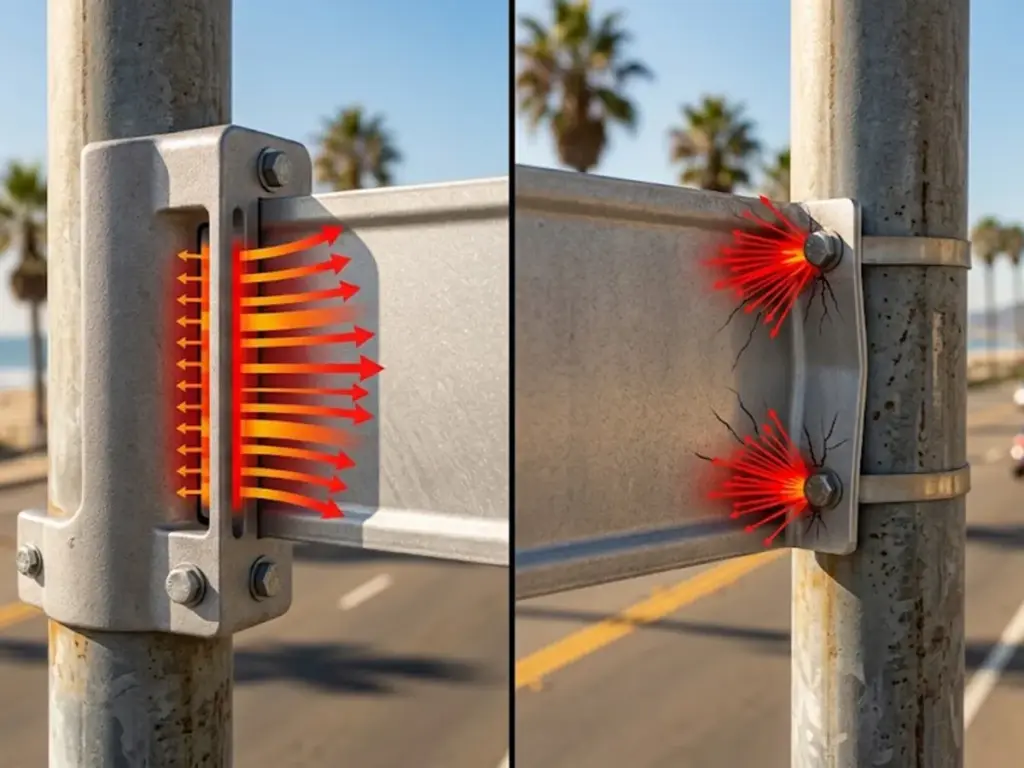
Essa distinção é mecanicamente decisiva. Cada furo de fixação perfurado em uma tampa plana estampada cria um aumento de tensão: uma descontinuidade geométrica localizada onde a tensão se concentra em 2–3× a tensão nominal da seção sob carga. As rachaduras por fadiga no hardware de sinalização iniciam-se quase exclusivamente nesses recursos. Em vez disso, um canal de ranhura extrudado distribui a carga de fixação ao longo de um engate linear contínuo, eliminando totalmente a concentração de tensão de contato pontual.
Consistência dimensional e o que significam tolerâncias rígidas no campo
A extrusão mantém tolerâncias transversais dentro das faixas publicadas nos Padrões e Dados de Alumínio da Associação de Alumínio – normalmente ±0,010″ para ±0,020″ em dimensões críticas para perfis nesta classe de tamanho. Praticamente, isso significa que o 500º suporte em uma produção assenta no poste e segura a lâmina de forma idêntica ao primeiro.
As tampas planas estampadas se comportam de maneira diferente. O desgaste progressivo da matriz e o retorno elástico do material introduzem desvio dimensional em toda a produção, produzindo lacunas de montagem que causam força de fixação desigual. A força de fixação desigual sob carga de vento cíclica é o mecanismo por trás do afrouxamento dos fixadores induzido por vibração – a causa mais comum de retornos de chamada de manutenção em hardware de sinalização municipal.
Anatomia de um suporte de tampa plana: Forças Legítimas e Limites Estruturais Definidos
Um suporte de sinalização de rua em formato de tampa plana padrão é um suporte competente, solução econômica dentro do seu envelope de aplicação correto. Torna-se um passivo apenas quando especificado fora desse envelope.
Como os suportes de tampa plana são construídos e como eles prendem as lâminas
Um suporte de tampa plana convencional é uma placa estampada ou moldada por pressão com um perfil flangeado que envolve a borda superior da lâmina de sinalização. A força de fixação é gerada por parafusos passantes ou parafusos de carro que puxam a tampa contra uma placa de apoio ou diretamente contra o poste. O design é simples, ferramenta barata, e totalmente adequado para serviço padrão 6″ × 18″ ou 6″ × 24″ lâminas em corredores urbanos protegidos.
Distribuição de tensão de carga de vento – e as zonas críticas de falha
Sob carga de vento lateral, uma tampa plana transfere força através de uma pequena área concentrada na interface do fixador. Três zonas de falha dominam:
- Bordas do furo de fixação - onde a concentração de tensão inicia a fissuração por fadiga.
- O raio de curvatura do flange da tampa — onde o carregamento repetido produz deformação plástica progressiva e eventual liberação da lâmina.
- A haste do parafuso — onde a carga de cisalhamento cíclica leva à falha por fadiga bem abaixo da classificação estática do fixador.
Especificações padrão da AASHTO para suportes estruturais para sinalização rodoviária, Luminárias, e sinais de trânsito (LTS-1) os quadros sinalizam a avaliação de suporte exatamente em torno desse comportamento de carga de fadiga, em vez de apenas na capacidade estática - razão pela qual as classificações de carga estática por si só são insuficientes para decisões de especificação.
Caminhos de corrosão e o ciclo de manutenção previsível
Conjuntos de tampa plana geralmente combinam fixadores de aço com tampas de alumínio ou aço revestido. Esse contato de metal diferente estabelece uma célula galvânica: em ambientes costeiros ou salinos, a corrosão inicia na interface do fixador – precisamente o local de maior tensão na montagem. Lascas de revestimento nas cabeças dos parafusos expostas aceleram o processo. O resultado é um ciclo previsível de manutenção de inspeção e reaperto que os conjuntos integrais extrudados evitam em grande parte, porque há menos fixadores, menos superfícies dependentes de revestimento, e sem arestas perfuradas para cortar.
Suportes extrudados para nomes de ruas sob carga de vento: Construindo o caso para conformidade com o DOT
Como a geometria da tampa extrudada distribui as forças laterais e de elevação
O argumento estrutural para colchetes extrudados para nomes de ruas reduz a um princípio: engajamento linear supera contato pontual. Onde uma tampa plana prende uma lâmina em dois ou três locais de parafusos distintos, um canal de ranhura extrudado engata a lâmina em toda a sua largura inserida. A mesma força total é distribuída por uma área de contato substancialmente maior, reduzindo proporcionalmente o pico de tensão local - o mecanismo que suprime o início de trincas por fadiga ao longo de uma vida útil de 10 a 20 anos.
Aplicando critérios de carga FHWA e AASHTO para 911 Especificações do suporte para sinalização de rua
911 colchetes de sinalização de rua ocupam o nível de especificação mais alto na maioria dos programas de sinalização municipal - porque a permanência da sinalização é uma função de segurança de vida, não é uma conveniência de orientação. As especificações devem prosseguir nesta ordem:
- Identifique a velocidade do vento projetada para a jurisdição usando ASCE 7-22 mapas básicos de velocidade do vento (adotado por referência no 2021 e 2024 Código Internacional de Construção).
- Determinar a categoria de exposição — Exposição C para terreno aberto, Exposição B para corredores suburbanos/arborizados.
- Calcular a pressão do vento de projeto e demanda de momento resultante na interface de montagem para as dimensões especificadas da lâmina.
- Confirme a capacidade de momento nominal do suporte excede a demanda calculada com o fator de segurança aplicável de acordo com AASHTO LTS-1.
- Verifique a categoria de fadiga em vez de confiar apenas na classificação de carga estática.
Para contextualizar como a seleção de materiais nesta categoria de hardware está evoluindo, nossa análise de direções emergentes em hardware de sinalização rodoviária de alumínio examina as mudanças no nível da indústria que impulsionam essas mudanças de design.
Modos de falha de campo: O que realmente acontece primeiro
A progressão da falha difere materialmente entre os dois projetos. Os conjuntos de tampa plana normalmente falham repentinamente – ejeção da lâmina após cisalhamento do parafuso ou deformação do flange, com pouco aviso visível. Bráquetes extrusados bem projetados tendem a apresentar, deformação plástica inspecionável no canal da ranhura antes de liberar a lâmina, dando às equipes de manutenção um sinal detectável de pré-falha durante a inspeção de rotina. Para programas de gestão de ativos baseados em ciclos de inspeção programados, que a diferença de comportamento tem valor operacional real.
Postar configurações de montagem superior e direta: Onde os projetos extrudados oferecem vantagens em campo
Por que o ponto de transferência de carga é importante nos suportes de sinalização de rua superior
Um suporte de sinalização de rua no topo do poste coloca a carga da sinalização diretamente sobre a linha central do poste, minimizando o momento de flexão excêntrico que os grampos de montagem lateral introduzem no próprio poste. Os designs extrudados da parte superior do poste integram a tampa do poste e a interface da lâmina em um único componente fabricado - eliminando o risco de desalinhamento da montagem em campo inerente aos arranjos de tampa e braçadeira de múltiplas peças.
Como fabricante de sinais de trânsito totalmente integrado, controlando toda a cadeia de fornecimento, desde substrato de alumínio até impressão retrorrefletiva personalizada, especificamos a geometria do suporte e as dimensões da lâmina como um sistema correspondente, em vez de componentes de origem separada.
Sistemas de slots integrados: Ajuste e facilidade de manutenção sem novo hardware
Os perfis de ranhura T e canal C permitem que a posição da lâmina seja ajustada lateralmente, ou uma lâmina a ser substituída, sem fazer novos furos ou adquirir hardware diferente. Em uma montagem de tampa plana, a mesma tarefa normalmente requer desmontagem completa e nova perfuração — uma operação de campo de 20 a 35 minutos por posição versus cerca de 5 a 8 minutos para um ajuste baseado em slot. Em um inventário municipal de 2.000 posições, essa diferença se soma a centenas de horas de tripulação anualmente.
Contagem de hardware e equação do tempo de instalação
| Dimensão de comparação | Conjunto de tampa plana padrão | Suporte de tampa extrudado |
| Contagem de fixadores (lâmina única) | 4–6 peças + placa de apoio | 2–3 peças, sem placa de apoio |
| Engajamento de carga | 2–Contatos de 3 pontos | Slot linear contínuo |
| Método de reposição da lâmina | Desmontar + perfurar novamente | Deslize dentro do canal do slot |
| Locais de corrosão galvânica | Múltiplas interfaces de aço/alumínio | Mínimo - perfil integral |
| Risco de variação dimensional | Morrer desgaste + operação de retorno elástico | ±0,010″–0,020″ tolerância à extrusão |
| Aviso de falha típico | Repentino – cisalhamento do parafuso, ejeção da lâmina | Gradual - deformação inspecionável |
A tabela acima compara os dois tipos de colchetes na contagem de hardware, engajamento de carga, facilidade de manutenção, exposição à corrosão, e comportamento de falha.
Custo Total de Propriedade para Aquisições de Obras Públicas: Um horizonte de 10 anos
Vida útil e resistência à corrosão ao longo de uma década
Perfis de alumínio extrudado não possuem soldas, sem chapeamento para lascar, e sem arestas de corte expostas onde a adesão do revestimento falha primeiro. No litoral, sal de estrada, ou ambientes congelados e descongelados, que se traduz diretamente em intervalos de substituição estendidos em comparação com conjuntos de aço revestido ou fundidos, onde o início da corrosão está estruturalmente incorporado no projeto.
Quantificando a frequência de envio de manutenção
O modelo de custo certo não é o preço unitário – é o custo por evento de manutenção multiplicado pela frequência do evento. Um único despacho inclui o tempo da tripulação, veículo, configuração de controle de tráfego, hardware de substituição, e assinar tempo de inatividade. Aplique o custo por evento da sua própria agência em um intervalo de substituição de 3 anos versus 10 anos em todo o seu inventário de sinalização; para a maioria dos condados de médio porte, a diferença amortizada favorece colchetes extrudados para nomes de ruas decisivamente, apesar de um custo unitário mais elevado.
Em todo o condado 911 Programas: Padronização como multiplicador de custos
Especificar um único padrão de suporte extrudado em todo o 911 programa de endereçamento produz economias compostas: preços por volume, um ciclo de qualificação de fornecedor, um procedimento de treinamento de tripulação, uma parte SKU, e intervalos de manutenção previsíveis. Escreva a especificação em torno de critérios dimensionais e de desempenho - conformidade de material ASTM B221, capacidade mínima de momento nominal, faixa pós-OD - em vez de referências de marca, preservando as compras competitivas, mantendo ao mesmo tempo um piso de qualidade rígido.
Lista de verificação de especificações técnicas antes de finalizar a seleção do suporte
Parâmetros Dimensionais e de Carga Críticos (6 Critérios de ir/não ir)
- Confirme a faixa de diâmetro externo do poste que o suporte acomoda.
- Verifique a largura nominal máxima da lâmina, altura, e peso.
- Calcule a pressão do vento de projeto de acordo com ASCE 7-22 para sua jurisdição e categoria de exposição.
- Combine a capacidade de momento nominal do suporte com a demanda calculada com os fatores de segurança AASHTO LTS-1.
- Especifique a espessura mínima da parede do poste para a configuração de montagem.
- Exigir certificação de material ASTM B221 para componentes de alumínio extrudado.
Especificação de suporte correspondente ao tipo de lâmina e grau de cobertura
O grau de cobertura afeta o peso da lâmina de forma mensurável – o filme prismático de grau de diamante adiciona massa em relação ao grau de engenharia nas mesmas dimensões. Lâmina dupla 911 montagens combinam peso e área de vento projetada em um único ponto de montagem, e deve sempre desencadear uma revisão da capacidade de momento em vez de apenas uma verificação da classificação do vento ao selecionar um suporte de sinalização de rua para serviços pesados.
Escrevendo especificações de colchetes em padrões municipais e RFPs
Exigir esses envios de todos os licitantes: desenhos dimensionais, dados de teste de carga documentados, certificações de moinho para ASTM B221, e termos de garantia por escrito. A linguagem baseada no desempenho mantém as compras competitivas; a linguagem específica da marca não.
Da especificação à aquisição: Finalizando seu padrão de colchetes para nomes de ruas
Documentação do fornecedor que protege o município
Listagens de catálogo não são especificações. Relatórios de inspeção dimensional, certificações de teste de carga, e os certificados de fábrica de materiais são a documentação que defende a decisão de especificação de uma agência caso uma falha seja litigada. Uma placa caída é um evento de manutenção; uma placa derrubada que fere alguém é um processo legal – e o arquivo de especificação é o registro que importa.
Três erros de especificação que criam problemas no meio do projeto
- Subespecificação da zona de vento — aplicação de critérios de zona baixa em um corredor com ventos fortes.
- OD do suporte incompatível com o DE do poste - forçando calços de campo que comprometem a força de fixação.
- Omitindo a qualidade do material – produzindo estoque de ligas mistas que contraria a padronização.
Colocando esta decisão em pleno contexto
Colchetes extrudados para nomes de ruas são a escolha correta para lâminas de serviço pesado, lâmina dupla 911 montagens, e zonas de vento elevadas. As tampas planas padrão permanecem apropriadas para lâminas de serviço padrão em corredores protegidos. Combine o hardware com o caso de carga – e documente o porquê.
Para uma referência mais ampla abrangendo cada tipo de suporte usado em aplicações de sinalização de trânsito e de rua, nosso guia completo para opções de suporte de sinalização para infraestrutura de tráfego é o ponto de partida recomendado para qualquer revisão de especificações.
Perguntas frequentes: Colchetes extrudados para nomes de ruas
Qual é a principal diferença estrutural entre um suporte extrudado e um suporte de tampa plana?
A extrusão produz um perfil uniforme com canais de ranhura integrados e estrutura de grãos contínua, enquanto as tampas planas dependem de furos de fixação perfurados que criam concentrações de tensão. O resultado é uma distribuição linear de carga em vez de contato pontual.
Os colchetes extrudados para nomes de ruas são necessários para 911 endereçamento de programas?
Não é obrigatório universalmente, mas a maioria dos condados os especifica para 911 lâminas porque a permanência do sinal é uma função de segurança da vida. Confirme os requisitos em relação ao padrão DOT do seu estado e ASCE 7-22 critérios de vento.
Qual classificação de velocidade do vento devo especificar para colchetes de nomes de ruas?
Utilize o ASCE 7-22 velocidade básica do vento para sua jurisdição e categoria de exposição, em seguida, verifique se a capacidade de momento nominal do suporte excede a demanda calculada sob os fatores de segurança AASHTO LTS-1.
Os braquetes extrudados custam mais do que as tampas planas?
Normalmente sim no preço unitário, mas a comparação que importa é o custo amortizado por evento de manutenção ao longo 10 anos - onde menos fixadores, melhor resistência à corrosão, e intervalos de substituição mais longos geralmente revertem o resultado.
Os suportes extrudados podem ser adaptados em postes existentes?
Geralmente, desde que o diâmetro externo do poste e a espessura da parede estejam dentro da faixa nominal do suporte. Verifique ambas as dimensões antes de fazer o pedido, e solicitar amostras para testes de instalação em campo em um posto representativo.
Referências
FHWA - Manual sobre Dispositivos Uniformes de Controle de Tráfego (MUTCD), 11ª Edição
ASCE 7-22 - Cargas Mínimas de Projeto e Critérios Associados para Edifícios e Outras Estruturas
A Associação de Alumínio - Padrões e dados de alumínio
ASTM B221 — Especificação padrão para barras extrudadas de alumínio e liga de alumínio, Hastes, Arame, Perfis, e tubos
FHWA - Recursos de manutenção de retrorrefletividade de sinalização