_1795244400_WNo_1600d900.jpg)
Parking signs with arrows help drivers understand where to park, which direction to follow, and where parking restrictions begin or end. They are used in parking lots, propriedades comerciais, public streets, garagens, hospitais, campi, and event venues to make vehicle movement more organized. Depending on the message and arrow design, a sign may direct drivers toward available parking, identify an entrance or exit, or indicate the section of a curb where parking is prohibited.
Choosing the right sign involves more than selecting an arrow that points left or right. Property managers and traffic planners need to consider sign purpose, redação, arrow orientation, distância de visualização, mounting location, visibilidade, and applicable local regulations. This guide explains the main types of parking signs with arrows, how to interpret their meanings, and how to select and position them for clearer parking and traffic management.
- What Are Parking Signs with Arrows?
- Why Do Parking Signs Use Arrows?
- Common Types of Parking Signs with Arrows
- What Do Different Arrow Directions Mean?
- Parking Signs vs. LED Arrow Boards
- Where Should Parking Signs with Arrows Be Placed?
- How to Design Effective Parking Signs with Arrows
- Materiais, Refletividade, e Visibilidade
- How to Choose the Right Parking Signs with Arrows
- Erros comuns para evitar
- Perguntas frequentes
- Conclusão
1. What Are Parking Signs with Arrows?
Parking signs with arrows are traffic and parking control signs that combine written instructions, símbolos, or parking information with one or more directional arrows. The arrow communicates a direction, while the accompanying message explains what drivers should do or which parking rule applies.
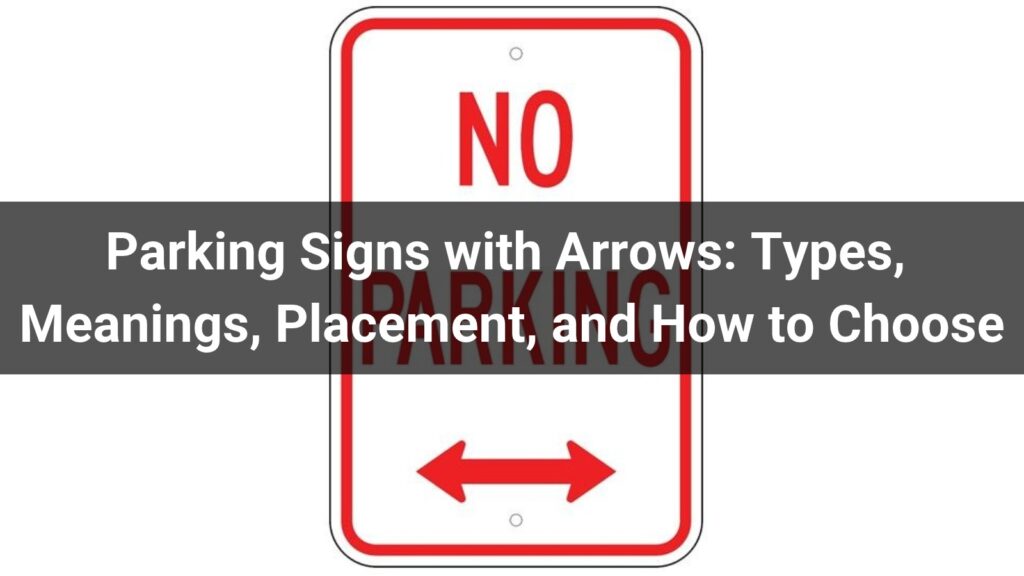
These signs serve two closely related purposes. Some are informational signs that guide drivers through a parking facility, such as signs pointing toward visitor parking, estacionamento acessível, an entrance, or an exit. Others are regulatory signs that use arrows to define the direction or extent of a parking restriction, such as a No Parking sign with a left arrow or right arrow.
The exact meaning depends on the sign message, its layout, the direction in which it faces, and the traffic regulations applicable to the location. An arrow on a directional parking sign is not necessarily interpreted in the same way as an arrow attached to a curbside parking restriction.
How Do Parking Arrow Signs Work?
A parking arrow sign provides a visual instruction that drivers can recognize without reading a long explanation. Por exemplo, a sign displaying the words "Visitor Parking" alongside a right-pointing arrow directs visitors toward the designated parking area on the right.
A No Parking sign with a directional arrow has a different function. The arrow helps indicate the direction in which the restriction applies along the curb or designated area. Drivers must read the complete sign and check nearby signs and markings to understand the restriction.
For effective communication, the arrow should be large enough to recognize at the intended viewing distance. It should also be visually connected to the relevant message so that drivers do not mistake which instruction it applies to.
Where Are Parking Signs with Arrows Used?
Directional and regulatory parking arrow signs are useful in locations where drivers need clear instructions or where several parking rules apply within a limited area. Aplicações comuns incluem:
- Commercial parking lots: Direct customers toward available parking, entradas, saídas, and designated spaces.
- Office buildings: Separate employee, visitor, entrega, and reserved parking areas.
- Hospitals and medical facilities: Guide visitors toward patient parking, emergency access, and drop-off zones.
- Schools and campuses: Organize student, funcionários, visitor, and pickup areas.
- Vias públicas: Clarify parking restrictions and the direction in which they apply.
- Locais de eventos: Help manage temporary parking arrangements and vehicle circulation.
- Parking garages: Direct drivers between levels, rampas, saídas, and available parking sections.
2. Why Do Parking Signs Use Arrows?
Parking areas often contain multiple routes, parking categories, and traffic restrictions. Text-only signs may explain a rule but still leave drivers uncertain about which direction to travel or which section of a curb is affected. Arrows provide a quick visual reference that makes the instruction easier to understand.
Melhorando o fluxo de tráfego
Clear directional signs help drivers move through a parking facility without repeatedly stopping to search for an entrance, exit, or available parking section. This is particularly important in large parking lots, multi-level garages, shopping centers, and event venues where vehicles may approach from several directions.
Signs such as "Parking Entrance →" and "Exit ←" can help separate incoming and outgoing traffic. When placed at decision points, they reduce unnecessary turning, reversing, and circulation through areas that are not intended for general traffic.
Reducing Parking Confusion
A parking facility may contain visitor spaces, employee parking, loading areas, Espaços acessíveis, espaços reservados, and short-term pickup zones. Without clear directional information, drivers may enter the wrong section or occupy spaces intended for another group.
Arrow signs connect a parking instruction with a specific direction. Por exemplo, "Reserved Parking ←" helps drivers identify where reserved spaces are located, while "Public Parking →" directs general visitors toward the appropriate area.
Clarifying Parking Restrictions
On public streets and private roads, arrows can help define the extent of a parking restriction. A No Parking sign with a left arrow or right arrow indicates the direction associated with the restriction. A double-headed arrow may indicate that the rule applies in both directions from the sign, depending on the sign design and local regulations.
This is useful where several curbside restrictions are placed along the same street. The arrow helps drivers distinguish the section covered by each sign rather than assuming that a restriction applies to the entire block.
Supporting Pedestrian and Vehicle Safety
Well-planned parking signs can help separate vehicle routes from pedestrian areas and identify locations where drivers need to slow down or change direction. Signs directing vehicles away from pedestrian entrances, rotas de acesso de emergência, or loading areas can support a more organized site layout.
3. Common Types of Parking Signs with Arrows
Parking signs with arrows are available in different formats according to their intended function. Some direct drivers to a destination, while others communicate restrictions or organize traffic movement. Identifying the purpose first makes it easier to select the appropriate wording and arrow configuration.
3.1 Directional Parking Signs
Directional parking signs guide drivers toward a specific parking destination or facility. They are commonly installed at entrances, intersections within parking lots, calçadas, rampas, and other decision points.
Typical messages include:
- Estacionamento →
- Estacionamento para visitantes ←
- Customer Parking →
- Employee Parking ↑
- Parking Entrance →
- Parking Exit ←
The arrow should point toward the actual destination or route. If the parking area is around a corner or on another level, the sign sequence should provide enough information for drivers to follow the route without guessing.
3.2 No Parking Signs with Arrows
No Parking signs with arrows communicate where parking is prohibited. They are often used along public streets, private access roads, loading areas, pistas de fogo, and other locations where vehicles must not be left unattended.
A left-pointing or right-pointing arrow generally indicates the direction in which the restriction applies. A double-headed arrow may indicate that the restriction extends in both directions. No entanto, the exact legal interpretation depends on the sign format and the applicable local traffic rules.
For a more detailed explanation of arrow directions on restriction signs, see the related guide: O papel das setas nos sinais de estacionamento: Esquerda, Certo, e regras de sequência dupla.
3.3 Parking Entrance and Exit Signs
Entrance and exit signs help drivers identify where to enter or leave a parking facility. They are especially useful at sites with separate entry and exit driveways, one-way circulation, or limited visibility around buildings.
A sign reading "Parking Entrance →" should direct vehicles toward the correct entrance lane. An "Exit ←" sign should point toward the designated exit route. Sempre que possível, use separate and clearly visible signs for incoming and outgoing traffic.
3.4 Reserved and Designated Parking Signs
Reserved parking signs identify spaces or sections assigned to specific users, such as employees, tenants, visitantes, clientes, or service vehicles. An arrow can direct drivers toward the relevant row or zone.
Examples include "Reserved Parking →," "Visitor Parking ←," and "Loading Zone →." The wording should clearly identify who may use the area, while the arrow should indicate the correct direction.
3.5 Accessible Parking Directional Signs
Accessible parking signs with arrows help drivers locate designated accessible parking spaces. They may be installed at facility entrances, interseções, or other points where drivers need to turn toward the accessible parking area.
The arrow should direct drivers to the actual accessible spaces rather than to a general parking area. The sign design, símbolo, colocação, and any required supplemental information should comply with the applicable accessibility and traffic regulations.
3.6 Loading Zone and Drop-Off Signs
Loading and drop-off areas need clear identification because vehicles may stop temporarily while passengers or goods are being handled. Arrow signs can indicate where a loading zone begins, which direction vehicles should enter, or where a pickup area is located.
Typical messages include "Loading Zone →," "Passenger Drop-Off ←," and "Delivery Vehicles Only →." Where stopping or waiting time is restricted, the sign should also communicate the relevant time limit or operating conditions.
| Tipo de sinal | Typical Message | Finalidade Primária |
|---|---|---|
| Directional parking | Estacionamento → | Guides drivers toward a parking area |
| Proibido Estacionar | Proibido Estacionar ← | Indicates the direction of a parking restriction |
| Entrance and exit | Saída → | Identifies a vehicle access route |
| Estacionamento reservado | Estacionamento para visitantes ← | Directs drivers to a designated parking section |
| Estacionamento acessível | Accessible Parking → | Guides drivers toward accessible spaces |
| Zona de Carga | Zona de Carga → | Identifies a designated loading or delivery area |
| Drop-off area | Passenger Drop-Off ← | Directs vehicles toward a passenger drop-off point |
4. What Do Different Arrow Directions Mean?
The meaning of an arrow on a parking sign depends on the type of sign. On a directional sign, the arrow generally points toward the destination or route. On a regulatory parking sign, it may identify the direction in which a restriction applies.
Understanding this distinction is important because the same arrow shape can communicate different instructions when used with different sign messages.
Left-Pointing Arrow
On a directional parking sign, a left-pointing arrow generally tells drivers to turn left or follow the route to the left. Por exemplo, "Customer Parking ←" directs customers toward the parking area on the left.
On a No Parking sign, a left-pointing arrow generally indicates that the parking restriction applies in the direction to the left of the sign. Drivers should check the sign wording, nearby signs, marcações de meio-fio, and local rules to determine the exact restricted section.
Right-Pointing Arrow
A right-pointing arrow on a directional parking sign indicates that drivers should proceed or turn right toward the stated destination. It may be used for parking entrances, visitor parking, saídas, or loading areas.
On a No Parking sign, the right arrow generally identifies the direction in which the restriction applies. Drivers should not assume that the restriction ends at the next driveway or intersection unless the local sign system or regulations establish that boundary.
Double-Headed Arrow
A double-headed arrow points in two opposite directions. On a regulatory parking sign, it commonly indicates that the restriction applies in both directions from the sign. This type of sign may be positioned within a restricted curb section to show that the rule extends to both sides.
On a directional or informational sign, a double-headed arrow may communicate movement in two directions or identify a route that continues on either side. The accompanying text and sign layout must make the intended instruction clear.
Upward and Downward Arrows
An upward arrow may indicate that drivers should continue straight ahead. It is often used in parking garages, internal roads, and multi-level facilities where drivers need to follow a specific route.
A downward arrow may be used in diagrams or signs to identify a location directly below or to point toward a particular row or area. Its meaning should be established by the complete sign design rather than assumed from the arrow alone.
| Direção de seta | Directional Parking Sign | Parking Restriction Sign |
|---|---|---|
| Esquerda ← | Directs drivers toward the left | Generally indicates the restriction applies to the left |
| Certo → | Directs drivers toward the right | Generally indicates the restriction applies to the right |
| Both directions ↔ | May indicate routes or movement in two directions | Generally indicates the restriction applies in both directions |
| Straight ahead ↑ | Directs drivers to continue forward | Meaning depends on the specific regulatory sign design |
5. Parking Signs vs. LED Arrow Boards
Static parking signs and electronic LED arrow boards both use arrows to communicate direction, but they serve different operational purposes. Understanding the difference helps property managers and traffic planners choose the correct equipment.
Static Parking Signs
Static parking signs use printed text, símbolos, and directional arrows on a fixed sign face. They are suitable for permanent or long-term instructions such as parking entrances, espaços reservados, visitor parking, no parking areas, and designated loading zones.
These signs are commonly installed on posts, paredes, cercas, or other fixed structures. Uma vez instalado, they communicate the same instruction continuously and do not require an electrical power source to display their message.
LED Arrow Signs and Flashing Arrow Boards
LED arrow signs use illuminated lamps to display directional patterns. Unlike conventional static parking signs, they can provide more noticeable guidance in temporary traffic management situations, como fechamento de pistas, desvios, zonas de trabalho, resposta a incidentes, e controle de tráfego de eventos.
Depending on the model, LED arrow signs may support multiple display patterns, adjustable brightness, different mounting arrangements, and customized configurations. These features make them useful where traffic direction may need to change or where drivers need an illuminated warning.
Por exemplo, OPTRAFFIC's Custom Lightweight LED Arrow Sign is designed for traffic guidance and safety applications. Published product information includes multiple size configurations, amber LED lamps, 12V/24V DC power options, brightness control, and optional mounting accessories.
_1795244727_WNo_1600d900.jpg)
Key Differences Between Static and LED Arrow Signs
| Comparação | Static Parking Sign | LED Arrow Sign |
|---|---|---|
| Display method | Printed text, símbolos, e flechas | Illuminated LED arrow patterns |
| Uso típico | Permanent parking instructions and restrictions | Temporary traffic direction and lane control |
| Power requirement | Generally no electrical power required | Requires a suitable power source |
| Message flexibility | Fixed after installation | May support multiple display patterns |
| Visibilidade | Depends on sign size, contraste, colocação, e refletividade | Uses illuminated LEDs for enhanced visibility |
| Instalação | Postagens, paredes, cercas, and fixed supports | Veículos, reboques, portable frames, or fixed structures, depending on design |
When Should You Use Each Type?
Static parking signs are generally more suitable when the parking layout and instructions remain consistent. They provide a straightforward way to identify parking categories, entradas, saídas, and restrictions.
LED arrow boards are more appropriate when traffic needs active directional guidance, especially in temporary or changing conditions. Por exemplo, an event organizer may use an LED arrow sign to direct vehicles around a temporary closure or to manage traffic near an event parking entrance.
For broader applications involving temporary lane control and parking lot traffic management, see the related Arrow Board Signs for Parking Lot Lane Control guia.
6. Where Should Parking Signs with Arrows Be Placed?
Even a well-designed parking sign may fail to communicate effectively if drivers cannot see it before making a decision. Placement should be based on the parking layout, vehicle approach direction, distância de visualização, velocidade de trânsito, and the location of important decision points.
Parking Lot Entrances
Entrance signs should be positioned where drivers can identify the correct driveway or access lane before reaching the entrance. If a site has separate entrances for customers, funcionários, entregas, or visitors, use clear wording and directional arrows to distinguish them.
A sign should not be hidden behind landscaping, veículos estacionados, Portões, or other structures. Drivers need enough time to recognize the instruction and move into the correct lane safely.
Internal Intersections and Turning Points
Intersections inside parking facilities are important locations for directional signs. Drivers may need to choose between several rows, rampas, zonas de estacionamento, or exits. Place signs before the decision point rather than directly after the turn.
Where a route includes several turns, use a consistent sequence of signs so drivers can follow the direction from the entrance to the destination.
Parking Rows and Designated Areas
Signs identifying visitor, employee, reserved, or accessible parking should be placed where drivers can associate the message with the correct parking section. Avoid placing one sign where its arrow could reasonably be interpreted as applying to several different rows.
For larger facilities, repeated signs may be needed at multiple access points. Consistent wording and arrow orientation help drivers recognize the same parking category throughout the site.
Parking Garage Ramps and Levels
Multi-level garages often require signs at ramp entrances, level transitions, turning points, and exit routes. Directional arrows can help drivers distinguish upward and downward travel, identify available parking levels, and locate the correct exit.
Pay attention to ceiling height, iluminação, structural columns, and the viewing angle of approaching vehicles. Signs should remain visible without interfering with vehicle clearance or pedestrian circulation.
Restricted Curbs and No Parking Zones
No Parking signs with arrows should be positioned according to the applicable sign regulations and the intended restriction boundary. Where a restriction covers a long curb section, additional signs may be needed to make the limits clear.
Do not rely on a single arrow sign to communicate a complicated restriction if the curb contains multiple parking zones, prazos, loading areas, or exceptions. Use the required sign combinations and markings to avoid conflicting instructions.
| Localização | Recommended Sign Purpose | Placement Consideration |
|---|---|---|
| Parking entrance | Identify the correct access route | Make the sign visible before drivers reach the entrance |
| Internal intersection | Direct drivers toward the correct parking section | Install before the turning or decision point |
| Parking rows | Identify visitor, employee, or reserved areas | Position the sign so its arrow clearly corresponds to the designated area |
| Garage ramps | Indicate level direction and traffic routes | Consider sightlines, iluminação, and vehicle clearance |
| Restricted curb | Define the direction of a parking restriction | Follow local sign placement and regulatory requirements |
| Loading area | Direct delivery and service vehicles | Keep the sign visible without obstructing loading operations |
7. How to Design Effective Parking Signs with Arrows
An effective parking sign communicates one clear instruction at a glance. The message, seta, cores, símbolos, and layout should work together rather than compete for the driver's attention.
Use Short and Direct Wording
Drivers usually have limited time to read signs while moving through a parking area. Use concise messages such as "Parking," "Visitor Parking," "Exit," "Loading Zone," or "No Parking." Add only the information needed to explain the rule or identify the destination.
If a sign needs to include time restrictions, vehicle categories, or additional conditions, organize the information in a clear hierarchy. The main instruction should remain the most prominent element.
Make the Arrow Easy to Recognize
The arrow should be large enough to be identified quickly and should not be confused with decorative graphics or other symbols. Use a familiar arrow shape and maintain a clear visual connection between the arrow and the wording.
For directional parking signs, make sure the arrow points toward the actual route. For regulatory signs, use the arrow configuration required by the relevant traffic authority.
Maintain Strong Text and Background Contrast
High contrast helps drivers read a sign under different lighting conditions. Text and arrows should stand out clearly from the background. Avoid placing several colors, decorative borders, or unnecessary graphics on a sign if they reduce the visibility of the main message.
Color selection should also reflect the sign's purpose and applicable standards. Regulatory signs may have prescribed colors and layouts, while private-property directional signs may allow more design flexibility.
Use Consistent Sign Layouts
Signs throughout the same parking facility should follow a consistent visual system. Use similar wording, arrow styles, tipografia, and color conventions for related instructions.
Consistency helps drivers recognize information more quickly. Por exemplo, if all visitor parking signs use the same layout, drivers can identify the relevant destination even when the wording is viewed from a distance.
Consider Viewing Distance and Traffic Speed
A sign intended for a slow-moving parking aisle may need a different size and layout from one installed beside a higher-speed access road. The sign should be large enough to be read at the distance from which drivers need to make a decision.
Consider the approach angle, available sight distance, surrounding lighting, and possible obstructions. A sign that is technically readable when standing directly in front of it may still be ineffective for an approaching driver.
8. Materiais, Refletividade, e Visibilidade
The material and finish of a parking sign affect its durability, aparência, and visibility over time. The right specification depends on whether the sign is installed indoors or outdoors, how frequently it is exposed to weather, and whether drivers need to read it at night.
Sinais de alumínio
Aluminum is commonly used for outdoor traffic and parking signs because it is lightweight, corrosion-resistant under suitable conditions, and suitable for many fixed sign applications. It can be manufactured in different sizes and shapes and can support printed or reflective sign faces.
For outdoor parking areas, aluminum signs may be considered where long-term exposure to rain, luz solar, and changing temperatures is expected. The thickness, mounting arrangement, edge treatment, and surface finish should be selected according to the installation environment.
Reflective Sign Materials
Reflective sheeting helps return light toward its source, making a sign easier to recognize when illuminated by vehicle headlights. This can be useful in outdoor parking lots, estradas de acesso, and areas with limited ambient lighting.
The appropriate reflective material depends on the required visibility, sign purpose, applicable specifications, and project budget. Reflective performance should not be assumed from the sign's color or appearance alone.
Plastic and Other Sign Substrates
Plastic substrates may be suitable for certain indoor or temporary parking signs. They can be lightweight and easy to handle, but their weather resistance, Resistência ao impacto, and expected service life should be evaluated before outdoor use.
For temporary instructions, a portable sign may be more practical than a permanently mounted panel. For long-term outdoor installations, select a substrate and printing or reflective system intended for the expected exposure conditions.
LED Arrow Sign Materials and Components
LED arrow signs use illuminated lamps and an enclosure designed to protect the electronic components. Product specifications may include the cabinet material, LED configuration, power supply, brightness control, waterproofing, and mounting accessories.
Por exemplo, the OPTRAFFIC Other Arrow Signs product range includes a customizable LED arrow sign with an anti-UV powder-coated aluminum or galvanized steel cabinet option, amber LED lamps, and 12V/24V DC power configurations.
| Material or Feature | General Characteristics | Considerações sobre seleção |
|---|---|---|
| Aluminum substrate | Lightweight metal substrate suitable for many outdoor sign applications | Grossura, corrosion protection, montagem, and exposure conditions |
| Folha reflexiva | Returns light toward its source to improve nighttime visibility | Desempenho reflexivo, sign purpose, and applicable requirements |
| Plastic substrate | Lightweight option for selected indoor or temporary signs | Resistência ao tempo, Resistência ao impacto, and expected service life |
| LED lamps | Illuminated directional display | Brilho, display patterns, poder, and visibility conditions |
| Protective cabinet | Enclosure for electronic sign components | Proteção contra intempéries, Exposição UV, Resistência à corrosão, e acesso para manutenção |
9. How to Choose the Right Parking Signs with Arrows
Selecting parking signs with arrows requires a clear understanding of the site layout, the intended instruction, and the conditions under which drivers will see the sign. A suitable sign should communicate the correct message, direct drivers accurately, and remain visible throughout its expected service life.
_1795244850_WNo_1600d900.jpg)
9.1 Identify the Main Purpose
Start by determining what the sign needs to communicate. Is it directing drivers toward a parking area, identifying an entrance or exit, marking reserved spaces, or defining a no-parking restriction?
These applications require different messages and may be subject to different design requirements. A directional parking sign should not be confused with a regulatory sign that controls where vehicles may stop or park.
9.2 Confirm the Arrow Direction
Check the route or restricted area from the driver's point of view. A left arrow should lead to the intended left-side destination, while a right arrow should point toward the correct right-side route. For restrictions, confirm the arrow convention used by the relevant authority.
If the route changes direction more than once, consider whether additional signs are needed at subsequent intersections. A single arrow at the entrance may not be sufficient to guide drivers through a complex facility.
9.3 Review the Parking Layout
Examine the site plan and identify entrances, saídas, interseções, parking rows, pedestrian routes, loading areas, and restricted sections. The sign should correspond to the actual layout and should not direct vehicles toward a dead end or an area where parking is unavailable.
Para sites maiores, develop a sign plan that shows the location, mensagem, and arrow direction of each sign. This helps prevent conflicting instructions and unnecessary duplication.
9.4 Select the Sign Size and Viewing Distance
Sign size should be based on the distance at which drivers need to recognize and respond to the instruction. Consider the speed of approaching vehicles, largura da estrada, altura do sinal, viewing angle, and surrounding visual conditions.
A small sign may be suitable for a pedestrian walkway or low-speed parking aisle, while a larger sign may be needed at a main entrance or along a wider access road.
9.5 Choose Suitable Materials and Finishes
Consider whether the sign will be installed indoors or outdoors, whether it will be exposed to sunlight and rain, and whether nighttime visibility is important. Select the substrate, printing method, and reflective finish according to the expected operating environment.
9.6 Check Applicable Standards and Local Regulations
Public-road parking signs and traffic control devices may need to follow specific standards and local authority requirements. Nos Estados Unidos, o Manual sobre Dispositivos Uniformes de Controle de Tráfego (MUTCD) provides national standards and guidance for traffic control devices on roads open to public travel. For parking, parando, and standing signs, review Section 2B.53 and the applicable state or local supplements.
Private parking facilities may also be subject to accessibility, fire access, prédio, and local traffic requirements. Confirm the applicable rules before ordering or installing signs, especially when they communicate legal parking restrictions.
9.7 Decide Between Static Signs and LED Arrow Boards
For fixed parking instructions, static signs are often the straightforward choice. If the site needs temporary directional changes, illuminated warnings, or active traffic control, an LED arrow sign may be more suitable.
Review the operating environment, power supply, Método de montagem, display requirements, and maintenance needs before choosing an electronic arrow sign.
| Fator de seleção | What to Confirm | Por que isso importa |
|---|---|---|
| Propósito | Orientação direcional, parking restriction, entrance, exit, or designated area | Determines the message and sign category |
| Arrow direction | Esquerda, certo, straight ahead, or both directions | Ensures the sign communicates the intended route or restriction |
| Site layout | Entrances, interseções, parking rows, e zonas restritas | Prevents confusing or incorrect directions |
| Dimensões do sinal | Viewing distance, velocidade de aproximação, and available mounting space | Supports clear recognition by approaching drivers |
| Material | Indoor or outdoor exposure, impacto, e condições climáticas | Influences durability and maintenance requirements |
| Visibilidade | Iluminação, contraste, and reflective requirements | Helps drivers recognize the instruction in different conditions |
| Conformidade | Local traffic, acessibilidade, and property requirements | Helps ensure the sign is appropriate for its application |
| Display type | Static sign or electronic LED arrow board | Matches the equipment to permanent or temporary traffic needs |
10. Erros comuns para evitar
Parking signs with arrows are intended to simplify navigation and clarify restrictions. No entanto, poor wording, incorrect arrow orientation, and unsuitable placement can create additional confusion. Reviewing common mistakes before installation helps improve the effectiveness of a parking sign system.
Using an Arrow That Points in the Wrong Direction
An incorrect arrow can send drivers toward the wrong parking area, an exit-only lane, or a restricted section. Before installation, check the sign from the approaching driver's viewpoint and compare its arrow with the actual site route.
Combining Too Many Instructions on One Sign
A sign that contains several parking categories, prazos, exceptions, and arrows may be difficult to understand while driving. Separate instructions where necessary and make the primary message visually prominent.
Confusing Directional Signs with Regulatory Signs
A directional sign tells drivers where to go. A regulatory sign communicates a rule that drivers must follow. Treating these two functions as interchangeable can lead to unclear wording or an inappropriate sign design.
Por exemplo, "Parking →" is a directional instruction, while "No Parking →" communicates a restriction. The arrow may appear similar, but the complete message changes its meaning.
Installing Signs Too Late
If a sign is placed after a turning point, drivers may not have enough time or space to follow its instruction. Install directional signs before important decision points and provide additional guidance where the route changes.
Ignoring Visibility and Obstructions
Árvores, veículos estacionados, building columns, lighting fixtures, and other signs can block a driver's view. Check visibility from the actual approach direction rather than evaluating the sign only from the installation position.
Using Inconsistent Arrow Styles
Different arrow designs across the same facility can make drivers uncertain about whether the signs belong to the same guidance system. Use consistent arrow shapes, redação, cores, and layouts for related instructions.
Overlooking Maintenance
Faded graphics, damaged panels, loose mounting hardware, and obstructed signs reduce the effectiveness of parking guidance. Include signs in routine site inspections and replace or repair damaged components when necessary.
11. Perguntas frequentes
1. What are parking signs with arrows used for?
Parking signs with arrows are used to direct drivers toward parking areas, entradas, saídas, Zonas de carregamento, and designated spaces. They can also indicate the direction in which a parking restriction applies, depending on the sign message and applicable regulations.
2. What does a left arrow on a parking sign mean?
On a directional parking sign, a left arrow generally tells drivers to proceed or turn left toward the stated destination. On a No Parking sign, it generally indicates that the restriction applies in the direction to the left of the sign. The exact interpretation should be checked against local regulations and the complete sign design.
3. What does a right arrow on a No Parking sign mean?
A right arrow on a No Parking sign generally indicates that the restriction applies to the right of the sign. Drivers should check nearby signs, interseções, marcações de meio-fio, and local rules to identify the exact boundary of the restricted area.
4. What does a double-headed arrow mean on a parking sign?
A double-headed arrow on a parking restriction sign generally means that the restriction applies in both directions from the sign. On other directional signs, it may communicate two-way movement or a route extending in both directions. The accompanying message determines the intended meaning.
5. What is the difference between a parking arrow sign and an LED arrow board?
A parking arrow sign is usually a static panel with printed text, símbolos, and arrows for permanent or long-term parking instructions. An LED arrow board uses illuminated lamps to display directional patterns and is commonly used for temporary traffic control, fechamento de pista, desvios, and event traffic management.
6. Where should directional parking signs be installed?
Directional parking signs are commonly installed at parking entrances, internal intersections, turning points, parking rows, garage ramps, and access routes. They should be visible before drivers reach the point where they need to make a decision.
7. What material is best for outdoor parking signs?
Aluminum is a common substrate for outdoor parking signs because it is lightweight and suitable for many weather-exposed applications. Reflective sheeting may be used when improved nighttime visibility is required. The final specification should consider local requirements, exposure conditions, and expected service life.
8. Do parking signs with arrows need to follow MUTCD requirements?
Parking signs installed on roads open to public travel in the United States may need to comply with applicable MUTCD requirements and local authority standards. Private parking facilities may also be subject to local traffic, acessibilidade, and fire access rules. Confirm the requirements for the specific installation location.
9. Can parking signs with arrows be customized?
Many parking signs can be customized with specific wording, arrow directions, dimensões, cores, símbolos, and mounting arrangements. Customization should preserve clear communication and meet any applicable regulatory requirements.
10. When should I use an LED arrow sign for parking lot traffic?
An LED arrow sign may be useful when vehicle routes need temporary or changing directional guidance, such as during events, Manutenção da estrada, fechamento de pista, or traffic diversions. For fixed parking instructions that do not change, a static directional sign is often more suitable.
12. Conclusão
Parking signs with arrows play an important role in organizing parking areas, guiando motoristas, and communicating where parking restrictions apply. From directional signs for entrances and exits to No Parking signs with left, certo, or double-headed arrows, the correct design helps drivers understand instructions and make decisions more confidently.
The most important selection factors include sign purpose, direção da seta, redação, colocação, distância de visualização, material, visibilidade, e requisitos regulamentares. Static parking signs are suitable for consistent, long-term instructions, while LED arrow signs can support temporary traffic guidance and changing traffic conditions.
A well-planned parking sign system should use clear messages, consistent arrow designs, and carefully selected installation locations. By matching each sign to the actual parking layout and the needs of approaching drivers, property managers and traffic planners can improve navigation and reduce unnecessary confusion.
For additional information about parking and traffic sign solutions, visita OPTSIGNS. For projects that require illuminated directional guidance, explorar o OPTRAFFIC Other Arrow Signs product range. The related guide on arrow board signs for parking lot lane control explains how electronic arrow displays can support temporary vehicle guidance.