Os estimadores de projetos conhecem o sentimento. Uma placa de silhueta passa na inspeção visual na entrega, depois cai dentro de uma semana no local. Pobre especificação de sinal de trabalhador corflute raramente é visível em uma guia de remessa, ainda assim, impulsiona o retrabalho, atrasos, e conversas estranhas com o empreiteiro principal. Rejeições repetidas corroem a confiança mais rápido do que qualquer erro em um único item de linha, e esquemas de orientação de tráfego (TGS) não perdoe um homem amarelo inclinado em uma faixa de rodagem movimentada. Todo estimador que reemitiu um pedido de compra no meio do projeto entende essa dor pessoalmente.
Este guia resolve essa lacuna. Ele estabelece exatamente especificação de sinal de trabalhador corflute benchmarks – densidade GSM, tolerâncias de slot, perfis de altura, e desempenho do vento – então sua próxima auditoria BOQ é defensável, não é adivinhação.
Silhueta recortada vs sinal retangular: Por que a lógica da engenharia muda
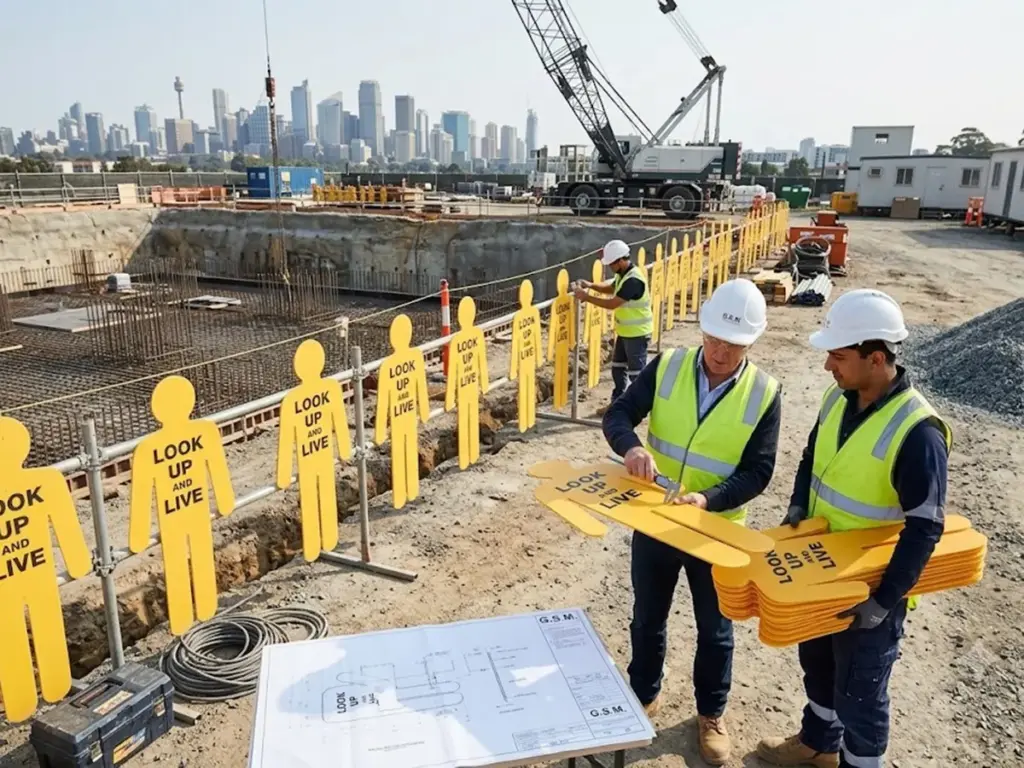
Um sinal retangular distribui a carga do vento uniformemente em um único painel plano. Um homem amarelo recortado não. O espaço negativo entre as pernas e sob os braços remove o próprio material que de outra forma enrijeceria essas regiões, criando pontos flexíveis independentes que se comportam como pequenas velas individuais no vento gerado pelo veículo.
É precisamente por isso que um genérico especificação de sinal de trabalhador corflute a documentação emprestada da sinalização retangular é estruturalmente incompleta. As especificações de espessura retangular assumem continuidade, material ininterrupto. Silhuetas não têm esse luxo.
Distribuição de carga em um painel plano versus um perfil humano segmentado
Um painel plano se flexiona como uma unidade única. Uma silhueta flexiona-se como vários membros semi-independentes, cada um com seu próprio ponto de ressonância em rajadas de vento - e é por isso que braços e cabeças falham primeiro.
Por que “3mm Corflute” por si só é uma especificação incompleta para um produto recortado
A espessura por si só não diz nada sobre a densidade interna da flauta. Duas folhas de 3 mm de diferentes tiragens podem ter um desempenho completamente diferente quando cortadas em um perfil de silhueta.
Erros comuns de item de linha do BOQ quando a sinalização Silhouette está subespecificada
O erro mais frequente que os estimadores encontram é uma listagem de cotação de fornecedor “3sinal de corflute de homem amarelo mm” sem número GSM, sem dimensão de slot, e nenhum método de corte - deixando o real especificação de sinal de trabalhador corflute indefinido até que o produto chegue ao local.
Perfis de altura e largura total para silhuetas padrão de homem amarelo
As silhuetas padrão da indústria normalmente variam de 900 mm a 1.200 mm de altura total para uso geral em obras rodoviárias, escalando até 1.500 mm para aplicações de alta visibilidade perto de corredores de alta velocidade. A proporção entre largura e altura é tão importante quanto a altura bruta, porque uma envergadura maior aumenta a área de captação do vento sem necessariamente melhorar a visibilidade do motorista.
| Dimensão | Faixa padrão | Notas |
| Altura total | 900–1200 mm | Aplicação padrão de obras rodoviárias |
| Altura total (variante de alta visibilidade) | 1200–1500mm | Corredores de alta velocidade, linhas de visão mais longas |
| Largura do braço | 550–750 mm | Dependente da pose |
| Largura da base/perna | 300–450 mm | Afeta a estabilidade da montagem no solo |
| Espessura do material | 3milímetros | Linha de base econômica padrão |
| Densidade recomendada | 700–800GSM | Exposição em nível de rodovia |
Fonte: Guia austroads para gerenciamento temporário de tráfego
Faixas de altura padrão e suas aplicações típicas no local
Silhuetas de altura mais baixa (900–1050 mm) adequar-se a obras urbanas de menor duração, enquanto a banda de mais de 1200 mm é geralmente reservada para obras arteriais e adjacentes a rodovias com distâncias de abordagem mais longas.
Largura da envergadura e seu efeito na área de captação de vento
Cada 50 mm adicionais de largura do braço aumenta a área de superfície exposta sujeita à força do vento lateral, é por isso que o correto especificação de sinal de trabalhador corflute deve equilibrar a visibilidade contra a carga estrutural.
Regras de escala – quando uma silhueta maior requer especificações totalmente diferentes
Quando uma silhueta exceder 1.200 mm de altura, Atualização GSM deixa de ser opcional. Maior área de superfície multiplica a exposição à carga do vento, e uma folha de 400–500GSM simplesmente não consegue manter a forma nessa escala.
Engenharia Estrutural: Por que o GSM é mais importante do que a espessura
Este é o argumento central da engenharia por trás de qualquer especificação de sinal de trabalhador corflute: 3mm é uma medida dimensional, GSM é uma medida de densidade, e os dois não são indicadores intercambiáveis de rigidez. Duas folhas podem compartilhar uma espessura idêntica de 3 mm, embora diferindo substancialmente na densidade do canal, qualidade da resina, e rigidez finalizada.
Corflute padrão 400–500GSM é geralmente adequado para planos, sinalização retangular estática em vento fraco, ambientes de baixo tráfego. Não é adequado para uma silhueta em forma humana, onde a remoção de material para criar o perfil de recorte concentra a tensão nos pontos estreitos – pulsos, tornozelos, e pescoço.
O que o GSM realmente mede e por que prevê rigidez melhor que mm
GSM mede a massa de material por metro quadrado, que se correlaciona diretamente com a espessura da parede do canal e a densidade da resina - os verdadeiros impulsionadores da rigidez, independente da leitura nominal do calibre de 3 mm.
O padrão de falha – flexão de braço, Cabeça caída, e colapso da flauta nas bordas cortadas
Silhuetas subespecificadas normalmente mostram flexão dos braços e queda da cabeça alguns dias após a instalação, um sintoma visível de colapso da flauta nos pontos de corte estreitos onde a seção transversal estrutural é mais fina.
Por que a densidade industrial de 700–800GSM é a referência para vórtices de esteira de veículos em rodovias
Os vórtices da esteira dos veículos gerados pelo tráfego pesado e de alta velocidade criam cargas turbulentas sustentadas muito além das condições típicas de vento ambiente referenciadas no AS/NZS 1170.2 orientação de ações estruturais do vento. Corflute de nível industrial 700–800GSM é a referência prática para silhuetas expostas a esta carga turbulenta repetida em obras civis de rodovias australianas.
Observação: Se a folha de dados do seu fornecedor atual não indicar um valor GSM, essa ausência é o risco. Como fabricante full-link, executando nossas próprias linhas de extrusão e corte e vinco, podemos especificar e certificar silhuetas de nível de engenharia para o especificação de sinal de trabalhador corflute seu site realmente precisa - não apenas de uma figura que sobreviva a uma auditoria documental.
Em 2024, 188 trabalhadores morreram devido a lesões traumáticas no local de trabalho na Austrália, com incidentes com veículos contabilizando 42% de lesões fatais – a maior categoria de causa registrada (Trabalho seguro na Austrália, 2025). Os ambientes de controle de tráfego e obras rodoviárias ficam perfeitamente dentro desse perfil de exposição, é precisamente por isso que a sinalização que falha estruturalmente em condições de tráfego em tempo real traz consequências muito além de um item de linha BOQ rejeitado.
3Sinais de trabalhador de corflute mm vs 5 mm - Escolhendo a linha de base correta
3mm continua sendo a base econômica padrão para a maioria das aplicações de silhueta, e por um bom motivo – equilibra o peso, manuseio, e custo em projetos civis de alto volume. 5mm torna-se justificado para instalações permanentes ou de longa duração, ou para locais em corredores de ventos extremos onde mesmo uma chapa bem especificada de 3 mm atinge o seu limite estrutural.
3mm como especificação padrão para controle de tráfego de curta a média duração
Para implantações rotativas de TGS – onde os sinais são movidos entre locais regularmente – 3mm em 700–800GSM normalmente oferece o melhor equilíbrio de peso, custo, e rigidez.
Quando 5mm é justificado – Duração, Exposição, e perfil de risco do local
Instalações permanentes ou semipermanentes e locais com exposição documentada a ventos fortes geralmente garantem a opção mais pesada de 5 mm, independentemente do GSM, simplesmente porque o calibrador adiciona uma camada adicional de margem de rigidez.
3 mm ajustado por GSM versus 5 mm bruto – que realmente tem melhor desempenho no vento
Uma folha de 3mm/700–800GSM especificada corretamente frequentemente supera uma folha de 5mm mal fabricada e de densidade desconhecida, é por isso que a verificação GSM deve preceder a decisão de espessura em qualquer especificação de sinal de trabalhador corflute análise.
Embora as silhuetas padrão se ajustem à maioria dos planos de controle de tráfego, alguns locais de alto risco requerem modificações específicas de contorno. Conhecer o processo técnico de cortes personalizados para pequenos empreiteiros, veja nossa análise de soluções de segurança amarelas com corte personalizado.
Anatomia da silhueta e especificações de slot para sistemas de montagem
A precisão na ranhura de montagem é tão estruturalmente importante quanto a própria chapa. Uma fenda muito frouxa permite que a silhueta chacoalhe e gire com o vento, fatigando gradualmente o material circundante. Uma ranhura cortada muito apertada força os instaladores a alargá-la manualmente no local, que freqüentemente quebra a flauta na borda de corte antes mesmo de o sinal ser implantado.
Tolerâncias de slot A-Frame e por que a variação de 1–2 mm é importante
Um desvio de tolerância de 1–2 mm em um slot de quadro A pode ser a diferença entre um ajuste confortável, ajuste estável ao vento e uma placa que gira livremente no primeiro dia no local.
Dimensões do canal de estacas de aço e resistência à rotação do vento
A largura do canal da estaca precisa corresponder ao perfil específico da estaca em uso naquele projeto — uma incompatibilidade aqui é uma das causas mais comuns de retrabalho no local sinalizado em auditorias pós-instalação.
Pernas, Braços, e pescoço – os três pontos fracos estruturais em qualquer perfil de silhueta
Esses três pontos carregam o menor material de seção transversal e a maior concentração de tensão, é por isso que eles deveriam ser o primeiro ponto de verificação em qualquer especificação de sinal de trabalhador corflute auditoria.
Corte e vinco automatizado versus roteamento manual – A questão da integridade da borda
O desgaste das bordas nas aberturas dos canais é o principal ponto de origem para falhas estruturais nos membros da silhueta. O corte e vinco industrial automatizado produz um corte limpo, perfil de borda selada; o roteamento manual ou o corte manual são muito mais propensos a microfraturas, particularmente em pontos estreitos como o pulso, tornozelo, e pescoço.
Como o roteamento manual introduz microfraturas em pontos estreitos
Ferramentas de corte manuais geram calor e fricção de forma inconsistente ao longo de um perfil curvo, que é exatamente onde seções estreitas de membros são mais vulneráveis à propagação de fraturas.
Tolerâncias de corte automatizado e por que elas são importantes para a consistência de pedidos repetidos
O corte e vinco oferece tolerâncias repetíveis em todas as unidades de um lote, o que é consideravelmente importante quando um estimador especifica dezenas ou centenas de silhuetas idênticas para um contrato.
Entrada de umidade em bordas desgastadas e perda de rigidez a longo prazo
Uma borda desgastada expõe o canal interno da flauta à umidade, que acelera a degradação e reduz progressivamente a rigidez efetiva muito antes de terminar a vida útil esperada do sinal.
Seleção de substrato - Corflute é sempre a escolha certa para sinalização Silhouette
As vantagens de custo e peso do Corflute fazem dele o substrato padrão para implantações de silhuetas rotativas e temporárias, mas essa suposição padrão deve ser documentada, não assumido, em uma resposta terna. Para uma análise completa das compensações de substrato em relação ao peso, custo, e vida útil, nosso guia de materiais comparando PVC, Alumínio, e Corflute para sinalização rodoviária cobre detalhadamente o quadro de decisão.
Vantagem de peso/custo da Corflute para uso temporário e rotativo em sites
O manuseio leve reduz o tempo de trabalho na instalação e remoção em rotações em vários locais, que é muitas vezes o fator decisivo para contratos civis de curta duração.
Quando o PVC ou o alumínio superam o Corflute para aplicações Silhouette
Instalações permanentes, ou locais com vento extremo ou risco de impacto, muitas vezes justificam o custo adicional de substratos de PVC ou alumínio em relação ao corflute padrão. Consulte nosso guia detalhado sobre o comparação da seleção de substrato em PVC, alumínio, e corfluta.
Documentando a justificativa do substrato para conformidade com a licitação
Registrando a decisão do substrato - e o especificação de sinal de trabalhador corflute usado para justificá-la — protege o estimador se a escolha for questionada posteriormente durante uma revisão de conformidade.
Considerações sobre aquisições para contratos civis multilocais
A consistência do lote é tão importante quanto as especificações individuais. Um fornecedor que acerta o GSM em uma amostra, mas se desvia de uma produção de 200 unidades, entregou efetivamente um resultado não verificável. especificação de sinal de trabalhador corflute, independentemente do que a primeira amostra testada em.
Se você precisar ir além das especificações de unidade única e precisar de uma lista de preços baseada em volume, onde possamos aumentar seus custos unitários para grandes lotes abaixo de vinte dólares, verifique nosso guia de preços de compras em massa.
Consistência GSM lote a lote e por que deveria ser um termo contratual
A especificação de uma faixa de tolerância GSM permitida no pedido de compra — em vez de um único valor-alvo — fornece aos estimadores uma base mensurável para rejeitar um lote inconsistente..
Requisitos da folha de dados do fornecedor antes de finalizar o envio de uma proposta
Antes da submissão, estimadores devem exigir uma folha de dados escrita confirmando GSM, dimensões do slot, e método de corte – as três variáveis que definem um auditável especificação de sinal de trabalhador corflute.
Pontos de verificação de controle de qualidade para implementações em vários locais
Verificação pontual de GSM e tolerância de slot na entrega, em vez de apenas na fase de cotação, detecta desvios antes que se torne uma falha no nível do site.
Finalizando sua especificação antes da aprovação
A lista de verificação inegociável é curta: envelope de altura/largura confirmado, densidade GSM documentada, tolerância de slot verificada, e um método de corte declarado. Tratar a sinalização de silhueta como um item de linha genérico de sinal retangular é a fonte mais comum de retrabalho no local, e é evitável com um documento especificação de sinal de trabalhador corflute anexado a cada pedido de compra.
Para uma referência mais ampla sobre a seleção e especificação de silhuetas de trabalhadores pré-cortadas em diferentes condições do local, nosso guia completo para cortar sinais de segurança para trabalhadores cobre a categoria completa com mais profundidade.
Perguntas frequentes - Especificações do sinal de trabalhador da Corflute
1º trimestre: Quanta resistência ao vento uma placa de corfluta de homem amarelo recortada realmente precisa em uma obra civil de uma rodovia?
Ele precisa resistir à carga turbulenta sustentada dos vórtices da esteira do veículo, não apenas o vento ambiente. É por isso que o recomendado especificação de sinal de trabalhador corflute para locais em rodovias exige densidade de 700–800GSM em vez de depender apenas de 3 mm de espessura.
Q2: Quais são as dimensões padrão do slot de montagem para silhuetas de estrutura em A e corflute de estacas de aço?
Os slots do quadro A têm normalmente 25–30 mm de largura, e canais de estacas de aço normalmente de 40 a 50 mm, com uma profundidade mínima de ranhura de 150 mm necessária para evitar a rotação lateral com o vento.
3º trimestre: Devo especificar corflute de 3 mm ou 5 mm para sinais de silhueta de trabalhador?
3mm continua sendo a linha de base padrão para implantações rotativas de curta e média duração, desde que o GSM seja verificado em 700–800GSM. 5mm é geralmente reservado para instalações permanentes ou locais com exposição extrema ao vento.
4º trimestre: Qual classificação GSM devo exigir na folha de dados do meu fornecedor para sinalização de trabalhador corflute?
Para obras civis em rodovias, solicite um mínimo de 700–800GSM. Qualquer coisa abaixo de 500GSM é geralmente insuficiente para uma silhueta recortada exposta à carga de vento sustentada gerada pelo veículo.
Q5: Quanto tempo duram as bordas da silhueta corflute cortada antes que o desfiamento se torne um problema estrutural?
As bordas cortadas automaticamente resistem ao desgaste por muito mais tempo do que as bordas roteadas manualmente, desde a limpeza, o perfil selado limita a entrada de umidade nas aberturas dos canais — o principal fator da perda de rigidez a longo prazo.
Referências
- Trabalho seguro na Austrália, Principais estatísticas de saúde e segurança no trabalho da Austrália 2025, outubro 2025
- SafeWork NSW, Controlador de trânsito atropelado por veículo em obra (30 abril 2026)
- Austroads, Guia para gerenciamento de tráfego temporário, Edição 1.2, atualizado em maio 2026
- Padrões da Austrália, COMO 1742.3:2019 Manual de dispositivos uniformes de controle de tráfego - Papel 3 (referenciado via Austroads AGTTM)