Every procurement manager evaluating bollard sourcing options eventually faces the same fork in the road: engage a factory directly or purchase through a local distributor. Both paths appear straightforward at first glance. The real complexity hides in the downstream financial consequences — import overhead, inventory carrying costs, compliance exposure, and supply chain risk — that rarely appear on a first-round quote.
This guide maps the full trade-off landscape across both bollard sourcing options. The goal is to equip procurement teams with the analytical tools to make a channel decision grounded in total cost of ownership, not just unit price.
Why Channel Selection Defines Total Cost — Not Just Unit Price
The foundational mistake in evaluating bollard sourcing options is treating the supplier’s quoted unit price as the total cost of procurement. 그렇지 않다. Total Landed Cost (TLC) — the aggregate of unit price, 화물, customs duties, port handling, warehousing, and quality overhead — is the only valid metric for a fair channel comparison.
Industry procurement data consistently shows that direct-import unit prices carry 18–35% cost additions before a bollard reaches the buyer’s dock, depending on shipment volume, origin port, and applicable Harmonized Tariff Schedule (HTS) duty rates. For traffic safety equipment classified under relevant HTS codes, import duties alone range from 3.9% 에게 6.5%. Add ocean freight, marine insurance, customs broker fees, ISF filing charges, and domestic drayage, and the factory-direct price advantage narrows considerably.
The capital dimension compounds the issue. Direct factory orders typically require a 30–50% deposit at purchase order issuance, with the balance due before shipment release. That locks working capital for 12–16 weeks across the production and transit cycle. A distributor’s Net-30 or Net-60 payment terms, 대조적으로, allow procurement teams to deploy product and begin generating project value before payment comes due.
Before finalizing any bollard sourcing option, procurement managers should complete a structured pre-purchase evaluation. 검토 그만큼 10 questions to ask first for a complete qualification checklist. Procurement managers evaluating bollard sourcing options must build the full five-variable cost model: unit price + logistics per unit + inventory carrying cost + risk premium + operational overhead. Only then does the true channel gap become visible.
Decoding Wholesale Bollard Margins: What the Markup Actually Pays For
Procurement managers evaluating bollard sourcing options frequently view the distributor markup as pure arbitrage — margin captured without proportional value delivered. That framing mischaracterizes how wholesale bollard margins function in a B2B supply chain.
The distributor margin in a safety equipment supply chain covers a bundled set of services: local warehousing and inventory risk absorption, last-mile logistics management, credit underwriting for Net-30/Net-60 terms, returns and claims handling, and pre-verified compliance documentation. Each of these services carries a measurable cost to any buyer who attempts to replicate them in-house.
Consider warehousing alone. A standard 40-foot container of 300–500 bollards requires meaningful warehouse square footage for receiving, 각색, and inventory management. Industrial warehouse space in major U.S. metros averaged $9.71 per square foot annually in Q1 2026, according to CBRE’s U.S. 산업 & Logistics Figures report. That carrying cost, invisible in a distributor invoice, is fully visible in a direct-import program’s operational budget.
The correct procurement question is not whether the distributor adds margin. It is whether the margin delta — typically 15–25% over factory ex-works price — exceeds the quantifiable cost of replicating the distributor’s services in-house. For teams without import infrastructure, the answer is frequently no.
Margin Compression Levers for High-Volume Buyers
Procurement teams with consistent volume have negotiation leverage on both channels. For factory-direct programs, levers include: volume consolidation across fiscal quarters, simplified SKU specifications, and flexible delivery window commitments. For distributor relationships, blanket purchase agreements, stocking commitments, and early payment discounts all compress the effective margin.
Neither channel yields margin compression without transactional leverage — and leverage requires predictable volume forecasting. Procurement managers who can demonstrate 12-month rolling demand commitments will consistently extract better pricing across both bollard sourcing options.
Factory Direct Shipping vs. Local Pickup: A Full Logistics Breakdown

The logistics contrast between the two bollard sourcing options is where the hidden cost of direct factory procurement becomes most tangible.
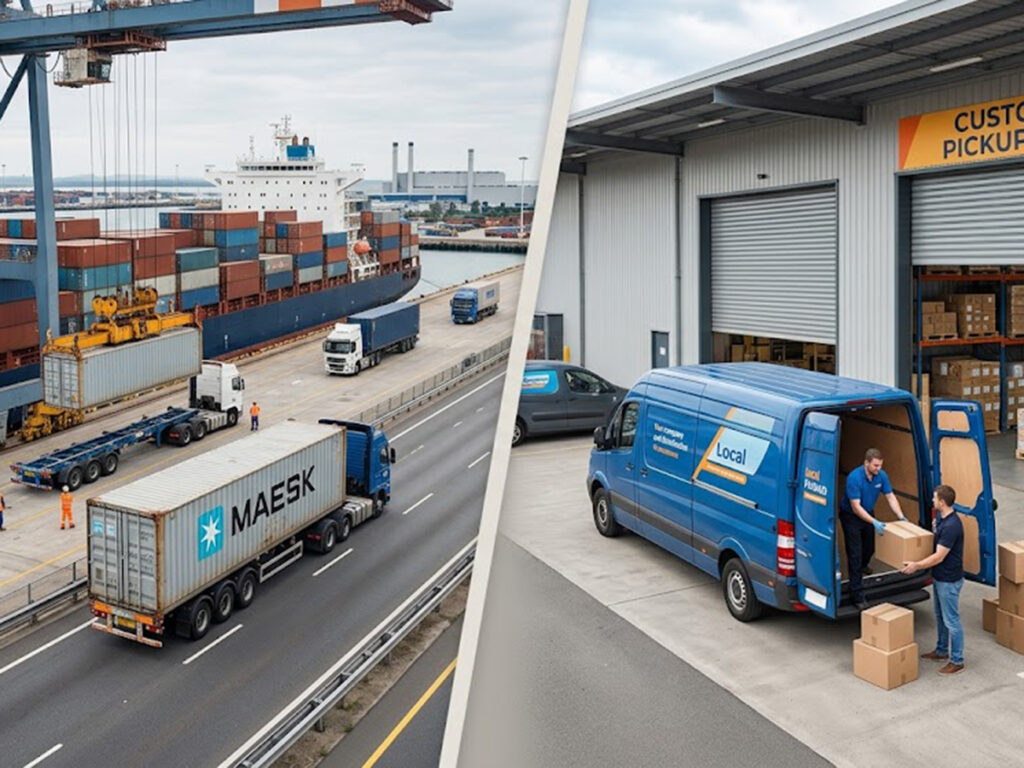
A factory-direct import cycle runs: purchase order issuance → factory production run (4–6 weeks) → container loading and export customs → international ocean freight (25–45 days transpacific from key manufacturing regions) → U.S. port arrival → CBP customs clearance + ISF filing → port drayage to buyer’s distribution point → receiving inspection. Every node in that chain is both a time variable and a cost variable.
Port drayage costs in major U.S. gateway ports — Los Angeles/Long Beach, Savannah, and Houston — have been elevated since 2022 and remain volatile. Drayage for a 40-foot container in the LA/LB complex averaged $650–$900 per move in early 2026, per data from the Pacific Merchant Shipping Association. Buyers absorbing this under EXW or FOB Incoterms must budget accordingly.
Local distributor procurement eliminates every pre-delivery logistics step. The buyer schedules delivery, receives the product at the dock, and moves immediately to deployment. For construction project teams operating on milestone-linked schedules — where delayed safety barrier installation can trigger contract penalties — that operational simplicity carries direct financial value.
MOQs, Container Economics, and Warehouse Reality
Factory-direct bollard sourcing operates on containerized Minimum Order Quantities typically ranging from 300 에게 500 units per production run. A standard 40-foot HC container carries approximately 67.7 cubic meters of usable space. Procurement managers must verify that their specified bollard dimensions and weights optimize container utilization — under-loaded containers inflate per-unit freight costs without reducing the fixed ocean freight charge.
The warehouse requirement is equally concrete. 전수, 각색, and storing 400 bollards demands both dock equipment and structured rack or floor storage capacity. For organizations without dedicated receiving infrastructure, that overhead — in both capital expenditure and ongoing labor — is a direct hidden cost of the factory-direct bollard sourcing option.
Evaluating whether your warehouse infrastructure can support a direct-import program? Speak with a Sourcing Specialist to model the full logistics overhead for your deployment volume.
Lead Time vs. 비용 절감: Calculating Your Program’s Break-Even Point
The lead time vs cost savings tension is the central financial calculation in any bollard sourcing options 평가. Factory-direct programs deliver lower per-unit economics — but only at volumes and timelines that amortize the import overhead. Distributor procurement delivers operational speed at a margin premium that decreases as a percentage of total project cost as project scale increases.
The break-even calculation requires five inputs: (1) factory ex-works unit price, (2) all-in logistics cost per unit, (3) inventory carrying cost (cost of capital × inventory value × holding period in months), (4) risk premium for transit damage and compliance exposure, 그리고 (5) operational overhead for freight management and receiving staff time.
When procurement teams complete this model rigorously, the apparent unit price gap — often cited at 25–40% in favor of factory direct — compresses to 8–15% on a Total Landed Cost basis for orders under 500 단위. Above that threshold, with in-house logistics infrastructure, factory-direct economics typically justify the import overhead.
Dive deep into procurement timelines and lead times, which are critical risk factors for commercial projects.
Timeline Decision Matrix
Programs with more than 90 days of procurement lead time before scheduled deployment can absorb factory-direct cycles. Programs with tighter deployment windows require distributor sourcing or risk project schedule penalties that erase cost savings entirely.
The hybrid sourcing model resolves this tension for organizations with both baseline and surge demand profiles. Factory-direct orders on a 90–120 day procurement cycle build buffer stock at a lower blended per-unit cost. An active distributor relationship provides immediate replenishment for urgent deployments or project overruns. Many procurement managers running large infrastructure programs find this hybrid approach delivers the optimal balance across their bollard sourcing options.
규정 준수, Legal Risk, and Vendor Vetting in the B2B Safety Equipment Supply Chain
Compliance is not an administrative formality in the B2B safety equipment supply chain — it is a risk-adjusted cost with direct liability implications. Procurement managers who overlook compliance architecture in their bollard sourcing options evaluation expose their organizations to project disqualification, federal penalty, and product liability risk.
Buy America Act Obligations
미국 구매법(Buy America Act) (BAA) requires that iron, 강철, and manufactured products used in federally funded surface transportation projects meet U.S. domestic content requirements. 연방 고속도로 행정부 (FHWA) enforces BAA compliance on all projects receiving federal-aid highway funding. Traffic safety equipment — including bollards — deployed on FHWA-funded roadway programs falls squarely within BAA scope.
Factory-direct imports from overseas manufacturers frequently fail BAA domestic content thresholds unless the manufacturer holds a current BAA waiver or the procurement meets a statutory exception. Procurement teams sourcing for municipal or federally funded contracts must verify domestic content certification before committing to a direct-import bollard sourcing option.
Distributors maintaining BAA-compliant stocked programs provide procurement teams with a cleaner compliance trail and eliminate the domestic content verification burden from the buyer’s pre-award workflow.
ISO 9001 and Quality Management Verification
ISO 9001:2015 certification is the baseline quality management credential procurement managers should require from both factories and distributors. The certification scope matters: an ISO-certified factory documents manufacturing process controls; an ISO-certified distributor documents handling, 저장, and fulfillment processes. Both certifications are independently required for a defensible vendor qualification record.
Procurement teams should request: current ISO certificate with explicit scope of certification, most recent surveillance audit report, and corrective action log from the past 24 달. These documents form the minimum evidentiary basis for a procurement manager’s compliance sign-off in the B2B safety equipment supply chain.
Contractual Risk Allocation Between Channels
Under EXW or FOB Incoterms — the standard terms for most factory-direct bollard purchases — the buyer assumes title and risk at the factory gate. Transit damage, port delays, customs holds, and delivery failures become the buyer’s contractual liability through the entire international freight chain.
Distributor supply agreements typically transfer risk at the point of local delivery. That compression of the buyer’s liability window is particularly valuable for procurement managers on public infrastructure projects, where product non-conformance or delivery failure can trigger liquidated damages clauses.
When Customization Requirements Make Factory Access Non-Negotiable
Standard distributor catalog offerings serve the majority of bollard deployment programs efficiently. 하지만, specific program requirements exist where a distributor’s standard SKU catalog simply cannot deliver — and a direct factory bollard sourcing option becomes operationally mandatory, regardless of lead time or logistics complexity.
Core Drivers: 브랜딩, Dimensional Specs, and Custom Mounting
Custom program requirements that mandate factory engagement include:
- Aesthetic & Corporate Identity: RAL or Pantone color matching for municipal branding programs or site-specific color-coding schemes.
- Bespoke Geometry: Non-standard dimensional specifications outside standard diameter and height ranges.
- 보안 & Proprietary Markings: Reflective banding or logo embossing for branded private property or campus safety programs.
- Substrate Engineering: Custom base plate or mounting configurations for non-standard substrate installations.
Financial & Timeline Impacts: NRE Tooling Costs and the 14-Week Engineering Cycle
Transitioning to a custom factory program introduces strict financial and chronological variables that procurement managers must account for:
The NRE Tooling Framework: Factory custom programs carry Non-Recurring Engineering (NRE) tooling costs — typically a one-time investment per custom specification. 하지만, this tooling cost per unit decreases sharply as order volume increases, making large-volume custom programs economically viable despite the initial NRE investment.
The 6–14 Week Engineering Approval Pipeline: Custom specifications add significant time to the total program timeline beyond standard production lead times. A realistic custom-program timeline runs as follows:
Specification Submission→Factory Engineering Review (2–3 weeks)→Prototype Production (3-4주)
→Sample Shipment & Buyer Approval (2–3 weeks) →Revision Cycle if needed (2-4주) →Production Release
💡The Sourcing Decision Fork: For programs not requiring customization, distributor catalog SKUs pre-certified to ASTM, mutcd, and applicable DOT specifications deliver immediate code compliance without the engineering approval overhead. This distinction — custom vs. standard specification — remains the primary fork in the bollard sourcing options decision tree.
Direct Factory vs. Local Distributor: The Procurement Manager’s Comparison Table
The table below maps both bollard sourcing options across the eight metrics most relevant to B2B procurement decisions. Use this as a structured reference when building internal business cases or briefing stakeholders.
| 메트릭 | Direct Factory Sourcing | Local Distributor Sourcing |
| 단가 | Lower ex-works price; Total Landed Cost rises 18–35% after freight, 직장 & drayage | Higher invoice price; logistics absorbed upstream — TLC gap narrows to 8–15% |
| 모크 | 300–500 units per container run; smaller runs via air freight erode savings | 1–50+ units; partial orders and blanket POs available |
| 리드 타임 | 10-16주 (production 4–6 wks + ocean transit 3–5 wks + customs 1–2 wks) | 1–10 business days for standard stocked SKUs |
| 사용자 정의 | Full custom tooling, RAL/Pantone color, non-standard dimensions, branded embossing | Standard catalog SKUs only; limited special-order capacity |
| 지불 조건 / Cash Flow | 30–50% deposit at PO; balance before shipment — capital locked 3–4 months | Net-30 / Net-60 terms; phased purchasing preserves working capital |
| Logistics Handling | Buyer manages freight forwarding, ISF filing, CBP customs, port drayage & receiving | Distributor absorbs all pre-delivery logistics; buyer receives at dock |
| 준수 확인 | Buyer responsible for ISO 9001, BAA, and regional certification vetting | Distributor holds pre-verified, code-compliant stocked inventory |
| Transit Risk | Buyer bears risk from factory gate under EXW/FOB Incoterms | Risk transfers to buyer at point of local delivery only |
원천: CBRE U.S. 산업 & Logistics Figures Q1 2026 (warehousing costs); Pacific Merchant Shipping Association 2026 Drayage Survey (port costs); FHWA Buy America Policy (규정 준수); Harmonized Tariff Schedule Chapter 73/39 (duty rates). 우리를. CBP ACE Data (customs processing benchmarks).
Reading the Table: How to Weight Metrics Against Your Program Profile
No single metric in this comparison determines channel superiority. The financially optimal bollard sourcing option depends on the intersection of four program variables: total deployment volume, lead time tolerance, internal logistics infrastructure, and compliance obligations. Procurement managers should weigh the metrics in the table against their specific program constraints before drawing a channel conclusion.
The Scenarios Where Each Bollard Sourcing Option Wins Outright
Three procurement profiles emerge consistently from a rigorous channel analysis:
- Factory-Direct Wins: High-volume programs (500+ 단위), custom specification requirements, in-house import and warehousing infrastructure, lead time tolerance exceeding 90 날, and organizations with dedicated freight and compliance teams. Annual procurement programs that can consolidate volume across quarters extract the strongest factory-direct economics from this bollard sourcing option.
- Distributor Wins: Urgent or phased deployments, low-to-mid volume programs (아래에 300 단위), compliance-critical federal or municipal contracts, organizations without import or warehousing infrastructure, and programs with deployment timelines under 60 날. The distributor bollard sourcing option also wins on all programs where BAA compliance is a condition of award.
- Hybrid Model Wins: Annual blanket programs with both predictable baseline demand and variable surge requirements. The hybrid architecture — scheduled factory-direct orders, building 90–120 day buffer stock, supplemented by an active distributor account for urgent replenishment — delivers the optimal blended per-unit cost while preserving operational flexibility. This approach is the advanced procurement architecture for organizations running large, recurring bollard deployment programs.
Strategic Verdict: Which Bollard Sourcing Option Saves More?
The answer is not universal — it is program-specific. Direct factory procurement delivers superior per-unit economics at scale, for standard or custom specifications, in programs with sufficient lead time and logistics infrastructure. Local distributor procurement delivers superior total value in urgent, compliance-sensitive, or low-to-mid volume programs where operational speed and payment flexibility outweigh the per-unit price premium.
The procurement manager’s responsibility is to identify which bollard sourcing option aligns with the specific financial, logistical, and compliance profile of each program — rather than applying a blanket channel preference across all procurement scenarios.
For the complete procurement framework governing bollard specification, 규정 준수, supply chain architecture, and supplier qualification across all bollard sourcing options, procurement teams should consult the
For the complete procurement framework governing bollard specification, 규정 준수, supply chain architecture, and supplier qualification across all bollard sourcing options, procurement teams should consult the comprehensive traffic bollard guide — the authoritative sourcing and procurement resource for B2B safety equipment buyers.
💼 Ready to evaluate your specific program? Request a Direct Volume Quote or Speak with our Specialist to build a cost model tailored to your deployment requirements.
자주 묻는 질문
1분기: What is the minimum order quantity for factory-direct bollard sourcing?
Factory-direct bollard programs typically require MOQs of 300–500 units per production run due to containerized shipping economics and factory setup costs. Smaller runs via air freight are possible, but erode per-unit savings significantly. Procurement managers should model annual volume against a 300-unit minimum and assess whether internal warehousing infrastructure supports that inventory commitment before committing to this bulk sourcing option.
Q2: How do lead times compare between the two bollard sourcing options?
Factory-direct sourcing carries total lead times of 10–16 weeks from PO issuance to site delivery (production 4–6 weeks + ocean transit 3–5 weeks + customs and drayage 1–2 weeks). Local distributor fulfillment for standard stocked SKUs typically ranges from same-day to 10 영업일. Programs with deployment deadlines under 60 days from procurement initiation should default to the distributor bollard sourcing option unless buffer stock is already in-country.
3분기: Does factory-direct bollard sourcing comply with Buy America Act requirements?
Factory-direct imports from overseas manufacturers frequently fail BAA domestic content thresholds for federally funded infrastructure projects. Procurement teams on FHWA-funded programs must verify domestic content certification before committing to a direct-import bollard sourcing option. Distributors with documented BAA-compliant stocking programs provide a cleaner compliance pathway for public-sector procurement.
4분기: What payment terms are available from each channel?
Local distributors with established credit relationships typically offer Net-30 to Net-60 terms, enabling product deployment before payment falls due. Factory-direct purchasing typically requires a 30–50% deposit at PO issuance with the balance before shipment — locking capital for the full production and transit cycle. Buyers with strong purchasing history may negotiate improved factory payment terms, but the front-loaded capital structure remains an inherent characteristic of the factory-direct bollard sourcing option.
Q5: When does a hybrid sourcing model make sense for bollard procurement?
A hybrid model is optimal for procurement programs with predictable baseline demand (suited to scheduled factory-direct orders) combined with variable surge or emergency demand (requiring distributor availability). This approach — factory-direct orders building 90–120 day buffer stock at lower per-unit cost, supplemented by an active distributor account — achieves blended cost reduction without sacrificing the operational flexibility that urgent deployments require.
Q6: What hidden costs should procurement teams account for when comparing bollard sourcing options?
Direct factory quotes under EXW or FOB terms exclude international freight, marine insurance, 수입 관세 (3.9–6.5% for applicable traffic safety equipment HTS classifications), customs broker fees, ISF filing charges, port drayage, and domestic delivery. These add 18–35% to the ex-works price depending on volume and origin port. Distributor pricing bundles all pre-delivery logistics into the invoice. Total Landed Cost comparison — not unit price comparison — is the only valid analytical basis for evaluating bollard sourcing options.
참조
- 연방 고속도로 관리 (FHWA). Buy America Policy. 우리를. 교통부.
- CBRE Research. 우리를. 산업 & Logistics Figures Q1 2026. CBRE Group, Inc.
- Pacific Merchant Shipping Association. 2026 West Coast Port Drayage Cost Survey.
- 국제 표준화기구. ISO 9001:2015 품질 관리 시스템— Requirements. ISO
- 우리를. 관세 및 국경 보호. Harmonized Tariff Schedule of the United States (2026).
- 우리를. 관세 및 국경 보호. Importer Security Filing (ISF) 요구 사항. CBP
- 우리를. 노동 통계국. 생산자 물가 지수: Safety Equipment and Supplies Manufacturing, 2025–2026.
- 연방 획득 규정 (멀리). Subpart 25.1 — Buy American Act. 우리를. General Services Administration.