Australian infrastructure projects present unique challenges for safety equipment. The combination of extreme UV indices, unpredictable wind loads, and rigorous compliance standards necessitates specific material engineering. その結果, generic or imported plastic signage often fails to meet the demands of the local environment.
Subpar materials fade rapidly under the Australian sun and warp under thermal stress. More critically, they often fail to meet として 1742.3 要件, posing significant liability risks. したがって, the traffic management industry relies on corfluteサイン engineered specifically for Australian conditions.
This technical guide analyzes the specifications for 仮設道路標識 オーストラリアで, カバー ボックスエッジ テクノロジー, Multi-message Sign (MMS) システム, and reflective compliance standards.
👉 Sourcing globally? オプトラフィック explains international naming conventions and hardware differences in our Global Guide to Corrugated Plastic Signage.
Defining “Road-Ready” corfluteサイン
Not all corrugated plastic meets civil engineering standards. Procurement officers must distinguish between retail-grade materials and road-ready specifications to ensure site safety.
The 5mm Standard vs. Retail Grade
While 3mm Corflute serves well for indoor events or short-term real estate applications, it lacks the structural mass required for roadside use. 対照的に, 5mm Corflute is the mandatory industry standard for 一時的な交通管理 (TTM). This specific thickness provides the structural integrity necessary to withstand the wind buffering generated by passing heavy vehicles without buckling.
UV Stabilised Polypropylene Copolymer
The Australian sun degrades untreated polymers rapidly. UV radiation breaks down the molecular chains in standard plastic, causing signs to crack, チョーク, and shatter within months of deployment.
To combat this, オプトラフィック manufactures signs using UV-stabilised high-impact polypropylene. This chemical treatment significantly extends the operational lifespan of the signage, ensuring the fluorescent background colour remains compliant for the full duration of the project.
Need specific data on material lifespan? Read the detailed report on オーストラリアの太陽を生き抜く: UV Stability of Corflute Signs
The Box Edge Sign Advantage
The ボックスエッジデザイン distinguishes Australian signage from US or European equivalents, where flat sheets are common. For Australian road conditions, flat sheets often prove insufficient.
Engineering the Box Edge
Manufacturers create this feature by die-cutting specific fold lines into the コルフルートシート. These edges fold backward to form a rigid, 3d “箱” perimeter. This structure acts as a reinforcement beam, significantly increasing the panel’s resistance to bending.
Operational Benefits
Beyond structural rigidity, the Box Edge offers critical operational advantages:
- Frame Compatibility: The box structure fits securely over standard bi-pod legs. Friction holds the sign in place, eliminating the need for bolts or screws that can rust or seize.
- おお&S Compliance: The design eliminates sharp plastic edges, thereby reducing laceration risks for workers during rapid deployment.
Concerned about high winds? Read the engineering analysis: Why Box Edge Design is Critical for Wind Stability
Optimising Traffic Control with Multi-message Signs (MMS)
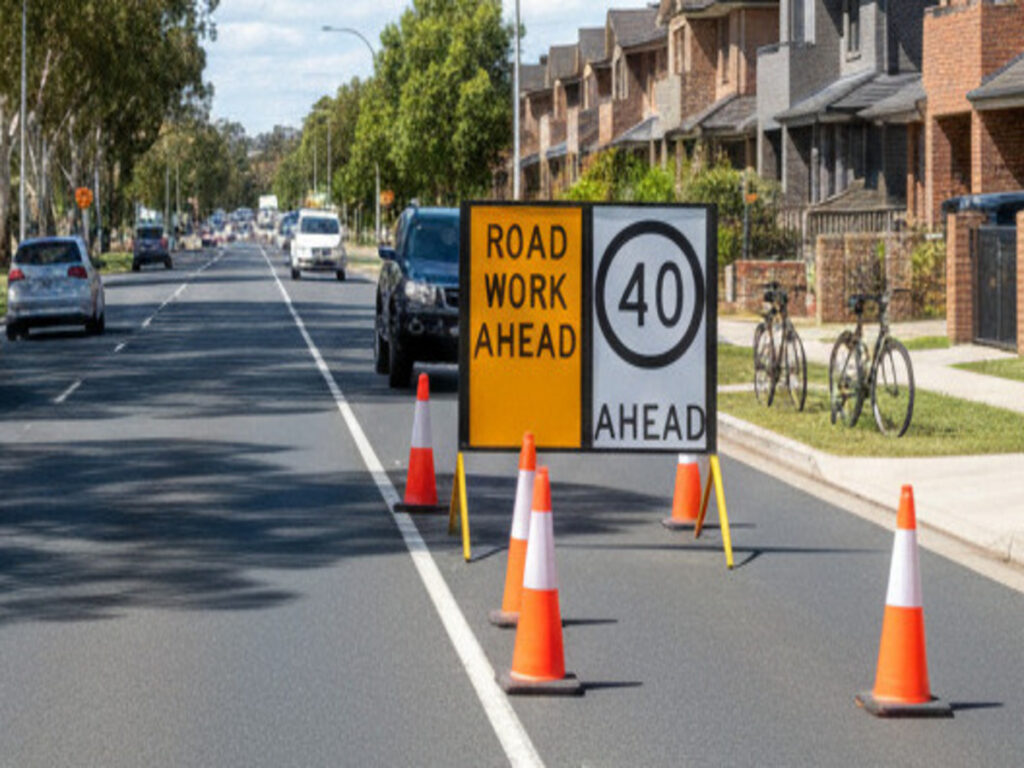
Multi-message Sign (MMS) frames form the backbone of traffic control in Queensland, NSW, そしてビクトリア. These systems allow a single station to display multiple hazard warnings efficiently.
The Corflute Insert System
MMS frames utilise a modular approach where traffic controllers slide lightweight コルフルートインサート into a galvanised steel frame. The system typically accommodates three formats:
- 600mm x 600mm: Designated for the main message (例えば。, “先に道路工事”).
- 1200mm x 300mm: Designated for supplementary information (例えば。, “道路工事を終了する”).
- 1200mm x 600mm: Large format warnings for high-speed zones.
Cost and Logistics Efficiency
The MMS system offers significant economic advantages. Contractors purchase durable metal frames once, while the コルフルートインサート remain inexpensive and interchangeable. This flexibility significantly reduces the payload weight for traffic control vehicles, improving fuel efficiency and logistics.
Want to reduce fleet operating costs? Read our technical breakdown on マルチメスサイン (MMS) and lightweight Corflute Inserts
として 1742.3 コンプライアンス: 反射率 & 色
Safety officers must strictly enforce オーストラリア標準 1742.3, as non-compliant signage leads to immediate site shutdowns and potential regulatory fines.
クラス1W (クラス 400) 折り返しを後押しします
Since construction often continues at night, daytime visibility represents only half the equation. The current standard mandates クラス1W (Wide Angle) またはクラス 400 反射シートを後押しします.
This technology reflects light from vehicle headlights back to the source, maintaining brightness even at wide entrance angles. オプトラフィック applies Class 1W sheeting directly to 5mm Corflute substrates to ensure maximum luminance and regulatory compliance.
Fluorescent Chromaticity
The background colour communicates the specific hazard level to drivers. 蛍光オレンジ is reserved exclusively for general roadworks and traffic control, その間 蛍光黄緑色 targets pedestrian, スクールゾーン, and vulnerable road user warnings.
Installation Best Practices for Temporary Road Signs
Even high-specification corfluteサイン fail if installed incorrectly. Wind loading remains the primary failure mode for temporary signage.
Mitigating the “帆の効果”
Corflute is lightweight by design; consequently, a broad sign face acts as a sail in strong winds. To mitigate this risk, ballast placement is critical. Sandbags must anchor the フレーム脚, as placing ballast directly on the sign damages the substrate and obscures the retroreflective face.
さらに, signs should be rotated approximately 3-5 車道から度離れたところ. This angular placement reduces headlight glare for drivers and mitigates direct wind pressure on the sign face.
Sustainability in Civil Construction
The construction sector increasingly prioritises environmental responsibility. corflute (ポリプロピレン) is a Code 5 プラスチック, making it 100% リサイクル可能. Unlike composite aluminium which requires layer separation, corfluteサイン can be recycled whole at the end of their lifecycle, aligning with sustainable site practices.
Planning a sustainable project? Read the Guide to Recycling Corflute on Construction Sites
結論: Sourcing Compliant Corflute Signs
交通管理において安全性の犠牲は容認できません. Project compliance depends entirely on the correct material specification.
Australian roadworks require 5mm, UV-stabilised, ボックスエッジコルフルート that meets として 1742.3 and withstands local environmental factors. オプトラフィック supplies certified traffic management solutions, distributing Class 1W Box Edge signs そして MMS inserts to Sydney, メルボルン, ブリスベン, and Perth.
Require branded site panels? Explore industrial printing rules in the Comprehensive Guide to Custom Corflute Signs.
よくある質問
Not explicitly for 毎 ゾーン, しかし “ボックスエッジ” is the industry standard for stability. Flat sheets often fail to stay secure in bi-pod legs under wind load. Most councils and main road authorities mandate Box Edge for compliance and safety.
クラス 1 is the old standard. クラス1W (Wide Angle), also known as Class 400, is the current requirement for roadworks. It reflects light from wider angles, ensuring the sign remains visible to drivers even if the sign is twisted or placed on a curve.
Standard treated Corflute lasts 12 に 24 屋外で数か月. Without UV stabilisation, the harsh Australian sun breaks down the plastic in less than 6 数ヶ月. Optraffic guarantees UV stability for long-term project durations.
はい. We manufacture inserts to exact Australian dimensions: 600x600mm, 1200x300mm, and 1200x600mm. They slide seamlessly into standard galvanised steel Multi-message frames used in QLD, NSW, and VIC.