For infrastructure firms and road contractors, highway marker compliance serves as the primary barrier to project acceptance. Failure to meet precise specifications triggers payment delays and increases long-term legal liability. While the federal MUTCD establishes a baseline, individual state-by-state highway signage standards often introduce rigorous local amendments.
Engineering teams must master these regional variations during the initial procurement phase. Professional firms often consult advanced guides on sign manufacturing and material selection to ensure hardware durability. Adhering to specific Department of Transportation (डॉट) sign standards prevents costly rework during final inspections.
Effective highway marker design requires a technical understanding of retroreflectivity and substrate durability. This guide analyzes the regulatory frameworks and regional nuances necessary for successful site handover. Use these insights to align your procurement strategy with complex interstate marker requirements.
The Foundation of Highway Marker Compliance: MUTCD vs. State Supplements
Federal Oversight and the Manual on Uniform Traffic Control Devices
At the national level, समान ट्रैफ़िक नियंत्रण उपकरणों पर मैनुअल (MUTCD) functions as the definitive technical standard. It establishes the minimum baseline for all interstate marker requirements to ensure driver safety. संघीय राजमार्ग प्रशासन (एफएचडब्ल्यूए) mandates strict adherence to these metrics to maintain cross-border uniformity.
Key technical pillars of the federal manual include:
- Standardized shapes: Specific geometric profiles for regulatory and warning signs.
- पुनर्मिलन: Minimum luminance levels for night-time visibility.
- टाइपोग्राफी: Regulated use of Highway Gothic or Clearview typefaces.
- बढ़ती हुई ऊँचाई: Precise vertical clearance to prevent visual obstruction.
This federal framework ensures that राज्य राजमार्ग मार्कर remain recognizable to drivers moving between different jurisdictions. Consistency reduces cognitive load and improves reaction times at high speeds.
Why State Highway Markers Diverge from Federal Norms
Despite federal guidelines, states exercise legal authority to issue MUTCD state supplements. These documents often exceed federal requirements to address specific regional challenges. Contractors must treat these supplements as the primary compliance document for project handover.
Typical factors driving state-level divergence include:
- Environmental stress: Coastal states require higher corrosion resistance for highway marker signs.
- Local road hierarchy: Urban corridors often demand larger scale markers for high-density traffic.
- Safety mandates: Northern states may require specific retroreflective grades for snow-heavy environments.
The following table illustrates how typical states deviate from federal standards through localized supplements:
| राज्य | Primary Authority | Key Divergence from Federal MUTCD | अनुपालन प्रभाव |
| कैलिफोर्निया | एएस एमयूटीसीडी | Unique “जी” series guide signs and specific bike lane markers. | Strict adherence required for Caltrans approval. |
| टेक्सास | TX MUTCD | Custom farm-to-market shields and specific route numbering styles. | Influences highway marker design for rural infrastructure. |
| न्यूयॉर्क | NYS Supplement | Enhanced signage for parkway height restrictions and tolling. | Critical for bridge strike prevention in metro areas. |
| फ्लोरिडा | FDOT Standards | Higher wind-load requirements and specialized clearview font use. | Essential for highway marker compliance in hurricane zones. |
Disregarding these nuances leads to immediate site rejection during Department of Transportation (डॉट) sign standards audits. Non-compliant signage increases liability and forces expensive material replacement. Professional firms must verify these local details with a qualified highway signs maker before production begins. Ensuring highway marker compliance protects the contractor’s bottom line and ensures public safety.
Critical Design Elements and Highway Route Marker Color Codes
Visual Specification for State Highway Markers
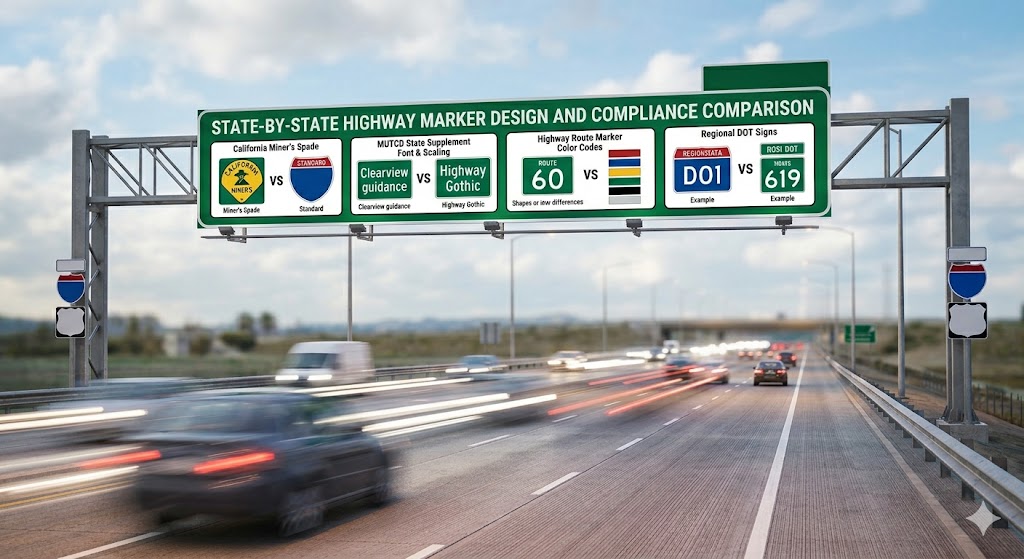
State-level identity defines the visual profile of regional infrastructure. While federal routes use standard shields, राज्य राजमार्ग मार्कर often feature unique silhouettes to assist local navigation. These variations demand precise manufacturing to meet inspection criteria.
Primary regional design profiles include:
- कैलिफोर्निया: Utilizes the “Miner’s Spade” shield with a green background for state routes.
- फ्लोरिडा: Employs a square white-on-black design for high-contrast visibility.
- टेक्सास: Features specific circular markers for farm-to-market road networks.
- वाशिंगटन: Uses a silhouette of George Washington for distinctive regional branding.
Beyond geometry, every highway signs maker must prioritize technical material specs. Contractors must verify the following elements to ensure highway marker compliance:
| विशेषता | Technical Requirement | Compliance Objective |
| टाइपोग्राफी | FHwA Series fonts or Clearview | Maximizes legibility at high speeds. |
| कनवास | ASTM D4956 Type IV or XI | Ensures long-term retroreflectivity performance. |
| सब्सट्रेट | 5052-H38 Grade Aluminum | Provides corrosion resistance and structural rigidity. |
| Edge Detail | Radius corners and deburred edges | Improves safety and prevents handling injuries. |
Decoding Highway Route Marker Color Codes by Region
Correct application of highway route marker color codes is a fundamental safety requirement. Colors function as a visual shorthand, allowing drivers to categorize roads instantly. Inconsistent coloring leads to driver confusion and immediate project rejection by inspectors.
Standardized color associations include:
🔵🔴Blue and Red: Reserved exclusively for interstate marker requirements.
⚫⚪White on Black: Indicates U.S. Route status or standard state highway junctions.
🟢हरा: Directs traffic toward destinations or exit points on guide signs.
🟤भूरा: Identifies cultural, historical, or recreational points of interest.
🔵नीला: Marks essential motorist services such as fuel or lodging.
These colors must maintain specific chromaticity coordinates under both daylight and artificial illumination. Professional highway marker design accounts for environmental fading caused by UV exposure. Choosing the wrong ink or film type compromises highway marker signs and necessitates early replacement. Always cross-reference the state-specific color palette with the latest Department of Transportation (डॉट) sign standards. Proper color coding ensures your project meets the highest benchmarks for state-by-state highway signage standards.
Regional Spotlight: Northeast Corridor DOT Sign Standards
New York and Pennsylvania Signage Nuances
In high-density corridors, परिवहन विभाग (डॉट) sign standards maintain extreme rigor to manage complex traffic flows. The New York State DOT (एनवाईएसडीओटी) Supplement modifies Section 2D.46 of the MUTCD. It mandates specific reference markers every tenth of a mile to assist emergency services. आगे, NYSDOT requires enhanced sizing for exit gore signs to prevent late-lane maneuvers in heavy congestion.
Pennsylvania follows PennDOT Publication 46, which dictates precise highway marker design for its diverse terrain. This regulation specifies that all permanent highway marker signs must use Type IX or Type XI retroreflective sheeting. This ensures visibility across the state’s frequent fog zones and mountainous curves.
The following table highlights specific regulatory requirements:
| राज्य | विनियमन | Specific Requirement | Compliance Goal |
| न्यूयॉर्क | NYS Supplement Section 2E | Larger fonts for overhead guide signs. | Improved legibility at 65+ मील प्रति घंटा. |
| पेंसिल्वेनिया | PennDOT Pub 46 | Mandatory use of “राजमार्ग गोथिक” श्रृंखला ई. | Visual consistency with older infrastructure. |
| न्यू जर्सी | NJDOT Standard Details | Specific bracket designs for bridge mounting. | Prevents vibration-induced sign failure. |
New England Regional Compliance Challenges
New England states introduce complexity due to extreme thermal shifts and corrosive winter environments. For any highway signs maker, standard materials often fail these regional stress tests. Compliance here involves meeting structural durability standards alongside visual metrics.
Key regional requirements include:
- संघात प्रतिरोध: रिडोट (Rhode Island) requires reinforced aluminum substrates to survive heavy snow-throw from plows.
- चिंतनशील प्रदर्शन: मासडॉट (मैसाचुसेट्स) mandates ASTM D4956 Type XI sheeting for all interstate marker requirements.
- Freeze-Thaw Stability: Vermont VTrans standards require specific post-foundation depths to prevent sign leaning during spring thaws.
Contractors must ensure highway marker compliance by verifying that mounting hardware is galvanized or stainless steel. These details prevent rust-streaking on the sign face, which triggers immediate inspection failure. Adhering to these state-by-state highway signage standards ensures the longevity of the infrastructure in harsh climates. Using the correct highway route marker color codes remains essential even when signs are partially obscured by road salt. Always confirm that your राज्य राजमार्ग मार्कर meet these localized durability clauses before deployment.
Western and Sunbelt Standards: Texas and California Case Studies
टेक्सास डॉट (TXDOT) Specific Signage Deviations
Texas implements rigorous highway marker design standards to address its vast geography and extreme weather. The TxDOT Texas MUTCD Section 2D.10 mandates unique silhouettes for farm-to-market and ranch-to-market systems. These distinct shapes allow drivers to distinguish between local rural networks and high-speed corridors instantly.
Coastal infrastructure must meet ASCE 7 wind-load standards to prevent structural failure during hurricanes. This regulation ensures highway marker signs remain attached to supports under high-velocity pressure. Larger sign formats and increased font scaling improve long-distance recognition on expansive plains. Adhering to these state-by-state highway signage standards prevents the common pain point of catastrophic sign loss during storm events. Contractors must verify that all राज्य राजमार्ग मार्कर utilize reinforced mounting brackets to ensure long-term stability.
कैलिफोर्निया (Caltrans) Signage Design and Environmental Compliance
California operates under the CA MUTCD, which introduces specific “जी” series guide markers for state-wide navigation. Section 2E.01 of this code requires precise placement of destination shields to manage high-volume traffic transitions. These markers solve the problem of driver confusion at complex multi-lane interchanges.
Caltrans also enforces the Green Chemistry Initiative, requiring non-toxic coatings and sustainable aluminum substrates. This mandate ensures highway marker compliance with strict state environmental protection laws. Agencies prioritize lifecycle sustainability, including the recyclability of sign faces and supports after their service life. Every highway signs maker must use low-VOC (Volatile Organic Compound) inks to meet local air quality regulations. Following these Department of Transportation (डॉट) sign standards ensures projects pass both structural and environmental audits. Consistent use of correct highway route marker color codes maintains the visual integrity required for high-speed interstate travel.
Southeastern Infrastructure and Saudi Vision 2030 संरेखण
Florida and Georgia Highway Signage Standards
In the Southeast, highway marker design must overcome high humidity and intense solar exposure. The Florida DOT (एफडीओटी) Standard Plans Section 700-010 requires specialized anti-graffiti coatings. These protective layers prevent permanent damage from vandalism and environmental pollutants. Florida also utilizes high-index glass beads in राज्य राजमार्ग मार्कर to maintain visibility during sudden, भारी बारिश.
The Georgia DOT (GDOT) नीति 6865-1 dictates specific letter-height-to-speed-limit ratios for rural corridors. This regulation ensures drivers have adequate perception-response time on high-speed provincial roads. By standardizing these proportions, GDOT eliminates the pain point of sign clutter and visual “noise.” Contractors must ensure highway marker compliance by using corrosion-resistant hardware that survives the region’s salt-heavy air. Adhering to these Department of Transportation (डॉट) sign standards guarantees that markers remain legible for their entire 12-year service life.
International Comparative Analysis for Global Firms
हम. state-by-state highway signage standards now serve as the blueprint for global megaprojects. Saudi Arabia’s Vision 2030 initiatives leverage MUTCD frameworks to standardize high-speed desert transit. This adoption solves the problem of navigating multi-lingual environments through universally recognized highway route marker color codes.
Key technical alignments include:
- मानकीकरण: International projects adopt U.S. interstate marker requirements to ensure peak traffic safety.
- भौतिक विज्ञान: Global firms utilize ASTM D4956 standards for retroreflective performance in extreme heat.
- Operational Consistency: Aligning with highway marker design norms allows for easier integration of autonomous vehicle sensors.
For global firms, mastering these highway marker signs creates a scalable model for diverse geographic markets. Using professional highway signs maker expertise ensures that local variations meet international safety benchmarks. This technical alignment mitigates the risk of project rejection during final infrastructure audits.
Best Practices for Ensuring Highway Marker Compliance in Infrastructure Projects
Implementing a Multi-Stage Quality Audit for Highway Signs
A rigorous audit framework prevents the costly rejection of installed assets. Firms must verify highway marker design at the fabrication, delivery, and installation stages. This systematic approach ensures that every unit meets the specific Department of Transportation (डॉट) sign standards required for the project.
A comprehensive pre-installation checklist must include:
- Geometric precision: Verify the physical dimensions and silhouette against state-specific design manuals.
- Colorimetric accuracy: Confirm that highway route marker color codes meet daytime chromaticity and nighttime luminance standards.
- Material certification: Validate the batch-specific ASTM D4956 retroreflectivity reports provided by the manufacturer.
- Structural integrity: Inspect the substrate thickness and mounting hole alignment to prevent stress fractures.
Collaborating with an experienced highway signs maker mitigates risk. These partners provide essential technical documentation and certified testing reports for every production run. This paper trail is vital for securing final project approval from state inspectors.
Avoiding Common Pitfalls in Interstate Marker Requirements
Non-compliance often stems from subtle deviations that compromise safety. Even small errors in interstate marker requirements can trigger a full site rejection. Contractors must monitor these high-risk areas to avoid project delays and liquidated damages.
The following table summarizes frequent failures and their technical solutions:
| Common Compliance Pitfall | Technical Root Cause | Prevention Strategy |
| Reflectivity Failure | Using outdated or low-index sheeting. | Mandate Type IV or XI sheeting for all राज्य राजमार्ग मार्कर. |
| Inaccurate Spacing | Ignoring longitudinal placement rules. | Adhere to Section 2D.46 spacing for milepost markers. |
| Scaling Errors | Using urban font sizes on rural highways. | Cross-reference speed limits with mandated letter heights. |
| Mismatched Shapes | Applying federal shields to state routes. | Consult the state-by-state highway signage standards for local silhouettes. |
These technical oversights lead to poor legibility and increased liability. By prioritizing highway marker compliance during the procurement phase, firms avoid the expense of retrofitting non-compliant signage. में परिशुद्धता highway marker signs ensures a seamless transition from construction to public operation. Proper adherence to these metrics protects both the contractor’s reputation and the road user’s safety.
निष्कर्ष: Securing Project Approval through Precise Highway Marker Design
Successful infrastructure delivery depends on a detailed understanding of state-by-state highway signage standards. While the MUTCD establishes a national framework, true compliance requires alignment with state-specific supplements and Department of Transportation (डॉट) sign standards.
By prioritizing accuracy in highway marker design, selecting the right highway signs maker, and implementing rigorous quality controls, contractors can:
- Minimize compliance risk through technical verification.
- Ensure smooth inspections and rapid project approvals.
- Deliver safer, long-lasting road infrastructure for public use.
For any organization involved in highway construction or maintenance, mastering highway marker compliance is not just a regulatory requirement—it is a strategic advantage. Precision in highway marker signs ensures a seamless transition from construction to public operation.
अक्सर पूछे जाने वाले प्रश्नों: Mastering Highway Marker Compliance
Q1: How do MUTCD state supplements impact highway marker design for interstate projects?
While the federal MUTCD provides a universal baseline, MUTCD state supplements often mandate higher technical specifications to address regional variables. उदाहरण के लिए, state-by-state highway signage standards in northern regions may require specific ASTM D4956 Type XI retroreflective sheeting to maintain visibility during heavy snowfall. Contractors must cross-reference these supplements to ensure highway marker design accounts for local deviations in sign sizing, typography, and placement geometry, thereby avoiding immediate rejection by state inspectors.
Q2: Why is the correct application of highway route marker color codes critical for site handover?
The highway route marker color codes function as a standardized visual language that dictates driver behavior and navigation efficiency. Using an incorrect color—such as a non-standard green for a recreational route or the wrong blue hue for interstate marker requirements—violates Department of Transportation (डॉट) sign standards. These chromaticity errors are easily detected during nighttime audits and typically necessitate a full replacement of the highway marker signs at the contractor’s expense before final payment release.
Q3: What are the primary structural requirements for highway marker signs in high-wind or coastal zones?
In coastal regions like Texas or Florida, highway marker compliance extends beyond visual graphics to structural survivability. Under regulations like ASCE 7 and state-specific DOT structural manuals, state highway markers must utilize reinforced 5052-H38 grade aluminum substrates and specialized mounting brackets. These engineering standards ensure the signs withstand specified wind velocities without detaching, solving the potential pain point of high-velocity debris risks and reducing long-term maintenance liability for the infrastructure firm.
Q4: How should a highway signs maker verify retroreflectivity compliance before delivery?
A professional highway signs maker must provide a certified testing report that validates the sign’s Coefficient of Retroreflection (R_A). This involves using a retroreflectometer to ensure the sheeting meets the specific Type IV or Type XI requirements defined in the project’s DOT sign standards. For contractors, receiving these third-party certifications at the procurement stage is the most effective way to guarantee that highway marker signs will pass federal and state visibility audits during the final inspection.
Q5: Can international projects use U.S. state-by-state highway signage standards as a benchmark?
हाँ. Major global infrastructure initiatives, such as Saudi Vision 2030, frequently adopt frameworks based on state-by-state highway signage standards to ensure rapid scalability and high safety ratings. By implementing U.S.-style highway marker design and interstate marker requirements, international contractors can standardize their procurement processes and utilize advanced materials like microprismatic sheeting. This technical alignment helps global firms deliver world-class road networks that meet rigorous international safety and durability benchmarks.
संदर्भ
- एफएचडब्ल्यूए - एमयूटीसीडी 11वां संस्करण, भाग 2: लक्षण (General Design and Route Signs): HTTPS के://mutcd.fhwa.dot.gov/pdfs/11th_Edition/part2a.pdf
- एफएचडब्ल्यूए - एमयूटीसीडी 11वां संस्करण, Section 2D.10: Route Signs and Auxiliary Signs: https://mutcd.fhwa.dot.gov/pdfs/11th_Edition/part2d.pdf
- Caltrans — California MUTCD 2024 दोहराव, भाग 2: संकेत और निशान: https://dot.ca.gov/programs/safety-programs/camutcd
- TxDOT — Texas MUTCD, दोहराव 2: Guide Signs and Rural Roadway Standards: https://www.txdot.gov/business/resources/tmutcd.html
- PennDOT — Publication 46: Traffic Engineering Manual (Signage Specifications): https://www.dot.state.pa.us/public/PubsForms/Publications/Pub%2046.pdf
- ASTM International — ASTM D4956-19: यातायात नियंत्रण के लिए रेट्रोरिफ्लेक्टिव शीटिंग के लिए मानक विशिष्टता: https://www.astm.org/d4956-19.html
- FDOT — FY 2024-25 Standard Plans, Index 700-010: Single Column Ground Signs: https://www.fdot.gov/design/standardplans