Highway signage compliance carries real consequences. A single non-compliant sign can void federal funding, trigger inspection failures, or expose contractors to tort claims. Project managers, नागरिक अभियंता, and DOT officials face a regulatory map split between federal mandates and state supplements. This pillar guide breaks the framework down.
For the full procurement-to-lifecycle view, bookmark The Definitive Highway Signs Handbook: विनिर्देश, खरीद, अनुपालन & Lifecycle Management as a companion resource.
The stakes climb each year. NHTSA estimates 36,640 traffic fatalities in 2025, ए 6.7% drop from 2024 but still far above safe-system targets (स्रोत: HTTPS के://www.nhtsa.gov/press-releases/traffic-deaths-2025-early-estimates-2024-annual). Roughly half of those crashes happen at night, when retroreflective signage matters most. Highway signage compliance directly drives those visibility outcomes — and the legal exposure that follows when signs fail.
Why Highway Signage Compliance Matters
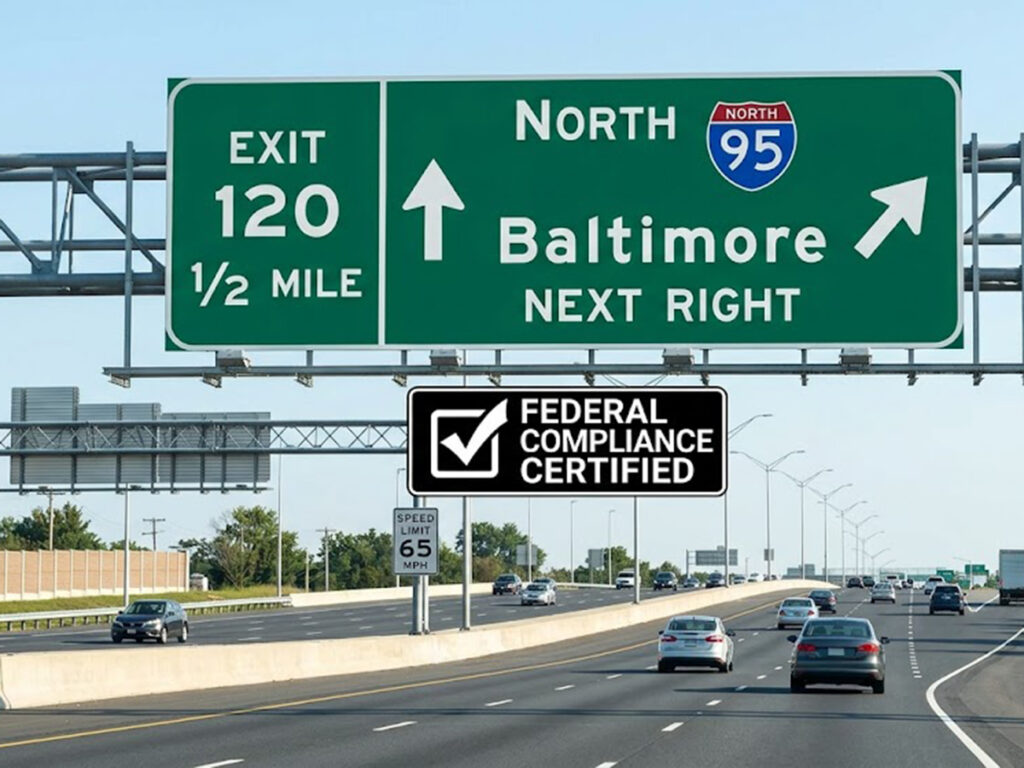
Three risks define the compliance landscape:
- Legal exposure. Federal-aid projects must conform to the MUTCD under 23 सीएफआर 655.603. Non-conforming devices can decertify projects and invite tort liability.
- Safety outcomes. Drivers depend on uniform, पढ़ने योग्य, पूर्वव्यापी संकेत. The MUTCD calls this the “expectation of uniformity.”
- Financial impact. Failed inspections trigger rework, schedule slippage, and withheld federal reimbursement.
Highway signage compliance is not paperwork. It protects budgets, अनुसूचियों, and lives.
The Federal Foundation — MUTCD and FHWA
संघीय राजमार्ग प्रशासन (एफएचडब्ल्यूए) publishes the Manual on Uniform Traffic Control Devices (MUTCD). Federal regulation adopts it by reference at 23 सीएफआर 655.603. The 11th Edition took effect January 18, 2024. States must adopt or substantially conform by January 18, 2026 — a deadline that reshapes every active project portfolio. FHWA issued Revision 1 in December 2025.
The MUTCD sets the federal baseline for highway signage compliance:
- Sign shape, रंग, and legend rules
- Minimum retroreflectivity levels
- Mounting height and lateral offset standards
- Breakaway support requirements
- These rules govern placement as much as they govern design.
Need the technical details on mounting heights and sight distance? See our deep dive: परिशुद्धता प्लेसमेंट: एफएचडब्ल्यूए & राजमार्ग चिह्न स्थापना के लिए MUTCD आवश्यकताएँ.
Highway signage compliance starts here. Federal rules form the floor — never the ceiling.
The State Variable — Why Federal Rules Aren’t the Whole Story
States adopt the MUTCD through three pathways:
- Adopt the federal MUTCD outright with no edits.
- Adopt the MUTCD plus a State Supplement — the most common approach.
- Publish a State MUTCD in substantial conformance with the federal version. कैलिफोर्निया, टेक्सास, and Minnesota use this model.
State supplements typically cover:
- Climate-specific material standards
- State-specific route markers and guide signage
- Local permitting and inspection workflows
- Approved Product Lists (APLs)
The variation is real. A sheeting material that passes in Arizona may fail Minnesota’s snow-load specification. Highway signage compliance, इसलिए, demands jurisdictional precision.
For a side-by-side breakdown of how requirements diverge, read our companion piece: राजमार्ग साइनेज में राज्य-दर-राज्य अंतर.
Design and Material Specs — Where Federal Meets State
Federal rules define the visual baseline. State rules dictate the materials. Contractors operate in the gap between them.
Key federal design parameters include:
- रंग, आकार, and legend conformance
- Retroreflective sheeting types (Type I through Type XI)
- Minimum legibility distances and letter heights
State overlays add:
- Specific sheeting Type approvals (varies by climate and traffic volume)
- Substrate gauge and corrosion requirements
- Documentation standards at delivery
Multi-state procurement teams should specify the strictest applicable standard across all jurisdictions. Highway signage compliance failures at delivery often trace back to a single APL mismatch.
For the full design and materials breakdown, देखना: राजमार्ग मार्कर डिज़ाइन और अनुपालन के लिए राज्य-दर-राज्य मार्गदर्शिका.
Best Practices for Multi-State Compliance Management
Project managers should treat highway signage compliance as a living workflow, not a one-time review.
Pre-Mobilization Checklist
☐ Identify every jurisdiction the project crosses
☐ Pull the current State Supplement or State MUTCD for each
☐ Cross-reference against the federal 11th Edition
☐ Document conflicts and apply the stricter standard
☐ Confirm APL requirements per state
☐ Schedule pre-construction meetings with each DOT reviewer
चल रही रखरखाव
- Build a sign inventory in GIS or asset-management software
- Schedule retroreflectivity testing on the FHWA cycle
- Document training and inspections to defend against tort claims
Field teams that win inspections share one trait. They document early, document often, and treat highway signage compliance as a discipline.
2026 Highway Signage Compliance Data at a Glance
| मीट्रिक | 2024 | 2025 | स्रोत |
| Traffic fatalities (हम।) | 39254 | 36640 | NHTSA |
| Fatality rate per 100M VMT | 1.19 | 1.1 | NHTSA |
| Nighttime share of fatalities | ~50% | ~50% | एफएचडब्ल्यूए |
| MUTCD edition in force | 11वां | 11वां + Rev. 1 | एफएचडब्ल्यूए |
सूत्रों का कहना है: HTTPS के://www.nhtsa.gov/press-releases/traffic-deaths-2025-early-estimates-2024-annual, HTTPS के://हाइवेज़.dot.gov/safety/other/visibility/nighttime-visibility-overview
यह क्यों मायने रखती है: nighttime crashes track closely to retroreflectivity failures. Highway signage compliance — especially sheeting maintenance — directly affects the nighttime crash curve.
Conclusion — Compliance as a Discipline
Highway signage compliance is a living obligation. Federal uniformity sets the floor. State supplements raise it. Project managers, नागरिक अभियंता, and DOT officials sit at the seam — and the public depends on their precision.
The January 18, 2026, adoption deadline for the MUTCD 11th Edition makes this year decisive. Teams that audit now will avoid funding clawbacks later. Teams that ignore highway signage compliance will pay in rework, देरी, or liability.
Next steps:
- Review your active project specifications against the 11th Edition this quarter.
- Schedule a compliance audit before your next multi-state mobilization.
- Subscribe for updates as state supplements publish through 2026.
Highway signage compliance protects budgets, परियोजनाओं, and lives. Treat it accordingly.
संदर्भ
- NHTSA. (2026, अप्रैल 1). Trump’s Transportation Department Announces Record-Low Traffic Deaths & Fatality Rates in 2025. https://www.nhtsa.gov/press-releases/traffic-deaths-2025-early-estimates-2024-annual
- एफएचडब्ल्यूए. (2025). समान यातायात नियंत्रण उपकरणों पर मैनुअल, 11th Edition with Revision 1 (दिसंबर 2025). https://mutcd.fhwa.dot.gov/
- एफएचडब्ल्यूए. एमयूटीसीडी 11वां संस्करण. https://mutcd.fhwa.dot.gov/kno_11th_Edition.htm
- ईसीएफआर. 23 सीएफआर 655.603 — Standards. https://www.ecfr.gov/current/title-23/chapter-I/subchapter-G/part-655/subpart-F/section-655.603
- एफएचडब्ल्यूए. रात्रिकालीन दृश्यता अवलोकन. https://highways.dot.gov/safety/other/visibility/nighttime-visibility-overview
- एफएचडब्ल्यूए. Sign Retroreflectivity. https://highways.dot.gov/safety/other/visibility/sign-retroreflectivity
- एफएचडब्ल्यूए. MUTCD — Information by State. https://mutcd.fhwa.dot.gov/resources/state_info/index.htm