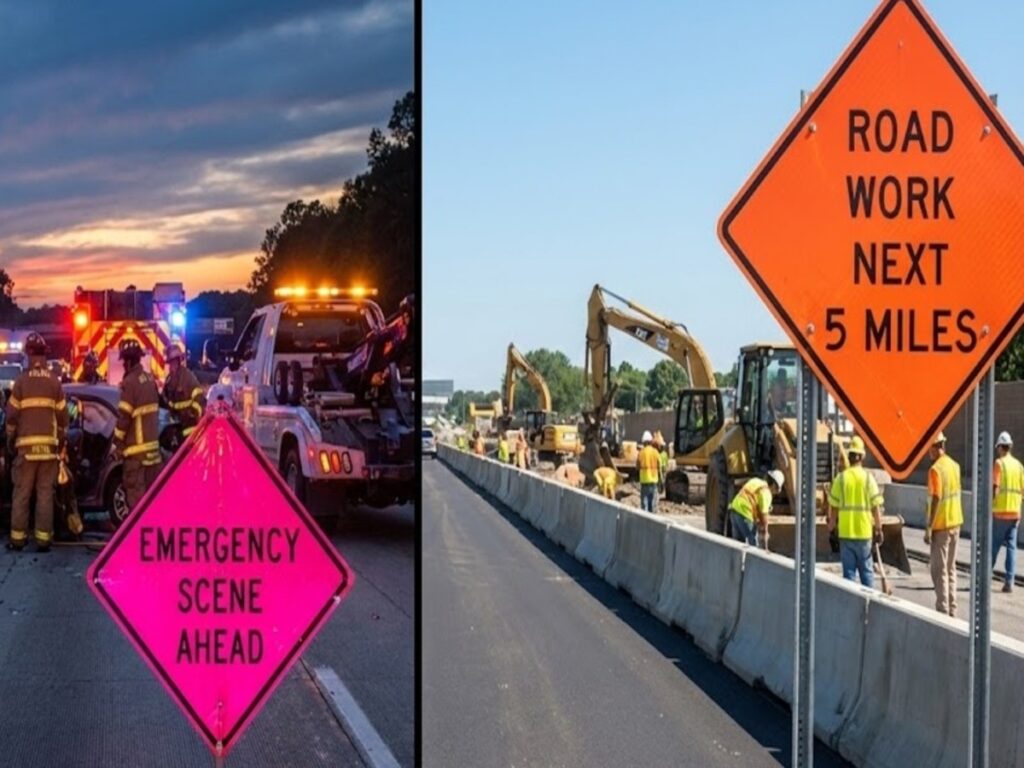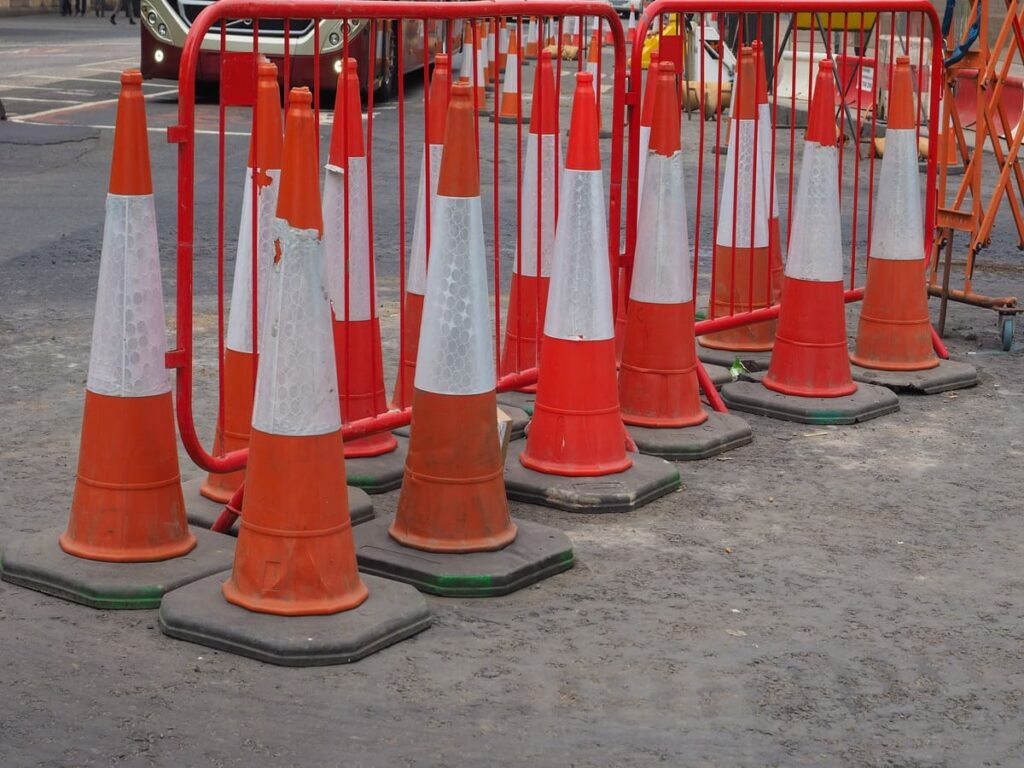

In the American heavy civil industry, the safety of a work zone is measured by the precision of its layout. You can procure the most advanced materials in the world, but if your construction road signs placement is flawed, the entire safety ecosystem collapses. Improperly installed signs are not just a safety hazard—they are a primary source of Department of Transportation (DOT) citations and catastrophic legal liability.
As the anchor of our Professional Installation Series, this guide provides a deep dive into the engineering, math, and field tactics required to deploy construction road signs that meet the federal Manual on Uniform Traffic Control Devices (MUTCD) standards.
1. The Anatomy of a Compliant Work Zone: Sequencing for Safety
A professional work zone setup is a psychological exercise in driver guidance. Drivers traveling at high speeds require a predictable sequence of information to transition safely from normal travel to a restricted construction area.
The Four-Zone Structure
- Advance Warning Area: This is where you tell the driver what to expect. This zone is where your heaviest temporary construction signs (like Road Work Ahead) are deployed.
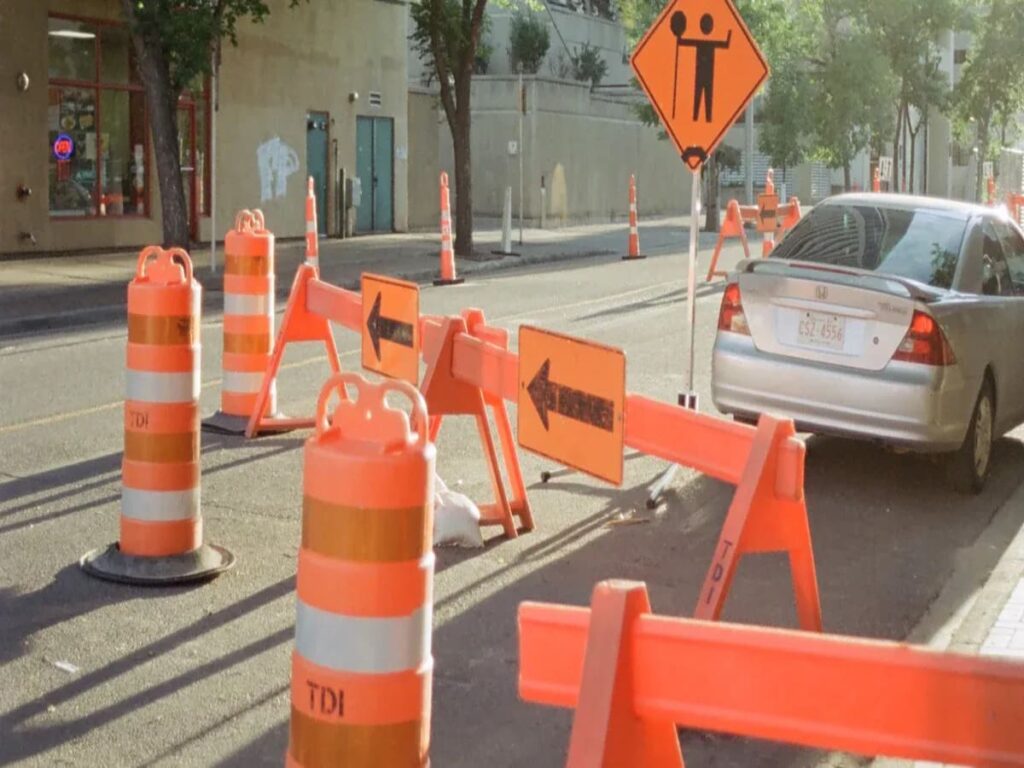
- Transition Area: This is the most dangerous section. It is defined by the “Taper”—the strategic line of channelizing devices and directional signs that move traffic laterally.
- Activity Area: The protected space for your crew and equipment. Placement here focuses on internal traffic control and protecting the “Buffer Space.”
- Termination Area: The area used to return traffic to its normal path, anchored by the End Road Work sign.
2. The Spacing Cheat Sheet: MUTCD Table 6C-1 Standards
The most common point of failure in a work zone audit is the spacing between advance warning signs. Many crews rely on “eye-balling” the distance, but the MUTCD is clear: spacing must be calculated based on the 85th-percentile speed—the speed at which 85% of traffic is traveling, regardless of the posted limit.
A. The “Three-Sign” Logic (A, B, and C)
When you look at the MUTCD spacing table, you will see three columns labeled A, B, and C. For a professional construction road signs placement, you must understand the “countdown” logic:
- Sign A (The Action): The sign closest to the transition or taper (e.g., Lane Ends).
- Sign B (The Warning): The intermediate sign (e.g., Right Lane Closed).
- Sign C (The Hook): The first sign the driver sees (e.g., Road Work Ahead).
B. Federal MUTCD Table 6C-1: Suggested Spacing
| Road Type | Speed Limit (MPH) | Distance A (ft) | Distance B (ft) | Distance C (ft) | Total Warning Distance |
| Urban (Low Speed) | $\le$ 25 mph | 100 | 100 | 100 | 300 ft |
| Urban (High Speed) | 30 – 50 mph | 350 | 350 | 350 | 1,050 ft |
| Rural Highways | 45 – 65 mph | 500 | 500 | 500 | 1,500 ft |
| Interstate / Expway | 65 – 80 mph | 1,000 | 1,500 | 2,640 | 5,140 ft (approx. 1 mile) |
C. Why Rural and Interstate Distances Are So Large
A vehicle traveling at 75 mph on an American Interstate covers 110 feet every single second.
- Perception Distance: It takes an average driver 2.5 seconds just to recognize a sign and process the message (275 feet traveled).
- Reaction Distance: Another 1.5 seconds to check mirrors and signal (165 feet traveled).
- The “Buffer” Requirement: If you place your signs too close together on a highway, the driver will reach the taper before they have physically moved their vehicle. This is why the total warning distance on Interstates exceeds 5,000 feet.
D. Field Adjustments: When the Table Isn’t Enough
As a Site Supervisor, the MUTCD table is your “floor,” not your “ceiling.” You must extend these distances in the following scenarios:
- Vertical Curves (Hills): If your sign C is hidden behind the crest of a hill, you must move it back so it is visible to the driver before they reach the crest.
- Horizontal Curves (Turns): Signs must be placed on the outside of curves where headlights are most likely to hit them directly.
- Visual Clutter: In dense urban areas like downtown New York or Chicago, the sheer volume of neon lights and shop signs can “wash out” a standard sign. In these cases, increasing the spacing or adding a Portable Changeable Message Sign (PCMS) is recommended to ensure your construction road signs placement remains effective.
3. Taper Geometry: Strategic Construction Road Signs Placement for Lane Transitions
A taper is more than just a line of cones; it is a directional vector that forces a vehicle to change its lateral position. If the taper is too steep, the “merging conflict” increases exponentially. For a compliant construction road sign installation, you must ensure the transition length matches the speed of the roadway.
Simplified Formulas for Construction Road Sign Spacing in Tapers
Instead of complex engineering, most U.S. contractors follow two “rule-of-thumb” formulas to determine the transition length ($L$) where your construction road signs must guide traffic:
- High-Speed Highways (45 mph or more): The length is simply the Lane Width ✖ Speed.
- Example: For a 12-foot lane at 65 mph, you need a 780-foot transition.
- Low-Speed Urban Streets (40 mph or less): The math is scaled down for tighter city geography.
- Example: A 12-foot lane at 35 mph only requires a 245-foot transition.
Four Types of Tapers for Construction Road Signs Placement
In a professional work zone setup, different scenarios require different intensities of construction road sign installation:
- The Merging Taper: The full distance (L) used when a lane is closed and traffic must merge.
- The Shifting Taper: Used when traffic shifts laterally but the number of lanes stays the same. This only requires half the distance (0.5L).
- The Shoulder Taper: Used when work occurs on the shoulder. This requires one-third of the distance (0.33L).
- The Downstream Taper: A short 100-foot section at the end of the work zone to guide traffic back.
Channelizing Device Spacing for Construction Road Sign Layouts
Once the taper length is set, you must place your cones or drums. A common industry standard for construction road sign placement and channelization is:
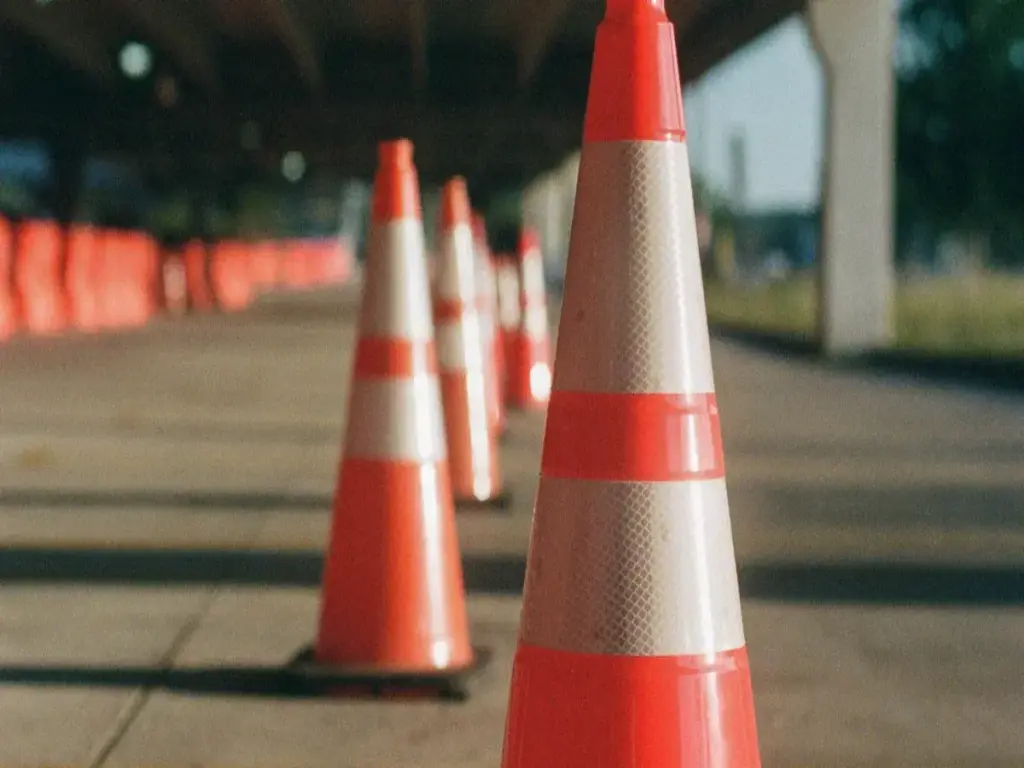
- Maximum Spacing: The distance between devices (in feet) should equal the posted speed limit (in mph).
- Field Tip: On a 65 mph highway, space devices 65 feet apart.
Critical Signage Placement at the Taper Point of Entry
Your Merge Right/Left symbol signs or Large Arrow Boards must be positioned exactly at the upstream end (the start) of the taper. This is the most critical construction road sign installation point because it is where the “Vortex Effect” is strongest.
Passing trucks create intense air pressure; if you use substandard, thin signs, they will flutter and eventually rip off their mounts. This is why high-speed tapers require .080 gauge aluminum construction road signs to ensure the installation remains upright and visible.
4. Vertical and Lateral Standards: Mounting for Visibility
A sign is useless if it is hidden behind an SUV or a bush. Proper construction road sign installation requires attention to height and offset.
- Urban Areas (7-Foot Rule): In business or residential districts, the bottom of the sign must be at least 7 feet above the ground. This ensures it stays above the roofline of parked cars and allows for pedestrian clearance.
- Rural Areas (5-Foot Rule): On open highways, a 5-foot mounting height is standard.
- Lateral Offset: Signs should be placed 6 to 12 feet from the edge of the shoulder. This protects the installation from the “vortex effect”—the intense wind vacuum created by semi-trucks—which we analyze in our Sign Fatigue and Wind Load Study.
5. Regional Expert Insight: State DOT Variations
While the federal MUTCD provides the framework, construction road signs installation is often governed by state-specific supplements that are more stringent. If you are a contractor operating across state lines, a “standard” layout that passed inspection in one state might fail in another.
To ensure full regulatory compliance, site supervisors must account for regional geography, climate, and traffic density when planning their construction road signs placement.
A. Texas (TxDOT): High-Speed Stability & Wind-Load Compliance
In Texas, the combination of vast open plains and high interstate speed limits (often 75+ mph) makes wind-load the primary challenge for temporary construction signs.
- The “Texas Twist”: TxDOT often requires specific skid-mounted sign stands that have been tested for higher wind gusts than federal minimums.
- Installation Spacing: Because of the high speeds, TxDOT frequently mandates longer “Buffer Spaces” than the MUTCD minimums. When performing construction road signs placement in Texas, you must ensure that your Advance Warning signs are anchored with enough ballast to withstand the “Vortex Effect” of passing triples (heavy trucks).
B. California (Caltrans): Visibility & High-Contrast Requirements
California’s construction road sign installation standards focus heavily on contrast and “Visual Pop” due to its varied geography—from foggy coastal roads to smog-prone urban basins.
- Fluorescent Orange Mandate: Caltrans was a pioneer in mandating Fluorescent Orange sheeting for all temporary construction signs. They’ve found that standard orange can “grey out” in California’s coastal marine layers.
- Placement Precision: Caltrans is notoriously strict regarding the lateral offset of signs in urban corridors like the I-405, where space is limited but visibility is paramount.
C. Florida (FDOT): MASH-Compliance & Corrosion Resistance
Florida’s DOT (FDOT) prioritizes crashworthiness and environmental durability.
- MASH Testing: Florida is a leader in enforcing the Manual for Assessing Safety Hardware (MASH) standards. Every construction road sign installation must use stands and hardware that have passed rigorous crash testing to ensure they don’t become projectiles during a high-speed impact.
- Coastal Salt-Air: For projects along the Atlantic or Gulf coasts, FDOT inspectors look for signs of “pitting” or corrosion. If the installation uses low-grade hardware that rusts, it can compromise the sign’s stability, leading to a failed audit.
D. New York (NYSDOT): Urban Complexity & Night-Work Standards
Managing construction road signs placement in New York requires navigating some of the densest traffic environments in the world.
- Reflectivity Requirements: Because much of the work in NYC or Albany is done at night, NYSDOT often requires a higher grade of retroreflective sheeting (Type XI) than other states.
- Sign Clutter Management: In New York’s urban geography, there is a high concentration of permanent signage. NYSDOT installation standards require contractors to physically “mask” or cover any permanent signs that conflict with the temporary work zone signs to prevent driver confusion.
E. Illinois (IDOT): The “Work Zone Safety Act” Standards
Illinois has some of the strictest penalties in the U.S. for work zone violations, which translates into very specific construction road sign installation protocols.
- Photo Enforcement Signage: IDOT requires specific signage warning drivers of automated camera enforcement. The placement of these signs must be precisely timed with the start of the work zone to ensure legal enforceability of speeding tickets.
6. The Night-Audit: The Final Test of Installation Success
In the United States, more than 40% of highway work occurs under the cover of darkness to minimize traffic disruption. However, nighttime environments transform a standard work zone into a high-risk theater where the only thing protecting your crew is the installation efficiency of your reflective signage. A “Night-Audit” is the mandatory field procedure to ensure that your construction road signs placement remains visible and legally compliant under artificial lighting.
A. The Science of Retroreflectivity: Prism vs. Perception
When conducting a Night-Audit, you aren’t just looking for “glow”; you are auditing Retroreflectivity Standards. In our Construction Sign Material Guide, we detailed the physics of micro-prismatic sheeting, but in the field, this translates into Decision Sight Distance.
- Observation Angle Performance: On curved highway ramps or undulating geography, a sign’s brightness can vary. During your audit, you must drive the zone in a standard vehicle to ensure that the construction road sign installation maintains its “pop” even as the angle of your headlights changes.
- The 500-Foot Rule: Federal standards often require that a sign be legible from at least 500 feet at night. If the text “halos” (bleeds) or appears dim during your drive-through, the installation fails the audit.
B. Glare Management and Light Tower Positioning
One of the most common failures in temporary construction signs setup is “Veiling Luminance”—glare caused by poorly positioned work lights.
- The Conflict: Portable light towers are essential for crew safety, but if aimed incorrectly, they can wash out the retroreflective properties of your signs, rendering the text unreadable.
- Audit Protocol: Ensure that no light towers are aimed directly at the face of your construction road signs. The light should be focused on the “Activity Area,” while the signs rely solely on vehicle headlights for their reflective return.
C. Environmental Impact on Installation Integrity
Nighttime geography introduces unique environmental variables that can compromise your construction road sign placement after the sun goes down:
- Dew and Frost Accumulation: In high-humidity regions like the Southeast or the Midwest, “dew-shielding” becomes an issue. Moisture on the sign face can scatter light, reducing reflectivity by up to 60%. If your audit reveals moisture-blindness, you may need to upgrade to sheeting with anti-dew coatings.
- Ambient Light Interference: In urban areas, the “visual noise” of streetlights and commercial neon can overwhelm orange signage. Your Night-Audit must verify that your construction road signs are positioned to create a high-contrast silhouette against the urban background.
D. The “Drive-Through” Documentation: Your Legal Shield
A professional Night-Audit must be documented to provide a “Defense of Compliance” in the event of an accident.
- Dashcam Verification: Many U.S. contractors now use 4K dashcams to record the entire approach to the work zone at night. This provides timestamped proof that every construction road sign placement was visible and upright.
- The “Ghosting” Check: During the audit, look for signs that have been knocked over by wind or “ghosted” (shadowed) by large construction equipment.
- Sign Cleanliness Audit: Road grime, dust, and salt spray significantly degrade the performance of Type IV and Type XI sheeting. A simple wipe-down during the Night-Audit can restore the visual compliance of an entire installation.
7. Defensive Documentation: Protecting Against Liability
In the U.S. legal system, “If it wasn’t logged, it didn’t happen.” A professional installation includes a Daily Traffic Control Diary.
The Sign Placement Log
Every morning, the Traffic Control Technician (TCT) must document:
- The exact GPS location of each temporary construction sign.
- Verification that all signs are MASH-compliant (no concrete blocks or rocks as ballast; sandbags only).
- Photo evidence of the layout from the driver’s eye level.
Conclusion: Build for Compliance, Install for Safety
Correct construction road signs placement is a blend of engineering math and field experience. By adhering to the MUTCD spacing tables, calculating accurate tapers, and choosing the right substrates, you create a work zone that protects your crew, the public, and your company’s reputation.
OPTRAFFIC solves these critical work zone challenges by providing MUTCD-compliant signage. From premium aluminum substrates to advanced retroreflective sheeting, OPTRAFFIC construction road signs are built to maintain their placement integrity and legibility, providing contractors with a durable, low-maintenance solution.
Regulatory Compliance & Authorities
| Region / Standard | Official Reference Link |
| Federal Standards | FHWA Manual on Uniform Traffic Control Devices (MUTCD) |
| Safety Hardware | AASHTO MASH Crash-Test Standards |
| Texas | TxDOT Highway Signage & Traffic Control Manuals |
| California | Caltrans California MUTCD (CA MUTCD) |
| Florida | FDOT Standard Plans & Design Standards |
| New York | NYSDOT Work Zone Safety & Engineering Rules |
| Illinois | IDOT Work Zone Safety Guidelines |
Configure Your Zone: Specific Traffic Control Layouts
A “one-size-fits-all” approach often fails inspections. Use the following technical guides to execute precise layouts for shoulder work, flagging operations, and pedestrian detours.
Explore our scenario-specific safety guides:
- Shoulder & Lane Closures:
- Traffic Control Operations:
- Signage & Pedestrian Standards:
FAQ
According to MUTCD Table 6C-1, for speeds of 65-80 mph, the recommended spacing is 1,000 ft (Sign A), 1,500 ft (Sign B), and 2,640 ft (Sign C), totaling over 5,000 feet of advance warning distance.
Yes. While the federal MUTCD provides the national baseline, states like California (Caltrans) or Texas (TxDOT) often have more stringent requirements for reflectivity, wind-load ballast, and specific sign colors (e.g., fluorescent orange).
The 85th-percentile speed is the speed at which 85% of traffic is traveling. The MUTCD mandates using this speed, rather than the posted limit, to calculate taper lengths and sign spacing to ensure real-world safety.
For high-speed highway environments, .080 gauge aluminum is the industry standard. It provides the necessary structural integrity to withstand the “Vortex Effect” and wind gusts from passing heavy trucks.