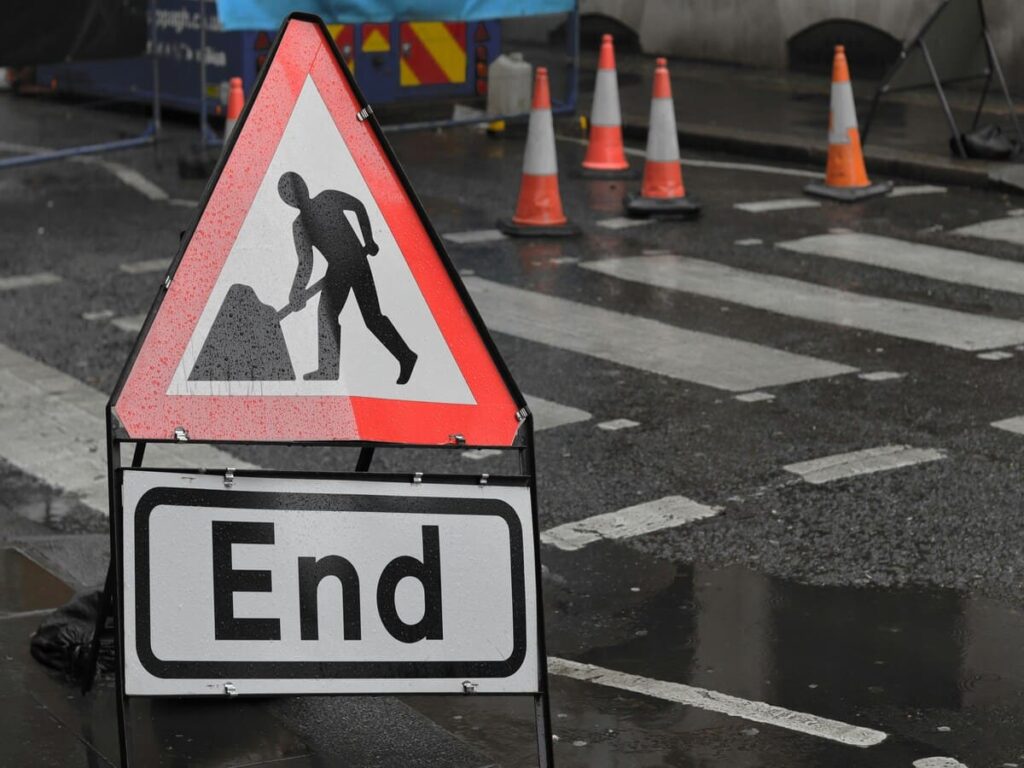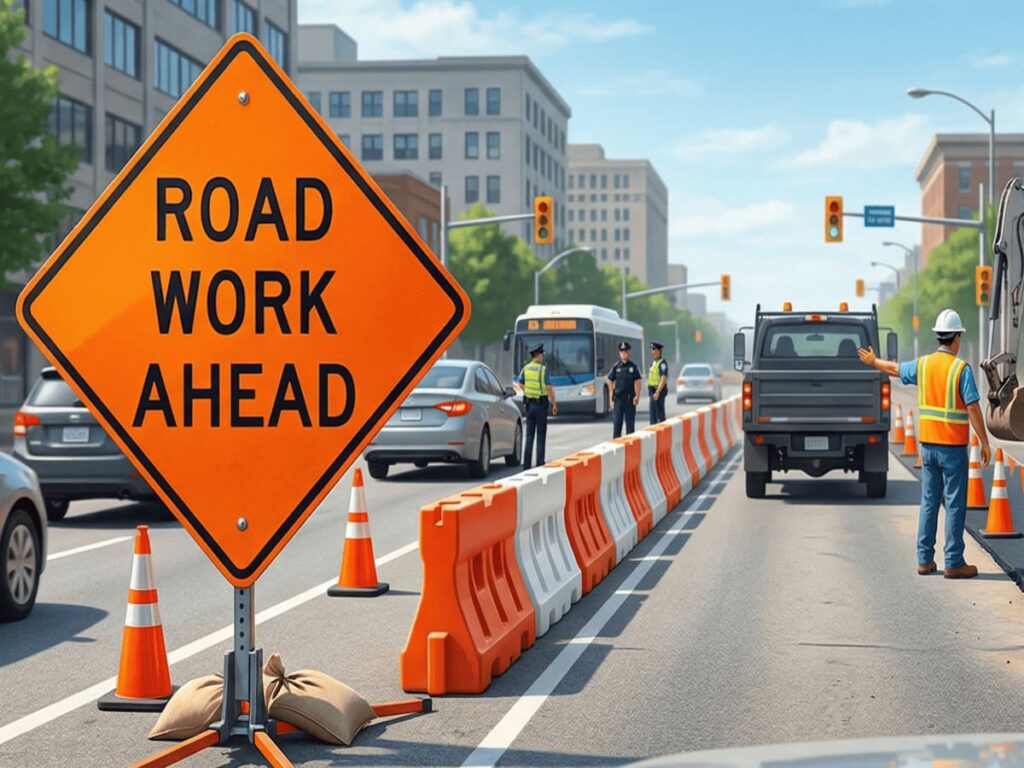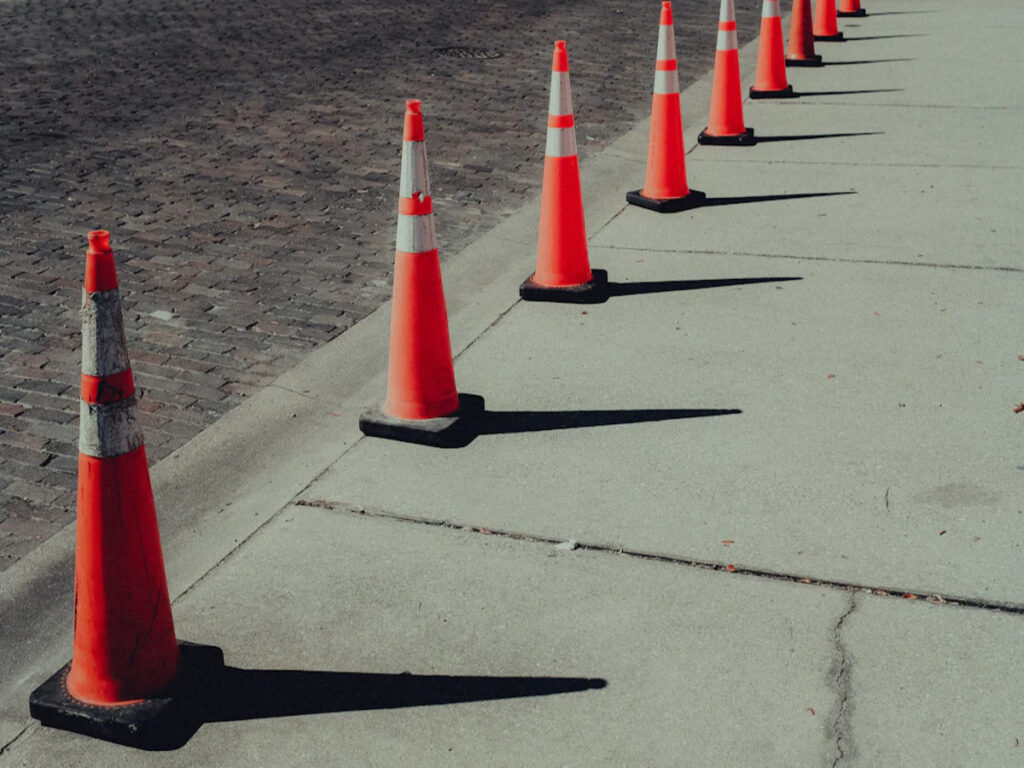
Non. Placing traffic cones on a public road without authorization is illegal in the UK. Only local councils, police forces, and licensed traffic management contractors are permitted to deploy cones on public highways. Doing so without a permit violates Section 137 de la loi sur les autoroutes 1980, and fines range from £100 to £1,000 depending on the severity of the obstruction and local council enforcement. Moving official cones placed by police or highway authorities is also a separate criminal offence under the Loi sur la réglementation routière 1984.
Can I Put Traffic Cones Outside My House in the UK?
This is one of the most common questions — and the answer depends entirely on whether the road in front of your house is public or private.
On a public road: Non. Placing cones on a public street outside your house to reserve a parking space is illegal, even if you own the adjacent property. This applies to dropped kerbs, double yellow lines, and standard residential streets alike. Councils treat this as obstruction of the highway under the Highways Act 1980, and enforcement officers can remove the cones and issue a fine.
On a private driveway or private land: Oui, with permission. If the area is entirely on private land that you own or manage, cones can be placed freely. A landlord managing a private car park can also use cones to enforce bay allocation, provided the land is not a public highway.
What to Do Instead (Legal Alternatives)
If you are dealing with vehicles regularly blocking your driveway or access, the following are your legal options:
- Report to your local council. Blocking a dropped kerb is a civil enforcement offence. Councils can issue a Penalty Charge Notice (PCN) to the offending vehicle.
- Apply for a parking restriction. Some councils allow residents to apply for a Traffic Regulation Order (TRO) for persistent problem areas.
- Contact the police. If a vehicle is blocking your access and you cannot leave your property, this can be reported to the local police on 101.
- Use legal driveway markings. A clearly painted “Restez à l’écart” marking on the road surface (applied with council permission) is a recognized deterrent.
Using cones on a public road — even temporarily, even in front of your own house — is not a legal solution.
Who Is Allowed to Place Traffic Cones on UK Roads?
Only the following parties have the legal authority to place traffic cones on public highways in the UK:
- Local highway authorities (conseils) — for roadworks, événements, and hazard management
- Police and emergency services — for incident management, scènes d'accident, and investigations
- Licensed traffic management contractors — working under a permit issued by the relevant highway authority
- Utility companies and construction firms — but only after obtaining a Section 50 licence (Acte de nouvelles routes et des travaux de rue 1991) or similar permit from the council
Even contractors working on your behalf must have the correct permits in place before cones can legally be deployed on a public road.
UK Traffic Cone Laws: The Legal Framework
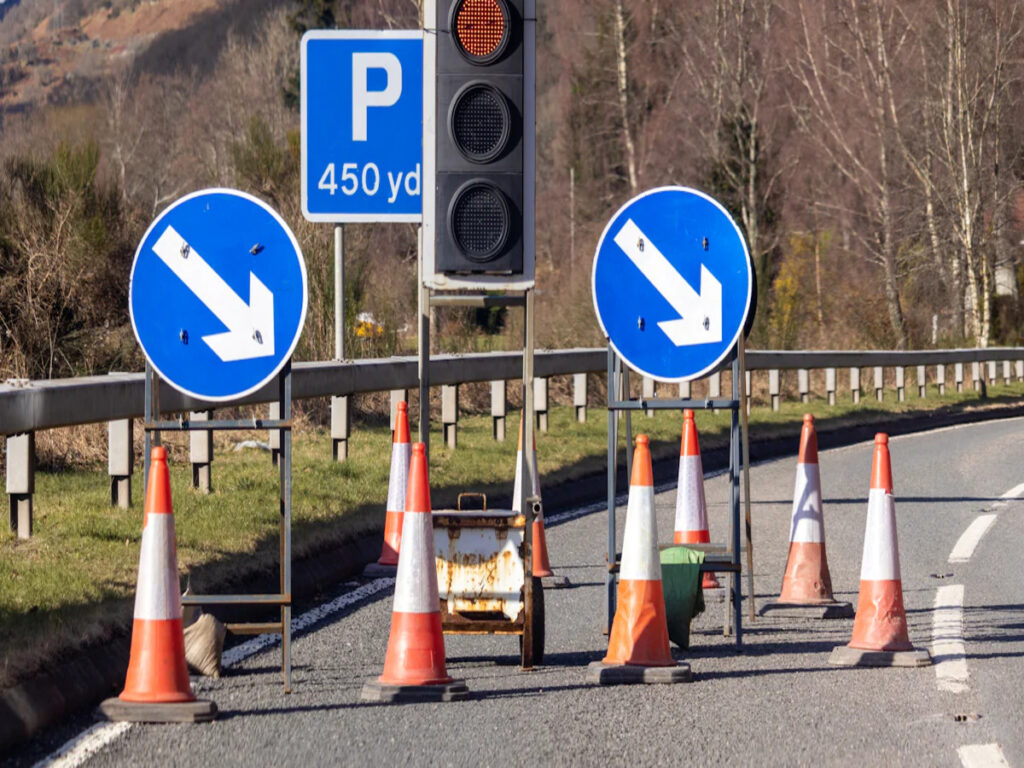
Loi sur les autoroutes 1980
La Loi sur la voirie 1980 is the primary legislation governing the use of public roads in England and Wales. Section 137 makes it a criminal offence to wilfully obstruct free passage along a highway without lawful authority. Unauthorized cone placement falls squarely within this definition. Penalties under this section can reach £1,000, and the offender can also be held civilly liable for any accidents or damage caused by their unauthorized cones.
Loi sur la réglementation routière 1984
This Act gives councils and police the power to restrict or regulate traffic on public roads. It also establishes the legal basis for traffic management schemes. Interfering with officially placed cones — including moving, removing, or repositioning them — constitutes obstruction under this Act and can result in prosecution.
Chapitre 8 du manuel de signalisation routière
Chapitre 8 sets out the detailed operational standards for temporary traffic management in the UK. It specifies cone heights, espacement, layout patterns, and the required signing and lighting for any road closure or lane restriction. All licensed contractors must work in compliance with Chapter 8. This is the document that defines comment cones must be used, not just who je peux les utiliser. For a complete breakdown of Chapter 8 cone requirements — including height by speed limit, taper spacing, and TMP obligations — see our Chapitre 8 Traffic Signs Manual guide.
UK Traffic Cone Size Requirements: What the Law Specifies
The height of traffic cones required on public roads in the UK is determined by the speed limit of the road. This is set out in Chapter 8 of the Traffic Signs Manual and BS EN 13422.
| Type de route / Limitation de vitesse | Hauteur minimale du cône | Reflectivity Required |
|---|---|---|
| Roads up to 40 mph | 450 mm | Yes — BS EN 13422 |
| Roads over 40 mph | 750 mm | Yes — BS EN 13422 |
| Autoroutes et routes à deux voies | 1,000 mm | Yes — BS EN 13422 |
| Propriété privée (pas de limite de vitesse) | No legal minimum | Facultatif |
Cones deployed on public roads must also feature retroreflective sleeves that meet BS EN 13422 normes. This ensures visibility at night and in low-light conditions. Sand-weighted bases are required on higher-speed roads to prevent displacement by vehicle airflow.
For a full technical breakdown of BS EN 13422 — including weight requirements, reflective sleeve classes, and material specifications — see our UK traffic cones EN 13422 compliance guide.
Est-il illégal de déplacer des cônes de circulation au Royaume-Uni?
Oui. Mobile, repositioning, or removing traffic cones placed by police, conseils, or licensed contractors is a criminal offence. The specific consequences depend on the context:
- Moving police cones at an incident scene — can result in arrest and prosecution for obstruction of a constable in the execution of their duty (Police Act 1996, Section 89)
- Moving highway authority cones — obstruction of the highway under the Highways Act 1980; fines up to £1,000
- Interfering with cones at a roadworks site — can trigger additional liability under the New Roads and Street Works Act 1991
Il n'y a pas “harmless” justification for moving official cones. Even if you believe the cones are placed incorrectly or unnecessarily, the correct action is to contact the relevant authority, not to move the cones yourself.
Penalties and Fines for Unauthorized Cone Use
| Offence | Législation | Potential Fine |
|---|---|---|
| Placing cones on public road without permit | Loi sur les autoroutes 1980, S.137 | Up to £1,000 |
| Moving official highway cones | Loi sur les autoroutes 1980 | Up to £1,000 |
| Moving police cones | Police Act 1996, S.89 | Unlimited (criminal offence) |
| Using cones at roadworks without licence | Acte de nouvelles routes et des travaux de rue 1991 | Up to £5,000 |
Beyond fines, unauthorized cone placement also creates civil liability. If your illegally placed cones cause an accident — a driver swerving, a pedestrian being misdirected — you can be held personally liable for damages and medical costs.
Safety Requirements for Traffic Cones on UK Roads
Correctly deployed traffic cones serve a precise function. When placed without proper training or planning, they create the opposite effect — confusion, misdirection, and increased accident risk. Chapitre 8 compliance requires:
- Correct spacing between cones depending on vehicle speed (longer tapers at higher speeds)
- Retroreflective sleeves on all cones used after dark or in low-visibility conditions
- Adequate advance warning signage before any cone layout begins
- A traffic management plan (TMP) for any deployment on roads with speed limits above 30 mph
- Éclairage (flashing amber beacons) on motorways and high-speed roads
These requirements exist because the consequences of poorly managed lane restrictions are severe. A cone knocked out of position on a motorway, or a taper that begins too close to a hazard, can directly cause fatal accidents.
Hiring a Licensed Traffic Management Company
If you have a legitimate reason to restrict access to a road or area — an event, travaux de construction, utility maintenance, or a film shoot — the correct route is to hire a licensed traffic management contractor and work through the council permit process.
A licensed company will handle:
| Service | Ce qu'il couvre |
|---|---|
| Traffic Management Plan (TMP) | Full layout and phasing plan submitted to the council |
| Permit application | Section 50 licence or equivalent for your specific activity |
| Cone deployment and removal | Chapter 8-compliant setup with trained operatives |
| Signing and lighting | All advance warning signs, balises, and variable message boards |
| Live monitoring | Real-time oversight of the restriction during operation |
| Incident response | On-call support if conditions change or an incident occurs |
Attempting to manage this yourself with purchased cones is not only illegal — it is considerably more expensive in the event of a fine, a claim, or an accident.
Reporting Unauthorized Cone Use
If you see traffic cones placed on a public road without obvious authorization — no workers present, no signage, no apparent emergency — you can report it through the following channels:
- Your local council via their highways department or the report-a-problem tool on their website
- The police on 101 if the cones are creating an immediate obstruction or safety hazard
- 999 if the obstruction is causing an active danger to traffic
Do not move the cones yourself. Report and let the relevant authority deal with it.
Conclusion
UK traffic cone law is straightforward in principle: public roads require permits, private land does not, and moving official cones is always an offence. The rules around cone height, réflectivité, and spacing exist because temporary traffic management carries real risk — getting it wrong has legal and financial consequences, et plus important encore, safety ones.
If you are a contractor, site manager, or procurement professional sourcing cones for legitimate roadworks or site use, the most important thing is that your equipment actually meets the standards required. Undersized cones, non-reflective sleeves, or lightweight bases that shift in traffic airflow are not just a compliance issue — they create liability.
OPTRAFIC fournitures Chapter 8-compliant traffic cones across the full size range, all with BS EN 13422 retroreflective sleeves and sand-weighted bases built for high-speed road environments. Whether you are equipping a single site or procuring for a fleet, our traffic cone range is built to the specifications this page describes.
Browse our full traffic cone range →
Guides connexes: UK Traffic Cone Regulations
- Chapitre 8 Manuel des panneaux de circulation: Explication des exigences relatives aux cônes de signalisation — Operational standards: cone height by speed limit, taper spacing, zones de sécurité, and TMP requirements.
- UK Traffic Cones EN 13422 Compliance Guide — Product standards: sleeve classes, weight requirements, spécifications matérielles, and bulk order verification.
- Loi sur les autoroutes 1980 et cônes de signalisation: Section 137, Amendes & Application expliquée — Section 137: what constitutes obstruction, penalty structure, enforcement bodies, and contractor compliance obligations.
| Références: Loi sur les autoroutes 1980 · Loi sur la réglementation routière 1984 · Chapter 8 Traffic Signs Manual · BS EN 13422 · Acte de nouvelles routes et des travaux de rue 1991 |
FAQ
Puis-je mettre des cônes sur la route au Royaume-Uni?
Non, not without authorization. Placing traffic cones on a public road without a permit from the highway authority is illegal under the Highways Act 1980. Only councils, police, and licensed contractors can legally place cones on public roads. Fines can reach £1,000.
Can I put traffic cones outside my house?
Not on a public road. Using cones to reserve a parking space on a public street — even directly outside your own home — is illegal. Si quelqu'un bloque votre allée, the correct action is to report it to your local council or police, not to put out cones.
Is it illegal to move traffic cones in the UK?
Oui. Moving official cones placed by police or highway authorities is a criminal offence. Depending on the context, this can result in fines up to £1,000 or prosecution under the Police Act 1996.
What are the legal cone height requirements in the UK?
Cone height requirements depend on road speed: 450 mm for roads up to 40 mph, 750 mm for roads over 40 mph, et 1,000 mm for motorways. All cones on public roads must have retroreflective sleeves meeting BS EN 13422.
Can I use traffic cones on my private driveway?
Oui. Sur des terres privées, there is no legal minimum for cone size and no permit is required. Cependant, if the cone placement extends onto a public pavement or road, it immediately becomes subject to highway law.
Can a business put cones outside their premises?
Not on a public road or pavement without a permit. In a private car park, Oui. If a business needs to manage access on a public road (Par exemple, for deliveries), they must apply to the council for a temporary traffic management permit.
Can a landlord put traffic cones in a car park?
Oui, if the car park is on private land. Landlords and property managers can use cones freely on private property to manage parking bays, enforce restrictions, or protect access points. This does not require a council permit.
What size traffic cone do I need for a UK road?
The minimum legal size for a public road depends on the speed limit: 450 mm (jusqu'à 40 mph), 750 mm (sur 40 mph), ou 1,000 mm (autoroute). Cones must also carry retroreflective sleeves and, for heavier traffic, sand-weighted bases.
Do traffic cones need to be reflective in the UK?
Oui, for all public road use. BS One 13422 requires retroreflective sleeve material on any cone deployed on a public highway. This is not optional — non-reflective cones do not comply with Chapter 8 du manuel de signalisation routière.
How far apart should traffic cones be placed on a UK road?
Spacing depends on vehicle speed and the type of taper being created. Chapitre 8 of the Traffic Signs Manual specifies exact taper ratios and spacing intervals for each road type. As a general rule, higher speeds require longer tapers with greater distances between cones. Licensed contractors are trained on these specifications.
What happens if someone puts illegal cones on the road?
Report it to your local council or call 101. The council or police can remove the cones and may issue a fine to the person responsible. Do not move the cones yourself — this could expose you to liability.
Who do I call if traffic cones are blocking the road?
Contact your local council’s highways department for non-urgent situations. Appel 101 for police non-emergency if the cones are causing an obstruction. Appel 999 only if there is an immediate danger to road users.
What are police cones used for?
Police cones are official traffic management devices used to close lanes, cordon off accident scenes, secure crime scenes, or manage traffic around incidents. Interfering with them — moving, repositioning, or removing them — is a criminal offence that can result in arrest.
Can I put cones on the road for an event or party?
Non, without a permit from your local council. If you are organizing a street party or event that requires road closure, you must apply to your local highway authority for a Temporary Traffic Regulation Order (TTRO). The council will then authorize any cone deployment as part of the approved traffic management plan.