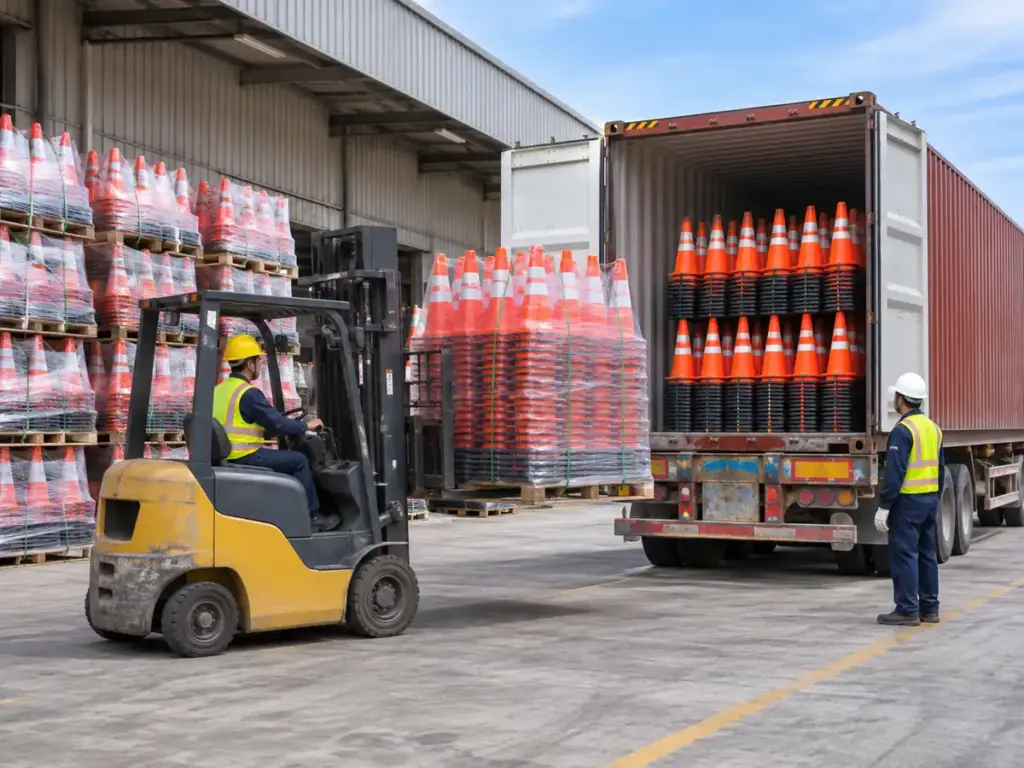
For traffic safety distributors and importers, eficiente traffic cone container loading directly affects the landed cost of bulk orders. Cone dimensions, diseño básico, stacking height, and packaging all determine how many units fit into a shipping container.
Suministros Optraffic conos de trafico for traffic management contractors, empresas de alquiler, and international distributors. Para pedidos grandes, selecting the right product is only one part of the process. Buyers also need a loading plan that balances shipping efficiency, cargo protection, and destination handling costs.
This guide explains how to estimate loading capacity, compare 20ft and 40ft containers, and reduce freight expenses without compromising product condition.
Control de llave
- Stacking efficiency: Cone base dimensions and nesting depth determine how many units fit into each stack.
- Container selection: A 40ft container offers more cargo space, but the lowest freight cost per cone depends on the actual loading arrangement.
- Packaging options: Palletized and floor-loaded shipments involve different space, manejo, and protection requirements.
- Landed cost: Distributors should compare freight cost per delivered cone rather than relying on unit purchase prices alone.
- Repeat orders: Consistent cone specifications and documented loading plans make future shipments easier to manage.
Why Traffic Cone Container Loading Matters for Bulk Orders
Traffic cones have a wide base and tapered body. This design supports stability in roadwork applications while allowing many models to nest together during storage and transportation.
Sin embargo, different cone designs create different loading results. A distributor ordering thousands of cones may find that base dimensions and nesting depth significantly affect the shipment’s total freight cost.
How Loading Efficiency Affects Freight Cost Per Cone
Consider two traffic cone models with similar unit prices.
Model A nests closely and allows more units per stack. Model B has a wider base and a larger nesting increment.
Even if both models meet the required application specifications, their shipping costs may differ.
The basic calculation is:
Freight cost per cone = Total shipment freight cost ÷ Number of cones shipped
Por ejemplo, assume an importer pays $3,000 in freight charges for a shipment.
| Loading scenario | Cones shipped | Freight cost per cone |
|---|---|---|
| Escenario A | 2,000 | $1.50 |
| Escenario B | 2,500 | $1.20 |
| Scenario C | 3,000 | $1.00 |
These figures illustrate how loading quantity changes unit freight cost. They do not represent verified OPTRAFFIC container capacities or current freight quotations.
In this example, increasing the shipment from 2,000 a 3,000 cones reduces the allocated freight cost from $1.50 a $1.00 por cono.
Sin embargo, greater loading density does not automatically produce the best commercial outcome. Buyers must also consider product suitability, protective packaging, unloading expenses, and inventory requirements.
Why Landed Cost Matters More Than Purchase Price
The product price represents only part of the importer’s total expenditure.
A more complete landed cost assessment includes:
- Product purchase cost
- Origin handling and export charges
- Ocean freight
- Cargo insurance, donde se aplica
- Customs duties and import fees
- Destination handling and inland transportation
- Unloading and warehouse expenses
Distributors sourcing cones from different markets must evaluate these expenses together.
For a comparison of sourcing-related costs, Mira nuestro blog “Costos de los conos de tráfico al por mayor fabricados en China vs.. México.”
That article examines sourcing geography and logistics costs. Container loading focuses on how product dimensions and packing methods affect the number of units shipped.
What Determines How Many Traffic Cones Fit in a Container?
No universal loading quantity applies to every traffic cone.
Two models with the same nominal height can have different stacking characteristics, base dimensions, and weights.
Por lo tanto, importers need model-specific measurements before calculating bulk shipping capacity.
1. Traffic Cone Height and Base Dimensions
Traffic cones commonly come in different height categories, including approximately 450 milímetros, 700 milímetros, 750 milímetros, y 900 milímetros.
Sin embargo, nominal cone height alone cannot determine container capacity.
The base footprint also matters because it affects how many stacks fit across the container floor.
Por ejemplo, a cone with a 400 × 400 mm base occupies less floor area than one with a 500 × 500 mm base, assuming both use the same stacking arrangement.
En la práctica, the loading team must also account for clearance, embalaje, and cargo securing.
2. Nesting Depth and Stack Height
Traffic cones generally nest by allowing the upper cone to slide partly inside the cone below it.
The additional height created by each cone is called the nesting increment.
For a simplified estimate:
Stack height = First cone height + (Number of additional cones × Nesting increment)
Suppose a cone measures 750 mm tall and each additional nested cone adds 45 milímetros.
A stack of 20 cones would have an approximate height of:
750 + (19 × 45) = 1,605 milímetros
This result is only a dimensional example. Actual stacking performance depends on the cone geometry, base construction, and any packing materials.
The importer should request physical stack measurements rather than assuming every model has the same nesting increment.
3. Cone Weight and Base Construction
Traffic cone weight affects payload calculations and material handling.
A heavier cone may suit certain traffic management conditions, but it also increases the weight of each stack.
Mientras tanto, cones with detachable rubber bases may support different packing arrangements from one-piece molded cones.
These differences can affect loading efficiency, unloading procedures, and warehouse storage.
Sin embargo, operational performance must come first. Distributors should select cones that meet their customers’ traffic management requirements before comparing freight efficiency.
For an overview of cone applications and materials, Mira nuestro blog “Guía completa de conos de tráfico: Todo lo que necesitas saber.”
20ft vs. 40ft Containers: Which Is Better for Bulk Traffic Cone Shipping?
International distributors commonly compare three dry-container options: 20ft standard, 40ft standard, and 40ft high cube.
Each option provides different cargo space and loading clearance.
According to freight provider DSV, representative specifications include:
| Container type | Internal volume | Internal height | Door opening height |
|---|---|---|---|
| 20ft standard | 33.2 m³ | 2.39 metro | 2.28 metro |
| 40ft standard | 67.7 m³ | 2.39 metro | 2.28 metro |
| 40ft high cube | 76.4 m³ | 2.70 metro | 2.58 metro |
Fuente: DSV, Dry Container and High Cube Dry Container Specifications. Actual dimensions vary by container manufacturer and equipment type.
When a 20ft Container Makes Sense
A 20ft container may suit distributors with smaller replenishment requirements or limited destination warehouse capacity.
It can also help businesses avoid purchasing more inventory than they can reasonably sell or store.
Sin embargo, the buyer should compare total freight quotations rather than assuming the smaller container always has the lowest delivered unit cost.
When a 40ft Container Offers an Advantage
A 40ft standard container provides approximately twice the internal volume of a 20ft standard container.
This can help importers consolidate larger orders into one shipment.
Sin embargo, the final cone quantity depends on floor layout, stacking height, peso, and cargo securing.
A buyer should not simply double the estimated 20ft loading quantity without checking the complete arrangement.
Is a 40ft High-Cube Container Worth Considering?
A 40ft high-cube container provides approximately 30 cm of additional internal height compared with a standard 40ft container.
This extra clearance may help when cone stacks can safely use the available vertical space.
Sin embargo, the loading team must check the container door opening, stack stability, and handling method.
Por ejemplo, a tall stack may fit inside the container but still exceed the door clearance when loaded upright.
Por lo tanto, the best container is the one that accommodates the verified packing plan at an acceptable total landed cost.
Palletized vs. Floor-Loaded Traffic Cones
The packaging and loading method affects container utilization as well as destination handling expenses.
For bulk shipments, distributors generally need to compare palletized loading and floor loading.
Palletized Loading for Distribution Warehouses
Pallets simplify forklift handling and help distributors receive products in organized units.
They can also support warehouse inventory management and standardized shipment documentation.
Sin embargo, pallets occupy floor space and add weight. The pallet dimensions may also create unused gaps inside the container.
For distributors operating pallet-based warehouses, these trade-offs may still be worthwhile.
Floor Loading for Higher Packing Flexibility
Floor loading places cargo directly into the container without using pallets as the main loading platform.
Depending on the product and protective packaging, this method may improve space utilization.
Sin embargo, it can require additional unloading labor and different securing arrangements.
The importer must evaluate whether the freight savings justify the destination handling requirements.
| Comparación | Palletized loading | Floor loading |
|---|---|---|
| Space utilization | Pallet dimensions may limit density | Can offer flexible stacking arrangements |
| Unloading | Supports forklift-based receiving | May require more manual or specialized handling |
| Warehouse operations | Easier pallet-unit inventory handling | Requires a suitable receiving process |
| Packaging cost | Includes pallet materials | Depends on protective packing and securing |
| Best suited for | Established distribution warehouses | Buyers with appropriate unloading capabilities |
Neither method is universally better.
The correct choice depends on the container layout, unloading equipment, product protection requirements, and overall shipment cost.
For more information on packaging options, Mira nuestro blog “Las tres mejores opciones de embalaje para conos de seguridad al por mayor.”
How to Calculate Traffic Cone Loading Capacity
A preliminary calculation helps importers understand how product dimensions affect the shipping plan.
Sin embargo, the final quantity must come from a verified loading arrangement.
Paso 1: Confirm the Cone Specifications
Start with four basic measurements:
- Altura del cono
- Base length and width
- Unit weight
- Nesting increment
If the order contains multiple cone models, calculate each model separately.
Mixed shipments need additional layout planning because different base dimensions can create unused spaces.
Paso 2: Determine the Stack Configuration
Próximo, calculate the height of a proposed cone stack.
A basic formula is:
Stack height = Cone height + (Stack quantity − 1) × Nesting increment
The proposed stack must remain within the applicable loading, manejo, and securing limits.
For upright loading, check the container’s internal height and door opening height.
If the packing plan uses another orientation, verify that the stacks can enter the container and remain stable throughout transportation.
Paso 3: Estimate the Number of Stacks
For a simple arrangement of rectangular stack footprints:
Stacks along length = Floor(Container length ÷ Stack footprint length)
Stacks across width = Floor(Container width ÷ Stack footprint width)
Preliminary stack positions = Stacks along length × Stacks across width
This calculation assumes uniform stack orientation and does not account for every practical loading restriction.
The final arrangement must consider protruding cone bases, embalaje, clearances, and cargo securing.
Paso 4: Check the Total Shipment Weight
Once the preliminary cone quantity is known, calculate the cargo weight.
Total cargo weight = Cone quantity × Unit cone weight + Packaging and securing materials
The calculation must remain within the container’s permissible payload and applicable transport limits.
The loading team must also distribute the weight correctly.
The IMO/ILO/UNECE Code of Practice for Packing of Cargo Transport Units provides guidance on cargo distribution, embalaje, and securing. It is a non-mandatory international code of practice, rather than a replacement for applicable transport regulations.
Paso 5: Verify the Loading Plan
Before finalizing a large shipment, the supplier and logistics team should confirm:
- Actual stack dimensions
- Loading orientation
- Container door clearance
- Total cargo weight
- Securing arrangement
- Unloading method
A documented packing test, container loading diagram, or verified previous shipment provides stronger support than a rough volume estimate.
How to Reduce Freight Cost Per Cone Without Increasing Shipping Risks
The objective is not simply to place the maximum possible number of cones into a container.
A good loading plan balances freight efficiency, product protection, handling safety, and the importer’s inventory needs.
Compare Suitable Cone Designs
Distributors can compare base size, nesting increment, and packaging across models that meet the same application requirements.
Por ejemplo, two cones may provide the required height and reflective configuration while offering different stacking efficiencies.
Sin embargo, buyers should not sacrifice stability or application requirements to gain additional loading capacity.
Protect Reflective Collars and Product Surfaces
Nested cones can experience movement and contact during transportation.
Poor packing may lead to abrasion, deformación, or damage to reflective surfaces.
The packing plan should therefore account for protective materials and avoid excessive pressure on sensitive components.
Cargo protection is particularly important for distributors supplying products to government contractors or traffic management companies with defined quality requirements.
Standardize Specifications for Repeat Shipments
Many traffic safety distributors purchase the same cone models multiple times each year.
Consistent dimensions help them reuse established loading plans and warehouse procedures.
Changes in cone bases, collares reflectantes, or packaging may affect shipment capacity.
Por lo tanto, buyers should confirm specification consistency when placing repeat orders.
Evaluate the Complete Delivery Process
A shipment that minimizes ocean freight may still create high unloading or warehousing expenses.
Por ejemplo, removing pallets might improve container utilization but increase manual handling requirements.
Distributors should compare these costs before selecting their preferred shipping arrangement.
What Bulk Buyers Should Confirm Before Requesting a Container Quote
Para pedidos grandes, clear specifications help suppliers evaluate the required products and shipping arrangements.
| Información | Por qué es importante |
|---|---|
| Cone height and model | Identifies the required product |
| Base dimensions | Supports stack layout calculations |
| Cone weight | Supports payload planning |
| Reflective collar specification | Defines visibility and product requirements |
| Required quantity | Determines shipment scale |
| Destination port and country | Supports freight and delivery planning |
| Preferred container type | Helps evaluate loading arrangements |
| Pallet or floor-loading preference | Defines handling requirements |
| Custom branding or packaging | Identifies potential specification changes |
Sample Approval Before a Large Order
For new product models, distributors may want to inspect a sample before confirming a container-scale purchase.
A sample helps verify material quality, diseño básico, reflective components, and physical dimensions.
The buyer can also evaluate whether the proposed product meets the requirements of the intended market.
Sin embargo, one sample cannot establish final container capacity. The supplier still needs verified bulk packing measurements.
Consistency Across Repeat Orders
Distributors often serve multiple contractors, government suppliers, y empresas de gestión del tráfico.
These customers may expect the same specifications across different deliveries.
Por lo tanto, consistent product dimensions, material configurations, and packaging can support more predictable inventory management.
OPTRAFFIC offers traffic safety products and customization options for different markets. Buyers can explore its one-stop traffic safety solutions when planning orders that combine cones with signs, bolardos, or other road safety equipment.
Conclusión
Efficient traffic cone container loading can help distributors control the freight cost of large orders.
Sin embargo, loading capacity depends on more than container volume. Cone base dimensions, nesting increment, unit weight, embalaje, and cargo handling all affect the final result.
For importers, the most reliable approach is to compare verified loading plans and calculate the total cost per delivered cone.
OPTRAFFIC supplies traffic cones for traffic management companies, rental businesses, and international distributors.
For bulk orders or container-scale shipments, buyers can contacta con el equipo de OPTRAFFIC with their product specifications, estimated quantities, and delivery destination to discuss product configurations and shipping arrangements.
Preguntas frecuentes
How many traffic cones fit in a 20ft shipping container?
The quantity depends on cone height, base dimensions, nesting increment, unit weight, y embalaje. There is no standard loading quantity for all traffic cones. Buyers should request model-specific packing data.
Can a 40ft container hold twice as many traffic cones as a 20ft container?
No necesariamente. A 40ft standard container has approximately twice the internal volume, but actual loading capacity depends on stack geometry, floor layout, peso, and cargo securing requirements.
Is palletized shipping better for wholesale traffic cones?
Palletized shipping can simplify unloading and warehouse operations. Sin embargo, pallets take up space and add weight. The best method depends on the importer’s handling equipment and total logistics costs.
How can importers calculate traffic cone freight cost per unit?
Divide the relevant shipment freight charges by the number of cones shipped. For a more complete commercial comparison, include purchase cost, deberes, manejo, and inland delivery expenses in the landed cost calculation.
Does the cone base affect container loading capacity?
Sí. The base dimensions influence the footprint of each stack. Wider bases can reduce the number of stacks that fit across the container floor, depending on the loading arrangement.
Can OPTRAFFIC support bulk traffic cone orders with custom specifications?
OPTRAFFIC offers traffic safety cones and customization options for different markets. Buyers should provide the required dimensions, reflective configuration, cantidad, and shipping destination so the team can assess the product and order requirements.