Por qué una especificación estricta de señalización de EPP separa las ofertas limpias de los dolores de cabeza de seis cifras
Tres vendedores. el mismo sitio. Ofertas de $18,400, $31,900, y $52,200. la unica diferencia? Una licitación que pedía “Suministrar e instalar señales de seguridad de EPP según sea necesario.” Esa ambigüedad les cuesta dinero real a los gerentes de proyectos. También les cuesta dormir. un suelto Especificación de señalización de EPI invita a interpretaciones tremendamente diferentes, materiales no coincidentes, y hallazgos de auditoría seis meses después de la ocupación.
Lo que está en juego es concreto. La pena máxima de OSHA por una infracción grave aumentó a $16,550 por cita en 2026, y las violaciones intencionadas o repetidas ahora alcanzan $165,514 cada (Fuente: https://www.osha.gov/penalties). La comunicación de peligros siguió siendo la segunda norma de OSHA más citada en el año fiscal 2025 con 2,546 violaciones (Fuente: https://blog.ansi.org/ansi/osha-2025-top-10-violations/). Una especificación vaga pone esos números en el escritorio del director del proyecto..
Este manual brinda a los gerentes de proyectos una estructura de trabajo para redactar un Especificación de señalización de EPI que produzca ofertas comparables y sobreviva una revisión de cumplimiento. Se supone que los lectores ya comprenden el panorama regulatorio, para obtener un recorrido fundamental., nuestra guía completa de señales de PPE que cubren el cumplimiento de OSHA, materiales, y la colocación sienta las bases.
La especificación de señalización de PPE de 8 secciones: El esqueleto de un director de proyecto
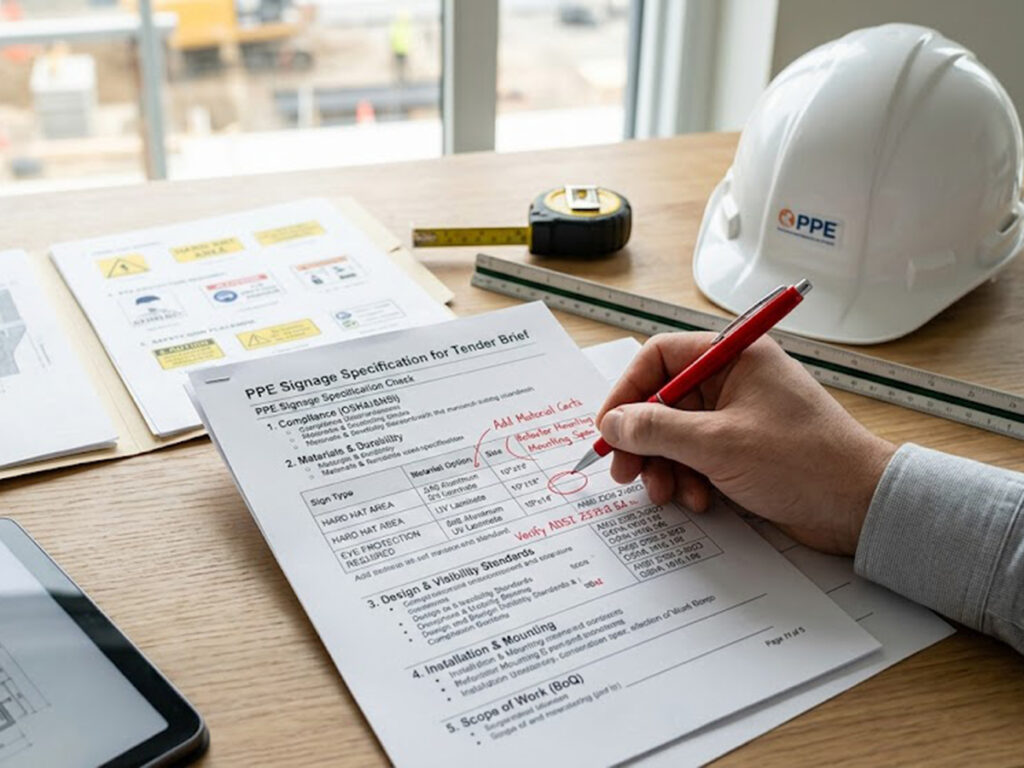
un completo Especificación de señalización de EPI sigue una columna vertebral predecible. Los directores de proyecto pueden copiar este esqueleto directamente en un paquete de licitación.. Cada sección bloquea una fuente diferente de variación de la oferta..
1. Alcance del trabajo y contexto del proyecto
Definir la dirección del sitio, clasificación ambiental, rango de cantidad total, y si la instalación está dentro del contrato. Un alcance de trabajo de señalización de PPE definido es el mayor predictor de la comparabilidad de las ofertas..
2. Normas y códigos aplicables
Citar las ediciones actuales explícitamente.. OSHA 29 CFR 1910.145 regula las señales y etiquetas de prevención de accidentes. ANSI Z535.2-2023 cubre señales de seguridad en instalaciones. ANSI Z535.4-2023 cubre las etiquetas de seguridad del producto. ISO 7010 Se aplica cuando la armonización internacional es importante.. NFPA 101 gobierna la salida.
3. Requisitos de sustrato y material
Especificar el calibre del sustrato, grado del material, clase adhesiva, y clasificación de durabilidad de la tinta. La sección dedicada a continuación cubre las especificaciones completas del material de señalización de PPE..
4. Formato, Leyenda, y requisitos de pictogramas
Bloquear el panel de palabras de advertencia (“PELIGRO,” “ADVERTENCIA,” “PRECAUCIÓN,” “AVISO”) según codificación de colores ANSI Z535.4. Indique la fuente del pictograma: ANSI versus ISO. Confirmar requisitos bilingües.
5. Colocación, Montaje, y cantidad
Dibujos del sitio de referencia.. Especifique las alturas de montaje (normalmente) 60 a 66 pulgadas hasta la línea central para señales de área general. Definir el tipo de sujetador por sustrato.
6. Presentaciones y aprobaciones
Requerir dibujos de taller de preproducción, hojas de datos de materiales, pruebas de color, y una muestra de tamaño completo.
7. Tiempo de entrega, Entrega, y fases
Fechas de entrega alineadas con los hitos estatales. Los letreros en stock se envían 3 a 5 días hábiles. Se necesitan señales personalizadas en formato ANSI 10 a 15 días hábiles. Señales de salida fotoluminiscentes. 4 a 8 semanas.
8. Garantía, Reemplazo, y documentación de cumplimiento
Establecer términos mínimos de garantía. El aluminio de primera calidad dura 7 a 10 Años al aire libre. Carreras de vinilo 3 a 5 años. Requerir documentos de cierre: cronograma de letreros conforme a obra y certificados de cumplimiento del fabricante.
Especificaciones de materiales de señalización de PPE que sobreviven al medio ambiente
La mayoría de las fallas en las especificaciones son fallas materiales.. Una refinería costera no tolera el mismo sustrato que un almacén climatizado. Una cámara frigorífica destruye los adhesivos estándar. Los gerentes de proyecto que redactan especificaciones estrictas para los materiales de señalización de PPE reducen las reclamaciones de garantía y reducen los ciclos de reemplazo..
La siguiente tabla asigna el entorno al sustrato.. Úselo como ancla técnica de cualquier Especificación de señalización de EPI.
| Ambiente | Sustrato recomendado | Grosor típico | Vida útil esperada |
| Interior, climatizado | PVC rígido o estireno | 0.040″ (1.0 milímetros) | 5–7 años |
| Estándar al aire libre | Aluminio con vinilo reflectante. | 0.063″–0,080″ | 7–10 años |
| Costero / UV alto / químico | Compuesto de aluminio o policarbonato., Tintas estables a los rayos UV | 0.080″–0,125″ | 10+ años |
| almacenamiento en frío (-20°C y menos) | Aluminio con vinilo adhesivo de baja temperatura. | 0.063″ mínimo | 5–7 años |
| Salida / poca luz | Rígido fotoluminiscente, UL 1994 listado, Clase B o C | 0.060″ mínimo | 25+ años (luminancia) |
Fuente: https://blog.ansi.org/ansi/ansi-z535-2-2023-environment-safety-signs/
Algunas palancas técnicas adicionales pertenecen a las especificaciones.:
- Clase adhesiva. Clase 1 permanente versus removible. La unión específica del sustrato es más importante por debajo del punto de congelación o por encima de 65°C.
- Grado de lámina reflectante. ASTM D4956 Tipo I (grado de ingeniería) versus tipo IV (prismático de alta intensidad) para aplicaciones al aire libre.
- Durabilidad de la tinta y la impresión. Solvente, curado UV, o serigrafiado. Especifique la garantía mínima del fabricante: la exposición al aire libre de 7 años es la base moderna.
El patrón de falla más común: escribiendo “durable” o “resistente a la intemperie” sin umbrales numéricos. Precio de los proveedores a la interpretación más baja.. La oferta que gana dura 14 meses. La factura de reemplazo recae en el director del proyecto..
Ejemplo de lenguaje de cláusula que puede incluir en su oferta hoy
Las siguientes cláusulas brindan a los gerentes de proyectos un lenguaje listo para usar.. Cada uno cierra una brecha de interpretación común.. Haga que el departamento legal y de EHS revisen la redacción final antes de emitir.
Cláusula de Cumplimiento de Normas
Toda la señalización de PPE deberá cumplir con ANSI Z535.2-2023 y ANSI Z535.4-2023., con encabezados de gravedad del peligro, códigos de color, y requisitos de pictogramas aplicados según lo especificado. Donde se requiere armonización internacional, ISO 7010 Se utilizarán pictogramas en lugar de símbolos ANSI..
Cláusula de sustrato y durabilidad
La señalización de PPE para exteriores se fabricará con un mínimo de 0,080″ 5052-Aluminio H38 con acabado antideslumbrante, Impreso con tintas estables a los rayos UV clasificadas para una exposición mínima a la intemperie de 7 años según los datos de garantía publicados por el fabricante..
Fotoluminiscente / Cláusula de salida
La señalización de salida y de poca luz deberá ser UL 1994 listado, fotoluminiscente Clase B mínimo, con valores de luminancia que cumplen con NFPA 101 Sección 7.10.
Cláusula de presentación
El contratista deberá presentar uno (1) muestra de producción de tamaño completo, hojas de datos del material del fabricante, y un programa completo de letreros acorde con los dibujos arquitectónicos para la aprobación del propietario no menos de 15 días hábiles antes de la fabricación.
Cláusula de garantía
Toda la señalización exterior deberá tener una garantía mínima del fabricante de siete (7) años contra el desvanecimiento, delaminación, y corrosión del sustrato.
Estas cinco cláusulas cubren aproximadamente 80% de variación de la oferta. El restante 20% proviene del alcance y la cantidad.
Cinco errores de especificación que arruinan la comparabilidad de las licitaciones
Los fracasos del mundo real se repiten. Los directores de proyectos que reconocen estos patrones los evitan.
1.”Señalización duradera” sin umbral numérico. Los postores valoran la interpretación más barata. El comprador recibió vinilo calandrado de 2 mil cuando el proyecto necesitaba película fundida de 3,4 mil..
2. Sin clasificación ambiental. Se emitió la misma especificación para un almacén interior y una refinería en la costa del Golfo.. Las señales costeras se delaminan en el interior 14 meses.
3. Falta el requisito fotoluminiscente en las rutas de salida. El jefe de bomberos lo detecta en el recorrido.. Se reemplazaron veintidós mil dólares en señalización 30 días antes de la entrega.
4. No hay requisitos bilingües en un sitio de fuerza laboral multilingüe. Citación de OSHA bajo la Cláusula de Deber General. Se requiere retrabajo a mitad de ocupación.
5. Plazo de entrega omitido en las especificaciones pero asumido en el cronograma. Un plazo de entrega fotoluminiscente de 6 semanas no se marca. La movilización se retrasa tres semanas.
Cada uno de estos fa
Requisitos de licitación de letreros de PPE: Una lista de verificación previa a la emisión para gerentes de proyectos
Antes de la solicitud de cotización (Solicitud de Cotización) es liberado, Los gerentes de proyecto deben verificar todos los requisitos de licitación de letreros de PPE con esta lista.. Trate esto como la puerta final para evitar costosas revisiones de las visitas al sitio o fallas en las auditorías de seguridad..
Auditoría de cumplimiento crítico
- Precisión de estándares: ¿Están todos los códigos citados con el año/edición actual?? (P.EJ., ANSI Z535.2-2023, OSHA 29 CFR 1910.145).
- Superposiciones jurisdiccionales: Tener autoridades competentes locales (Autoridad que tiene jurisdicción) requisitos han sido abordados, como planes OSHA específicos de cada estado o códigos del jefe de bomberos?
Material & Especificaciones técnicas
- Medidor de sustrato: ¿El espesor se especifica numéricamente? (P.EJ., .063″ aluminio) en lugar de utilizar términos vagos como “de servicio pesado”?
- Rendimiento reflectante: Para áreas al aire libre o con poca luz, es el grado de lámina ASTM D4956 (Tipo I, III, o IV) declarado explícitamente?
- Longevidad ambiental: ¿Existe una clasificación obligatoria de resistencia a los rayos UV y una duración de la garantía expresada en años??
Diseño & Claridad operativa
- Lógica Visual: ¿Está especificando ANSI vs.. Pictogramas ISO? ¿Está el panel de palabras de advertencia? (PELIGRO vs.. PRECAUCIÓN) codificado por colores según ANSI Z535.4?
- Estrategia lingüística: ¿Está claro el requisito bilingüe para el grupo demográfico específico de su fuerza laboral??
Ejecución & Logística
- Integración de proyectos: ¿El alcance del trabajo de señalización de PPE está relacionado con dibujos arquitectónicos con alturas de montaje específicas? (P.EJ., 60″ a la línea central)?
- Presentaciones: ¿Necesita dibujos de taller y hojas de datos de materiales? (SDT) antes de la producción?
- Límite de instalación: ¿El alcance de la instalación es explícito? “En contrato” o “Por otros”?
Cierre del proyecto
Documentación de entrega: ¿Se requieren cronogramas de letreros conforme a obra y certificados de cumplimiento del fabricante para el proyecto final?&METRO (Operaciones & Mantenimiento) manual?
Cómo crear una biblioteca de especificaciones de señalización de PPE reutilizable en todos los proyectos
Los gerentes de proyecto que realizan licitaciones continuas en múltiples sitios no pueden permitirse el lujo de redactar desde cero cada vez.. Un reutilizable Especificación de señalización de EPI biblioteca escala el trabajo.
La mecánica es simple pero disciplinada.:
- Mantenga una especificación maestra con variantes etiquetadas según el entorno: interior, estándar al aire libre, costero, frío, salida.
- Control de versiones del documento. ANSI revisa la serie Z535 aproximadamente cada cinco años; la edición actual es 2023 (Blog ANSI, 2025).
- Cree una lista de proveedores preaprobados con certificaciones de cumplimiento documentadas archivadas.
- Estandarice los cronogramas de letreros en BIM y plantillas de dibujo para que las cantidades fluyan automáticamente a la RFQ.
Los gerentes de proyecto que quieran profundizar en el lado del proveedor de la ecuación pueden revisar nuestra Secretos del proveedor de señalización de seguridad de EPI mejor calificado antes de agregarlos a la lista aprobada.
Cerrando el círculo: Especificaciones más nítidas, Mejores ofertas, Menos sorpresas
Tres movimientos conllevan el mayor apalancamiento en cualquier Especificación de señalización de EPI: umbrales de material numérico, citas estándar explícitas, y un calendario de carteles adaptado a los dibujos. Los gerentes de proyecto que bloquean estos tres recuperan horas de tiempo de aclaración y comprimen la variación de la oferta a un solo dígito..
La inversión se amortiza rápidamente. Las ofertas más limpias reducen los ciclos de adquisiciones. Los materiales más estrictos eliminan la señalización de reemplazo en el segundo año. Citaciones a ANSI Z535.2-2023 y OSHA 29 CFR 1910.145 proteger contra el $16,550 exposición a violaciones graves que volvió a aumentar en 2026.
Preguntas frecuentes sobre las especificaciones de señalización de PPE
¿Cuál es la diferencia entre una especificación de señalización de EPI y un alcance de trabajo??
El Especificación de señalización de EPI define lo que se está adquiriendo: materiales, formatos, estándares, y durabilidad. El alcance del trabajo de señalización de PPE define lo que se está haciendo: suministro únicamente versus suministro e instalación., cobertura del sitio, y escalonamiento. Un escrito de licitación completo contiene tanto. son complementarios, no intercambiables.
¿Los gerentes de proyecto deben citar ANSI Z535 si el proyecto está regido por OSHA??
Sí, en la práctica. OSHA 29 CFR 1910.145 hace referencia a ANSI como el estándar de consenso reconocido de la industria. OSHA permite los últimos formatos ANSI Z535 en lugar de los más antiguos 1967 Formatos Z35.1 (Seguridad Clarión, 2025). Citar la edición actual (Z535.2-2023 y Z535.4-2023) es el camino más claro para demostrar el cumplimiento..
¿Existe una plantilla de RFP gratuita para señalización de seguridad con la que los gerentes de proyecto puedan comenzar??
Existen plantillas de RFP genéricas en línea. La mayoría se queda corta en cuanto a calibres de materiales., Requisitos del formato ANSI, y clases fotoluminiscentes. El esqueleto de 8 secciones de este artículo es la estructura mínima viable para una plantilla RFP para señalización de seguridad.. Combínelo con la lista de verificación previa a la emisión para obtener un punto de partida útil.
¿Con cuánta antelación se debe especificar la señalización del PPE en el cronograma del proyecto??
Emitir la licitación de señalización a más tardar 10 a 12 semanas antes de la entrega in situ requerida para cualquier proyecto que incluya letreros personalizados o fotoluminiscentes. Los paquetes de stock únicamente se pueden comprimir a 4 a 6 semanas. El retraso en el cronograma en la señalización casi siempre se debe a una cláusula de tiempo de entrega incumplida.
¿Quién debe revisar la especificación de señalización del EPI antes de su emisión??
Como mínimo, EHS para el cumplimiento, Contratación por condiciones comerciales., y el director del proyecto para la alineación del cronograma. Los sitios regulados deben agregar la autoridad competente o el enlace del jefe de bomberos. Tres pares de ojos captan la mayoría de las lagunas en las especificaciones antes de que lleguen al grupo de postores.
¿Cómo comparan los gerentes de proyectos las ofertas cuando los proveedores proponen diferentes materiales??
un apretado Especificación de señalización de EPI elimina la mayor variación. Donde permanece la variación, normalizar las ofertas a una base de referencia de sustrato común, por ejemplo, 0.080″ Aluminio con garantía de 7 años.. Solicitar precios alternativos como una línea separada. Esto protege la comparación sin rechazar la innovación..
Artículos relacionados en esta serie
Pastillas:
Señales de EPI: La guía completa para el cumplimiento de OSHA, Materiales, Colocación & Obtención
Clústeres:
Cómo la adquisición a granel de letreros requeridos por PPE puede ahorrarle dinero a su empresa
Guía completa para adquirir señalización de PPE
Señales de seguridad de PPE de construcción resistentes a la intemperie: Aluminio vs Corflute
Cómo elegir los materiales adecuados para las señales de PPE requeridas en su lugar de trabajo
Secretos del proveedor de señales de seguridad de PPE para obtener la máxima calidad
Referencias
OSHA 29 CFR 1910.145, http://www.osha.gov/laws-regs/regulations/standardnumber/1910/1910.145
ANSI Z535.2-2023, https://blog.ansi.org/ansi/ansi-z535-2-2023-environment-safety-signs/
ISO 7010, https://www.iso.org/standard/72424.html
NFPA 101, https://www.nfpa.org/codes-and-standards/nfpa-101-standard-development/101