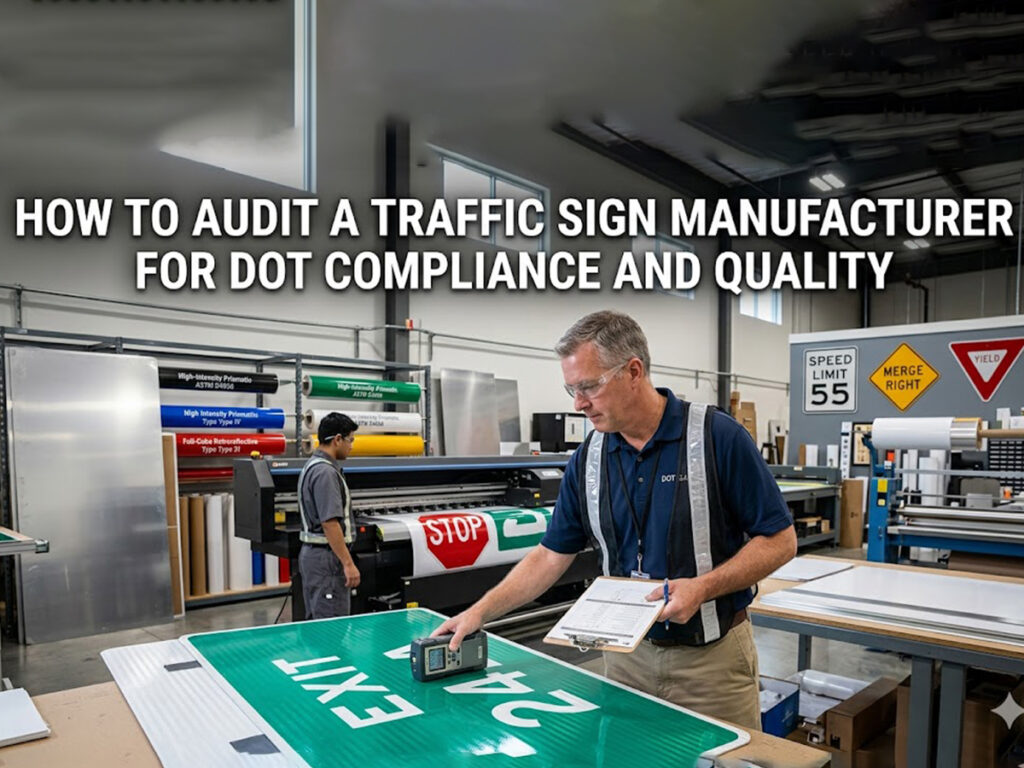
Effective auditing of a fabricante de letreros de tráfico serves as a technical safeguard for public safety and infrastructure longevity. QA inspectors must move beyond visual checks to perform a deep-dive verification of material science and regulatory adherence. In the context of broader safety infrastructure, comprensión custom highway sign fabrication standards is critical for ensuring that assets from road traffic sign manufacturers meet the stringent lifespan and visibility requirements mandated by Department of Transportation (PUNTO) proyectos.
For a rigorous evaluation of road signage manufacturers, inspectors should adopt a structured framework focused on three core pillars:
- Regulatory Alignment: Verification of current state-level Approved Product List (APL) status and MUTCD manufacturing requirements.
- Integridad de materiales: Technical validation of ASTM D4956 compliance and substrate chemical treatments.
- Process Accountability: Assessment of batch-level traceability from raw sheeting to the finished product.
Professional audits confirm that road sign manufacturers maintain high-level principles. This consistency prevents premature sign failure and ensures maximum return on public infrastructure investment.
Defining Audit Objectives for Traffic Sign Manufacturers
A successful audit begins with clearly defined objectives that align with DOT expectations and federal guidelines. Inspectors must evaluate both technical compliance and the factory’s manufacturing capability. This proactive approach identifies potential failures before signs reach the field. A rigorous audit protects public funds and ensures road user safety.
Aligning with State-Level Approved Product List (APL) Verificación
One of the first steps in how to audit traffic sign manufacturers involves verifying the supplier’s status on the state’s Approved Product List (APL). This list acts as a primary filter for quality control.
Audit actions must focus on the following:
- Active Status Verification: Confirm the traffic sign manufacturer holds a current, non-expired listing for the specific sign categories required.
- Component Synergy: Verify that retroreflective sheeting, tintas, and substrates are individually approved. Using an unapproved ink on an approved sheeting often voids the manufacturer’s warranty.
- Specific Material Matching: Cross-check that the physical inventory in the shop matches the exact product codes listed on the APL.
Failure to align with APL requirements leads to immediate disqualification from DOT projects. This remains true even if the final production quality appears high.
Identifying Key Compliance Standards: MUTCD frente a. ASTM D4956
The professional audit must distinguish between design standards and material performance. Auditors use the following framework to evaluate road sign manufacturers:
| Estándar | Primary Focus | Regulatory Requirement Detail |
| Muescato | Diseño & Disposición | Sección 2A.06 requires signs to be uniform in shape, color, and size to provide a consistent message to drivers. |
| ASTM D4956 | Ciencia de los materiales | Sets minimum retroreflectivity values (R_A) and colorimetric coordinates for all sheeting types. |
MUTCD Manufacturing Requirements
El manual de dispositivos de control de tráfico uniformes (Muescato) dictates the visual “idioma” of the road. Inspectors verify that the road signage manufacturers follow Section 2A.07, which requires all signs to be retroreflective or illuminated. Además, Sección 2B.03 mandates specific font styles (Highway Gothic or Clearview) and stroke widths. Auditors must check digital templates to ensure these geometric proportions remain exact during the scaling process.
Cumplimiento de ASTM D4956
ASTM D4956 compliance defines how the sign performs over its service life. The standard classifies sheeting into “Tipos” based on lens construction and brightness. Por ejemplo, Type IV sheeting uses high-intensity microprismatic lenses for permanent highway signs. Mesa 1 of ASTM D4956 specifies the minimum coefficient of retroreflection at various observation angles. An auditor must confirm the manufacturer uses a material that meets or exceeds these specific optical benchmarks.
By enforcing these standards, road traffic sign manufacturers ensure that signs remain visible to elderly drivers and autonomous vehicle sensors under all weather conditions.
Pre-Audit Preparation: Documentation and Certification Review
Before visiting the facility, inspectors must conduct a comprehensive documentation review. This desktop audit phase establishes the manufacturer’s technical credibility and operational maturity. Identifying gaps in paperwork early prevents wasted time during the physical inspection.
Verifying Manufacturer Certification for DOT Projects
A compliant traffic sign manufacturer must demonstrate formal certification through a structured quality system. This documentation proves the facility can maintain consistency across large-scale production runs.
Critical audit documents include:
- ISO 9001:2015 Proceso de dar un título: This serves as a global benchmark for quality management. The certificate must be valid, actual, and issued by an accredited body.
- DOT-Specific Permits: Inspectors check for state-issued permits that authorize the factory to produce specific sign categories.
- Quality Management System (sistema de gestión de la calidad): The QMS must outline clear protocols for internal oversight and error correction.
The QMS must specifically address Section 106 of the Standard Specifications for Construction of Roads and Bridges. This regulation requires manufacturers to maintain materials that meet contract requirements from source to installation. The auditor verifies that the QMS includes a “Certificate of Compliance” process for every shipment. This ensures manufacturer certification for dot projects remains a living process rather than a static document.
Assessing Material Traceability and Sheeting Certification Records
Traceability acts as the cornerstone of DOT accountability. Inspectors must verify a clear “paper trail” from the raw material to the finished road asset.
The Traceability Chain
A compliant system allows an auditor to trace a finished sign back to its chemical origin. The flow follows this mandatory path:
Finished Sign → Sheeting Roll ID → Production Batch → Supplier Mill Report
Audit Checkpoints for Material Integrity
Inspectors evaluate the following records to ensure retroreflective sheeting certification and substrate quality:
| Tipo de documento | Technical Requirement | DOT Compliance Detail |
| Sheeting Certs | ASTM D4956 Grade | Confirms the sheeting batch meets minimum brightness values. |
| Mill Test Reports (MTRs) | Alloy Chemistry | Proves the aluminum is 5052-H38 or 6061-T6 alloy. |
| Lot Records | Batch Uniformity | Ensures all signs in a single project share consistent color. |
The auditor checks for compliance with AASHTO M 268, which governs retroreflective sheeting performance. Inspectors must confirm that the road sign manufacturers archive these records for at least three to five years. Strong traceability reduces state liability if a product fails prematurely in the field. This documentation confirms total adherence to retroreflective sheeting certification requirements and material safety standards.
Fabrication Facility Inspection: Evaluating Production Precision
On-site inspection validates compliance against real-world manufacturing practices. Inspectors must confirm that the facility maintains the precision necessary for long-term safety. This phase bridges the gap between theoretical standards and physical product quality.
MUTCD Manufacturing Requirements for Font, Disposición, and Color
Design accuracy directly impacts motorist reaction time. Inspectors evaluate road signage manufacturers based on the Manual on Uniform Traffic Control Devices (Muescato).
Audit focus areas include:
- Standard Alphabet Compliance: Section 2A.13 requires the use of FHWA Standard Alphabets. Auditors verify the correct application of Highway Gothic or Clearview series.
- Geometric Layout: Layouts must match the Standard Highway Signs (shs) manual. This includes specific corner radii, border widths, and symbol proportions.
- Colorimetric Coordinates: Signs must meet the chromaticity limits defined in 23 Parte CFR 655 Appendix to Subpart F.
Auditors must review design software to ensure version control. Using outdated templates violates MUTCD manufacturing requirements and compromises legal legibility.
Production Workflow: Substrate Preparation and Aluminum Integrity
Durability begins with chemically sound substrate preparation. Road sign manufacturers must prevent environmental degradation through rigorous pre-treatment.
✅Key inspection points include:
- Cleaning and Degreasing: Surfaces must be free of oils and mill scale. This ensures a permanent bond for retroreflective sheeting.
- Recubrimiento de conversión: Verification of Alodine (Chromate) or equivalent treatments. This process meets ASTM B449 standards for aluminum pre-treatment.
- Alloy Verification: Inspectors check for 5052-H38 or 6061-T6 alloys. These provide the tensile strength required for high-wind loads.
Rigorous checks here support successful sign substrate durability testing and extend the asset’s service life.
Digital Printing and Silk Screening: Ink Curing and Durability Standards
The application phase must yield a weather-resistant finish. Modern traffic sign manufacturers primarily utilize digital UV-LED or thermal transfer systems to meet high-volume DOT demands.
✅QA Inspectors must verify:
- Matched-Component Systems (MCS): Manufacturers must use inks, chapas, and overlays from a single supplier. This ensures chemical compatibility and maintains the mandatory 10-to-12-year DOT warranty.
- Curing Parameters for Silk Screening: Auditors check that drying ovens maintain temperatures between 150°F and 190°F (65°C to 88°C). Dwell times must typically range from 5 a 10 minutes depending on ink density.
- UV Digital Printing Specs: For UV-LED systems, auditors verify lamp intensity output between 4 a 8 W/cm^2. The wavelength must stay within the 365nm to 395nm range to ensure a complete polymer cross-link.
- Thickness and Uniformity: Ink layers must provide consistent opacity without pinholes. Total dry film thickness (DFT) should meet the supplier’s specific micron requirements for UV protection.
Non-compliance in this phase often voids manufacturer warranties. Poor curing leads to premature fading and significantly reduces the visibility of the traffic sign manufacturer’s output. Failure to hit these physical benchmarks compromises the sign’s ability to meet ASTM D4956 compliance over its intended service life.
Material Compliance: Testing Standards for Road Traffic Sign Manufacturers
Technical material validation serves as the foundation of every facility audit. Inspectors must ensure all raw components meet contract-specific performance standards to prevent premature asset failure. This rigorous oversight confirms that road traffic sign manufacturers can deliver products that withstand harsh environmental conditions while maintaining peak visibility.
Cumplimiento de ASTM D4956: Matching Sheeting Types to DOT Specs
Adherence to ASTM D4956 compliance requires a precise match between sheeting grades and roadway classifications. Auditors must verify that the traffic sign manufacturer maintains strict inventory segregation to prevent the mixing of optical grades. Por ejemplo, high-speed interstate projects typically mandate Type XI Full Cube sheeting, while rural routes may utilize Type IV High-Intensity Prismatic materials.
| Tipo de láminas | Optical Construction | Minimum RA (White at 0.2°/-4°) |
| Tipo IV | Prismático de alta intensidad | 360 cd/lx/m^2 |
| Tipo IX | Very High-Intensity | 380 cd/lx/m^2 |
| Tipo XI | Prismático de cubo completo | 580 cd/lx/m^2 |
Fuente: ASTM D4956 Table 1 specifications.
QA Inspectors should cross-examine purchase orders against physical stock to ensure material integrity. Using an inferior sheeting grade violates federal safety mandates and creates significant state liability. Además, auditors must confirm that road signage manufacturers provide daytime colorimetric data. This data must fall within the chromaticity coordinates defined in ASTM D4956 Section 7.1 to ensure correct daytime recognition.
Photometric Testing: Verifying Minimum Coefficient of Retroreflection
Field performance relies on measurable retroreflectivity. Inspectors must witness live photometric testing to validate DOT compliant traffic sign manufacturing practices. A standard audit involves using a calibrated retroreflectometer to measure the coefficient of retroreflection (R_A).
The technician must perform measurements at multiple points on the sign face following ASTM E810 protocols. These values must meet or exceed the minimum thresholds established in MUTCD Section 2A.08. Por ejemplo, overhead guide signs often require higher R_A values to remain visible to drivers at long distances. Witnessing these tests ensures that the output from road traffic sign manufacturers provides sufficient nighttime luminance for all road users.
Resistencia ambiental: Adhesion and Anti-Graffiti Coating Inspection
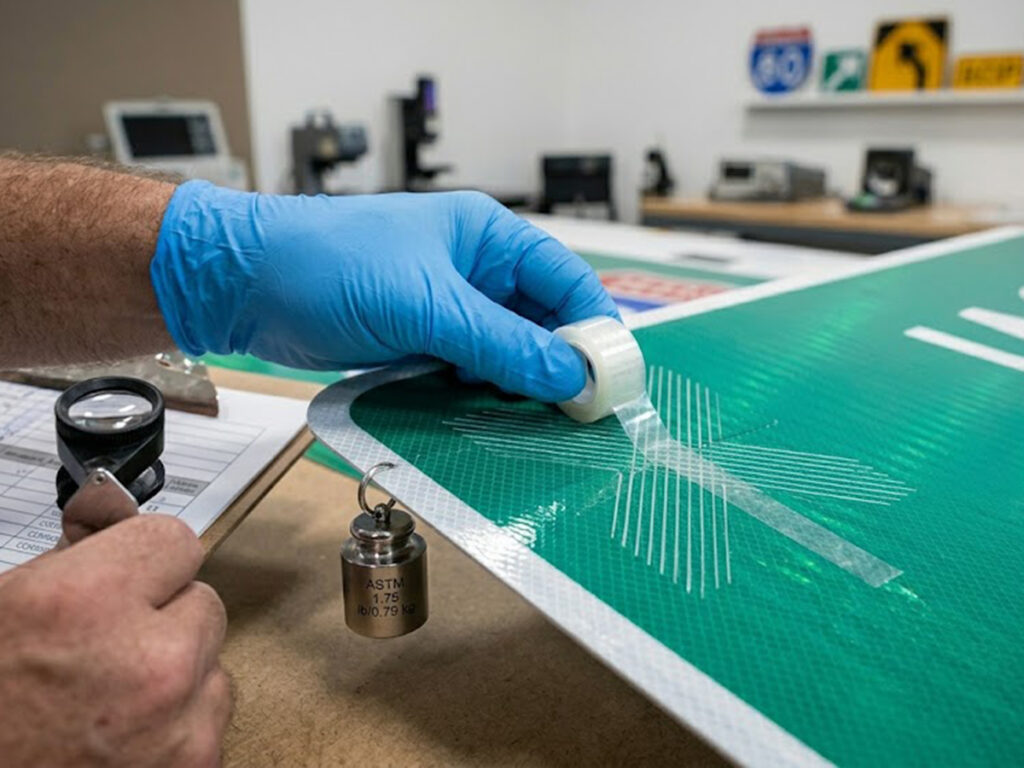
Durability testing confirms that signs can resist extreme weather and vandalism. A primary check involves the ASTM D4956 Section 7.5 adhesion test. The sheeting bond must be strong enough to support a 1.75 lb (0.79 kg) weight for five minutes. Durante este periodo, the sheeting should not peel more than 2 pulgadas (50 milímetros) from the substrate.
Además, auditors must inspect anti-graffiti overlays to ensure long-term maintenance efficiency. These overlays must meet ASTM Type B (Solvent-Resistant) or Type C (Permanente) estándares. Inspectors verify performance by applying a permanent marker to a test sample and attempting removal with a standardized solvent. Successful testing confirms that road sign manufacturers provide a surface that resists ghosting and chemical damage. These checks guarantee that DOT assets remain functional throughout their intended 12-year service life.
Quality Control Systems and Post-Production Protocols
A reliable road signage manufacturer must maintain rigorous internal quality control systems that extend far beyond the assembly line. These systems ensure that every sign leaving the facility consistently meets the high safety standards of the purchasing agency. By implementing systematic oversight, the manufacturer reduces the risk of installing non-compliant assets on public roadways.
In-Process Checkpoints for Road Sign Manufacturers
Effective road sign manufacturers implement structured inspection “stop points” throughout the production cycle. These checkpoints identify defects before they become embedded in the finished product.
Standard audit evaluations focus on the following internal gates:
- Substrate Preparation Approval: Verification that the aluminum meets ASTM B209 standards for thickness and alloy composition. Inspectors check for the removal of all surface contaminants that might hinder adhesion.
- Sheeting Application Verification: Technical review of the bonding process. This ensures no air bubbles or wrinkles exist between the sheeting and the metal.
- Design and Layout Validation: A comparison of the digital print file against the Standard Highway Signs (shs) manual to ensure exact geometric proportions.
Identifying issues at these stages prevents costly rework and guarantees that the traffic sign manufacturer maintains high production efficiency.
Final Pre-Shipment Inspection and Labeling Requirements
Every sign must undergo a final quality gate before delivery to the project site. Auditors verify that the facility performs a 100% visual inspection for surface defects, such as ink “bleeding” or sheeting delamination.
Compliance with MUTCD Section 2A.08 is a critical focus during this phase. This regulation requires that agencies maintain an assessment system to ensure signs meet minimum retroreflectivity levels. To support this, road signage manufacturers must provide mandatory back-of-sign labeling.
| Label Requirement | Descripción | Objetivo |
| Manufacturer Identity | Name and location of the facility. | Establishes accountability for product performance. |
| Fabrication Date | Month and year of manufacture. | Tracks the remaining service life of the asset. |
| Tipo de láminas | Specific ASTM D4956 classification (P.EJ., Tipo XI). | Informs field inspectors of expected brightness levels. |
Proper labeling is essential for DOT asset tracking and long-term warranty management. It ensures that the state can quickly identify and replace signs that fail prematurely in the field.
Corrective and Preventive Actions (CAPA) for Non-Conforming Products
Traffic sign manufacturers must operate a documented CAPA system to handle production errors. This system proves the manufacturer can identify, isolate, and correct systemic failures.
The audit focuses on how the facility manages non-conforming products under Section 106.03 of the Standard Specifications. This regulation mandates that any material failing to meet contract requirements must be immediately removed and replaced. A robust CAPA process requires the manufacturer to perform a root cause analysis for every failure. This might involve recalibrating UV-LED lamps or retuning aluminum cleaning baths. By implementing these corrective measures, the manufacturer demonstrates the technical maturity required for high-stakes DOT projects. This proactive approach ensures continuous improvement and long-term reliability for road traffic sign manufacturers.
Conclusión: Strengthening Quality in Traffic Sign Manufacturing
For DOT QA inspectors, auditing a traffic sign manufacturer serves as a vital safeguard for public safety and infrastructure reliability. This technical oversight ensures that every road asset meets the rigorous demands of modern transit environments. From the initial APL verification to the final fabrication facility inspection, each step validates the manufacturer’s commitment to excellence.
A disciplined audit of road sign manufacturers prevents premature field failures. Rigorous testing ensures total ASTM D4956 compliance and adherence to MUTCD manufacturing requirements. These standards guarantee that signs remain visible to drivers and autonomous sensors for their entire service life. Como consecuencia, structured audits protect taxpayer investments by ensuring long-term product durability.
Al final, a technically precise audit process defines the quality of national traffic systems. By holding road traffic sign manufacturers to these high benchmarks, inspectors maintain the integrity of the transportation network. Consistent accountability across all road signage manufacturers remains the foundation for a safer, more reliable road infrastructure.
Preguntas frecuentes (Preguntas frecuentes)
What are the primary indicators of a DOT compliant traffic sign manufacturing facility?
The compliant traffic sign manufacturers must demonstrate a combination of administrative and technical maturity. Key indicators include a valid ISO 9001:2015 certification and an active listing on the state’s Approved Product List (APL). During a fabrication facility inspection, auditors look for calibrated retroreflectometers, climate-controlled sheeting storage, and automated aluminum pre-treatment systems. Facilities that maintain a Matched-Component System (MCS) for inks and sheeting typically offer the most reliable long-term warranties.
How do road sign manufacturers ensure ASTM D4956 compliance for high-speed corridors?
To meet ASTM D4956 compliance, manufacturers must match sheeting types to the specific luminance requirements of the roadway. For high-speed corridors, road traffic sign manufacturers typically utilize Type XI Full Cube Prismatic sheeting. This material provides the highest coefficient of retroreflection (R_A) at wide observation angles. Auditors verify this by reviewing batch-specific photometric test results and confirming that the material meets the colorimetric coordinates defined in ASTM D4956 Section 7.
Why is substrate pre-treatment critical for sign substrate durability testing?
Sign substrate durability testing often fails if the aluminum preparation is inadequate. Road signage manufacturers must perform chemical degreasing and apply a conversion coating, such as Alodine, according to ASTM B449. This process prevents “óxido blanco” and ensures the adhesive on the retroreflective sheeting creates a permanent bond. Without proper pre-treatment, signs are prone to premature delamination and corrosion, leading to significant maintenance costs for the DOT.
What are the mandatory MUTCD manufacturing requirements for sign design?
MUTCD manufacturing requirements focus on the legibility and uniformity of the sign face. According to MUTCD Section 2A.06, all signs must maintain consistent shapes, bandera, and font styles. Road sign manufacturers must use FHWA Standard Alphabets, specifically Highway Gothic or Clearview. Auditors verify that digital templates follow the exact stroke widths and letter spacing defined in the Standard Highway Signs (shs) manual to ensure motorists can read signs at designated speeds.
How does a traffic sign manufacturer handle non-conforming products during an audit?
un profesional fabricante de letreros de tráfico must implement a Corrective and Preventive Action (CAPA) sistema. Bajo la sección 106.03 of the Standard Specifications, any material that fails to meet contract standards must be isolated and marked for rejection. The audit process reviews the manufacturer’s root cause analysis records to ensure they have corrected the underlying issue. This might include adjusting UV-LED curing wavelengths or recalibrating sheeting application rollers to prevent future defects.
Referencias y fuentes de autoridad
FHWA — MUTCD 11ª edición, Parte 2: Letreros (efectivo en enero 18, 2024): https://mutcd.fhwa.dot.gov/pdfs/11th_Edition/part2.pdf
ASTM International — ASTM D4956-19: Especificación estándar para láminas retrorreflectantes para control de tráfico: https://www.astm.org/d4956-19.html
ASTM International — ASTM E810: Standard Test Method for Coefficient of Retroreflection of Retroreflective Sheeting Utilizing the Coplanar Geometry: https://www.astm.org/e810-03r13.html
ASTM International — ASTM B449: Standard Specification for Chromates on Aluminum (Alodine/Conversion Coating): https://www.astm.org/b0449-93r17.html
AASHTO — M 268: Especificación estándar para láminas retrorreflectantes para control de tráfico: https://store.transportation.org/Item/PublicationDetail?ID=4115
A NOSOTROS. Government Publishing Office — 23 Parte CFR 655 Appendix to Subpart F: Alternate Color Specifications for Retroreflective Sign Materials: https://www.ecfr.gov/current/title-23/part-655/subpart-F/appendix-to-subpart-F