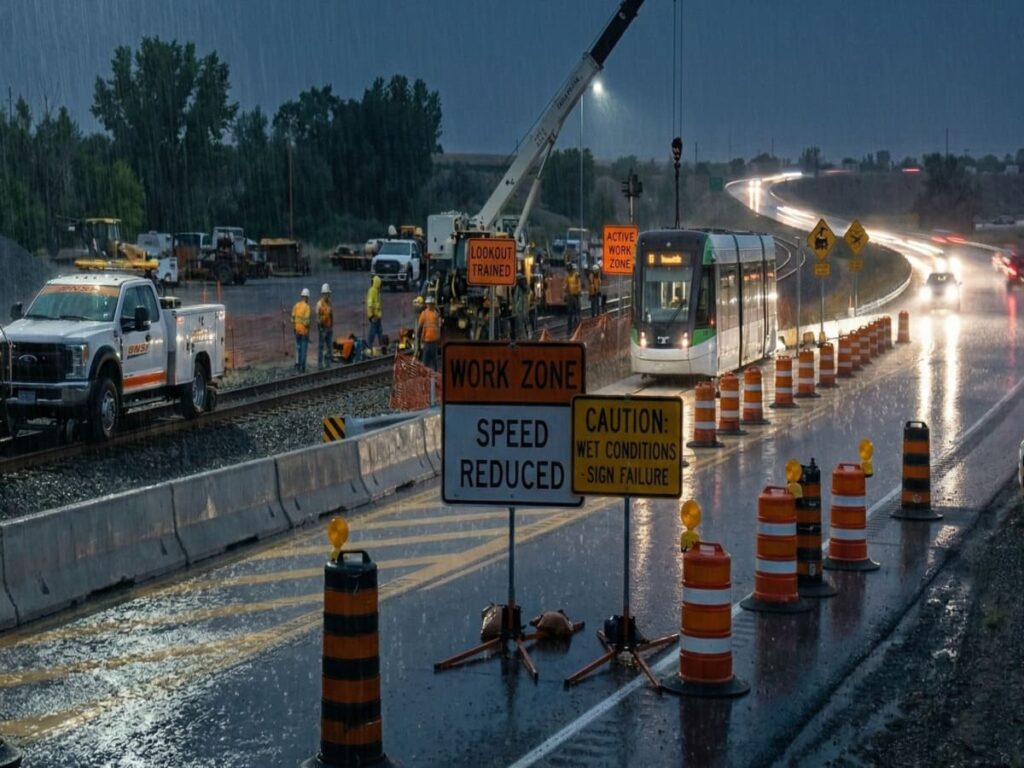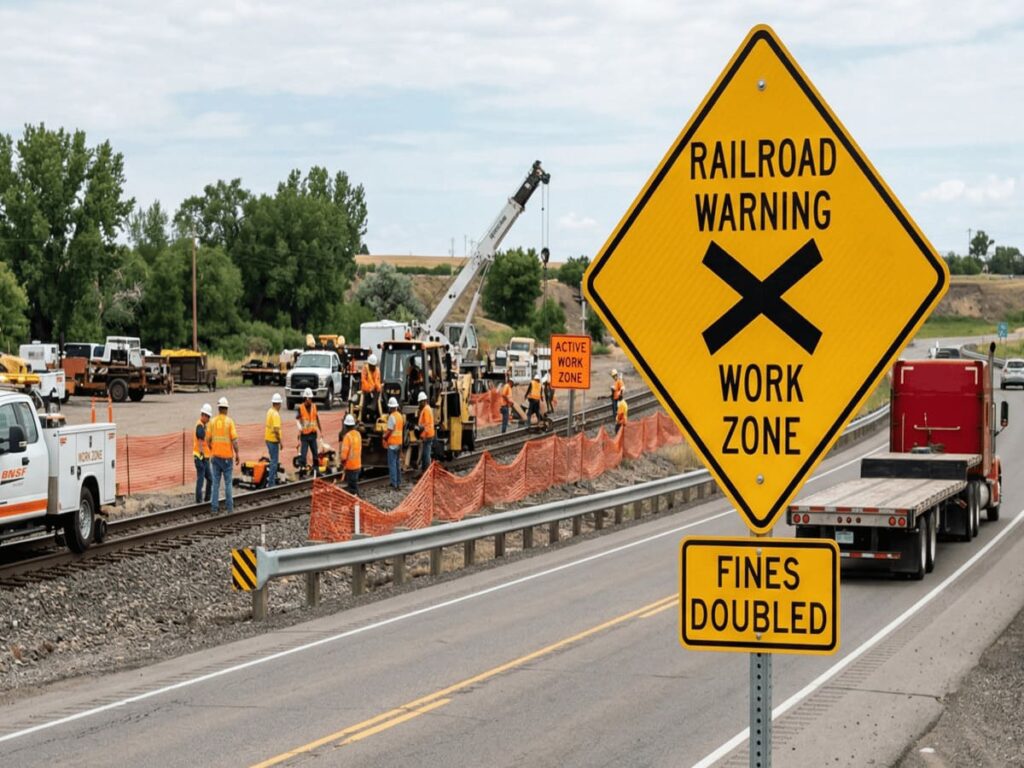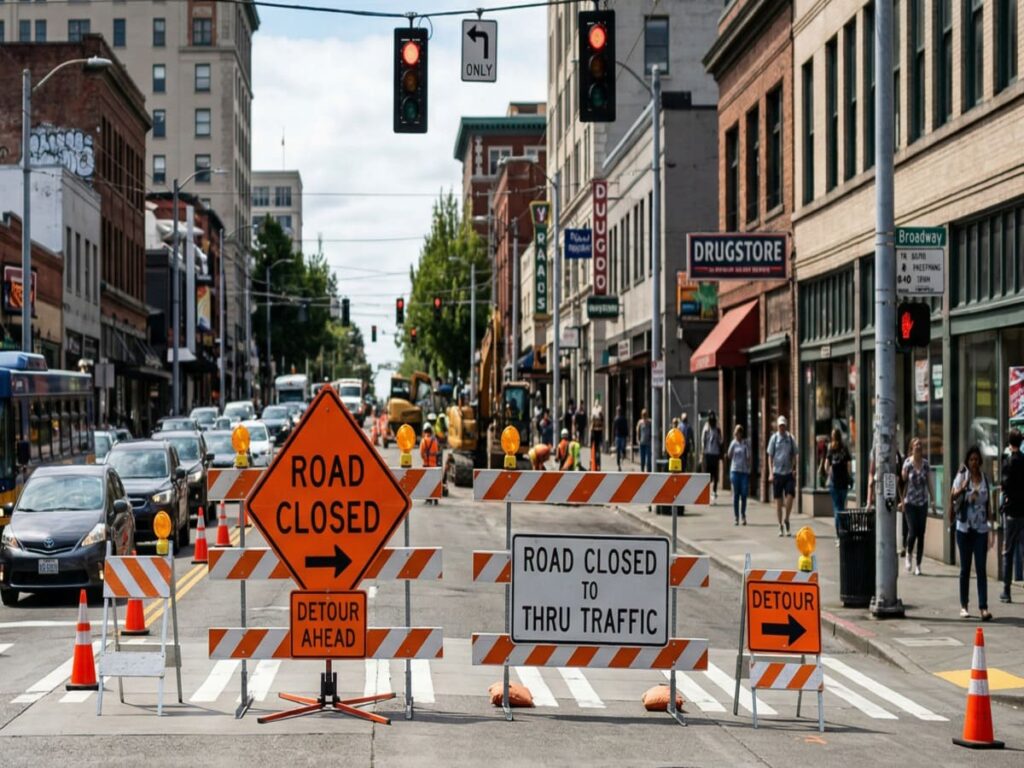
إنشاء علامات منطقة العمل for a high-speed one-lane, two-way operation is not a scaled-up version of low-speed flagging — it is an entirely different risk category. في 65 ميلا في الساعة, a driver needs more than 325 feet to stop. لكن, most struck-by incidents on highway flagging operations happen because the sign sequence, flagger position, or communication protocol failed to account for that physics. This guide gives TCS supervisors and crew leads a field-ready SOP for getting the setup right.
Consider this scenario: it’s 2 أكون. on a two-lane mountain state highway, نشر 65 ميلا في الساعة. Your crew is milling bridge deck. في أثناء, your flagger is standing on a 3-foot shoulder, 1,800 feet from the opposite end of the zone — with a bend in the road between them. The radio has been cutting out for 20 دقائق. An 18-wheeler just entered the advance warning area. Every decision made in the previous hour either contains or prevents the collision that follows.
This guide translates MUTCD 11th Edition Part 6E (Flagger Control) and Part 6G (التطبيقات النموذجية) into actionable steps for علامة منطقة العمل الموضع, flagger coordination, pilot car operations, and night work on roads at 45 ميلا في الساعة وما فوق. It is written for Traffic Control Supervisors (TCS), مديري العمليات, and crew leads who need a repeatable SOP — not a restatement of the manual.
What this guide covers: Two-lane highways and state roads at 45–70 mph · Short-term (≤4 hours) and long-shift (multi-crew) operations · Flagger-only, سيارة الطيار, and AFAD setup scenarios · Night work requirements · Advance warning sign sequencing for high-speed approaches
What it does not cover: Basic low-speed flagging fundamentals · Urban signalized intersection closures · Freeway full-closure detour planning
MUTCD 11th Edition Note: The FHWA Final Rule made the 11th Edition effective January 18, 2024. States align through their own adoption timelines per Table 1B-1. All references in this guide cite the 11th Edition. Always verify your state DOT supplements before field deployment — several states have speed-specific modifications to taper lengths and sign spacing.
جزء 1: Why Work Zone Signs Alone Cannot Protect a High-Speed Operation
1.1 The Stopping Distance Problem
The physics of high-speed work zones are unforgiving. في 65 ميلا في الساعة, the total stopping distance — perception, reaction, and braking combined — exceeds 325 feet under ideal dry pavement conditions. في المطر, on worn tires, or with a fatigued driver, that number climbs past 400 قدم.
نتيجة ل, لك علامات منطقة العمل and your flagger station must both be visible well before the point where a driver can no longer stop. What gets crews in trouble is not understanding the gap between “legally required placement” و “operationally sufficient placement” — especially on curves and grades where sight distance contracts sharply.
| Posted Speed (ميلا في الساعة) | Perception-Reaction | مسافة الكبح (جاف) | Total Stopping Distance | دقيقة. وضوح الأعلام |
| 45 ميلا في الساعة | ~66 ft | ~110 ft | ~176 ft | ≥350 ft |
| 55 ميلا في الساعة | ~80 ft | ~165 ft | ~245 ft | ≥500 ft |
| 65 ميلا في الساعة | ~95 ft | ~230 ft | ~325 ft | ≥650 ft |
| 70 ميلا في الساعة | ~103 ft | ~270 ft | ~373 ft | ≥750 ft |
1.2 The Four Failure Modes Specific to High-Speed Operations
معظم highway work zone flagging failures trace to one of four causes that simply do not apply at low speeds:
Communication blackout. On a 1,500-foot zone with a crest curve between the two flagger stations, visual coordination is impossible. Radios drop, and as a result crews default to guessing — a simultaneous release from both ends into a single lane is not a near-miss, it is a head-on collision.
Queue blowback. Holding traffic for more than three minutes on a 65 mph road produces queues that extend backward past crests, حول المنحنيات, and into intersection sight triangles. بالتالي, drivers at the rear of that queue have no warning. The struck-by risk transfers from the work zone to the queue tail.
Flagger exposure geometry. High-speed roads have narrow or nonexistent shoulders. The escape path that works at 35 mph — stepping onto the shoulder — does not exist at the same margin when only 18 inches separate the travel lane from a guardrail. لهذا السبب, flagger positioning and escape route planning must be explicit, not assumed.
Driver compliance degradation. Studies consistently show that driver compliance with STOP paddle signals drops as approach speed increases. في 65 ميلا في الساعة, some drivers begin braking but do not intend to stop fully. لذلك, your setup must accommodate the non-compliant vehicle — buffer lengths and device density are not optional.
جزء 2: Pre-Shift Recon — Five Checks Before Deploying Work Zone Signs
Every high-speed flagging failure has a pre-shift decision point where you could have prevented it. Recon is not administrative — it is the highest-leverage activity of the entire operation.
2.1 Sight Distance Assessment
Walk both ends before placing any signs or cones. From each proposed flagger station, look toward the other end: can you see the opposite station clearly, without interruption, for the full zone length? If not — due to a crest, منحنى, dip, large equipment, or anything else — you cannot rely on visual communication and must establish radio protocol before opening the zone.
The practical threshold is straightforward: if your sight line breaks at any point within the zone, treat the entire operation as radio-dependent from the first release. بخاصة, do not allow visual-only coordination as a fallback after radios fail.
2.2 Zone Length and Queue Blowback Calculation
Estimate queue length before traffic stops, ليس بعد. في 65 mph with moderate traffic volume (500–800 vehicles per hour), a 3-minute hold produces a queue of approximately 700–900 feet. If a crest curve, التقاطع, or on-ramp sits within 1,000 feet of your upstream flagger station, you have a queue blowback risk. في هذه الحالة, you need a mitigation plan — either a shorter maximum hold time, additional upstream warning signs, or Law Enforcement presence.
2.3 Flagger Station Selection
Each flagger station must meet three criteria simultaneously:
- Located within the Decision Sight Distance of the approaching travel lane (see table in Part 1)
- Positioned on a surface where the flagger can stand safely on both feet, not on a cross-slope
- Has a clearly identified escape path reachable in under 3 seconds — a guardrail gap, a cutout, a ditch ramp, or equipment positioned as shelter
If a location fails any of these three criteria, it is not a valid flagger station. Adjust the zone limits before adjusting the criteria — never the other way around.
2.4 Communication Equipment Check
Before every shift, pair radios, verify the channel, and transmit a full-sentence test exchange at the proposed flagger station locations — not in the staging area. Terrain interference that does not exist at the truck often does exist at the shoulder 1,800 القدمين على بعد.
Establish your backup protocol before you need it. If primary radio contact fails during a hold, the backup is a Pilot Car or a designated runner — never “continue as visual.” الكلمة “Continue” on a degraded radio in a high-speed zone is how simultaneous releases happen.
2.5 Escape Route Briefing
OSHA requires employers to identify and communicate escape paths to each worker before they enter a high-speed work zone. في الممارسة العملية, the TCS walks each flagger station before the shift opens, physically identifies the escape path, and confirms it aloud with the flagger standing there. This takes 90 seconds per station and has no substitute.
جزء 3: Work Zone Sign Sequence, Cone Configuration, and Arrow Board Setup
3.1 The Correct Advance Warning Sign Sequence for High-Speed Roads
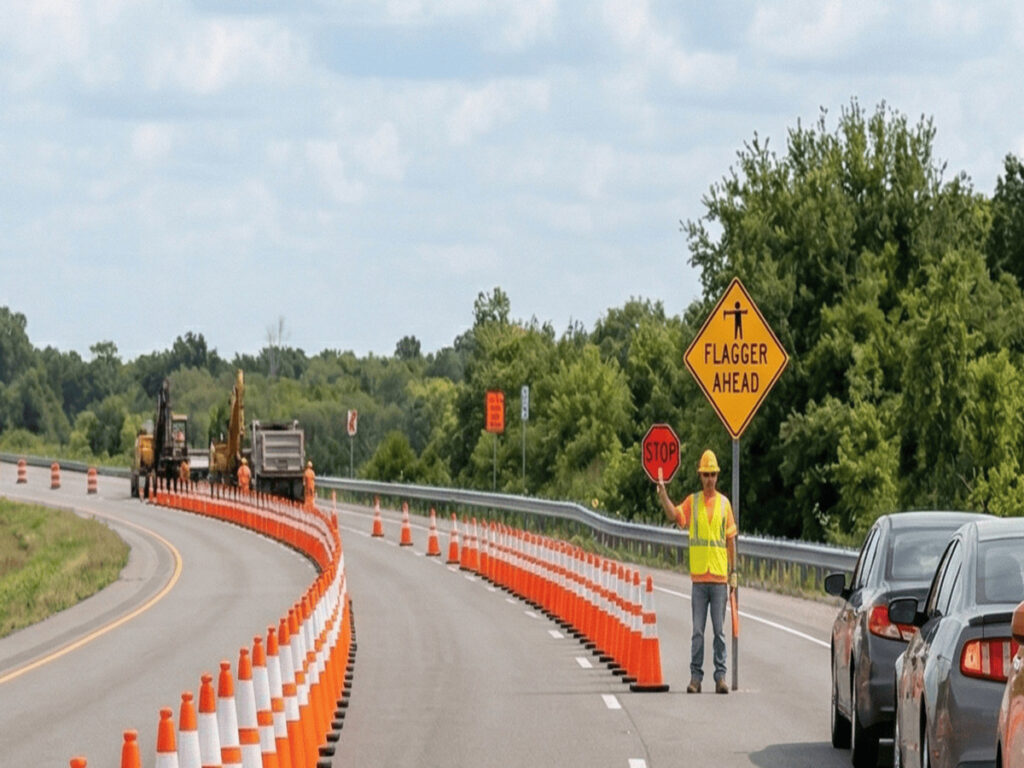
The MUTCD 11th Edition Part 6 sign sequence for one-lane two-way operations at high speed differs fundamentally from a standard lane closure sequence. The critical distinction: you are not directing a merge. بدلاً من, you are requiring a complete stop before a single shared lane. نتيجة ل, both the sign content and the approach driver’s mental model must reflect this difference.
The four-sign sequence below applies to speeds ≥45 mph. Measure all distances from the flagger station back toward approaching traffic.
| لافتة | رمز MUTCD | مسافة (55 ميلا في الساعة) | دقيقة. مقاس | تصنيف |
| أعمال الطريق المقبلة | W20-1 | ≥1,500 ft | 48″ × 48″ | معيار (سوف) |
| One Lane Road Ahead | W20-4 | ≥1,000 ft | 48″ × 48″ | معيار (سوف) |
| كن مستعدًا للوقوف | W3-4 | ≥500 ft | 48″ × 48″ | Standard ≥45 mph |
| Flagger Symbol | W20-7 | ≥350 ft | 48″ × 48″ | معيار (سوف) |
Critical work zone sign distinction — do not substitute: The W20-4 One Lane Road Ahead sign tells drivers that two-way traffic will share a single lane. في المقابل, ال حارة مغلقة لافتة (R4-7) tells drivers to merge and continue. Using a Lane Closed sign in a one-lane two-way setup causes drivers to merge and accelerate rather than stop and wait for clearance — a direct head-on collision risk. This is the most common sign selection error on these setups.
Why the Be Prepared to Stop Sign Is Mandatory at Speed
ال كن مستعدًا لإيقاف الإشارة (W3-4) is classified as Standard (سوف) at speeds ≥45 mph, not Guidance (يجب). It is not an add-on for extra caution — it is a required element of the علامة منطقة العمل sequence. بالإضافة إلى, its absence at high-speed sites creates a compliance gap and contributes directly to rear-end collisions within the approach zone.
Work Zone Sign Size and Stand Stability on Highway Shoulders
Sign size matters at speed. The minimum for highway work zone signs is 48″ × 48″. في 65 ميلا في الساعة, sign legibility distance requires this minimum. بالتالي, ل علامة العمل أمام الطريق placement on grades or curves where the sign does not enter full view at the required advance distance, increase to 60″ × 60″.
Sign stability on highway shoulders. High-speed road shoulders generate vehicle-induced turbulence and persistent wind exposure that will knock over an under-weighted stand. لذلك, استخدم portable work zone sign stand with a minimum base weight appropriate for the exposure — most highway-grade stands use ballast bags or low-profile heavy base frames to prevent tipping. A downed sign in the travel lane creates a secondary hazard that negates every other precaution you have taken.
OPTRAFFIC — Work Zone Signs: W20-1, W20-4, W3-4, and W20-7 as MUTCD-compliant aluminum road signs — engineer-grade and high-intensity prismatic sheeting, standard 48″ × 48″. Browse work zone signs →
3.2 Highway Traffic Cone Configuration and Channelization
Channelization in a high-speed one-lane two-way setup serves two distinct functions: it defines the taper that guides vehicles into the shared lane, and it provides lateral protection for the flagger station. Both functions require the right equipment at the right spacing.
Taper Length and Cone Spacing for High-Speed Work Zones
Road construction cones placement for high-speed tapers follows the MUTCD formula L = W × S. For a standard 12-foot lane offset at 55 ميلا في الساعة, this produces a minimum merging taper of 660 قدم. Traffic cone spacing work zone guidelines specify: do not exceed 40 قدم في 55 mph — tighter spacing (20–30 ft) in the first third of the taper, where drivers make their initial lane-change decision.
| سرعة | دقيقة. Taper Length (W=12 ft) | الأعلى. تباعد المخروط | دقيقة. ارتفاع (يوم) | دقيقة. ارتفاع (ليلة) |
| 45 ميلا في الساعة | 540 قدم | 40 قدم | 18″ | 28″ with dual collars |
| 55 ميلا في الساعة | 660 قدم | 40 قدم | 28″ | 28″ with dual collars |
| 65 ميلا في الساعة | 780 قدم | 40 قدم | 28″ | 36″ preferred |
ارتفاع, وزن, and Night Compliance for Highway Work Zone Cones
MUTCD traffic cone requirements for high-speed roads specify that cones used at night on roads above 45 mph must be a minimum of 28 بوصة طويلة. خاصة, the standard dual reflective collar configuration — a 6-inch upper band and a 4-inch lower band — sets the compliance baseline for nighttime highway work. بعبارة أخرى, 28 مخروطات المرور بوصة with dual collars are not an upgrade; they are the minimum standard for any high-speed night operation.
Heavy base traffic cones for highway shoulders. في 65 ميلا في الساعة, vehicle-induced air displacement topples standard lightweight cones. لذلك, cones on high-speed shoulders need a base weight of at least 10–12 lbs (4.5–5.5 kg). Lightweight cones from low-speed applications are not interchangeable with highway-exposure equipment — even if they meet the height requirement.
Flagger station protection. In addition to taper channelization, the cone configuration around the flagger station must provide at least 4 feet of lateral clearance from the nearest travel lane edge. This is not channelization — it is the physical barrier between the flagger and a non-stopping vehicle.
OPTRAFFIC — Traffic Cones: 28 مخروطات المرور بوصة و 36 inch highway traffic cones with dual reflective bands and heavy base weighting — manufactured to MUTCD night and high-speed requirements. Browse highway traffic cones →
3.3 Arrow Board: Required with Work Zone Signs at ≥45 mph
In a one-lane two-way setup at high speed, the MUTCD 11th Edition upgrades the arrow board from Option to Guidance — meaning you should deploy it unless a documented engineering reason prevents it. في الممارسة العملية, treat it as required equipment alongside your work zone signs.
Mode selection matters. Do not use a sequential arrow (merge arrow) mode in a one-lane two-way setup. The sequential arrow tells approaching drivers to move over and continue. بدلاً من, use the Caution (four-corner flash or diamond flash) وضع, which signals “slow down and be prepared to stop” rather than “دمج اليسار.” Using the wrong arrow board mode contradicts your sign sequence and directly undermines driver compliance.
Position the arrow board upstream of the W20-7 Flagger sign — not beside the flagger station. Drivers should encounter the arrow board’s caution signal before they reach the flagger, so they receive visual confirmation that the work zone signs they read 1,000 feet back are about to require action.
جزء 4: Dual Flagger Communication — the Protocol Your Work Zone Signs Cannot Replace
Work zone signs handle the advance warning. لكن, they cannot coordinate two flaggers separated by 1,000 ل 3,000 قدم, with moving vehicles between them, under time pressure. That coordination either works or it fails — and when it fails at 65 ميلا في الساعة, the consequences are severe.
4.1 What a Correct Radio Exchange Looks Like
The single most effective intervention in high-speed flagging safety is replacing informal communication with a standardized confirmation protocol. خاصة, the protocol must eliminate the two failure modes that cause simultaneous releases: ambiguous confirmations and assumed clears.
The core rule is simple: you cannot release traffic without an explicit, full-sentence confirmation from the opposite flagger that the zone is clear of vehicles and that they are holding their direction.
في الممارسة العملية, a correct exchange follows a fixed sequence. أولاً, the releasing flagger announces that they are holding their direction and requests a zone status confirmation. The opposite flagger then responds with three pieces of information: that the last vehicle in their direction has passed, that the zone is clear, and that they are holding. Only after that three-part response does the releasing flagger confirm what they heard, state that they are releasing, and begin the release. أخيراً, when the last vehicle has passed through, the releasing flagger notifies the opposite end, who in turn confirms clearance before releasing their direction.
Complete sentences take a few seconds longer per cycle. لكن, they prevent the most catastrophic single failure mode in high-speed flagging operations — two platoons entering a single shared lane from opposite ends simultaneously.
Three words must never appear in a release confirmation: “نعم,” “Yeah,” و “Clear.” الكلمة “واضح” is particularly dangerous because it can mean either “the zone is clear of vehicles” أو “I heard you, proceed.” In a high-speed flagging context, those two meanings have opposite implications. بدلاً من, flaggers must use complete, unambiguous phrases that leave no room for misinterpretation.
4.2 Visual Communication: When It Is and Is Not Permitted
MUTCD 6E permits visual (hand signal) coordination only when both flaggers maintain an uninterrupted line of sight for the full zone length. خاصة, that means:
- No crest curves within the zone
- No parked equipment or material storage blocking the sight line
- No fog, دخان, هطول أمطار غزيرة, أو الغبار
- Night operations: explicitly prohibited for visual-only coordination
If any of these conditions exist when the shift starts, visual coordination is not authorized — even if radios are working. بصورة مماثلة, if any of these conditions develop during the shift, suspend releases immediately until radio communication is confirmed or a Pilot Car is in place.
4.3 Release Decision Rules
A flagger may issue a SLOW signal only when all three conditions are simultaneously true:
- The opposite flagger has confirmed by full-sentence radio transmission that they are holding and the zone is clear of vehicles
- No workers, معدات, or vehicles are operating in the travel portion of the work space
- The flagger has personal line of sight to the zone entry point and has confirmed it is clear
The following conditions require the flagger to hold — even after receiving an all-clear from the opposite end:
- Radio transmission was partial, cut out, or the word “واضح” appeared ambiguously
- A vehicle is visible in the approach lane and has not come to a complete stop
- Any worker has entered the travel lane in the last 30 seconds without confirmation of clearing
- The radio has just restored after a blackout period — require a second full-exchange confirmation before releasing
4.4 Maximum Hold Time and Queue Management
MUTCD Guidance identifies 5 minutes as the upper limit for a single hold on most facilities. للطرق عالية السرعة, the operational ceiling is lower: a 3-minute hold at 65 mph produces a queue that, under moderate traffic volume, can extend 600–900 feet upstream. On a road with any upstream geometry restriction, this is a hazard.
If your work cycle requires holds exceeding 3 minutes regularly, one of three adjustments is needed: a shorter active work span per cycle, a Pilot Car to extend effective zone length without extending hold time, or Law Enforcement to manage queue tails at upstream decision points.
جزء 5: Pilot Car Operations and AFAD — When Work Zone Signs Need Backup Systems
5.1 سيارة الطيار: Three Conditions That Require It
A Pilot Car (also called a lead vehicle or pace vehicle) physically escorts a released platoon through the zone, eliminating the communication dependency between flaggers for zone-clear verification. It is the correct solution when the zone’s geometry or length makes radio-only coordination genuinely unreliable.
These three conditions each independently require Pilot Car consideration:
- Zone length exceeds 1 ميل — radio reliability over these distances degrades in terrain, and as a result the psychological pressure on flaggers to release before confirmed clearance increases
- Zone contains a curve or crest that interrupts the flagger sight line — in this case, the Pilot Car serves as the physical confirmation that the zone is clear
- Night operation on a road with limited shoulder width — Pilot Car headlights provide oncoming traffic with a clear signal that the zone is occupied
The Pilot Car must carry a roof-mounted high-intensity rotating or flashing amber light, أ “FOLLOW ME” sign visible from the rear, و “PILOT CAR — END OF CONSTRUCTION” sign visible from the front. بالإضافة إلى, the driver must stay in radio contact with both flaggers and must confirm zone clearance before the opposite flagger releases the next platoon.
5.2 AFAD vs. Human Flagger — Decision Framework
Automated Flagger Assistance Devices (afads) display STOP/SLOW conditions from a remote position, removing the human flagger from the roadside exposure. For high-speed operations with extended hold times, they represent a meaningful reduction in struck-by risk.
| Operating Condition | Human Flagger | AFAD |
| Zone ≤500 ft, clear sight line, خلال النهار | Preferred — faster to deploy | مقبول |
| Zone 500–1,500 ft, radio-dependent | Acceptable with full protocol | المفضل |
| Zone >1,500 ft or interrupted sight line | Requires Pilot Car supplement | Preferred with Pilot Car |
| ليلة, posted ≥55 mph | High exposure risk; فصل 3 required | Strongly preferred |
| Operation >4 hours continuous | Mandatory rotation; higher labor cost | فعالة من حيث التكلفة |
| Unplanned emergency repair, immediate deploy | Only viable option | Setup time too long |
AFAD compliance note: Each state maintains a list of accepted AFAD devices. Verify state DOT approval before specifying equipment on a bid or deploying on a state-funded project. When AFAD is in use, the W20-7 Flagger Ahead sign must be removed or covered — an AFAD is not a flagger, and the sign creates driver expectation for a person that is not there.
جزء 6: Night Work Zone Signs and Equipment Standards
Night operations on high-speed two-lane roads intensify every risk present during the day and add driver impairment, degraded retroreflectivity, and crew fatigue. The MUTCD 11th Edition and OSHA treat night work on high-speed roads as a distinct risk category with specific equipment requirements — not simply a variation of daytime operations.
6.1 Retroreflective Work Zone Signs at Night: What MUTCD Requires
All temporary traffic control signs at night must be retroreflective — this is a Standard (سوف) requirement with no exception. For high-speed highway operations, engineer-grade sheeting sets the functional minimum; لكن, high intensity prismatic sign sheeting (النوع الثالث) أو diamond grade reflective signs (النوع التاسع/الحادي عشر) are preferable and increasingly required by state DOTs for roads above 55 ميلا في الساعة.
Retroreflective performance degrades with contamination. Mud, road film, and moisture all reduce effective retroreflectivity. لذلك, night inspections must include a drive-by check of sign face visibility from the approach lane at the required distance. A sign that passes a daytime inspection can fail a night inspection after a rain event.
Each advance warning sign in the sequence should carry a Type A or Type B flashing beacon when you deploy it at night on high-speed roads.
6.2 LED Barricade Lights and Flashing Beacons
The MUTCD specifies two classes of warning lights for work zone use:
- النوع أ (low-intensity flashing): for low-speed and supplemental use. Not suitable as primary warning on high-speed roads at night.
- النوع ب (high-intensity flashing): required as the primary warning device on high-speed roads. ال LED barricade light Type B is what goes on each advance warning sign post at night on a 55+ طريق ميل بالساعة.
ال flashing beacon for work zone signs must be mounted to be visible from the approach direction — typically above the sign face on the same post, or on an independent stand adjacent to the sign. Mount height should allow visibility over low vehicles and in the presence of glare from oncoming headlights.
Solar powered road warning lights have become a practical option for extended or recurring operations. They eliminate battery maintenance cycles on long shifts and are particularly effective for fixed-position devices on overnight or multi-night projects. Verify that the solar output and battery reserve capacity are rated for continuous night operation in your climate region.
LED warning lights for traffic cones. On high-speed roads at night, cones in the taper and buffer zone can be supplemented with clip-on or insert-style cone lights. These are not a substitute for the retroreflective collars required by MUTCD — they are a supplement that increases conspicuity beyond what passive retroreflectivity provides at high approach speeds.
6.3 Traffic Cones at Night: The Dual-Collar Standard
MUTCD 11th Edition is explicit: cones at night on roads above 45 mph must be at least 28 inches tall with retroreflective material. The standard configuration — a 6-inch retroreflective collar near the top and a 4-inch collar below — sets the compliance baseline, not an upgrade level. بعبارة أخرى, traffic cones with dual reflective bands at this specification define what a MUTCD-compliant night highway cone actually is.
في 65 ميلا في الساعة, cone retroreflectivity must hold throughout the shift. Film, رُطُوبَة, and dirt on the collars can reduce night visibility by 60–70% within a single shift on a wet road. بالتالي, cone condition checks are a required part of the mid-shift inspection, ليس اختياريا.
OPTRAFFIC — Night Work Zone Equipment: road construction warning lights (Type B LED barricade lights, solar warning beacons) و 28″/36″ traffic cones with dual reflective bands for high-speed nighttime operations. Browse LED warning lights →
6.4 Flagger Apparel and Shift Rotation
إدارة السلامة والصحة المهنية 29 CFR 1926.200 and ANSI/ISEA 107 together establish the apparel standard for flaggers. At speeds above 50 mph and for all night operations:
- فصل 3 high-visibility vest (الحد الأدنى) — 360° retroreflective striping
- Class E high-visibility pants or gaiters — strongly recommended and required by several state DOTs for night highway flagging
- Retroreflective or illuminated STOP/SLOW paddle — not a standard daytime paddle used at night
ATSSA guidelines recommend flagger rotation every 60–90 minutes on high-exposure highway shoulder stations. بالإضافة إلى, the rotation must include a verbal handoff of current zone status: the incoming flagger needs to know the last direction released, current hold time, and radio protocol confirmation before the outgoing flagger leaves the station.
جزء 7: Troubleshooting — Six Work Zone Sign and Equipment Failures
7.1 Wrong Work Zone Sign: Lane Closed Instead of One Lane Road Ahead
What happens: Drivers read “حارة مغلقة,” expect to merge and continue at speed, ignore the flagger’s signal, and enter the shared lane without slowing.
يصلح: ال one lane road sign vs lane closed sign distinction produces opposite driver behaviors. Audit your equipment inventory and replace any Lane Closed signs in a one-lane two-way setup with W20-4 One Lane Road Ahead signs before the next shift opens.
7.2 Missing Be Prepared to Stop Sign
What happens: السائقين في 65 mph see Road Work Ahead and a Flagger sign — but receive no intermediate signal that a complete stop is coming. The first indication that they must stop appears at the flagger’s paddle at 350 قدم, which is inside the stopping distance margin at 65 ميلا في الساعة.
يصلح: Add the W3-4 كن مستعدًا لإيقاف الإشارة between the One Lane Road Ahead and the Flagger sign. At high speed, MUTCD classifies this as Standard — required, ليس اختياريا. Treat its absence as a compliance failure that needs immediate correction.
7.3 Informal Radio Confirmations Leading to Simultaneous Release
What happens: Flagger A transmits “all good, send ’em.” Flagger B interprets this as zone clearance and releases simultaneously. Two platoons enter the shared lane from opposite ends.
يصلح: Implement the standardized protocol in Part 4.1 before the shift opens. Run a full practice exchange at the flagger stations before the first release. This 3-minute investment eliminates the most catastrophic single failure mode in high-speed flagging.
7.4 Cones Tipping on High-Speed Shoulder
What happens: Lightweight 28″ cones on a 65 mph shoulder tip over within the first 30 دقائق, creating debris and an uncontrolled gap in the channelization.
يصلح: Switch to heavy base traffic cones for highway — minimum 10 lb base weight. بدلاً عن ذلك, use Channelizer Drums (يكتب 1 أو 2) in the taper and buffer zone areas. Drums have a significantly lower tip rate under vehicle-induced air displacement and MUTCD accepts them for high-speed work zones.
7.5 Queue Blowback Past an Upstream Intersection
What happens: A 4-minute hold at 65 mph pushes a queue past an intersection 800 قدم المنبع. Drivers at the intersection have no warning that the road ahead is stopped.
يصلح: Reduce maximum hold time to 3 دقائق. If the work cycle requires longer holds, add advance warning signage at the upstream intersection and request Law Enforcement to manage the queue tail. In an active emergency, position a crew member with a paddle at the intersection until the hold clears.
7.6 Night Cone Retroreflectivity Failure
What happens: Cones with dual reflective collars that performed acceptably at shift start become near-invisible by 2 أكون. after repeated rain and spray.
يصلح: Add cone inspection to the 2-hour night inspection cycle. Carry clean rags or a small spray bottle to wipe reflective collars. Budget for cone replacement mid-shift on wet-weather operations — a cone that cannot reflect is not a traffic control device.
ملخص: How Work Zone Signs and SOP Work Together
The high-speed one-lane two-way failures that end careers and produce fatalities are almost never random. بدلاً من, they trace back to predictable, preventable gaps: a missing W3-4 that left a driver with no warning that a full stop was required at 65 ميلا في الساعة; a radio protocol loose enough that “واضح” meant two different things to two different people; cones light enough to tip on the first platoon pass; a flagger station placed 50 feet past where the sight line ended.
Work zone signs handle the advance warning. لكن, the sign sequence, cone specification, and communication protocol together form the minimum architecture for a controlled operation. Sites that run below this baseline are not running a work zone. They are running an uncontrolled exposure.
OPTRAFFIC — Complete Work Zone Equipment
- Work zone signs MUTCD compliant: W20-1, W20-4, W3-4, W20-7 in 48″×48″ aluminum — Safety Signage →
- 28-inch traffic cones with reflective collar and heavy-base 36″ highway cones — Traffic Cones →
- Road construction warning lights: Type B LED barricade lights and solar warning beacons — LED Warning Lights →
References and Further Reading
- MUTCD الإصدار الحادي عشر الجزء 6 — Temporary Traffic Control (الهيئة الفيدرالية للطرق السريعة (FHWA).): https://mutcd.fhwa.dot.gov/pdfs/11th_Edition/part6.pdf
- صحيفة وقائع السلامة المرورية في منطقة عمل إدارة السلامة والصحة المهنية (OSHA).: https://www.osha.gov/sites/default/files/publications/work_zone_traffic_safety.pdf
- ANSI / ises 107-2020 — High-Visibility Safety Apparel and Accessories
- ATSSA — Quality Guidelines for Temporary Traffic Control Devices and Features
- عمليات وضع العلامات: أعلام أمام علامة & Buffer Zone Guide — OPTSIGNS: optsigns.com/flagging-operations-signs-guide/
- كتاب اللعب الميداني للتحكم المؤقت في حركة المرور MUTCD, جزء 6 — OPTSIGNS: optsigns.com/ultimate-guide-mutcd-temporary-traffic-control/
- Road Work Ahead Sign Placement in High-Speed and Urban Environments — OPTSIGNS: optsigns.com/road-work-ahead-sign-placement-high-speed-urban-environments/