مقدمة: The Spatial Reality of a Slow Sign
Many drivers view a slow sign as a simple speed suggestion. لكن, traffic engineers treat this sign as a critical physical boundary. كل slow sign represents a calculated buffer for vehicle deceleration.
أوبترافيك prioritizes technical accuracy in all road safety infrastructure. We recognize that effective signage dictates driver behavior through physics. This article explores the relationship between velocity, perception, and braking distance. Understanding these factors ensures maximum protection for work zone personnel and motorists.
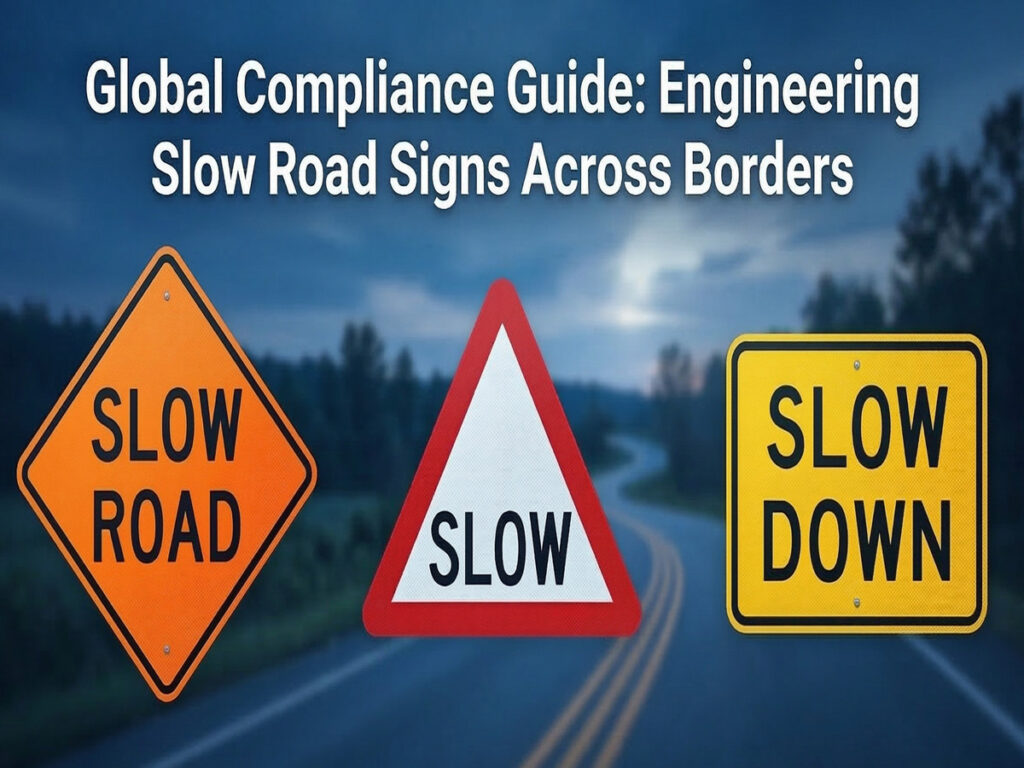
Regional regulations dictate the exact design of these critical boundaries worldwide. Compare international standards in our دليل الامتثال العالمي: هندسة إشارات الطرق البطيئة عبر الحدود.
Strategic Engineering of the Traffic Slow Sign
The placement of a traffic slow sign determines the safety of a construction site. Engineers must calculate the exact point for initial driver detection. هذا “مسافة الكشف” allows the brain to process upcoming road changes.
منطقة التحذير المسبق
The first traffic slow sign must appear well before the actual hazard. This placement accounts for the Perception-Response Time (فريق إعادة الإعمار) of the average motorist. Standard benchmarks set this PRT at approximately 2.5 ثوان. بسرعات الطرق السريعة, a vehicle travels significant distances during this mental processing phase.
Transition and Buffer Zones
Safety managers use the traffic slow sign to channel traffic flow. Sudden movements at high speeds cause vehicle instability. لذلك, the longitudinal buffer space acts as an invisible safety net.
أوبترافيك follows MUTCD Table 6C-2 to determine precise buffer lengths. ل 60 mph work zone, we recommend a 450-foot longitudinal buffer. This distance provides a critical recovery zone for distracted drivers. This space must remain empty of all equipment and personnel. Proper spacing reduces work zone fatalities by providing an essential margin of error.
The Human Factor and the Traffic Slow Sign
The human brain experiences a biological delay when seeing a traffic slow sign. This delay includes detection, تعرُّف, and physical reaction.
Processing Visual Stimuli
The high-contrast colors of a slow sign trigger the optic nerve. لكن, the driver must still interpret the specific command. Factors like glare or fatigue can extend this processing time. بالتالي, the sign must stand out against complex visual backgrounds.
Velocity and Reaction Gaps
Speed drastically reduces the time available for driver reaction. في 65 ميلا في الساعة, تغطي السيارة 95 feet every second. A three-second delay means the car travels 285 feet before braking. لذلك, كل traffic slow sign must offer enough lead time to bridge this gap.
The Physics of Deceleration and the Slow Sign
Deceleration requires significant energy dissipation. أ slow sign initiates this process by alerting the driver to reduce kinetic energy. Engineers use specific formulas to determine the required braking distance for various vehicle weights.
Kinetic Energy and Braking Force
Kinetic energy increases with the square of the vehicle’s speed. Doubling the speed quadruples the energy the brakes must absorb. لذلك, أ slow sign at a high-speed approach requires a much longer clearing distance. Optraffic designs signage to account for these exponential physical forces.
The Coefficient of Friction
Road surface conditions dictate how effectively a vehicle responds to a slow sign. مطر, الجليد, or loose gravel reduce the coefficient of friction. في هذه الظروف, tires lose grip more easily during sudden braking. بالتالي, site foremen must move the traffic slow sign further upstream during inclement weather.
علم المواد: Ensuring Slow Sign Conspicuity
Visibility directly impacts the “meaning” ل slow traffic signage. If a driver cannot see the sign, the safety protocol fails. High-quality materials ensure the sign remains visible under all lighting conditions.
معايير الانعكاسية
Optraffic utilizes advanced retroreflective sheeting for every traffic slow sign. We follow ASTM standards to ensure maximum light return. Micro-prismatic technology directs light back to the driver’s eyes rather than scattering it. This technology extends the detection distance by several hundred feet at night.
Understand the engineering behind these visual safety benchmarks. Read our detailed analysis: العلم وراء إعادة الانفعال ودوره في رؤية علامة الطريق السريع.
Angularity and Observation Angles
The angle of the road affects how light hits a slow sign. Signs placed on curves require superior angularity performance. Our engineering team ensures that the traffic slow sign remains bright from sharp approach angles. This precision prevents “sign blackout” during critical maneuvers.
Environmental Variables Affecting the Slow Signange
The surrounding environment can degrade the effectiveness of slow traffic signage. External factors often compete for a driver’s limited attention span.
Overcoming Visual Clutter
Urban environments contain many distracting lights and billboards. معيار slow sign can easily disappear in this “visual noise.” To counter this, Optraffic recommends using fluorescent backings. These materials glow under UV light to provide superior contrast in busy city centers.
The Impact of Weather on Sign Legibility
Fog and heavy snow act as physical barriers to light. These conditions shorten the effective range of any traffic slow sign. Using larger, high-intensity signs helps penetrate these atmospheric obstructions. Regular maintenance also prevents dirt buildup from neutralizing the sign’s reflective properties.
Compliance and Liability for the Traffic Slow Sign
Inadequate signage placement creates significant legal risks for contractors. A misplaced slow traffic signage can lead to catastrophic accidents. Regulatory bodies like the الهيئة الفيدرالية للطرق السريعة (FHWA). و إدارة السلامة والصحة المهنية enforce strict placement mandates.
Meeting Federal Mandates
كل علامة المرور must comply with Mutcd height and size requirements. These standards ensure uniformity across different jurisdictions. Uniformity helps drivers recognize and obey commands instantly. Failure to meet these standards often results in heavy fines during site inspections.
Documenting Safety Protocols
Site foremen should record the exact location of every لافتة. These records provide vital defense evidence during litigation. Detailed logs prove that the company prioritized worker and public safety. Optraffic supports these efforts by providing hardware that meets global compliance benchmarks.
التكامل الرقمي: The Future of the Slow Sign
Technology is transforming the traditional traffic sign into an active data terminal. Static signs are evolving into intelligent systems. These systems communicate directly with modern vehicle sensors.
Radar Feedback and Driver Behavior
Integrated radar sensors enhance the effectiveness of a slow sign. These sensors display the driver’s current speed in real-time. This immediate feedback loop triggers a natural urge to slow down. Studies show that dynamic feedback reduces average speeds more effectively than static metal signs.
V2X and Connected Infrastructure
The next generation of the traffic slow sign includes V2X الاتصال. These signs broadcast “بطيئة” commands to onboard computer systems. This ensures that even distracted drivers receive an alert inside the cabin. Optraffic leads this transition by integrating smart connectivity into our safety products.
خاتمة: Engineering a Safer Trajectory
أ slow sign is more than a piece of aluminum and reflective film. It is a precise tool based on the laws of physics. Correct placement accounts for both human biological limits and mechanical braking power.
Optraffic remains dedicated to advancing road safety through technical excellence. We provide the equipment necessary to manage complex traffic environments. Understanding the science behind the traffic slow sign ينقذ الأرواح. Every foot of braking distance matters in a high-stakes work zone.
التعليمات
أ slow traffic road sign acts as a critical regulatory or warning tool. It instructs drivers to reduce their current velocity immediately. This sign often appears near schools, مناطق العمل, أو منحنيات حادة. Optraffic engineers these signs using high-intensity reflective materials. This ensures the command remains visible from long distances.
he primary purpose of the slow down sign is to manage kinetic energy. Lower speeds significantly reduce the distance required for a full stop. This protects road workers and prevents high-speed collisions in transition zones. بالإضافة إلى ذلك, these signs alert drivers to hidden hazards or changing road conditions ahead.
Extreme weather like fog or heavy rain reduces sign legibility. These conditions physically block the light returning to the driver’s eyes. Using larger signs or fluorescent backgrounds helps overcome these atmospheric barriers. Regular maintenance also prevents dirt from obscuring the critical reflective surface.