A single blocked fire lane costs far more than a towing bill. Under NFPA 1, Section 18.2, a commercial facility that fails to maintain a clear fire apparatus access road can face daily municipal fines ranging from $100 to $500 per violation — on top of civil liability exposure if emergency response is delayed. For property managers, warehouse logistics directors, and procurement professionals, no parking signage is not a minor operational detail. It is a front-line compliance asset.
This guide addresses the four primary cost centers that drive enterprise no parking signage decisions: regulatory non-compliance penalties (MUTCD R7-series, OSHA 29 CFR 1910.37, NFPA 1), civil towing dispute liability, operational throughput loss at loading docks, and the total cost of ownership (TCO) of substandard sign materials.
What Legally Constitutes a ‘No Parking Area’ Under Federal and Local Standards
The regulatory definition of a no parking area depends entirely on jurisdictional context. Per the Manual on Uniform Traffic Control Devices (MUTCD), 2009 Edition with 2012 Revisions, R7-series signs govern no parking restrictions on all roads open to public travel — including privately owned roads serving shopping centers, business parks, and logistics campuses. The federal standard applies wherever a road meets the legal threshold of public access, regardless of who owns the land underneath it.
A legally enforceable no parking zone requires three elements to withstand a towing dispute or citation challenge: compliant sign placement, MUTCD-specified dimensions and retroreflectivity, and verified jurisdictional authority. Facility teams evaluating no parking signage programs can reference the buyer’s compliance guide on MUTCD standards for commercial & regulatory no parking signs for the complete regulatory specification framework.
Public Road vs. Private Property: Where Jurisdiction Determines Enforcement Authority
On public roads and publicly accessible private roads, signs must conform to federal color, retroreflectivity, and mounting height standards under MUTCD Part 2B. On purely private internal roadways, operators have broader design latitude — but must still satisfy local fire code (NFPA 1, Section 18.2), state vehicle codes for enforceable towing authorization, and ADA accessibility corridor requirements.
Procurement teams should note that non-MUTCD-compliant signs on publicly accessible roads can invalidate towing authority entirely. A towing company legally exposed by a deficient sign has a strong incentive to refuse the call — leaving the property owner with both the unauthorized vehicle and the compliance gap. Understanding the legal requirements for posting no parking signs on commercial property is the essential starting point for any enforcement program.
Fire Lane and Emergency Access Designations Under NFPA 1 and IFC
Fire lane no parking zones occupy a distinct regulatory category. NFPA 1 (Fire Code), Section 18.2.3.4, and the International Fire Code (IFC) Section 503.3 mandate that fire apparatus access roads display signs reading “NO PARKING — FIRE LANE” with curbing or pavement markings where applicable. Every fire lane no parking sign installation requires approval from the local Authority Having Jurisdiction (AHJ). Noncompliance fines at the commercial level commonly range from $100 to $500 per day per violation.
For complete compliance specifications across fire lane environments, teams should consult Fire Lane Signage Compliance: OSHA and NFPA Rules for Commercial Facilities.
Loading Dock and Freight Zone Restrictions: OSHA Egress and Operational Mandates
OSHA 29 CFR 1910.37 mandates that exit routes remain clear at all times. A vehicle blocking a loading dock that also obstructs an exit corridor constitutes a direct OSHA violation — with penalties reaching $15,625 per serious violation under 2023 penalty schedules. Beyond safety codes, each hour of blocked dock time costs a distribution facility an estimated $500 to $1,000 in dwell-time penalties and labor inefficiency. A no parking loading zone sign program, properly deployed at 200–500 foot approach distances for heavy vehicle operators, represents one of the highest-ROI compliance investments a logistics director can make.
MUTCD-Compliant No Parking Sign Dimensions: Technical Specifications for Procurement Teams
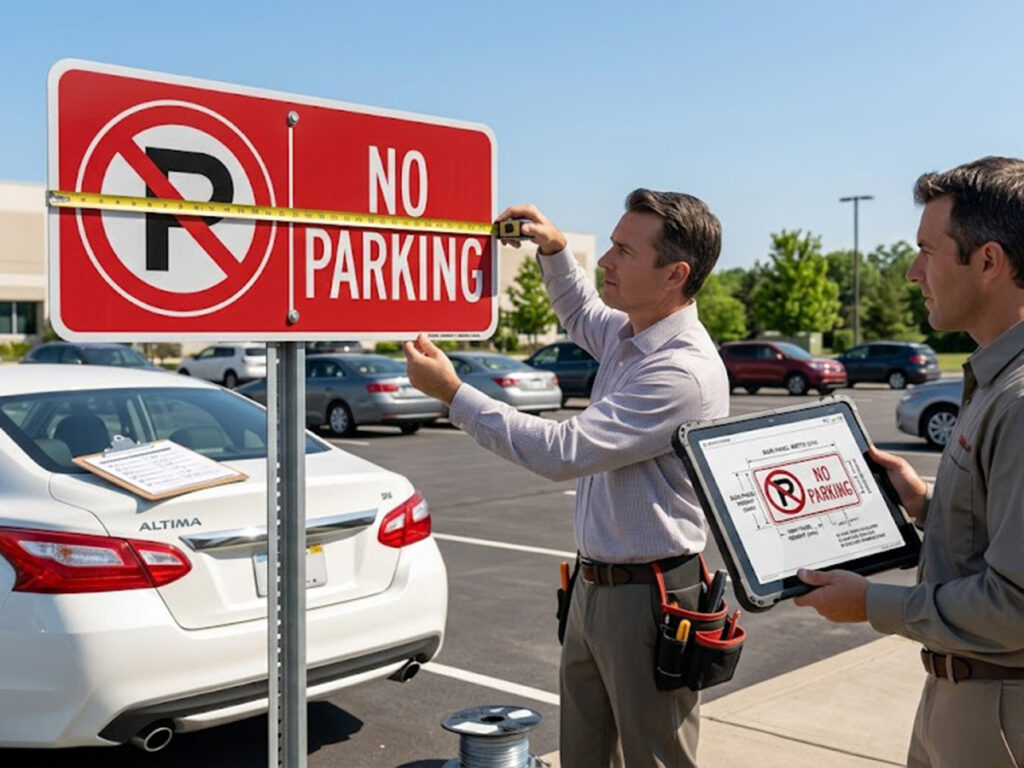
Sign dimensions are not a product preference — they are a compliance variable. MUTCD Table 2B-1 establishes standard sizes for R7-series regulatory signs. The R7-1 “No Parking” sign measures 12″ x 18″ for conventional roads and 18″ x 24″ for higher-speed arterials and commercial facility entrances where viewing distance exceeds 150 feet.
Undersized no parking sign dimensions on commercial loading zones or fire lanes are among the top three reasons towing companies refuse to operate under a property’s authority.
| Sign Designation | Dimensions | Min. Letter Ht. | Retro Grade | Recommended Application |
| R7-1 | 12″ x 18″ | 4 in. | Type I (EG) | Private lots, ≤25 mph zones |
| R7-1 | 18″ x 24″ | 6 in. | Type III (HIP) | Commercial entrances, arterials, loading docks |
| R7-200 | 18″ x 24″ | 6 in. | Type III (HIP) | No Parking Area boundaries, multi-lane lots |
| R7-200a | 24″ x 30″ | 8 in. | Type XI (DG) | High-speed corridors, construction zones |
Source: MUTCD Table 2B-1
Mounting Height, Lateral Placement, and Sight-Line Requirements
MUTCD Section 2A.18 specifies a standard mounting height of 5 feet above the edge of pavement for conventional roads and 7 feet in pedestrian areas, including parking structures. In industrial facilities with forklift or heavy equipment traffic, mounting height should be elevated to 8–10 feet (sign bottom) on internal roads to avoid shear damage. Lateral offset from the edge of pavement runs a minimum of 2 feet on low-speed facilities and 6–12 feet on high-speed roads. Post depth requires 36–42 inches below grade for stability in standard soil conditions.
Retroreflectivity Grades and Nighttime Compliance Under MUTCD Section 2A.08
Retroreflectivity compliance is the most frequently mismanaged dimension of no parking signage procurement. MUTCD Table 2A-3 mandates minimum retroreflectivity levels by sign color and road classification. White backgrounds on R-series signs require Type III (High-Intensity Prismatic, RA ≥ 250 cd/lux/m²) or higher on roads above 35 mph. Facilities that procure reflective no-parking signs at Engineer Grade (Type I, RA ≥ 70 cd/lux/m²) for cost savings on arterial roads face a retroreflectivity audit failure and forced replacement. Retrofitting a 50-sign campus from Type I to Type III averages $3,500–$7,000 — far exceeding the upfront premium of specifying correctly.
No Parking Sign Placement Strategy by Facility Type and Enforcement Zone
Effective no parking signage deployment maps regulatory requirements to specific site geometries and traffic patterns. MUTCD Section 2B.18 requires signs at the beginning and end of each restricted zone, with intermediate spacing not exceeding 100 feet in high-turnover areas. Four primary commercial environments each carry distinct requirements: multi-tenant commercial real estate, industrial and distribution facilities, healthcare campuses, and active construction sites.
Commercial Real Estate and Multi-Tenant Property Parking Control
Property managers overseeing multi-tenant buildings must enforce parking restrictions across shared corridors and visitor lots while maintaining tenant relations. Towing authorization signs — required by most state vehicle codes (e.g., California Vehicle Code 22658, Texas Transportation Code 684) — must display the property address, authorized towing company name and phone number, and towing hours. These signs function as a co-dependent system alongside the primary no parking in driveway sign or lot restriction sign.
Warehouse and Distribution Center Deployment
Industrial facilities carry the highest operational cost exposure from uncontrolled parking. Three critical zones require dedicated no parking signage programs: dock aprons and staging lanes (no parking zones must extend 50 feet minimum from dock doors for semi-trailer approach), fire apparatus access roads running the facility perimeter (NFPA 1 requires 20-foot minimum clear width), and equipment staging areas requiring supplemental “Equipment Zone” panels.
Large facilities (100,000+ sq. ft.) should map sign placement against a parking plan with no parking here to corner sign variants defining zone boundaries precisely. A no-parking-anytime sign at each dock apron section, spaced every 75 feet, provides the density needed for legally defensible enforcement. Metal no parking signs — specifically .080-inch aluminum — are the standard substrate for dock environments due to their corrosion resistance and MUTCD approval.
Construction Site Temporary No Parking Zones: MUTCD Part 6 Requirements
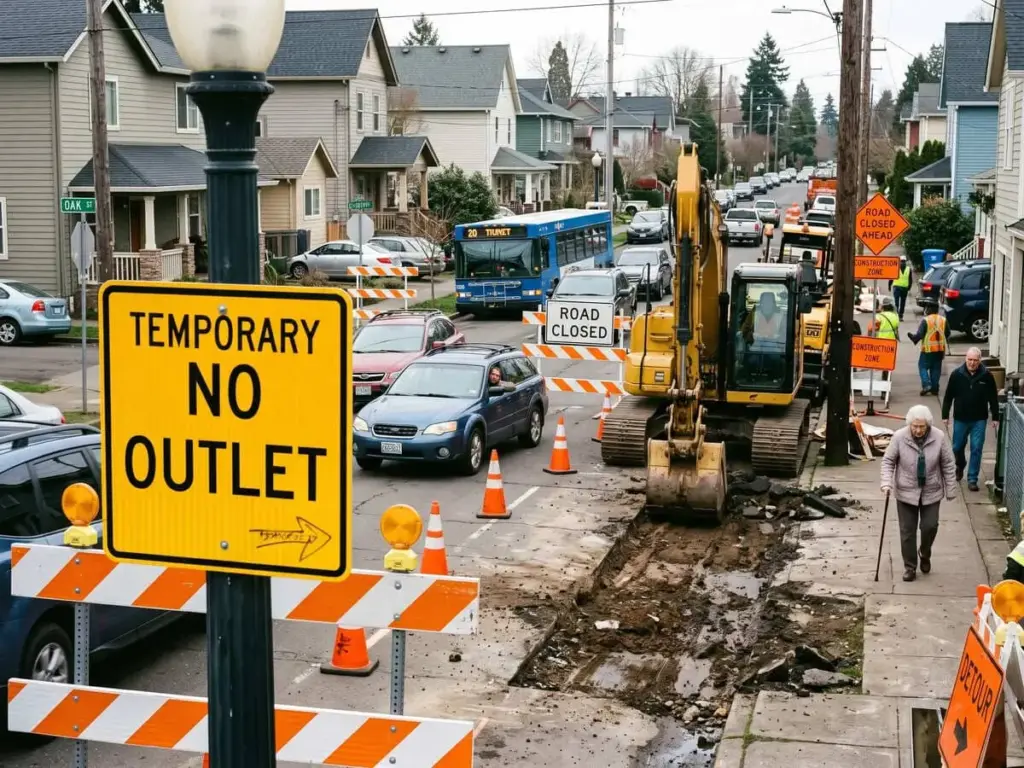
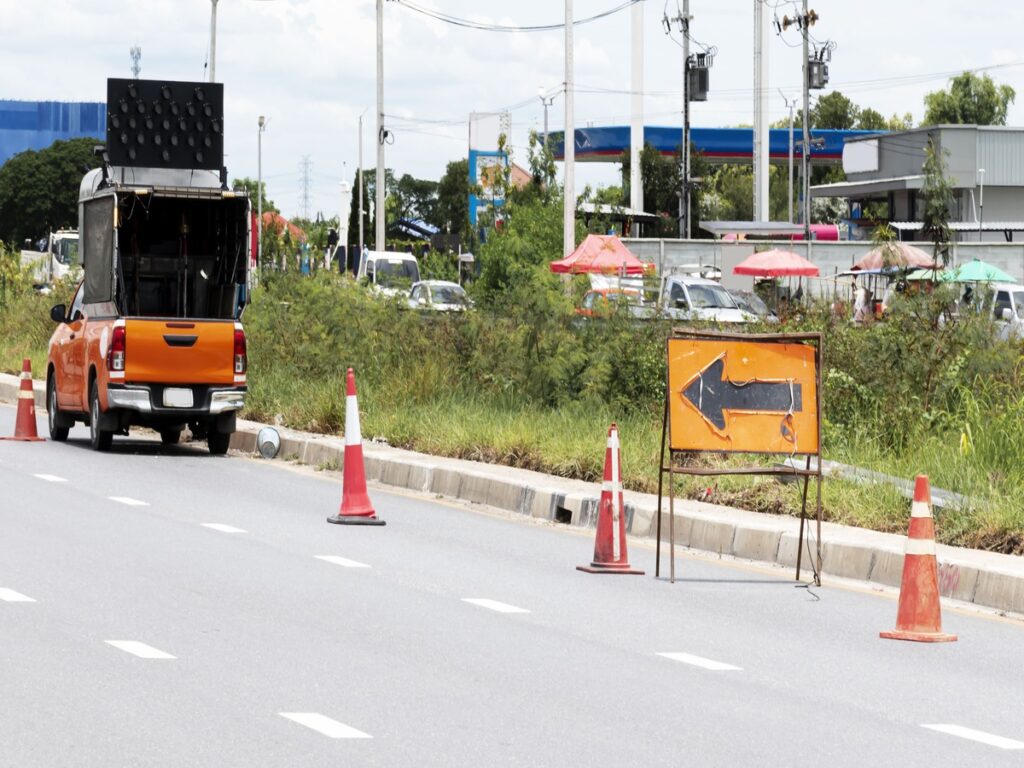
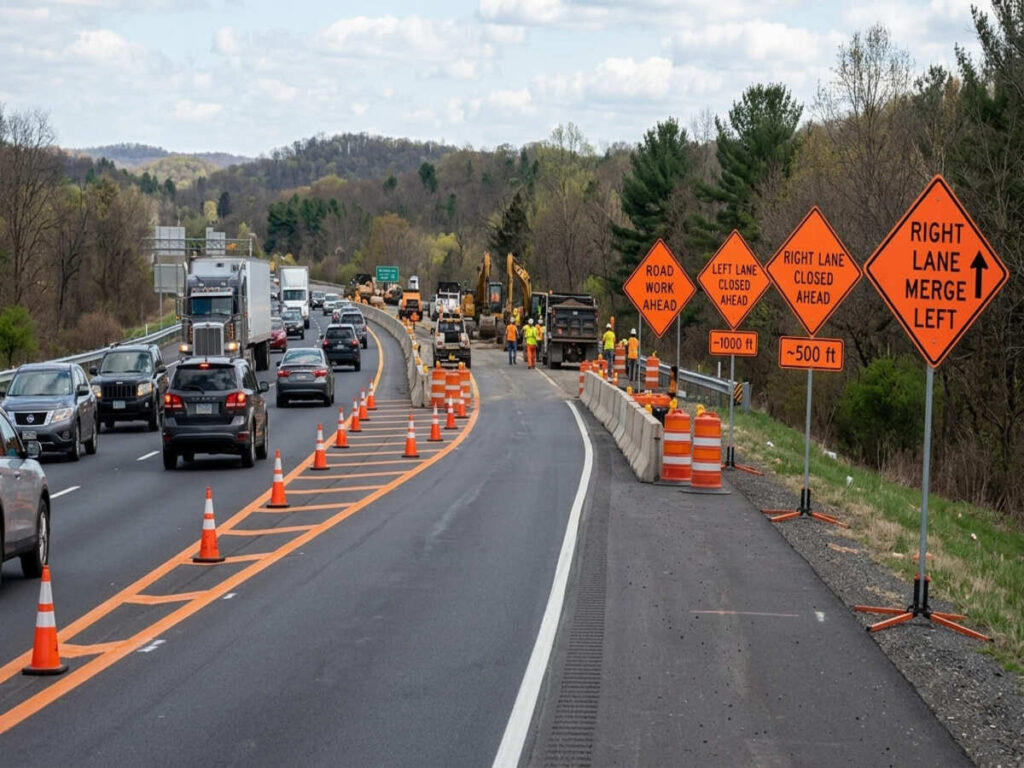
Construction project managers operate under MUTCD Part 6 (Temporary Traffic Control), which governs all signage in or adjacent to work zones on public roads. No parking construction signs require advance notification signage (R7-200a) beginning 200–500 feet upstream on arterial roads, with effective dates and hours posted on the sign face per most state DOT requirements. For rapid-deployment guidance on portable bases and barricade-mounted systems, teams should review fast-deployment methods for temporary no parking signs on active job sites.
Material Selection and Total Cost of Ownership: Engineering the Right Sign for Every Environment
Procurement decisions that optimize for unit price systematically underperform on TCO. The correct framework evaluates three variables: expected service life, environmental exposure class, and vandalism/impact risk. Primary substrate options for commercial no parking signage include .080-inch aluminum (standard), .125-inch heavy-gauge aluminum (high-impact environments), galvanized steel (extreme weather), and HDPE (corrosive chemical environments).
A $22 Engineer Grade aluminum no parking sign requiring replacement every 5–7 years vs. a $38 Type III High-Intensity Prismatic sign with a 10-year rated service life represents a 15–20% TCO reduction over a 20-year facility lifecycle at 50-sign scale. The math compounds further when replacement labor ($15–$25 per sign for post-mounted units) is included in the analysis.
Aluminum vs. Steel vs. HDPE: Substrate Performance Matrix
| Substrate | Weight | Corrosion Resistance | Service Life | Best Application |
| .080″ Aluminum | 0.6 lbs/sq ft | Excellent | 7–10 yrs | Standard commercial lots |
| .125″ Aluminum | 0.9 lbs/sq ft | Excellent | 10–15 yrs | Dock entrances, high-impact zones |
| Galvanized Steel | 1.2 lbs/sq ft | Good (with coating) | 10–15 yrs | Coastal, high-wind sites |
| HDPE | 0.5 lbs/sq ft | Superior | 12+ yrs | Wastewater, chemical facilities |
Source: ASTM B209 (Aluminum) — FHWA Retroreflectivity
Retroreflective Film Systems: Matching Grade to Application and Budget
Film system selection governs both nighttime compliance and sign lifecycle. Engineer Grade (Type I) films carry a 7-year manufacturer rating (3M, ORAFOL). High-Intensity Prismatic (Type III) films are rated 10 years and are the recommended baseline for any 24-hour facility. Diamond Grade (Type XI, RA ≥ 700 cd/lux/m²) films, rated 12+ years, are specified for high-speed ingress/egress corridors above 45 mph.
Importantly, re-sheeting — replacing the retroreflective film on an intact aluminum substrate — allows facilities to restore retroreflectivity compliance without full sign replacement. For a 50-sign campus, re-sheeting at year 7 costs approximately 40% less than purchasing new signs. This TCO lever goes unrecognized by most procurement teams buying complete replacement signs outright.
Corrosion Protection and Maintenance Inspection Intervals
Sign failures in commercial environments trace primarily to two causes: substrate corrosion and sheeting delamination. Procurement specifications should require ASTM B209 aluminum alloy 5052-H38 for sign blanks, with powder-coat edge sealing to prevent moisture ingress at cut edges — critical in coastal and freeze-thaw environments.
Recommended maintenance schedule: visual inspection quarterly, retroreflectivity compliance check annually using a retroreflectometer calibrated to ASTM E1710 standards, and full replacement at 50% of minimum MUTCD retroreflectivity value. For a 50-sign facility, annual inspection takes 2–3 hours — a negligible cost versus the citation risk of non-compliant no-parking signage.
Custom and Personalized No Parking Signs: Compliance-Bounded Customization for Enterprise Facilities
The demand for custom no parking signs and personalised no parking signs in B2B environments reflects four legitimate operational drivers: corporate campus branding programs requiring logo integration, multi-language facilities (Spanish/English bilingual or site-specific), complex restriction messaging exceeding standard R7-series legends, and industrial interior zones where color-coded departmental identification is required.
Custom no parking signage for publicly accessible roads must still operate within the MUTCD compliance envelope: MUTCD Section 2A.11 requires white backgrounds and red borders/legends for R-series signs, FHWA-approved letter fonts (Series B, C, D, or E), and minimum retroreflectivity grades. Customization is a branding and operational tool — not a regulatory bypass.
Designing Custom No Parking Signs That Remain MUTCD and OSHA Compliant
OSHA 29 CFR 1910.144 governs color coding on facility safety signs: red designates prohibition and danger. Custom sign layouts undergo a compliance review before production — especially for signs authorizing towing under state vehicle codes that mandate specific legend language. Enterprise campuses should develop a master Sign Schedule document to ensure consistency across multi-building deployments.
Bulk Procurement Workflows for Custom No Parking Signage Programs
A large-scale custom signage program follows a structured five-phase workflow: (1) site audit and sign inventory, (2) specification development covering substrate, sheeting grade, legend variants, and mounting hardware, (3) design proof and compliance review (typically 2–3 rounds for complex programs), (4) phased production scheduling to prevent simultaneous expiration across a campus, and (5) staggered delivery by zone for large sites.
Enterprise campuses of 500,000+ sq. ft. commonly require 75–200 no parking signs across multiple restriction categories. Volume pricing activates at 25-unit minimums for custom metal no parking signs, with per-unit costs declining 20–35% at 100-unit quantities. Procurement teams managing multi-site programs benefit from a master supply agreement that eliminates per-project RFQ cycles and ensures specification consistency across the portfolio.
Managing a multi-site signage program? Consult an Industrial Safety Signage Specialist to develop a compliant custom sign specification package — from design proof to bulk delivery. Request a Program Quote.
Temporary No Parking Signage: MUTCD Part 6 Compliance for Construction and Event Applications
Temporary no parking zones serve three primary commercial use cases: construction zone traffic control under MUTCD Part 6, event traffic management requiring variable-restriction signs, and emergency access control during facility incidents or utility work. Temporary no parking sign systems must balance rapid deployment capability with sufficient durability for 30–120 day deployments in live site conditions.
MUTCD Part 6D governs worker and pedestrian safety in temporary traffic control zones. No parking lawn signs and barricade-mounted variants used in work zones must be mounted on crashworthy supports per NCHRP Report 350/MASH standards when placed within the clear zone. All temporary regulatory signs must meet the same retroreflectivity requirements as permanent signs — a compliance point routinely missed in construction sign kit procurement.
Portable Sign Systems and Hardware for Rapid-Deployment No Parking Zones
Portable sign bases must be rated for the wind load of the sign panel: an 18″ x 24″ panel in a 50 mph wind zone generates approximately 8 lbs of lateral force, requiring a minimum 15 lb base. Roll-up signs offer superior portability but require retroreflective film lamination for nighttime compliance. T-post systems with drive anchors are preferred for 30+ day deployments in turf or unpaved areas.
For multi-event applications, interchangeable panel systems that use the same post infrastructure for multiple restriction messages reduce per-event sign cost by 40–60% versus full sign replacement.
Where to Buy No Parking Signs: B2B Sourcing Criteria and Volume Procurement Considerations
Decision-makers ready to buy no-parking signs at commercial scale should evaluate four primary sourcing channels: direct industrial sign manufacturers offering bulk programs, sign distributor networks for multi-product facility supply consolidation, government/municipal supply contracts (GSA Schedule, state cooperative purchasing agreements), and online configurator platforms for MUTCD stock signs with rapid fulfillment.
The critical qualifier for any commercial-grade no-parking signage supplier: documented MUTCD product certifications, ASTM-compliant materials documentation, retroreflectivity test data (photometric reports per ASTM E810), and rush production capability. Low-cost marketplace sourcing of no parking signs where retroreflectivity grade and substrate gauge are unspecified introduces the same liability exposure the signage program exists to eliminate.
Supplier Qualification Checklist: MUTCD and Material Certifications
- ASTM B209 certificate of conformance for aluminum substrates
- Retroreflective sheeting photometric test reports per ASTM E810 or E1710
- MUTCD compliance declaration for R-series sign products
- ISO 9001 Quality Management System certification (preferred for enterprise suppliers)
- Minimum 7-year warranty on sheeting; 10-year warranty on substrate for standard commercial applications
Building a Legally Defensible No Parking Zone: From Signage Audit to Enforcement Authorization
A legally defensible no parking zone requires more than a compliant sign. It requires a documented system. The four-phase implementation methodology:
- Phase 1 — Site Audit (inventory existing signage, identify compliance gaps, map enforcement zones);
- Phase 2 — Specification Development (substrate, grade, dimensions, legend, mounting);
- Phase 3 — Installation and Documentation (installation photos, GPS-tagged sign location map, maintenance log initialization);
- Phase 4 — Enforcement Authorization (towing contractor coordination, local law enforcement notification for public-road signs, AHJ approval for fire lane designations).
Most facilities fail at Phase 4. A compliant no parking signage system without a legally authorized enforcement mechanism does not protect the property owner from towing dispute liability. Facility managers seeking a single authoritative resource covering the full spectrum of no parking signage compliance, material selection, and procurement strategy will find the complete decision framework in this guide.
Conducting a Commercial Signage Compliance Audit
A structured compliance audit protocol covers six elements:
- (1) sign inventory with photographs and GPS tagging;
- (2) dimensional compliance check against MUTCD Table 2B-1 for the applicable road class;
- (3) retroreflectivity visual inspection or retroreflectometer reading (ASTM E1710);
- (4) mounting height and lateral placement measurement;
- (5) legend accuracy review (correct R-series designation, towing authorization language);
- (6) condition rating on a 1–5 scale for replacement prioritization.
Annual audit cycles are best practice for commercial facilities and required for those operating under ISO 45001 Occupational Health and Safety management systems. A 50-sign campus audit completes in approximately 2–3 hours — a negligible investment versus the citation and liability exposure of non-compliant no parking signage.
Towing Authorization Language and Legal Prerequisites
Most states require that private property towing authorization signs display: the property address or name, the name and phone number of the authorized towing company, a statement that vehicles will be towed at the owner’s expense, and the hours during which towing is authorized. Failure to meet these requirements creates unlawful towing exposure — Texas Transportation Code §684.082 provides for $1,000 minimum statutory damages per unlawful tow. Signs must be posted at each entrance to the restricted area, not only within it.
Conclusion: Commercial No Parking Signage as a Strategic Compliance Asset
dimensions: regulatory compliance cost avoidance, towing liability protection, operational throughput protection at loading docks, and long-term TCO reduction through correct material specification. The gap between a compliant program and a deficient one is rarely a budget problem — it is a specification problem.
Facility managers, procurement professionals, and project managers who approach no parking signage as a strategic compliance asset rather than a commodity purchase systematically outperform those who optimize for unit price alone. The decision variables — retroreflectivity grade, substrate gauge, sign dimensions, placement density, and enforcement authorization documentation — are all knowable, specifiable, and auditable.
This guide covers the full spectrum of commercial no parking signage requirements. For procurement teams ready to move from specification to sourcing, the next step is a site audit and volume quote request from a qualified industrial signage manufacturer with documented MUTCD compliance credentials.
Frequently Asked Questions: No Parking Signage for Facility Managers and Procurement Teams
What are the exact MUTCD-required dimensions for a commercial no parking sign on a privately owned road open to public traffic?
Per MUTCD Table 2B-1, the standard R7-1 sign for conventional roads (≤45 mph) is 12″ x 18″. For higher-speed arterials (>45 mph), the standard increases to 18″ x 24″. Under 23 CFR Part 655, privately owned roads open to public travel require full MUTCD compliance. Facilities using 12″ x 18″ signs on roads above 45 mph face enforcement disputes and potential towing authority. Supplemental time restriction or towing authorization panels add 6–12 inches vertically to the total sign assembly height.
Can a facility manager legally install custom no parking signs, or must all signage match MUTCD standard designs exactly?
Facility managers may install custom no parking signs within MUTCD-defined parameters on publicly accessible roads: white background, red border and legend, FHWA-approved fonts (Series B through E), and minimum retroreflectivity grades. On purely private internal roads not open to public travel, design flexibility increases — OSHA 29 CFR 1910.144 governs color coding (red = prohibition), but specific MUTCD fonts and dimensions are not mandatory. All towing authorization language must comply with state-specific statutory requirements regardless of customization level.
What retroreflectivity grade is required for no parking signs at a 24-hour industrial warehouse, and how often must compliance be verified?
For 24-hour facilities with nighttime carrier traffic, MUTCD Table 2A-3 mandates High-Intensity Prismatic (Type III) sheeting on R-series white backgrounds for roads above 35 mph. Internal roads with speed limits of 10–15 mph may use Engineer Grade (Type I) if access is not public-facing. Annual retroreflectivity verification using an ASTM E1710-calibrated retroreflectometer is best practice. Signs measuring below 50% of the MUTCD minimum RA value require immediate replacement.
What is the 20-year lifecycle cost difference between Engineer Grade and High-Intensity Prismatic no parking signs on a 100-sign campus?
Engineer Grade (Type I) 18″ x 24″ aluminum signs cost $18–$25 per unit at commercial volume; Type III equivalents run $30–$45. The upfront delta is $1,000–$2,000 at 100 signs. Over 20 years, Engineer Grade requires approximately three replacement cycles vs. two for Type III. Including replacement labor ($15–$25 per sign), the Type III program delivers a net lifecycle savings of $2,500–$5,000 — before factoring in the compounding cost of retroreflectivity compliance failures on high-speed access roads.
How many no parking signs are required to legally designate a loading dock no-parking zone, and what placement rules apply?
MUTCD Section 2B.18 requires signs at the beginning and end of each restricted zone, with intermediate signs at intervals not exceeding 100 feet. A standard 100-foot loading dock face requires a minimum of 2–3 signs plus approach advisory signs visible from at least 150 feet. OSHA 29 CFR 1910.37 additionally requires clear marking of pedestrian egress corridors adjacent to dock zones. Facilities with 24-hour carrier access should combine no parking signage with MUTCD Section 3B retroreflective pavement markings for maximum legal defensibility.
Reference
- OSHA 29 CFR 1910.37
- ASTM E1710, Standard Test Method for Measurement of Retroreflective Pavement Marking Materials
- Standard Test Method for Coefficient of Retroreflection of Retroreflective Sheeting Utilizing the Coplanar Geometry
- ASTM B209 (Aluminum), Standard Specification for Aluminum and Aluminum-Alloy Sheet and Plate