Why Bollard Dimensions Matter for Commercial Site Planning
Bollard sizing decisions shape every downstream outcome of a perimeter security project. Property developers who under-spec face failed inspections, inadequate impact protection, and expensive retrofits. Those who overspec waste capital on industrial-grade hardware in retail-grade applications.
The True Cost of Specifying the Wrong Bollard Size
Vehicles crash into commercial buildings more than 100 times per day across the United States, injuring up to 16,000 people and killing as many as 2,600 annually (Source: https://www.storefrontsafety.org/crash-statistics). Many incidents occur where bollards were absent or undersized for the threat profile. Correct traffic bollard dimensions separate a routine hardware line item from a multi-million-dollar liability claim.
How This Guide Helps Property Developers Spec with Confidence
This guide translates the industry’s three-tier sizing framework into procurement-ready specifications. It covers heights, diameters, wall thicknesses, and steel grades matched to real-world commercial applications. Developers can apply it directly to RFPs, value engineering reviews, and multi-site standardization efforts.
Quick-Reference: The Three Sizing Tiers at a Glance
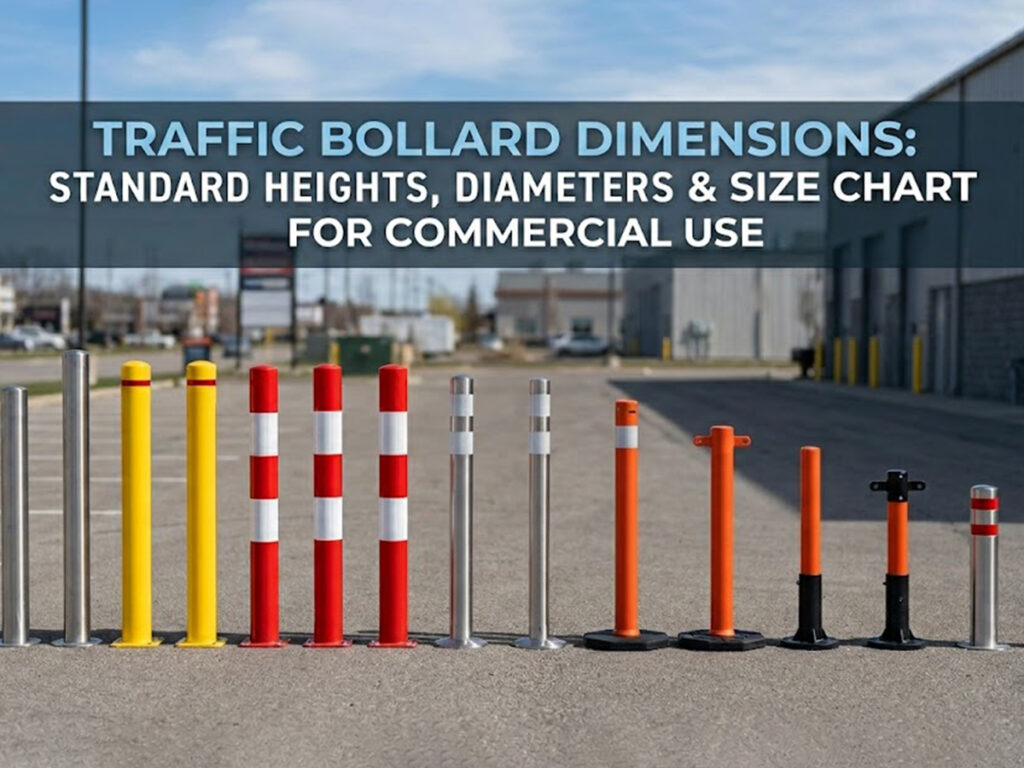
Standard traffic bollard dimensions fall into three commercial tiers: guidance (30–36″ tall, 3–4.5″ diameter), standard facility protection (36–42″ tall, 4.5–6″ diameter), and heavy-duty security (36–48″+ tall, 6–8″+ diameter). Each tier matches a specific risk profile, which the following sections unpack in detail.
Standard Traffic Bollard Height Specifications
Traffic bollard height determines visibility, detectability, and engagement with vehicle bumpers. The commercial standard centers tightly around the 36-to-42-inch range.
The 36–42 Inch Commercial Standard Explained
Commercial bollards typically stand 36 to 42 inches above grade. This range hits three engineering targets at once. It keeps the bollard top within the driver’s line of sight from a standard sedan or SUV. It engages the front bumper crumple zone of most passenger vehicles. And it preserves pedestrian sightlines across plazas and walkways. PROWAG accessibility guidance generally specifies bollard heights in the 36-to-48-inch range so cane users can detect them reliably.
When to Spec Shorter Bollards (30″) for Pedestrian & Guidance Applications
Shorter 30-inch units suit park pathways, crosswalk guidance, and pedestrian flow channeling. They mark boundaries without overwhelming the visual character of a streetscape. Such traffic bollard dimensions perform best where impact resistance is secondary to wayfinding.
When Taller Bollards (48″+) Are Required for Security Zones
Critical infrastructure perimeters, federal facilities, and high-value asset zones push above the 42-inch ceiling. Taller bollards improve daytime visibility from heavy commercial vehicles and increase visual deterrence. Many sites pair these specs with placement standards outlined in federal traffic control guidance for bollard installations to align design with code.
Traffic Bollard Diameter & Wall Thickness Standards
Diameter and wall thickness together define how a bollard absorbs kinetic energy. The two specifications cannot be evaluated in isolation.
Standard Commercial Diameters: 4″, 6″, and 8″ Explained
Commercial bollards carry outer diameters of 4 to 8 inches in standard configurations. A 4-inch bollard offers a slim visual profile for storefronts and guided pedestrian areas. The 6-inch diameter handles most structural-protection use cases — utility boxes, loading-dock corners, columns near vehicle drives. An 8-inch bollard signals heavy-duty intent and pairs with thicker walls for asset protection. Choosing between 4 inch vs 6 inch bollards comes down to threat profile, not aesthetics alone.
Schedule 40 vs. Schedule 80 Steel: Wall Thickness Demystified
Wall thickness — not just outer diameter — drives impact resistance. A 4-inch Schedule 40 pipe carries a 0.237-inch wall, while Schedule 80 increases that meaningfully. Schedule 80 walls run roughly 40 to 50 percent thicker than Schedule 40 at the same nominal diameter. That extra mass translates into substantially higher kinetic energy absorption.
How Diameter and Wall Thickness Together Determine Impact Resistance
Two bollards can share the same 6-inch outer diameter and deliver radically different protection. One built from Schedule 40 may bend under a 20-mph SUV impact. The same 6-inch unit in Schedule 80, when properly mounted, can meet ASTM F3016 S20 standards — stopping a 5,000-pound vehicle at 20 mph. Specifying traffic bollard dimensions without specifying wall thickness leaves the spec functionally incomplete.
Engineering Test Summary (ASTM F3016-19): In controlled crash testing of a standard 6-inch Schedule 80 steel bollard (6.625″ O.D., 0.432″ wall thickness), a 5,000-lb surrogate vehicle impacting at 19.8 mph generated approximately 66,000 ft-lbs of kinetic energy. The dimensional mass of the Schedule 80 wall restricted the dynamic penetration (P1) to just 3.2 inches, well below the 12-inch maximum allowance. Specifying traffic bollard dimensions without specifying wall thickness leaves the spec functionally incomplete.
The Commercial Bollard Size Chart — Three Tiers for Every Application
The following commercial bollard size chart consolidates standard traffic bollard dimensions across three risk-aligned tiers. Each tier reflects industry-standard configurations used in commercial development.
| Tier & Risk Profile | Standard Height | Outer Diameter | Wall Thickness & Material | Est. Weight (per ft) | Procurement TCO Focus (B2B Insight) |
| Tier 1 — Traffic & Guidance | 30–36″ | 3–4.5″ | Schedule 40 Steel (0.125″–0.237″) | ~7.6 – 10.8 lbs | Low freight cost; prioritize UV-resistant powder coating to eliminate 18-month maintenance cycles. |
| Tier 2 — Facility Protection | 36–42″ | 4.5–6″ | Schedule 40 Steel (0.237″–0.280″) | ~14.6 – 19.0 lbs | Standard developer floor; buy in bulk to optimize LTL shipping rates. Great for everyday parking lot strikes. |
| Tier 3 — Heavy-Duty Security | 36–48″+ | 6–8″+ | Schedule 80 Steel (0.432″–0.500″) | ~28.6 – 43.4 lbs | High mass drives shipping premiums; verify ASTM crash certification before signing off on mill test reports. |
Source: Industry-standard commercial bollard specifications, compiled from Reliance Foundry and Security Informed
Tier 1 — Traffic & Guidance Bollards (Visual Wayfinding)
Tier 1 prioritizes visual guidance over impact resistance. Park pathways, plaza edges, and pedestrian crossings rely on these traffic bollard dimensions to channel foot traffic and signal vehicle boundaries. Procurement teams should treat Tier 1 as cosmetic-plus, not protective.
Tier 2 — Standard Facility Protection (The Developer Default)
Tier 2 is the workhorse of commercial development. It defends storefronts, utility cabinets, transformer enclosures, fire risers, and loading-dock corners against low-speed parking-lot impacts. Most Class A office, retail, and light industrial projects standardize here. Once the tier is locked, the next planning step is determining the correct spacing between bollard units.
Tier 3 — Heavy-Duty Security (High-Risk Asset Zones)
Tier 3 protects high-value assets from intentional and accidental vehicle incursions. Distribution centers, data center perimeters, fuel depots, government facilities, and ATM kiosks all fall here. These configurations commonly carry ASTM F3016 or ASTM F2656 crash ratings.
Need help spec’ing a multi-site rollout? Consult a perimeter security expert before locking the SKU.
Matching Bollard Dimensions to Your Application Type
Application drives sizing — not the other way around. Developers should start with the site’s threat profile and then back into the right traffic bollard dimensions.
Retail Storefronts, ATMs & Pedestrian-Facing Facades
Storefronts sit squarely in Tier 2 territory. Industry data shows that 46% of vehicle-into-building crashes result in injury and 8% result in a fatality. A 36-to-42-inch height paired with a 4.5-to-6-inch Schedule 40 diameter handles typical parking-lot strikes. ATM kiosks, drive-thru lanes, and outdoor dining patios warrant ASTM F3016-rated Tier 3 configurations.
Real-World Implementation Case: During a 2025 multi-site asset protection upgrade for a major retail plaza developer in Texas, the engineering team replaced standard 4-inch guidance posts with 6-inch Schedule 80 ASTM F3016 S20-rated steel bollards along the storefront perimeter. In February 2026, a sedan lost control in the parking lot, striking a newly spec’ed 6-inch bollard at an estimated 18 mph. The verified structural dimensions successfully deflected the vehicle, resulting in zero structural building damage and preventing a catastrophic storefront penetration liability claim. (Source: Storefront Safety Council Database & ASTM F3016 Test Records)
Parking Garages, Loading Docks & Service Drives
Loading docks face repeated low-speed strikes from forklifts, trailers, and delivery vehicles. A 42-inch height with a 6-inch Schedule 40 or Schedule 80 diameter delivers the right balance of visibility and durability. Parking-garage column protection follows the same baseline.
Why 24-Inch Bollards Don’t Meet Most Commercial Protection Standards
A traffic bollard 24 inches in height falls below commercial protection thresholds. Such short units serve decorative or wheel-stop functions rather than vehicle barrier roles. They sit beneath standard bumper height on most passenger vehicles, so impact energy transfers into the unit’s base rather than the post itself. Developers seeking real protection should default to the 36-inch commercial floor or higher.
How Bollard Dimensions Translate to Real-World Impact Performance
Bollard sizing connects directly to verifiable performance ratings. Property developers should understand the link before signing off on a spec sheet.
The Relationship Between Diameter, Wall Thickness & Kinetic Energy
Kinetic energy scales with the square of velocity. A 5,000-pound vehicle at 20 mph delivers four times the kinetic energy of the same vehicle at 10 mph. ASTM F3016 tests bollards against 5,000-pound vehicles at 10, 20, and 30 mph. Larger diameters paired with thicker walls (Schedule 80) absorb that energy without exceeding the P1 penetration limit of one foot.
Visibility, Reflectivity & ADA Sightline Considerations at Standard Heights
The 36-to-42-inch range balances driver visibility against pedestrian sightlines. To comply with ADA Chapter 4 (Accessible Routes), standard regulations require a minimum 36-inch clear passage between the finished outer diameters of adjacent bollards, which sets the floor for spacing decisions. Furthermore, under PROWAG (Proposed Rights-of-Way Accessibility Guidelines) Section R302, bollards operating as protruding objects must maintain a highly detectable dimensional profile (minimum 36″ height above grade) and feature a minimum 30% visual contrast against the background to ensure cane users and visually impaired pedestrians can detect them reliably.
Dimensions Are Only Half the Equation — Mounting Matters Too
Even the best traffic bollard dimensions fail if the mounting is wrong. A 6-inch Schedule 80 bollard surface-bolted to a thin concrete slab will fail far below its rated capacity. Property developers should pair dimensional decisions with the right foundation strategy. A future cluster article will cover how the mounting method affects whether a bollard delivers its rated protection.
Procurement Checklist — Specifying Bollard Dimensions for Bulk Orders
Bulk procurement requires a tight specification sheet. The following checklist prevents change orders and inspection failures.
The 7 Dimensional Data Points Every RFP Should Include
A complete traffic bollard specification covers:
- Above-grade height (e.g., 36″, 42″, 48″)
- Outer diameter (e.g., 4″, 6″, 8″)
- Wall thickness or steel schedule (Schedule 40 or 80)
- Steel grade and finish (e.g., ASTM A53, hot-dipped galvanized, powder-coated)
- Mounting type (embedded, surface-mount base plate, removable sleeve)
- ASTM crash rating, if applicable (F3016 S10/S20/S30 or F2656 M30/M50)
- Quantity and linear spacing per site
Common Spec Sheet Mistakes That Trigger Costly Change Orders
Three errors dominate field experience:
- Specs that list outer diameter without wall thickness invite Schedule 40 substitutions on Tier 3 applications.
- Specs that omit finish create rust failures within 18 months.
- Specs that ignore mounting force the general contractor to improvise foundations on-site.
Volume Procurement: Standardizing Dimensions Across Multi-Site Portfolios
Multi-site developers benefit from locking two or three SKUs across their portfolio. A common pattern: one Tier 2 unit (42″ × 6″ Schedule 40, embedded) and one Tier 3 unit (48″ × 8″ Schedule 80, ASTM F3016 S30). Standardization compresses procurement timelines and simplifies replacement logistics.
View bulk pricing on commercial-grade bollards or request a custom quote for your project portfolio.
Final Sizing Recommendations & Next Steps for Your Project
Specifying the right traffic bollard dimensions is a foundation decision — every downstream choice (placement, spacing, foundation, finish) flows from it.
Recap — Matching Tier to Site Risk Profile
Tier 1 covers guidance. Tier 2 covers standard facility protection at most commercial sites. Tier 3 covers crash-rated security at high-value perimeters. Property developers who anchor their RFPs to this three-tier framework reduce specification ambiguity and accelerate procurement cycles.
Where Dimensions Fit Into the Broader Compliance Picture
Dimensional decisions interlock with placement, foundation, and code compliance. Property developers can explore the complete compliance, placement, and installation framework for commercial bollards to align every spec with federal and local requirements. Teams ready to finalize traffic bollard dimensions for an upcoming development should consult a perimeter security specialist for site-specific recommendations.
Frequently Asked Questions About Traffic Bollard Dimensions
What is the standard height of a commercial traffic bollard?
Commercial traffic bollard dimensions for height typically run 36 to 42 inches above grade. This range balances driver sightlines, pedestrian visibility, and vehicle bumper engagement. PROWAG accessibility guidance extends the upper bound to 48 inches for cane detectability.
Are 24-inch bollards suitable for vehicle impact protection?
No. A traffic bollard 24 inches in height falls below standard bumper heights on most passenger vehicles, so impact energy bypasses the post entirely. Such units function as decorative markers or wheel stops, not vehicle barriers. Use the 36-inch commercial floor or higher for real protection.
What diameter bollard stops a vehicle?
For low-speed impacts, a 6-inch outer diameter in Schedule 80 steel, embedded in concrete, meets ASTM F3016 S20 ratings against a 5,000-pound vehicle at 20 mph. A 4-inch Schedule 40 bollard provides only guidance — not impact protection. Bollard diameter for vehicle impact applications should always pair with verified wall thickness.
What’s the difference between Schedule 40 and Schedule 80 bollards?
The difference is in the wall thickness. A 4-inch Schedule 40 pipe has a 0.237-inch wall, while Schedule 80 is roughly 40 to 50 percent thicker at the same nominal size. Thicker walls absorb more kinetic energy on impact, making Schedule 80 the standard for crash-rated applications.
Do bollard dimensions need to comply with ADA requirements?
Yes. ADA Standards require a minimum 36-inch clear passage between bollards. PROWAG also recommends bollard heights in the 36-to-48-inch range for cane detectability. Height, spacing, and contrast all factor into compliance with federal accessibility law.
How do bollard dimensions relate to crash ratings?
Crash ratings (ASTM F3016 and F2656) verify performance, but they depend on dimensions. Larger diameters, thicker walls, deeper embedment, and harder steel grades all push a bollard toward higher ratings. Dimensions alone do not certify performance — a full ASTM crash test does.
References
U.S. Access Board, “Public Right-of-Way Accessibility Guidelines (PROWAG).”
Kloeckner Metals Corporation, “What is Schedule 40 Steel Pipe?“
ASTM International, “ASTM F3016/F3016M-19 Standard Test Method.”
U.S. Department of Justice, “2010 ADA Standards for Accessible Design.”