Stop Paying for Bollard Replacements: The True Cost of Manual Reset Systems
Every facility manager knows the pattern. A delivery driver clips a bollard at 2 a.m. By morning, the post lies flat, the lock is missing, and a work order hits the maintenance queue. Multiply that event across 40 bollards, and the operational drag becomes impossible to ignore. This is the quiet tax of legacy traffic posts. Collapsible bollards demand human hands. Replacement bollards demand purchase orders. Neither belongs in a lean maintenance budget.
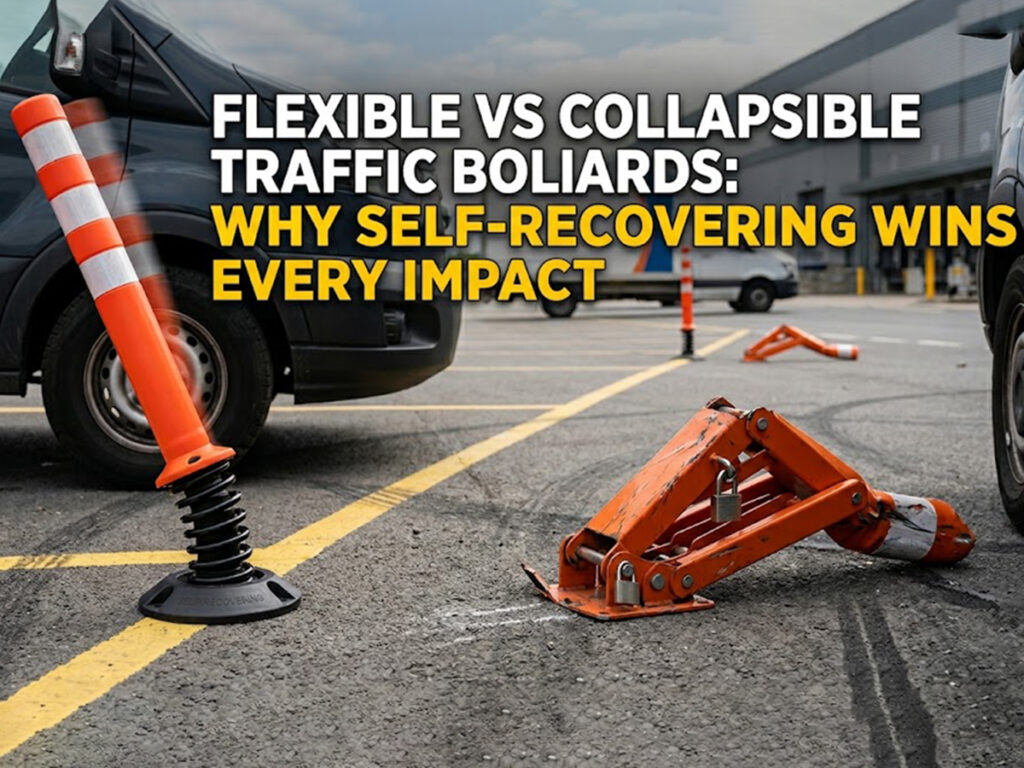
The flexible traffic bollard category exists to end this cycle. Self-recovering posts absorb impact, spring back to vertical, and return to service without staff dispatch. The shift from rigid steel to flexible polyurethane is reshaping how facility teams approach traffic delineation.
The Hidden Labor Tax of Traffic Management
The U.S. Bureau of Labor Statistics reports a median annual wage of $48,620 for general maintenance and repair workers as of May 2024 (Source: https://www.bls.gov/ooh/installation-maintenance-and-repair/general-maintenance-and-repair-workers.htm). That figure translates to a fully-loaded hourly cost of roughly $35 per hour once benefits and overhead are added. A typical manual reset event consumes 10 to 15 minutes of staff time. Multiply across a 40-bollard site with weekly impacts, and reactive labor easily exceeds $5,000 per year.
That math excludes parts, service vehicle fuel, and the productivity lost to other maintenance areas.
Why Facility Managers Are Abandoning Steel Collapsible Posts
Hinges bend. Padlocks rust. Anchors loosen after every impact. Field crews report that folding traffic bollards rarely make it past a few seasons in high-traffic environments. The flexible traffic bollard sidesteps every one of those failure modes by removing the moving parts entirely.
This guide breaks down the engineering, the lifecycle costs, and the use-case fit for both categories. By the end, procurement teams will hold a defensible spec recommendation backed by real numbers.
Need a quick estimate? Consult our experts to get the bollard maintenance cost to see your facility’s annual exposure to manual reset labor.
How Flexible Traffic Bollards Self-Recover from Impact
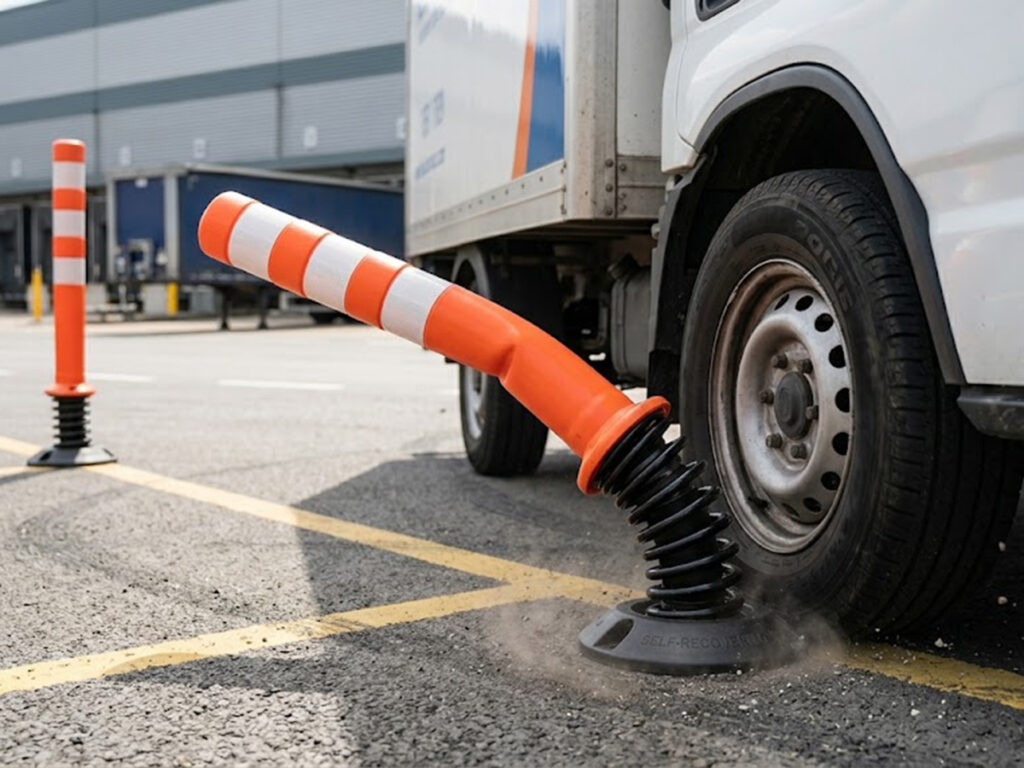
A flexible traffic bollard works because of two design principles: elastomer memory and mechanical deflection. Together, they let the post bend, absorb, and rebound without permanent damage.
UV-Stabilized Polyurethane Construction Explained
Polyurethane behaves differently from rigid plastics like HDPE or steel. Its elastomer structure stores impact energy and releases it on the rebound, much like memory foam returning to shape after compression.
UV stabilization keeps the material from chalking or growing brittle under sun exposure. Properly compounded polyurethane retains its elasticity in sub-freezing winters and triple-digit summers, which matters for any low-maintenance traffic bollards spec.
The Spring-Loaded Base and 360-Degree Deflection
Premium flexible traffic bollard models pair the polyurethane sleeve with an internal spring-loaded base. The spring allows the post to pivot in any direction from any approach angle. Vehicles entering from an unexpected angle find no rigid resistance.
Surface-mount versions anchor to concrete with four bolts. Embedded sleeve mounts drop into asphalt for a flush, low-profile install. Both methods preserve the 360-degree deflection range.
From 90-Degree Bend to Upright in Seconds
A premium flexible traffic bollard is engineered to meet rigorous NTPEP (National Transportation Product Evaluation Program) standards. Under standard test methods, these high-performance polyurethane posts demonstrate the durability to withstand up to 200 repeated impacts at 30 mph (48 km/h), achieving full vertical recovery from 90-degree deflections without structural tearing or anchor failure. The instant the load releases, the spring base and polyurethane elasticity drive the post back to vertical. No staff visit, no work order, no replacement invoice.
Manufacturers refer to this property as self-healing or self-recovering. Both terms describe the same outcome: full visual and functional restoration without manual intervention.
Inside the Collapsible Bollard: Hinged Mechanisms and Their Limitations
Collapsible traffic bollards solve a different problem. They control authorized access, not impact absorption.
How Hinged, Padlockable Bollards Actually Work
A typical collapsible bollard consists of a steel or aluminum upright welded to a hinged base, secured by a padlockable locking collar. Authorized staff unlock, fold the post down, and a permitted vehicle passes through.
This design assumes the post stays upright until someone with a key chooses otherwise. It is an access control device first, an impact protection device second.
The Manual Reset Problem — Labor Hours You Didn’t Budget For
Collapsible traffic control bollards introduce a labor dependency at every impact event. Each unscheduled fold-down requires:
- A staff dispatch
- A walk to the bollard location
- Lifting the post upright
- Securing and verifying the padlock
Lost keys halt the entire reset workflow. Damaged hinges turn a five-minute task into a parts order.
Mechanical Wear on Hinges, Locks, and Springs
Outdoor environments punish mechanical assemblies. Salt accelerates corrosion. Sand jams hinges. Freeze-thaw cycles seize lock cylinders.
Folding traffic bollards rely on every one of those mechanisms working perfectly. A flexible traffic bollard has nothing to seize because it has no mechanism to fail.
Impact Performance Showdown — What Happens When a Vehicle Strikes
According to the National Safety Council’s comprehensive data tracking, traffic incidents in non-public environments—specifically private parking lots and driveways—remain a critical liability for facility managers. Even as overall U.S. traffic fatalities experienced a 12% decline, these private sectors continue to account for tens of thousands of injuries annually (Source: https://www.nsc.org/newsroom/nsc-predicts-12-percent-decrease-traffic-deaths). The vast majority of these parking lot impacts occur at low speeds, with delivery vehicles and cars colliding directly with rigid, fixed infrastructure like traditional bollards.
Flexible Polyurethane Under Impact — Absorb, Deflect, Recover
Operational data from high-throughput distribution centers reveals a recurring failure pattern: delivery vans navigating tight turning radii consistently clip perimeter markers. When a rigid collapsible post takes this lateral force, the kinetic energy is transferred directly down to the substrate, leading to concrete spalling (cracking around anchor bolts). Conversely, an energy-absorbing flexible polyurethane post deflects the load immediately, preserving both the vehicle’s paneling and the structural integrity of the concrete floor.
No paint transfer. No panel dent. The site keeps running while the driver continues the route.
Steel Collapsible Upright Under Impact — Full Brunt and Structural Damage
A steel collapsible bollard struck while locked upright tells a different story. The post is engineered to fold on command, not on impact. When the energy arrives outside the authorized fold-down cycle, the structure resists.
The resulting damage usually includes:
- Bent upright tubing
- Cracked or pulled baseplates
- Vehicle bumper, panel, or undercarriage damage
- Compromised anchor points in the substrate
Replacement, not repair, often becomes the only path forward.
Vehicle Damage and Property Owner Liability Exposure
Rigid impact transfers force back into the striking vehicle. That force creates damage claims, third-party complaints, and insurance friction. A flexible traffic bollard absorbs that energy instead. Property owners face fewer claims, and tenants face fewer disruptions.
Want a site-specific assessment? Request a free walk-through, and our team will identify your highest-impact zones and recommend a flexible traffic bollard layout.
The Three-Pillar Case for Self-Recovering Bollards
Three arguments anchor the move toward self-recovering posts. Each one translates directly into a line item on the facility budget.
Pillar 1 — Ending the Rip-and-Replace Cycle
A single flexible traffic bollard tolerates hundreds of low-speed impacts from cars, forklifts, and street sweepers without cracking. Procurement teams trade a recurring replacement cycle for a one-time capital purchase.
Lifecycle math favors the flexible camp. One self-recovering post often outlasts four to eight collapsible replacements over the same five-year window.
Pillar 2 — Minimizing Liability Through Energy Absorption
OSHA documents roughly 34,900 serious forklift-related injuries each year, and warehouse operators face mounting pressure to reduce collision exposure (Source: https://www.osha.gov/powered-industrial-trucks). A flexible traffic bollard yields under impact, dropping the energy transferred to vehicles, equipment, and bystanders. Insurance underwriters increasingly favor passive yielding traffic devices for the same reason.
Pillar 3 — Zero Labor Downtime After Every Impact
Self-recovering posts demand no staff time after installation. No padlock to unlock. No hinge to re-align. Maintenance teams skip the dispatch entirely.
A 24/7 distribution center, drive-thru lane, or hospital access road benefits the most. The post is ready for the next vehicle the instant the first one passes.
Side-by-Side Comparison Matrix — Flexible vs Collapsible at a Glance
The table below summarizes the procurement decision. Facility managers can forward it directly to a director or CFO during budget reviews.
| Specification / Metric | Flexible (Self-Recovering) Bollard | Collapsible (Fold-Down) Bollard |
| Material Composition | High-grade UV-stabilized Polyurethane | Powder-coated Steel or Aluminum |
| Impact Mechanics | 360° deflection, multi-axis spring base | Rigid structure; hinges fold only when unlocked |
| Reset Requirement | Instantaneous self-recovering (0 seconds) | Manual intervention required (unlock, lift, lock) |
| 5-Year Maintenance Profile | Routine visual inspections only | Periodic hinge lubrication, lock replacement, hardware tightening |
| Impact Tolerance (Low-Speed) | Tested for 100+ vehicle strikes | High risk of hinge deformation after a single hard hit |
| Vehicle Damage Liability | Minimal (yields to absorb kinetic energy) | High (transfers full structural brunt back to vehicle) |
Source: Compiled from MUTCD flexible delineator post specifications and BLS labor cost data.
Total Cost of Ownership Over a 5-Year Horizon
Consider a 40-post facility with weekly impact events. A flexible install front-loads the spend on durable units. A collapsible install distributes spend across recurring labor and replacement parts. Most high-traffic sites recover the upfront premium within 12 to 24 months.
📊 5-Year TCO Calculation Model & Assumptions
To help procurement teams audit their investment, our financial payback model is based on the following real-world warehouse/parking lot baseline assumptions:
- Site Scale: 40 bollards with a high-frequency collision profile (1 impact per bollard group weekly = 50 impact events/year).
- Labor Cost: $35/hr fully loaded. Manual reset or repair takes 15 minutes ($8.75 labor per event).
- Hardware Replacement Rate: Collapsible steel hinges fail after 4 impacts (requires a $150 replacement part). Flexible posts sustain hundreds of hits (0% part replacement over 5 years).
Collapsible 5-Yr Cost = Initial Post Cost x 40) + Annual Labor x 5) + Replacement Parts x Failure Rate
Flexible 5-Yr Cost = Premium Post Cost x 40) + Visual Inspection Labor x 5
Bollard Replacement Cost Comparison — The Numbers Procurement Wants
A single replacement event for a damaged steel collapsible can run $200 to $600 once parts, labor, and downtime are tallied. Twelve such events per year on a mid-sized property push annual reactive spend past $5,000 — before insurance claims. The bollard replacement cost comparison favors flexible posts on lifecycle math, not sticker price.
Based on this exact derivation, the premium initial hardware cost of flexible polyurethane shifts from an expense to an operational saving within 14.2 months.
Matching the Right Bollard to the Right Use Case
Both categories earn their place when the application is right. The decision hinges on whether the dominant event is accidental impact or authorized passage.
When Flexible Self-Recovering Bollards Are the Right Spec
Choose a flexible traffic bollard for:
- High-traffic parking lots and parking structures
- Drive-thru lanes and quick-service restaurant entries
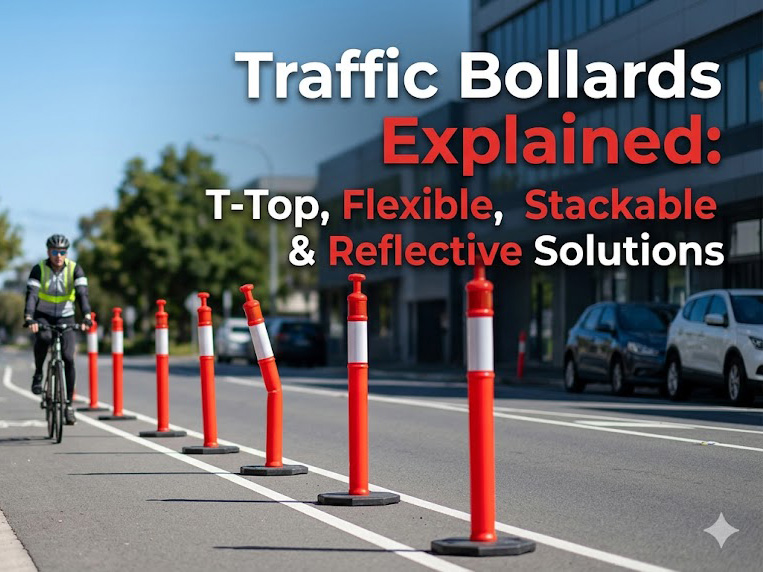
- Bike lane separators and pedestrian buffers
- Warehouse turning radii and forklift corridors
- Loading dock alignment and fuel island guidance
These environments share one trait: vehicles arrive at unpredictable angles, often distracted, and impact is a question of when, not if.
Hybrid Site Planning — Using Both Strategically
Many facilities deploy both. A flexible post array handles everyday traffic guidance, and a single collapsible post controls the emergency access point. Site planners audit each location by asking one question: is this entry accidental or authorized?
Building a Low-Maintenance Bollard Strategy for Your Facility
Procurement decisions improve when teams audit current failure points before specifying replacements. A short, structured review delivers the business case.
A Spec Sheet Checklist Before You Buy
Vet every flexible traffic bollard quote against these criteria:
- Polyurethane grade and UV stabilization certification
- Base mounting compatibility with the existing substrate
- Reflective sheeting grade (engineer grade or diamond grade)
- Height, diameter, and visibility profile
- Impact-cycle warranty terms
How to Audit Your Current Bollard Failure Points
Pull the last 12 months of maintenance tickets. Tag every bollard-related work order. Map them to physical locations to expose chronic impact zones. The resulting heat map sells itself to finance.
Where Self-Recovering Bollards Fit in the Broader Bollard Category
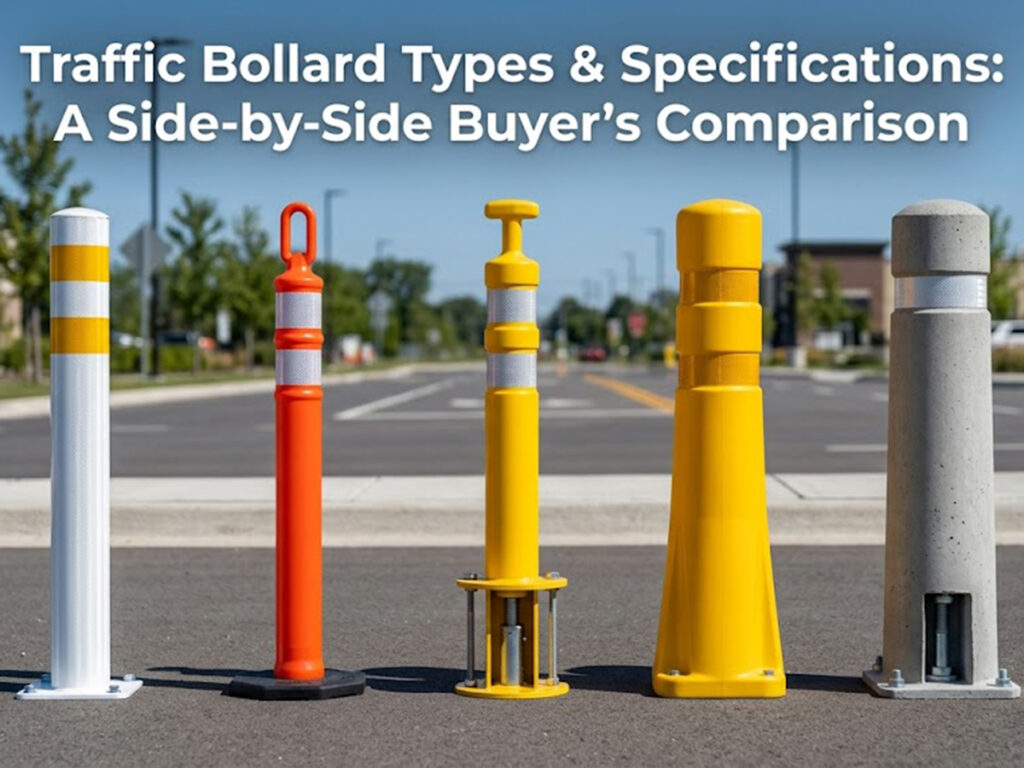
The flexible vs collapsible debate is one slice of a larger procurement landscape that also covers fixed steel, removable, embedded, and security-rated K-rated bollards. Facility teams evaluating multiple categories at once should review the full traffic bollard buyer’s comparison before finalizing any specification.
Facility Manager FAQ — Technical Answers for the Decision-Maker
How long does a flexible polyurethane traffic bollard last under repeated impact?
A quality flexible traffic bollard typically delivers 7 to 10 years of service under high-impact conditions. The UV-stabilized polyurethane resists hundreds of low-speed strikes without structural failure, though reflective sheeting may need a refresh halfway through the lifecycle.
Can a collapsible bollard stop a vehicle if it’s struck while locked upright?
No. Collapsible bollards are not crash-rated impact barriers. Striking one while upright transfers full impact energy to both the vehicle and the anchor point, often damaging both.
What’s the real labor cost difference between flexible and collapsible bollards?
Collapsible bollards require 10 to 15 minutes of staff time per reset event, plus periodic hinge servicing. Flexible posts are effectively maintenance-free after installation, with only visual inspections during routine site walks.
Are flexible bollards suitable for cold-weather climates?
Yes. UV-stabilized polyurethane retains elasticity through freeze-thaw cycles, unlike rigid plastics that grow brittle in the cold or steel collapsibles whose hinges seize after exposure to road salt.
Can flexible self-recovering bollards be installed on existing concrete or asphalt?
Yes. Surface-mount anchor patterns drop onto existing substrates with standard concrete anchors. Asphalt installations use sleeve-mount or epoxy systems that avoid invasive coring.
When should I still choose a collapsible bollard over a flexible one?
Reserve collapsible bollards for authorized-access scenarios such as fire lanes, gated service drives, and event entrances where the padlockable manual fold-down is the primary feature.
References
- U.S. Bureau of Labor Statistics. General Maintenance and Repair Workers, Occupational Outlook Handbook.
- Occupational Safety and Health Administration. Powered Industrial Trucks (Forklifts) — Safety and Health Topics.
- Federal Highway Administration. Manual on Uniform Traffic Control Devices (MUTCD), Chapter 3F — Delineators.
- National Safety Council. NSC Projects 12% Decrease in U.S. Traffic Fatalities in 2025 (February 2026).