Navigating the Patchwork of Global Safety Sign Standards
Workplace safety signage no longer stops at a single border. A multinational manufacturer running plants in Houston, Rotterdam, Manchester, and Perth must satisfy four distinct regulatory regimes — and a single non-compliant sign can void an insurance defense, trigger a regulatory citation, or cost a worker’s life. This is why global safety sign standards have become a board-level compliance concern in 2026.
The stakes are measurable. The U.S. Bureau of Labor Statistics reports that 5,070 American workers died from occupational injuries in 2024 — one death every 104 minutes (Source: https://www.bls.gov/news.release/cfoi.nr0.htm). On the enforcement side, Hazard Communication ranked as the second most cited OSHA standard in fiscal year 2025 with 2,546 violations. Inadequate signage drives a meaningful share of those citations. Maximum OSHA penalties now reach $16,550 per serious violation and $165,514 per willful or repeat violation (Source: https://www.osha.gov/news/newsreleases/osha-trade-release/20250114).
Standardized signage solves three problems at once. It compresses worker reaction time during emergencies. It removes language as a failure mode in multilingual workforces. It builds a documented affirmative defense if regulators or claimants come knocking. Companies that get this wrong face direct exposure — a topic explored in depth in our guide on avoiding legal liability through OSHA-compliant signage.
A Comparative Overview of the Five Major Safety Sign Frameworks
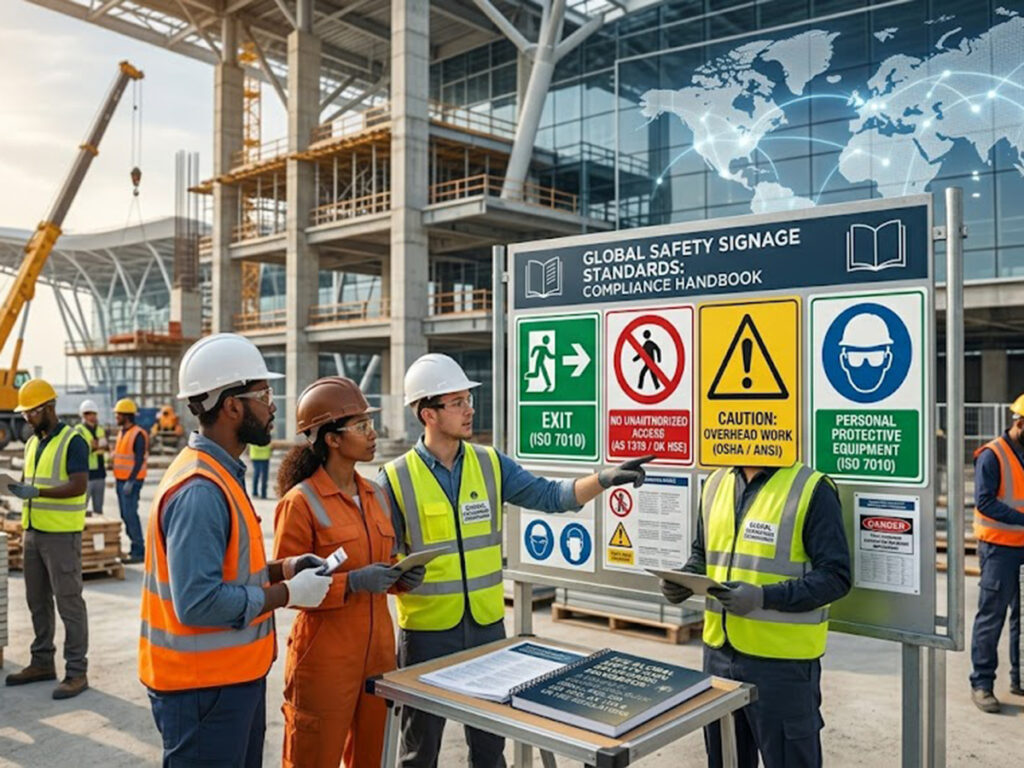
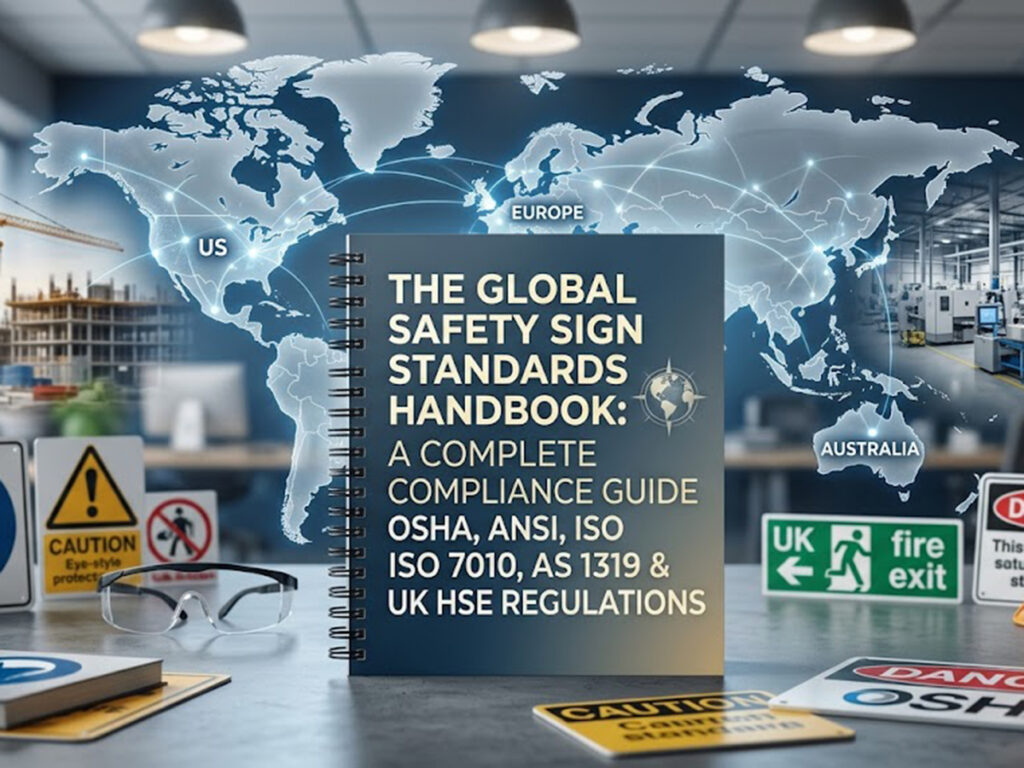
Five frameworks dominate the international landscape: OSHA and ANSI Z535 in the United States, ISO 7010 internationally, the UK HSE Safety Signs and Signals Regulations, and AS 1319 in Australia. The United States stands as the structural outlier — it leads with text and signal words. The rest of the world has converged on pictograms. This single divergence creates most multinational compliance friction. Firms running multi-country projects with inconsistent national standards increasingly standardize on ISO 7010 as a corporate baseline, then overlay jurisdictional requirements.
This handbook gives EHS managers, procurement leads, and compliance officers a working reference covering each framework, the practical differences, and an action plan for global safety sign standards compliance.
United States — OSHA 29 CFR 1910.145 and ANSI Z535 Standards
The U.S. system operates on two interlocking layers within the broader landscape of global safety sign standards. OSHA 29 CFR 1910.145 carries federal legal force. ANSI Z535 is a voluntary consensus standard, but OSHA enforcement increasingly references it as the practical specification.
OSHA 29 CFR 1910.145 — what the regulation actually requires
OSHA’s accident-prevention sign rule defines mandatory signal words, color associations, and tag requirements. It separates “danger,” “caution,” and “safety instruction” signs. The regulation has the force of law. Failure to comply triggers citations under the same penalty schedule as any other OSHA standard.
The ANSI Z535 standards family explained
ANSI Z535 contains six interlocking sub-standards. Z535.1 governs safety colors. Z535.2 covers environmental and facility safety signs. Z535.3 sets criteria for safety symbols. Z535.4 addresses product safety signs and labels. Z535.5 governs safety tags and barricade tapes. Z535.6 covers product safety information in collateral materials.
Dive deeper: Understanding ANSI Z535.2 and OSHA Requirements for Safety Signs
Signal words and the U.S. hazard severity hierarchy
The U.S. approach communicates severity through three primary headers:
- DANGER (white text on safety red) — imminent hazard that will cause death or serious injury
- WARNING (black on safety orange) — potential hazard that could cause death or serious injury
- CAUTION (black on safety yellow) — potential hazard for minor or moderate injury
- NOTICE (white on safety blue) — non-hazard information
ANSI Z535.2 specifies that the header height should occupy 25–33 percent of the total sign height. The viewing distance formula sets the minimum letter height at viewing distance divided by 50. A worker reading from 50 feet needs at least one-inch letters.
ISO 7010 and the Harmonized International Pictogram Library
ISO 7010 inverts the U.S. logic. It starts with pictograms and treats supplementary text as optional. Every registered symbol carries a unique prefix-based code with a precise specification.
Structure of the ISO 7010 codebook
The standard uses five prefixes. W signals warning (W012 = electrical hazard). M signals mandatory action (M004 = wear eye protection). P signals prohibition (P002 = no smoking). E signals emergency or safe condition (E001 = emergency exit left). F signals fire safety equipment (F001 = fire extinguisher). ISO 3864-1 governs shape and color principles. ISO 3864-3 sets design principles for graphical symbols.
Shape and color logic that enables instant recognition
The geometry tells the story before the symbol does:
| Function | Shape | Color |
| Prohibition | Circle with red diagonal bar | Red on white |
| Mandatory action | Solid circle | White on blue |
| Warning | Equilateral triangle | Black on yellow |
| Safe condition / emergency | Square/rectangle | White on green |
| Fire safety | Safe condition/emergency | White on red |
Source: https://www.iso.org/standard/72424.html
Adoption across the EU, UK, Asia, and Latin America
ISO 7010 has been adopted in full across the European Union as EN ISO 7010. The UK, Singapore, Malaysia, the UAE, and much of Latin America follow suit. The U.S. remains the principal holdout. Our analysis of how ISO 7010 unified safety signage across Europe covers the harmonization story in detail. Global safety sign standards continue to converge around the ISO library.
United Kingdom HSE Safety Signs and Signals Regulations
The UK enforces a distinct framework within global safety sign standards that leans on ISO 7010 pictograms but retains national overlays.
The Health and Safety (Safety Signs and Signals) Regulations 1996
The HSE administers the 1996 Regulations under the Health and Safety at Work etc. Act 1974. Employers must provide signs wherever residual risk remains after engineering controls and safe systems of work. The “so far as is reasonably practicable” standard sets the legal duty. Maximum fines under the parent Act are unlimited. A clause-by-clause walkthrough is available in our practical guide to UK signage compliance.
The five sign categories recognized under UK law
UK law recognizes five categories: prohibition (circular, red bar), warning (yellow triangle), mandatory (blue circle), safe condition (green rectangle), and fire equipment (red rectangle). Photoluminescent escape signage must meet BS 5499 and BS EN ISO 7010 luminance requirements.
UK-specific overlays for fire safety and construction
The Regulatory Reform (Fire Safety) Order 2005 lays fire-specific signage rules. The Construction (Design and Management) Regulations 2015 add construction-site requirements. For day-to-day workplace selection, refer to our guide on interpreting safety signs in UK workplaces, which covers practical placement decisions.
AS 1319 Compliance for Australian Workplaces
Australia operates under AS 1319-1994 “Safety signs for the occupational environment,” one of the most distinctive frameworks among global safety sign standards. The standard is voluntary, but the model WHS Regulations adopt it by reference, giving it de facto legal force across most states.
AS 1319 scope and WHS legislation integration
AS 1319 categorizes signs by function. NSW, Queensland, Western Australia, and other jurisdictions incorporate it through their WHS Regulations. Victoria operates under the OHS Act 2004, but applies a parallel substance. Our complete reference guide to AS 1319 covers the technical specifications.
Australian sign categories and the text-with-pictogram approach
AS 1319 takes a belt-and-braces approach. Most categories require text alongside the pictogram:
- Regulatory signs: prohibition, mandatory, limitation/restriction
- Hazard signs: danger (red signal word panel), warning (yellow triangle)
- Emergency information signs: white on green
- Fire signs: white on red
The viewing-distance formula sets the minimum letter height at viewing distance (mm) divided by 250 for non-urgent text and 200 for urgent text. AS 1319 specifies sans-serif fonts, typically Helvetica Medium.
Distinguishing legally enforceable signs from advisory guidance
Not every Australian safety sign carries statutory weight. Some categories function as advisory public guidance only. The distinction matters for liability — explored in detail in our breakdown of which Australian safety signs carry legal weight.
OSHA vs ISO 7010 — Decoding the Key Differences
This comparison drives most cross-border signage decisions. AS 1319 compliance and ANSI Z535 standards reflect two opposing design philosophies.
Text-first vs symbol-first design philosophy
ANSI leads with words. ISO leads with pictograms. ANSI uses signal words to rank severity. ISO ranks function through the shape — a triangle for warning, regardless of severity, a circle for mandatory or prohibited.
Severity ranking and color logic compared
Under ANSI Z535 standards, red signals death or serious injury, orange signals serious potential harm, and yellow signals moderate hazards. Under ISO 7010, red signals prohibition or fire equipment, yellow signals all warnings regardless of severity, and blue signals mandatory action. ISO does not encode severity through color.
Worked example — electrical cabinet in four jurisdictions
The same 480V cabinet generates four different signs:
| Element | OSHA / ANSI Z535 | ISO 7010 | AS 1319 | UK HSE |
| Primary identifier | “DANGER” white on red header | W012 lightning pictogram on yellow triangle | Pictogram + “DANGER” text | W012 pictogram |
| Required text | Full hazard description | Optional | Mandatory descriptive text | Often present |
| Shape | Rectangular two-panel | Equilateral triangle | Triangle with text panel | Triangle |
| Reading distance | ANSI Z535.2 Annex B | ISO 3864 / EN ISO 7010 | AS 1319 Table 2.1 | EN ISO 7010 |
For a focused U.S.–Australia comparison, see our side-by-side analysis of OSHA and AS 1319 standards.
Industry-Specific Workplace Safety Sign Requirements
Different industries layer additional requirements on top of the general global safety sign standards frameworks.
Construction signage under OSHA, CDM, and Australian WHS
Construction sites use barricade tape color codes: red for danger, yellow for caution, magenta for radiation. OSHA 29 CFR 1926 governs U.S. construction. The UK CDM Regulations 2015 add job-site identification requirements. Australian WHS construction regulations follow AS 1319 with state-specific additions.
Chemical and process industries — GHS vs facility signs
The Globally Harmonized System (GHS) governs hazard pictograms on chemical containers. GHS pictograms are diamond-shaped with red borders. ISO 7010 facility signs are triangular wall signs. They are complementary, not interchangeable. The EU CLP Regulation and U.S. HazCom 2012 implement GHS for container labeling.
Healthcare, biohazard, and laboratory signage
ISO 7010 includes the biohazard pictogram W009. U.S. facilities follow Biosafety in Microbiological and Biomedical Laboratories (BMBL) levels. ISO 21482 introduced a supplementary radiation symbol after the Goiânia incident to communicate danger to untrained populations.
Workplace Safety Sign Requirements for Multinational Operations
The practical question for global operators: how do they reconcile four divergent systems without quadrupling procurement costs?
Building a unified corporate signage program
Most multinationals adopt ISO 7010 as the corporate baseline. They then add jurisdictional overlays — ANSI signal-word headers for U.S. sites, AS 1319 supplementary text for Australian sites, and English text for UK sites. This model reduces SKU count, accelerates new-site mobilization, and lowers the risk of error during personnel transfers.
Procurement, supplier qualification, and certification
Procurement teams verify ISO 7010 compliance, ISO 17398 durability ratings, and ISO 9001 quality systems. Third-party certification bodies — TÜV, BSI, SAI Global — issue conformity certificates. Detailed certification requirements appear in our guide to safety sign certification for international project bidding.
Audit-ready documentation and signage registers
A defensible signage register records each sign’s location, ISO or ANSI code, installation date, inspection cycle, and replacement due date. Photographic records support post-incident review. Documentation is the single strongest affirmative defense available after a workplace incident.
The Future of Global Safety Sign Standards
The trajectory points one direction: harmonization. The pace, however, varies.
The convergence toward ISO 7010
Recent ANSI Z535 revisions explicitly accommodate ISO-compatible pictograms alongside U.S. signal-word headers. Multinational corporate policy increasingly drives convergence faster than national regulators do. Full harmonization remains decades away, but the practical baseline has already shifted.
Digital safety signage and IoT-integrated displays
Dynamic LED signs, IoT-connected hazard displays, and AR-based hazard overlays are appearing in advanced facilities. ISO and IEC committees are developing dynamic signage standards. Compliance documentation will need to evolve.
The AS 1319 revision question and Commonwealth alignment
Safe Work Australia is reviewing AS 1319. Industry expects a future revision to align more closely with ISO 7010. A parallel — and instructive — case study in slow international convergence appears in our piece on how traffic safety signs still differ around the world.
Building a Resilient Global Safety Signage Program
Global safety sign standards reward organizations that treat signage as a managed compliance program, not a procurement afterthought.
The five frameworks at a glance
OSHA and ANSI Z535 lead the U.S. with text-first signal words. ISO 7010 leads the international community with pictograms. The UK HSE Regulations 1996 align with ISO 7010 plus national overlays. AS 1319 governs Australia with a mandatory text-plus-pictogram design.
A global safety sign standards compliance action plan
- Audit current signage against all applicable jurisdictional requirements.
- Identify gaps between site-level signage and the applicable standard.
- Adopt ISO 7010 as the corporate baseline.
- Build a procurement chain documenting ISO 17398 durability ratings.
- Schedule quarterly visual inspections and annual formal reviews.
- Maintain a complete signage register with photographic records.
When to escalate to a specialist
Cross-border project mobilization, major facility build-outs, post-incident reviews, and M&A integration of safety programs across geographies all justify specialist input. Effective global safety sign standards compliance protects workers first and corporate balance sheets second.
References
- Occupational Safety and Health Administration. Top 10 Most Frequently Cited Standards for Fiscal Year 2025.
- OSHA. 29 CFR 1910.145 — Specifications for accident prevention signs and tags.
- UK Health and Safety Executive. Safety signs and signals — The Health and Safety (Safety Signs and Signals) Regulations 1996 (L64).
- Standards Australia. AS 1319-1994 Safety signs for the occupational environment.