Introduction: Why Highway Road Signs Are an Infrastructure Asset Class

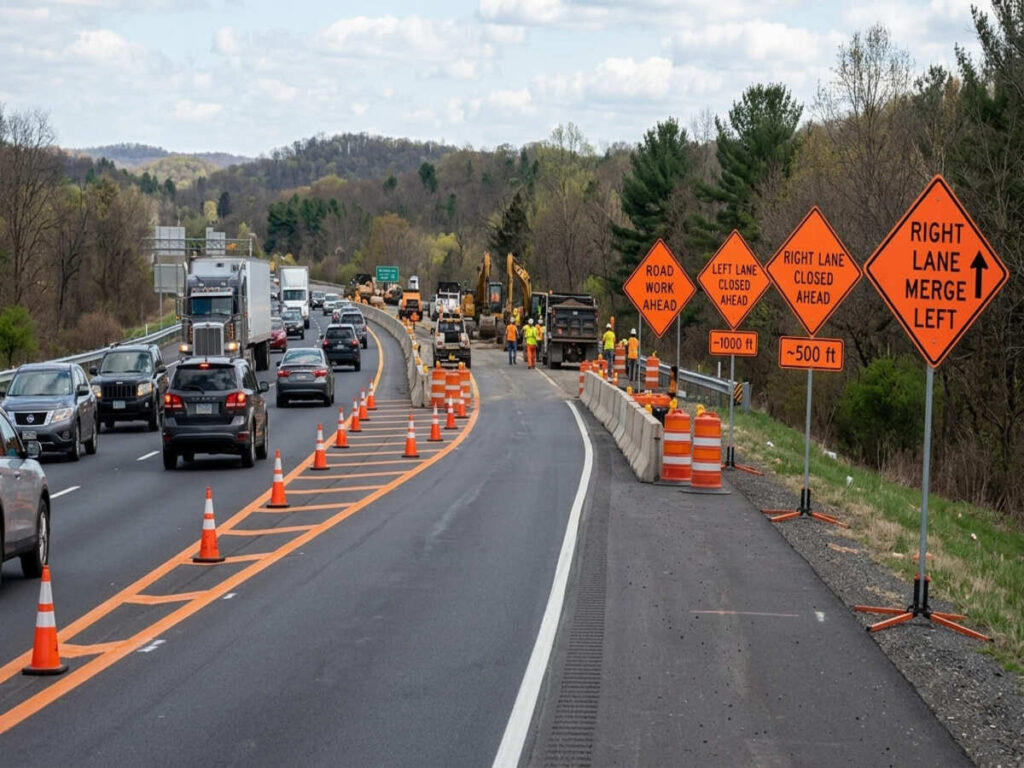
Highway road signs are no longer commodity hardware. They are regulated public assets with measurable service lives, audit obligations, and growing digital responsibilities. The U.S. operates an estimated 60-million-strong inventory of traffic control devices on public roads. Each one carries fiscal, legal, and safety weight.
NHTSA reported 36,640 traffic fatalities in 2025—the second-lowest fatality rate in recorded history at 1.10 deaths per 100 million vehicle miles traveled (Source: https://www.nhtsa.gov/press-releases/traffic-deaths-2025-early-estimates-2024-annual). Roughly half of those fatalities still occur at night, when only a quarter of travel happens (Source: https://highways.dot.gov/safety/other/visibility/nighttime-visibility-overview). That single data point reframes every procurement, specification, and maintenance decision. This handbook consolidates the four lenses every DOT director, traffic engineer, and procurement officer must master in 2026: regulation, fiscal stewardship, digital readiness, and lifecycle governance.
The Regulatory Architecture Governing Highway Road Signs
Highway road signs sit inside a layered legal framework. The Federal Highway Administration (FHWA) sets the national baseline through the Manual on Uniform Traffic Control Devices (MUTCD). State DOTs then adopt, supplement, or modify it. Local agencies inherit these rules. The 11th Edition of the MUTCD became the federal standard on January 18, 2024. States had to adopt or substantially conform by January 18, 2026.
ASTM, AASHTO, and ISO Layers
Material standards add another layer. ASTM D4956 governs retroreflective sheeting classification. AASHTO LRFD-LTS-1 covers structural supports. ISO 14823 defines graphic data dictionaries for machine-readable signage. Engineers must specify all three to avoid compliance gaps.
Regulatory Risk and Tort Exposure
Non-compliance carries direct consequences. Federal-aid project audits can claw back funding. Tort liability exposes agencies to wrongful death claims when failed highway road signs contribute to crashes.
🔗 Deep Dive: The full state-by-state guide to highway marker design and compliance.
Specification Engineering — From Design Intent to Bid Document
Specifications transfer risk. A weak spec sheet shifts liability back to the agency. A strong one defines exactly what compliant highway road signs must deliver across a 10-to-15-year service life.
Performance vs. Prescriptive Specifications
Performance specs define outcomes—minimum retroreflectivity, wind load survival, color stability after UV exposure. Prescriptive specs name the product, sheeting type, and substrate gauge. Performance specs invite innovation. Prescriptive specs simplify enforcement. Engineers should match the approach to project complexity and oversight capacity.
Hidden Cost Drivers in Sign Specifications
Retroreflective Sheeting Class Comparison (ASTM D4956)
| Sheeting Type | Initial Brightness | Typical Service Life | Best Application |
| Type I (Engineer Grade) | Lowest | 5–7 years | Temporary, low-speed |
| Type III (HIP) | Mid-range | 10 years | Urban arterials |
| Type IV (HIP Prismatic) | High | 12 years | Rural highways |
| Type XI (DG3) | Highest | 12–15 years | Interstate, overhead |
Source: https://www.astm.org/d4956-19.html, https://safety.fhwa.dot.gov/roadway_dept/night_visib/policy_guide/fhwasa07020/
🔗Read more: Material trade-offs and manufacturing economics are mapped in Custom Highway Signs: Materials, Costs, and Manufacturing Decoded.
Procurement Strategy — Beyond the Low-Bid Award
Procurement officers face a new reality in 2026. The Build America, Buy America (BABA) Act now governs every federal-aid highway dollar. FHWA terminated its long-standing manufactured products waiver in March 2025. Projects obligated after October 1, 2026 must satisfy the 55% domestic component cost test (FHWA Buy America Update). Domestic sourcing is no longer optional for highway road signs incorporated into federally funded projects.
Cooperative Purchasing Vehicles
Sourcewell, NASPO ValuePoint, and state DOT master agreements multiply procurement efficiency. Mid-sized municipalities access pre-negotiated pricing without launching their own RFPs. These vehicles compress procurement cycles from months to weeks.
Lifecycle-Weighted Bid Evaluation
Smart agencies score bids on more than unit price. Warranty length, sheeting manufacturer certification, delivery reliability, and post-installation support all enter the matrix. A defensible scoring model can save a mid-sized DOT seven-figure sums annually on highway road signs procurement.
Total Cost of Ownership — The Fiscal Truth About Highway Road Signs
Acquisition price tells only one-third of the story. Total Cost of Ownership (TCO) captures the full fiscal footprint of highway road signs across their service life.
TCO = Acquisition + Installation + Inspection + Maintenance + Replacement − Salvage
Engineers normalize TCO over the expected service life. A Type XI sheeting sign delivers 12–15 years. A Type I sign lasts five to seven. The math rarely favors the cheapest option.
Why Cheapest Often Costs the Most
Consider an agency managing 1,000 highway road signs. Option A: $180 unit cost, 7-year life, requires 2.1 cycles over 15 years. Option B: $260 unit cost, 14-year life, requires 1.07 cycles. Option B saves the agency over $150,000 across the inventory once installation labor is included.
Capital vs. Operating Budget Allocation
GASB 34 requires accurate infrastructure asset reporting. Many agencies misclassify sign expenditures as operating costs. This distorts capital planning and weakens grant applications. Procurement officers should align with finance early in the budgeting cycle.
The Digital Transformation of Highway Road Signs
Highway road signs are evolving from passive reflective surfaces into active data nodes. Connected and autonomous vehicles depend on machine-readable signage to navigate. The MUTCD 11th Edition introduced Part 10, which establishes principles for traffic control devices serving both human drivers and automated systems (MUTCD 11th Edition Key Changes).
V2X and Machine-Readable Standards
Vehicle-to-Everything (V2X) communication uses the SAE J2735 message set. Roadside units broadcast Traveler Information Messages (TIM) to nearby vehicles (FHWA V2X Hub Research). ISO 14823 defines the graphic data dictionary that lets autonomous vehicles parse static highway road signs at speed.
Digital Twins and AI Inspection
Agencies are migrating sign inventories from spreadsheets to GIS-integrated digital twins. LiDAR-equipped fleet vehicles now scan retroreflectivity automatically. Computer vision systems flag damaged or missing signs without nighttime crews. This shift cuts inspection costs and improves audit defensibility.
Preparing for CAV-Compatible Corridors
Fourteen states now reference V2X readiness in procurement language. Jurisdictions that lag risk being designated CAV-incompatible by freight operators. Procurement officers should specify ISO 14823 compliance for all new highway road signs on federal-aid corridors.
Sustainability and Long-Term Asset Stewardship
In the modern infrastructure landscape, highway signage is no longer viewed merely as a functional utility but as a critical component of a jurisdiction’s Environmental, Social, and Governance (ESG) framework. Effective asset stewardship requires balancing high-performance safety requirements with the imperative to reduce the carbon intensity of roadside hardware.
The environmental impact of highway signage is primarily concentrated in the upstream production phase. Aluminum substrate manufacturing represents the most significant portion of embodied carbon, followed by the complex chemical composition of high-intensity reflective sheeting—comprising specialized polymers, micro-prismatic optics, and industrial adhesives. To mitigate these impacts, forward-thinking procurement officers are transitioning toward Green Public Procurement (GPP) models, mandating the inclusion of Environmental Product Declarations (EPDs) to quantify the lifecycle global warming potential (GWP) of each sign unit.
Circular Economy & End-of-Life (EoL) Recovery
Transitioning to a circular model is the most effective way to optimize the Total Cost of Ownership (TCO). While aluminum is a “permanent material” with recovery rates exceeding 95% without loss of structural integrity, the technical challenge lies in the efficient separation of retroreflective sheeting and protective overlays.
Agencies can achieve significant “landfill diversion” and recoup salvage value by:
- Integrating Take-Back Clauses: Mandating that vendors manage the decommissioning and recycling of expired assets.
- Chemical vs. Mechanical Stripping: Evaluating advanced recovery techniques that allow aluminum blanks to be refurbished and reused for secondary applications, significantly reducing the demand for virgin material.
ESG Reporting & Federal Infrastructure Mandates
Sustainability is now a matter of regulatory necessity. Under Executive Order 14057, federal agencies are directed to achieve net-zero emissions through strategic procurement and operational efficiency. This mandate trickles down to state and municipal levels via Federal-aid Highway Program requirements.
State Departments of Transportation (DOTs) are increasingly tasked with disclosing Scope 3 emissions—indirect emissions that reside within the supply chain of infrastructure materials. By adopting high-durability, long-lifecycle signage solutions, agencies can demonstrably reduce the frequency of replacement cycles, thereby lowering the cumulative carbon footprint of their transit corridors and aligning with national climate resilience goals.
Jurisdictional Variation — The Global and Domestic Picture
Engineers and infrastructure planners operating on cross-border corridors must navigate a landscape defined by significant regulatory divergence. The global signage architecture is essentially split between two dominant frameworks: the Vienna Convention on Road Signs and Signals, which standardizes iconography across most of Europe, Asia, and Africa, and the Manual on Uniform Traffic Control Devices (MUTCD), which dictates standards across North America and several Oceania regions.
The primary friction point lies in communication philosophy:
- The Vienna Framework: Prioritizes symbolic intuition and pictograms to bypass linguistic barriers in multi-language territories.
- The MUTCD Framework: Relies more heavily on alphanumeric legibility and text-based instruction to ensure specific driver compliance.
USMCA Compliance & Freight Corridor Harmonization
The United States-Mexico-Canada Agreement (USMCA) has intensified the need for signage harmonization to facilitate the seamless movement of goods. Freight movement across these borders often exposes dangerous discrepancies in “Visual Expectancy.”
Mexican carriers, accustomed to the Norma Oficial Mexicana (NOM)—which blends European-style pictograms with local variants—frequently encounter unfamiliar warning patterns and text-heavy regulatory signs at U.S. and Canadian Ports of Entry (POE). This “cognitive load” on long-haul drivers can lead to navigation errors, increased dwell times, and safety incidents at critical logistics hubs.
To bridge this gap, multinational engineering firms and DOTs are increasingly focusing on:
- Bilingual Integration: Implementing dual-language or high-recognition symbolic overlays on primary freight routes.
- Standardized Geometry: Harmonizing the shape and color-coding of warning signs (e.g., the transition from the yellow diamond to high-fluorescent sheeting) to provide a consistent visual “trigger” regardless of the language used.
- Intermodal Synergy: Ensuring that port-of-entry signage aligns with global V2X (Vehicle-to-Everything) standards, allowing on-board telematics to translate physical signage for international drivers in real-time.
The Strategic Roadmap for 2026 and Beyond
A Maturity Model for Sign Programs
Agencies fall along a four-stage maturity ladder: Reactive, Compliant, Optimized, and Connected. Reactive agencies replace signs only after failure. Compliant agencies meet MUTCD minimums. Optimized agencies use TCO modeling. Connected agencies deploy V2X-ready highway road signs.
- Five Questions Every DOT Should Answer in 2026
- Is the sign inventory MUTCD 11th Edition compliant?
- Do specifications reflect TCO or only unit cost?
- Is procurement V2X-ready and BABA-compliant?
- Is the retroreflectivity program audit-defensible?
Has the agency modeled embodied carbon in capital planning?
Continue the Handbook
Each Tier-2 guide in this series solves one operational problem in depth. Engineers should start with materials. Procurement officers should start with the bidding playbook. Executives should start with lifecycle management. The path through this body of work is the path to a defensible, fiscally sound, future-ready highway road signs program.
Related Articles
The Complete Guide to Custom Highway Signs: Materials, Costs, and Manufacturing
Navigating Highway Signage Compliance: A Comprehensive Guide to Federal and State Regulations
The DOT & Municipal Procurement Playbook for Highway Signs: Bidding, Pricing and Cost Control
Global Highway Road Signage Standards: A Regional and Jurisdictional Guide
References
NHTSA. Traffic Deaths 2025 Early Estimates. nhtsa.gov
FHWA. Nighttime Visibility Overview. highways.dot.gov
FHWA MUTCD. Information by State. mutcd.fhwa.dot.gov
NACTO. The 11th Edition of the MUTCD, Two Years Later (2025). nacto.org
FHWA. Buy America Updates Promoting Domestic Manufacturing. highways.dot.gov
FHWA. V2X Hub Research Report (FHWA-HRT-22-047). fhwa.dot.gov
MUTCD.info. MUTCD 11th Edition Key Changes. mutcd.info