For municipal procurement officers, selecting a durable sign for highway applications is no longer a routine task. It is a data-driven engineering decision. This choice directly affects lifecycle costs, maintenance frequency, and safety compliance.
In any comparison of highway sign materials, engineers must evaluate substrate performance under mechanical stress and environmental exposure. The debate of HDPE vs. aluminum highway signs represents a critical decision point for modern infrastructure. While HDPE offers flexibility and corrosion immunity, aluminum highway signs remain the benchmark for structural reliability. This material excels in high-speed transport networks where wind loads are extreme.
Basic procurement guides often provide a broad overview of custom highway signs. However, professional specifications require a deeper look at measurable engineering parameters. This technical analysis focuses on the data procurement officers need for long-term infrastructure planning.
Mechanical Integrity and Substrate Tensile Strength
Aluminum’s Structural Dominance in High-Velocity Zones
In high-speed corridors, substrate tensile strength determines overall performance. Aluminum alloys like 5052-H38 deliver tensile strength between 210 and 290 MPa. This ensures excellent rigidity for metal highway signs.
This high strength-to-weight ratio allows the material to maintain flatness. It effectively resists deformation like “oil-canning.” For a large sign for highway use, rigidity prevents structural fatigue. This is especially vital on gantries where vibration is constant.
Aluminum also offers predictable mechanical behavior. This simplifies engineering calculations for load distribution. Consequently, it remains the standard for aluminum highway signs in regulated systems.
HDPE’s Elasticity and Impact Absorption Limits
HDPE offers high impact resistance and flexibility. However, its lower substrate tensile strength introduces dimensional stability challenges. Unlike metal, polymers often flex under sustained pressure.
Under prolonged stress, HDPE suffers from creep deformation. High temperatures accelerate this warping over a 10-year service life. Such deflection eventually compromises retroreflective angles and safety compliance.
While HDPE works in low-speed zones, it lacks structural rigidity. These limitations restrict its use in demanding aluminum highway sign applications where precision is critical.
Technical Property Comparison
| Property | Aluminum (5052-H38) | HDPE (High-Density) |
| Substrate Tensile Strength | 210 – 290 MPa | 20 – 37 MPa |
| Modulus of Elasticity | ~70 GPa | ~0.8 – 1.5 GPa |
| Thermal Expansion | 23.8 (μm/m·°C) | 110 – 200 (μm/m·°C) |
| Structural Rigidity | Excellent / High | Low / Flexible |
Source: https://www.scribd.com/document/285666029/Aluminum-5052-H38, http://k-mac-plastics.com/data-sheets/hdpe.htm, https://www.makeitfrom.com/compare/5052-H32-Aluminum/High-Density-Polyethylene-HDPE
Wind Load Performance and Structural Stability
Calculating Drag and Flexural Modulus
Wind load performance follows AASHTO LTS-6 standards. These regulations require materials to withstand dynamic pressure and vibration without structural failure. Aluminum highway signs excel here due to their high flexural modulus (E). Rigidity allows for thinner panels, typically 0.080″ to 0.125″. This stiffness minimizes oscillation and reduces stress on mounting hardware. We calculate the wind force (F) using the following formula:
F = P x A x C_d
- P is the dynamic wind pressure.
- A is the surface area of the sign for highway.
- C_d is the drag coefficient (typically 1.2 for flat plates).
Calculation Example:
Consider a 10 m^2 sign facing a 1.5 kPa wind pressure. The total force is 1.5 x 10 x 1.2 = 18 kN. Aluminum’s high modulus ensures the panel deflects less than L/180 of its span. This keeps the sign visible and secure.
HDPE Performance in Gust-Prone Environments
HDPE has a much lower flexural modulus than metal. Consequently, it experiences higher deflection under identical wind loads. To meet AASHTO standards, procurement officers must specify much thicker panels.
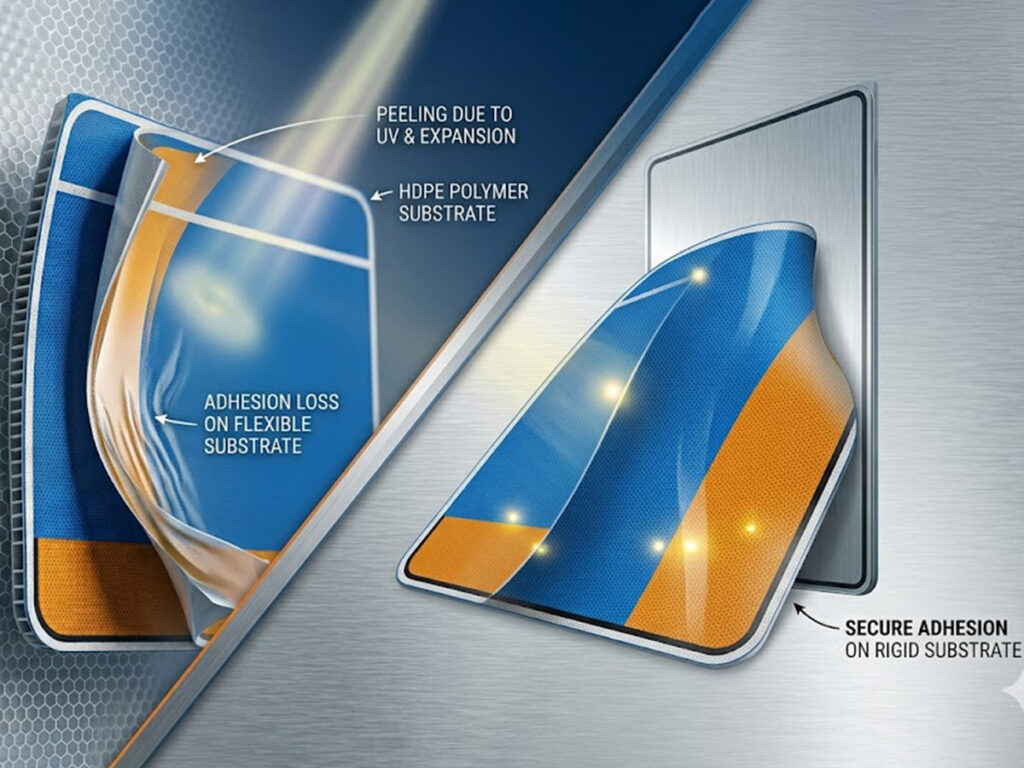
Even with extra thickness, HDPE often suffers from “flutter” in gusty areas. This vibration accelerates material fatigue at the bolt holes. Frequent oscillation also degrades the reflective sheeting bond over time.
In this comparison of highway sign materials, aluminum provides superior stability. It maintains aerodynamic integrity at high elevations. For metal highway signs, the risk of structural failure in storm conditions remains significantly lower.
Environmental Resilience and Corrosion Resistance for Signage
Chemical Passivation of Aluminum Alloys
Aluminum highway signs possess a unique self-healing mechanism. Upon oxygen exposure, the metal forms a dense, microscopic alumina (Al_2O_3) layer. This passive film prevents further oxidation and environmental decay.
In coastal regions, high salinity accelerates the degradation of inferior materials. However, aluminum resists chloride-induced pitting effectively. Procurement officers often specify Alodine (chromate conversion) or anodized finishes for extreme conditions.
These treatments provide exceptional corrosion resistance for signage against winter de-icing agents. Even under constant exposure to magnesium chloride, aluminum maintains its structural integrity. This ensures a service life often exceeding 20 years in harsh climates.
HDPE’s Immunity to Electrochemical Corrosion
As a thermoplastic, HDPE is entirely immune to rust and galvanic corrosion. It does not conduct electricity, which eliminates the risk of electrochemical breakdown. This makes it a theoretical candidate for high-acid industrial zones.
However, HDPE faces a significant threat from ultraviolet (UV) radiation. Even with Hindered Amine Light Stabilizers (HALS), the polymer chains eventually break down. This results in surface “chalking” and a loss of mechanical toughness.
In this comparison of highway sign materials, aluminum offers better optical longevity. Reflective sheeting bonds more securely to stable metal than to expanding plastics. For long-term visibility compliance, aluminum remains the more reliable engineering choice.
| Factor | Aluminum (Coated) | HDPE (Stabilized) |
| Rust/Corrosion | Immune (with Passivation) | Immune (Non-metallic) |
| Salt Spray Resistance | Excellent | Excellent |
| UV Stability | High (Substrate is Inert) | Moderate (Subject to Fading) |
| Chemical Resistance | High (pH 4.5–8.5) | Very High |
| Expected Service Life | 15–25 Years | 5–10 Years |
Life Cycle Assessment: Sustainability and Recyclability
The Closed-Loop Recyclability of Aluminum Signs
Sustainability now drives modern infrastructure procurement. Aluminum highway signs offer a distinct advantage through closed-loop recyclability. This metal remains one of the few materials that retains 100% of its properties after processing.
Recycling aluminum requires only 5% of the energy needed for primary production. This creates a massive reduction in carbon emissions for municipal projects. According to the Aluminum Association, nearly 75% of all aluminum ever produced is still in use today.
The high scrap value of metal highway signs further incentivizes recovery. Unlike plastic, aluminum provides a financial return at the end of its life. This revenue helps offset the initial costs of a durable sign for highway upgrades.
HDPE Post-Consumer Challenges
HDPE is technically recyclable, but highway-grade versions present unique hurdles. These signs contain heavy loads of UV stabilizers and specialized pigments. These additives often contaminate the standard recycling stream.
Consequently, retired HDPE signs rarely become new high-quality signage. Most undergo “downcycling” into lower-value products like park benches. This limits their contribution to a true circular economy.
In this comparison of highway sign materials, aluminum supports “Green Procurement” mandates more effectively. Procurement officers must weigh the lower initial cost of HDPE against the permanent value of aluminum.
| Metric | Aluminum (Infinitely Recyclable) | HDPE (Downcyclable) |
| Recycling Energy Savings | 95% vs. Primary Production | ~10-15% vs. Virgin Resin |
| Scrap Market Value | High ($1.00 – $1.50/lb avg.) | Low to Variable |
| Recycling Purity | High (Closed-Loop) | Moderate (Additive Contamination) |
| U.S. Recycling Rate | ~35-40% (Infrastructure avg.) | ~10% (Complex Polymers) |
Source: https://www.epa.gov/facts-and-figures-about-materials-waste-and-recycling/aluminum-material-specific-data, https://www.aluminum.org/Recycling
Final Engineering Verdict for Municipal Infrastructure
Summary of Technical Trade-offs
The rigorous evaluation of HDPE vs. aluminum highway signs reveals distinct performance envelopes. Engineers must prioritize the mechanical requirements of the specific roadway.
Aluminum highway signs deliver superior tensile strength and structural stability. They maintain critical retroreflective angles under high wind loads. Conversely, HDPE offers niche benefits in impact resistance and electrochemical immunity.
For the majority of high-speed corridors, aluminum remains the undisputed industry standard. It consistently meets the stringent safety and durability specifications required by modern transport departments.
Data-Driven Procurement Recommendations
Selecting a durable sign for highway applications requires a risk-based approach. Procurement officers should apply the following criteria to optimize infrastructure investment:
- High-Speed Arterial Roads: Specify aluminum (0.100″ to 0.125″ gauge). This ensures compliance with AASHTO wind-load standards and long-term structural integrity.
- Coastal or Salt-Belt Regions: Utilize treated aluminum highway signs. Anodized or Alodine-coated metal provides the highest resistance to atmospheric salinity and de-icing chemicals.
- Secondary or Residential Zones: Consider HDPE for low-traffic environments. It serves as a cost-effective alternative where wind speeds and structural fatigue risks remain minimal.
- Sustainability Mandates: Prioritize metal highway signs for high-recovery projects. Aluminum’s high scrap value and closed-loop recyclability support aggressive green procurement goals.
Frequently Asked Questions Regarding Highway Signage Substrates
Why are aluminum highway signs preferred over HDPE for high-speed corridors?
In high-velocity zones, aluminum highway signs provide the necessary substrate tensile strength to resist permanent deformation. Aluminum alloys like 5052-H38 maintain structural flatness under extreme wind pressure. In contrast, HDPE often suffers from flexural fatigue and “flutter,” which can dislodge mounting hardware or degrade reflective sheeting performance over time.
How does corrosion resistance for signage differ between these two materials?
While HDPE is naturally immune to electrochemical rust, metal highway signs made of aluminum utilize a self-passivating oxide layer. For extreme environments, such as coastal roads or salt-treated winter routes, aluminum treated with Alodine or anodized coatings provides superior protection against chloride pitting. This ensures the sign remains structurally sound for 20+ years, outlasting the UV-lifecycle of most polymers.
Can a durable sign for highway use be recycled at the end of its life?
Yes, but the efficiency varies significantly. Aluminum is a “closed-loop” material, meaning it can be recycled indefinitely without losing its mechanical properties. It also maintains a high scrap value, which helps offset municipal replacement costs. While HDPE is recyclable, highway-grade versions often contain UV-stabilizers and additives that complicate the process, usually resulting in “downcycling” rather than new signage production.
What impact does temperature have on the comparison of highway sign materials?
Thermal stability is a critical engineering factor. HDPE has a high coefficient of thermal expansion, meaning it expands and contracts significantly more than metal. In high-heat regions, this can lead to “warping” or “oil-canning” in plastic signs. Aluminum remains dimensionally stable across a wide temperature range, ensuring that the sign face stays flat and the retroreflective angles remain compliant with safety standards.
How do wind load performance requirements influence substrate thickness?
According to AASHTO LTS-6 standards, a sign for highway use must withstand specific dynamic pressures. Because aluminum has a high flexural modulus, engineers can use thinner gauges (0.080″ to 0.125″) to achieve the required rigidity. To match this performance, an HDPE sign would require a much thicker profile or heavy-duty steel reinforcement, often negating its initial weight and cost advantages.
Related articles in this series
Mastering the Bid: How DOT Agencies Procure Bulk Highway Signs
How to Specify Highway Sign Materials for Extreme Sub-Zero Climates
2026 Pricing Guide: Calculating Total Cost of Ownership for Highway Signs
Designing Highway Signs for ADAS and Autonomous Vehicle Recognition
A State-by-State Guide to Highway Marker Design and Compliance
Back to Pillar: The Complete Guide to Custom Highway Signs: Materials, Costs, and Manufacturing
References:
- AASHTO — LTS-6: Standard Specifications for Structural Supports for Highway Signs, Luminaires, and Traffic Signals (Wind load and flexural modulus requirements): https://store.transportation.org/Item/PublicationDetail?ID=4655&srsltid
- ASTM International — ASTM B209/B209M: Standard Specification for Aluminum and Aluminum-Alloy Sheet and Plate (Tensile strength and chemical composition for 5052-H38 alloys): https://www.astm.org/b0209_b0209m-21.html
- EPA — Sustainable Materials Management (SMM) Data: Aluminum Material-Specific Data (LCA and closed-loop recyclability metrics for infrastructure metals): https://www.epa.gov/facts-and-figures-about-materials-waste-and-recycling/aluminum-material-specific-data