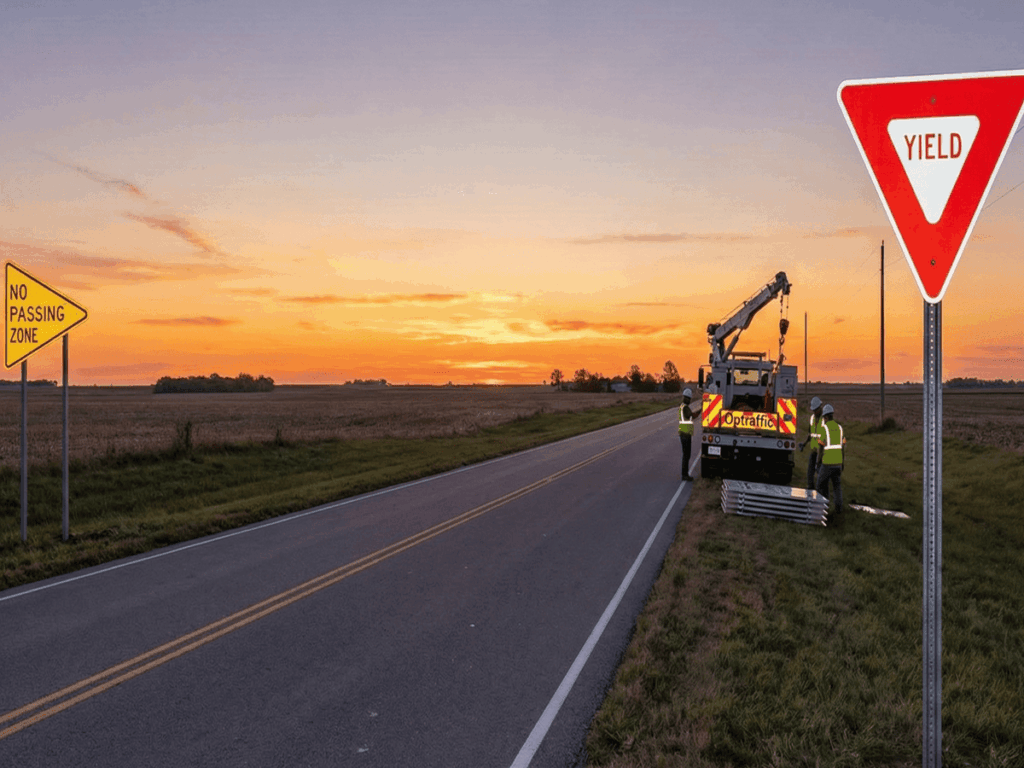
Solar-powered traffic signs solve one recurring field problem: reliable power at the point of need. They reduce trenching, speed deployment, and support higher-conspicuity devices where grid power is impractical.
Elon Musk’s most recent public framing of the energy problem is directly relevant to this product category. In a January 6, 2026 interview, he described the core value of batteries as “buffering” energy—charging when power is available and discharging later—to increase usable throughput without adding new generation. He also noted that solar at scale requires surface area beyond rooftops. Translated to roadside applications, these principles are straightforward: panel placement determines energy capture, while storage sizing determines whether that energy can be reliably delivered through nights, storms, and winter conditions.
In practice, teams specifying off-grid traffic equipment—such as OPTRAFFIC variable message signs—treat panel exposure and battery buffering as first-order design constraints, because uptime is a safety requirement, not a convenience.
This guide is written for procurement teams, engineers, and contractors who need a specification-driven path to selecting solar-powered traffic signs that perform consistently on streets and highways. If your scope also includes standard road signs for the same corridors, OPTRAFFIC can supply those as well.
Quick decision summary for buyers
Procurement teams often need a fast way to align the device type with the “must-not-fail” requirements. The table below gives a starting point for streets and highways.
| Use case | Typical device | What usually breaks first | What to specify first |
|---|---|---|---|
| High-speed curves, ramps, lane shifts | solar flashing beacons / solar-powered flashing warning signs | undersized battery for winter nights | Wh/day load, winter-month sizing, autonomy days |
| School approaches | solar-powered school zone signs | schedule drift, vandal damage, battery aging | schedule control, enclosure security, service plan |
| Mid-block crossings | solar-powered pedestrian crossing signs / RRFB solar systems | high activation counts, dimming/flash compliance | activation profile, IA-21 documentation, autonomy |
| Speed compliance corridors | solar-powered speed limit signs / solar radar speed feedback signs (solar powered) | display load exceeds solar yield | load modes, controller logging, battery chemistry |
| Remote/rural corridors | mixed | long response time for repairs | autonomy + remote monitoring (optional) |
A consistent pattern appears across categories: buyers get better outcomes when they treat the system as an energy budget (Wh/day) plus a winter sizing problem—not as a panel-wattage shopping exercise.
What counts as solar-powered traffic signs
The term “solar-powered traffic signs” covers multiple device families with very different energy loads. Buyers get better results when they specify the device class first.
Solar-powered flashing warning signs and solar flashing beacons
These include curve warnings, stop-ahead, lane reduction, and other warning signs paired with external beacons or LED-enhanced sign faces.
Typical procurement focus: flash pattern, duty cycle, autonomy days, and conspicuity.
Solar-powered school zone signs
Common configurations include time-based flashing beacons, speed feedback displays, and school crossing assemblies.
Typical procurement focus: schedule control, winter performance, vandal resistance, and maintenance access.
Solar-powered pedestrian crossing signs and RRFB solar systems
RRFB-based systems and other high-attention crossing treatments have higher activation loads and stricter deployment expectations.
Typical procurement focus: compliance documentation, activation method, and battery sizing for high trigger counts.
Solar-powered speed limit signs and solar radar speed feedback signs
This category includes static speed limit signs with lighting or LED enhancement and radar speed feedback displays that draw more power.
Typical procurement focus: display readability, power budget, and controller logging.
Solar-powered parking signs and solar illuminated regulatory signs
This includes parking-control signs with lighting, time-of-day visibility requirements, and locations where trenching is not cost-effective.
Typical procurement focus: illumination uniformity, tamper resistance, and battery replacement strategy.
Compliance context buyers should build into the spec
Compliance requirements do not disappear because power is solar. In many cases, solar power increases scrutiny because it enables flashing and illumination behaviors that must be consistent and predictable.
MUTCD adoption timing affects bid specs
FHWA’s MUTCD site documents that the Final Rule adopting the 11th Edition was published December 19, 2023 with an effective date of January 18, 2024, and that states have a two-year period from the effective date to adopt the National MUTCD or a substantially conforming state manual—placing the deadline at January 18, 2026.
That timeline matters because device types, flashing practices, and documentation packages are often aligned to the current MUTCD baseline used by an agency. A procurement that is silent on MUTCD edition context invites inconsistent submittals.
RRFB deployments must follow FHWA Interim Approval conditions
FHWA issued Interim Approval for RRFBs under IA-21 and provides the official conditions and usage expectations on its MUTCD resource pages.
Practical impact: buyers should require (1) a compliance statement mapped to IA-21 conditions, and (2) commissioning tests that validate flash operation, activation logic, and any required inventory or documentation steps.
Define operational requirements before comparing products
Most field failures trace back to underspecified duty cycles and unrealistic autonomy expectations.
Duty cycle and trigger profile
A good RFQ describes:
- Operating mode: 24/7, dusk-to-dawn, scheduled windows, or event-triggered
- Flash behavior: pattern and rate (as applicable)
- Activation method: pushbutton, passive detection, radar trigger, always-on schedule
- Expected activations per day (for crossing systems and feedback signs)
Autonomy requirement (days without usable sun)
Autonomy should be explicit, such as:
- Minimum 3–5 days for low-risk, easily serviced sites
- Minimum 7–10 days for remote corridors, winter-shaded sites, or high-consequence locations
Site constraints that affect solar yield
Buyers should require a brief site assessment covering:
- Shade and horizon obstructions
- Snow accumulation risk and panel angle
- Vandalism exposure
- Wind loading and mount type
Solar sizing that procurement teams can defend
Solar-powered traffic signs succeed when generation and storage match the real load. Buyers do not need to run a full simulation, but they should require a documented energy model.
Build the energy budget in Wh/day
Vendors should submit:
- Average and peak power (W) by mode
- Total daily energy use (Wh/day) under the configured schedule
- Temperature derating assumptions for the battery
Use a recognized method for solar production assumptions
NREL’s PVWatts is widely used to estimate PV energy production and references multi-decade historical weather data in its methodology and outputs.
Procurement requirement that works: the vendor must provide a winter-month worst-case estimate with location assumptions, tilt/orientation, and shading assumptions disclosed.
Translate Musk’s “buffer” concept into a roadside spec
Musk’s January 2026 “buffer the energy” framing is a useful procurement shortcut: the battery exists to preserve service when generation drops. That maps to a clear requirement: minimum autonomy days at end-of-life battery capacity and winter solar conditions.
Battery, controller, and safety standards buyers should call out
Solar traffic sign battery selection: LiFePO4 vs AGM
For many modern roadside systems, LiFePO4 (LFP) is selected for cycle life and stability. The correct choice still depends on temperature range, enclosure design, and service model.
Spec language to include:
- Battery chemistry and usable capacity (Wh), not only nameplate Ah
- Depth-of-discharge limits used for sizing
- End-of-life assumption (for example, 80% remaining usable capacity)
- Low-temperature charging behavior and protections
Controller requirements that reduce failures
A strong controller specification includes:
- Charging method (often MPPT on higher-load systems)
- Programmable schedules and dimming logic
- Fault logging (voltage, current, temperature, events)
- Low-voltage disconnect and recovery behavior
Safety standards: specify what “listed” means in submissions
UL describes UL 9540 as a basis for safety of energy storage systems and references component standards such as UL 1973 for stationary battery systems.
Procurement implication: buyers should require documentation that the battery system and integrated power package meet applicable safety expectations for the product class, installation environment, and local code requirements.
Durability and enclosure performance that predicts field life
IP ratings and roadside exposure
IP ratings provide a standardized way to describe resistance to dust and liquid intrusion. IEC explains that IEC 60529 rates enclosure resistance against dust and liquids. In procurement specs, IP65 is one of the most frequently requested targets—yet it is often misunderstood in ways that lead to incorrect expectations in the field. For a practical breakdown, refer to Common Misconceptions About IP65: What You Need to Know.
Practical spec choices (examples):
- Controller/battery enclosure: minimum IP rating appropriate to the environment
- Cable glands: strain relief and sealing requirements
- Corrosion resistance: coated hardware, stainless fasteners where appropriate
Wind loading and mounting (streets vs highways)
High-speed corridors and exposed areas drive mount requirements:
- Wind-rated mounts and torque specs
- Anti-theft fasteners and tamper-resistant enclosures
- Vibration tolerance (especially for cantilever or mast-arm installs)
Serviceability and parts standardization
Buyers should prefer designs that simplify maintenance:
- Modular battery packs
- Standard connectors
- Tool-access panels that do not compromise sealing
Optical performance and driver comprehension
Solar power enables illumination and flashing, but it does not guarantee comprehension.
Conspicuity requirements
Buyers should require:
- Day/night dimming behavior (photocell or schedule)
- Viewing angle expectations for the roadway geometry
- Confirmation that the sign face and beacon combination does not create “visual clutter”
Avoid over-complex flash behavior
On complex approaches, too many flashing devices reduce clarity. A better approach uses:
- One primary attention device per decision point
- Clear spacing and consistent application across a corridor
Buying specifications by application
Buying specifications vary by roadway context. The sections below group common solar-powered traffic sign deployments by application—so engineering, procurement, and field teams can match performance requirements to real operating conditions, from intersection control to high-speed approaches and vulnerable road user zones.
For teams evaluating where these systems deliver the most measurable safety value, the companion guide Solar-Powered Road Sign Applications That Actually Reduce Risk provides a risk-based view of deployment scenarios and how to prioritize them.
Streets: intersections, arterials, and local road networks
Best-fit solar-powered traffic signs:
- Solar-powered flashing warning signs for curves and stop-ahead
- Solar illuminated regulatory signs where grid power is expensive
Priority specs: vandal resistance, clean scheduling, and easy maintenance.
Highways: rural corridors and high-speed approaches
Best-fit solar-powered traffic signs:
- Solar flashing beacons on curves, ramps, and lane transitions
- Solar-powered speed limit signs and speed feedback displays on approaches
Priority specs: autonomy, structural robustness, and remote fault reporting.
School environments
Best-fit solar-powered school zone signs:
- Time-based beacons and speed feedback displays
Priority specs: schedule control, winter performance, and rapid repair process.
Pedestrian crossings
Best-fit solar-powered pedestrian crossing signs:
- RRFB solar systems (where used) and other compliant crossing enhancements
Priority specs: IA-21 documentation and activation-based battery sizing.
Solar-powered traffic signs cost and total cost of ownership
Sticker price rarely reflects field economics.
What drives total cost
A practical TCO model includes:
- Hardware and mounting/foundation
- Installation labor and traffic control
- Avoided trenching and utility coordination
- Battery replacement cycle over service life
- Inspection and cleaning intervals
- Failure response cost (truck rolls)
Common cost trade-offs
- Higher-capacity batteries often reduce service calls.
- Better controllers reduce premature battery damage.
- Remote monitoring can pay back quickly on remote corridors.
Copy/paste RFQ and RFP checklist
Procurement teams can insert the following as submission requirements.
Required technical submittals
- Device category and configuration description
- Energy budget (Wh/day) by operating mode
- Winter-month solar production assumptions (tilt/orientation/shade disclosed) with methodology
- Autonomy calculation (days) using end-of-life battery capacity assumptions
- Battery specification in usable Wh and chemistry
- Safety documentation aligned to applicable UL expectations (system and battery components where relevant)
- Enclosure IP rating documentation (IEC 60529 reference)
- Installation manual (mounting, torque, wiring, grounding)
- Warranty terms separated for panel, controller, LEDs, and battery
Field acceptance tests
- Functional test for schedule/trigger behavior
- Day/night dimming verification
- Flash pattern verification (where applicable)
- Runtime verification against configured duty cycle
- Fault simulation test (low voltage, disconnect/recovery)
Frequent buying mistakes to avoid
Undersizing for winter and shade
A solar-powered traffic sign that works in July can fail in January. Short daylight hours, low sun angle, snow cover, and frequent overcast reduce charging—especially on tree-lined streets, north-facing curves, and sites with partial-day shade. A typical outcome is a beacon that flashes normally in summer, then starts brownouts or nighttime shutdowns in winter.
What to require: a winter-month sizing disclosure (assumptions, minimum daily input, and autonomy under low-irradiance conditions).
Specifying “panel watts” without Wh/day
Panel wattage is not the same as usable energy delivered. Tilt angle, shading, latitude, temperature, and controller efficiency can turn a “high-watt” panel into low real-world output. Buyers who compare only panel watts often end up with systems that never reach full charge during cloudy stretches.
What to require: documented Wh/day assumptions plus stated autonomy (days of operation with limited/no charging).
Ignoring battery end-of-life assumptions
Batteries degrade over time, and performance can drop materially before replacement is scheduled—especially with heat, cold, or deep cycling. In the field this shows up as intermittent resets, reduced flash intensity, or early shutoffs after a few years.
What to require: performance requirements at end-of-life capacity (e.g., 70–80% of nominal) and a clear replacement interval.
Weak enclosure and mounting requirements
Power design fails quickly if the enclosure leaks or the mount loosens. Water intrusion, corrosion, wind loading, vibration, and freeze–thaw cycles can defeat an otherwise compliant solar system. A common example is a panel that slowly shifts out of optimal angle or a battery box that takes on moisture and accelerates failure.
What to require: defined sealing/integrity expectations, corrosion-resistant hardware, and mounting rated for site wind and vibration exposure.
Solar-powered traffic signs perform reliably when procurement treats them as engineered energy systems, not bolt-on accessories. A dependable specification begins with a defined duty cycle and activation profile, then ties Wh/day load, winter-month solar assumptions, and end-of-life battery autonomy to the site’s shade, weather, and maintenance realities. That approach turns runtime claims into auditable submittals rather than marketing language.
The most durable programs also demand complete documentation and repeatable commissioning: controller protections, enclosure ratings, acceptance tests, and a maintenance plan that matches field access constraints. When buyers adopt the “solar + storage buffering” lens emphasized in Musk’s recent remarks—collection area and siting plus storage sized for continuity—they reduce outages, limit truck rolls, and protect compliance outcomes on both streets and highways.
FAQ
How long should a solar traffic sign battery last?
Battery life depends on chemistry, depth of discharge, temperature, and cycling. Procurement should specify usable capacity at end-of-life and require controller protections that prevent deep discharge.
Are solar-powered traffic signs “set and forget”?
They are not. Buyers should plan periodic cleaning, fastener checks, and battery health checks.
What is the most defensible way to size a solar-powered traffic sign?
A documented Wh/day budget plus a winter-month solar production estimate using a recognized method such as PVWatts, combined with an explicit autonomy requirement.
Do RRFB solar systems require special compliance steps?
FHWA publishes Interim Approval conditions for RRFBs (IA-21). Buyers should require documented compliance mapping and acceptance tests aligned to those conditions.
Can OPTRAFFIC supply more than standard road signs?
Yes. In addition to manufacturing standard regulatory and warning road signs, OPTRAFFIC also provides solar-powered traffic safety equipment for off-grid and rapid-deployment projects—particularly solar-powered VMS (portable traffic message signs) and solar lighting towers. These product lines are manufactured under an ISO 9001 quality system, with commonly requested compliance documentation such as CE and RoHS, and (by model) IP-rated enclosure protection; OPTRAFFIC VMS offerings are also positioned for work-zone use with NTCIP compatibility and MUTCD alignment. OPTRAFFIC solutions are supplied globally, including deliveries to 50+ countries and support for major international events and large infrastructure programs.