Introduction: The Liability of Blocking Pedestrians
Closing a sidewalk is legally more dangerous than closing a road. When you block a vehicle, the driver just hits the brakes. When you block a pedestrian—especially one with a visual or mobility impairment—you create an immediate lawsuit risk.
You cannot just string up yellow caution tape. The Americans with Disabilities Act (ADA) mandates a specific set of construction traffic signs designed for “accessibility.” You must provide a safe, detectable path for everyone.
This means every Sidewalk Closed sign must be paired with an audible and tactile barrier. If a blind person’s cane cannot detect your barricade, your setup is non-compliant.
Vehicle vs. Pedestrian Spacing: Pedestrian zones require short, immediate spacing. However, if your project also impacts the adjacent road, you must follow the stricter spacing rules for vehicles. Review our The Essential Guide to Construction Road Signs Placement & MUTCD Spacing to coordinate both zones.
Advance Warning: The Sidewalk Closed Ahead Sign
Pedestrians hate backtracking. If a person in a wheelchair travels 300 feet down a block only to find a “Dead End,” they may be forced to enter the active roadway to get around it. This is a fatal safety failure.
You must place the Sidewalk Closed Ahead sign (W21-5 series) at the nearest safe intersection, not just at the closure point.
Intersection Logic (Crosswalk Closed Sign)
You must divert pedestrians before they commit to the block.
- The Decision Point: Place a Sidewalk Closed Ahead sign at the corner before the pedestrian crosses the street.
- The Action: Pair this with a Crosswalk Closed sign (R9-3a) if the crossing itself is blocked.
- The Goal: Force the pedestrian to cross to the safe side of the street early, while they still have a protected crosswalk.
Sign Placement Height
Unlike highway construction traffic signs, pedestrian signs operate at eye level.
- Mounting: Mount signs 7 feet from the ground to the bottom of the sign.
- Safety: This height ensures the sign does not become a head-injury hazard for distracted walkers or visually impaired persons.
The Hard Closure: ADA Compliant Barricades & Signs
You cannot simply block a walkway with cones or yellow caution tape. According to the Americans with Disabilities Act (ADA), a closure must be “detectable” by a person with a visual impairment using a white cane.
If a blind pedestrian’s cane sweeps under your road barrier (like a road cone or tape), they will walk directly into the hazard. This is a violation of federal law.
The “Continuous Bottom Edge” Rule (MUTCD 6F.63)
To fully close a sidewalk, you must use an ADA-compliant barricade. The MUTCD Section 6F.63 mandates specific geometry to ensure cane detection:
- Bottom Rail: The barricade must have a solid, continuous bottom rail. Its bottom edge must be no higher than 2 inches above the ground. This ensures the cane hits the wall, not the air.
- Top Rail: The top surface must be at least 32 inches high to serve as a hand-trailing guide.
- Stability: The wall must be firm enough that a person can lean on it without it falling over.
Selecting the correct hardware is critical here. For a deeper comparison of equipment classes, review our guide on Traffic Barricades for Sale: Which Type Is Best for Road Closures. Note that while Type I and II barricades are standard for highway lane closures, most do not meet the specific ‘cane detectability’ standard required for sidewalk closures.
Placement of the Sidewalk Closed Sign (R9-9)
The physical traffic barrier stops the body; the sign informs the mind.
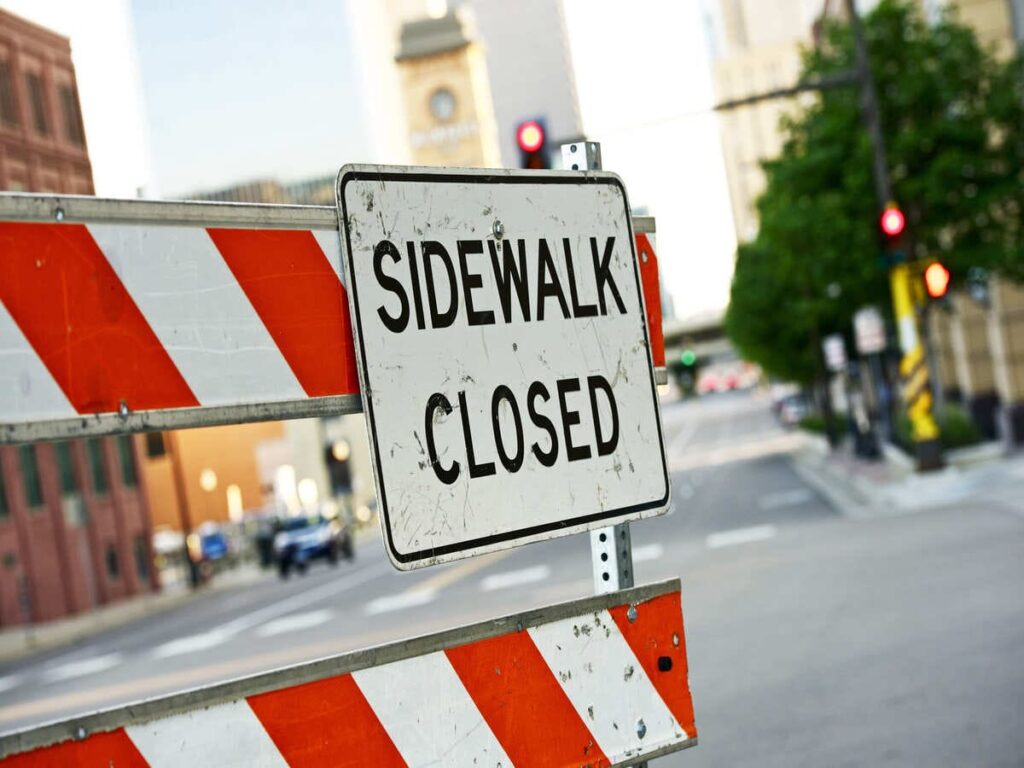
- The Sign: Mount the Sidewalk Closed sign (R9-9) directly on the barricade, facing the pedestrian flow.
- The Instruction: If the detour requires crossing the street, use the specific Sidewalk Closed Use Other Side sign (R9-10) or Cross Here sign (R9-11).
- Visibility: Unlike highway construction traffic signs, these must be retroreflective and high-contrast (Black on White regulatory style) to command immediate compliance.
Warning: Never use “Caution Tape” alone. Tape is not a barricade. It provides zero physical protection and is invisible to a white cane.
The Detour Path: Creating a Safe Passage (PROWAG)
Once you block the sidewalk, you must provide an alternate route. This “Pedestrian Detour” must meet the strict standards of PROWAG (Public Rights-of-Way Accessibility Guidelines).
You cannot force a wheelchair user onto grass, gravel, or a muddy shoulder.
Surface Requirements
The detour path must be:
- Firm: It does not deform under the weight of a wheelchair.
- Stable: It does not slip or move.
- Slip-Resistant: It provides traction even when wet.
Minimum Width (48 Inches)
The continuous clear width of the detour must be at least 48 inches (4 feet).
- Turning Space: If the detour requires a U-turn or a sharp corner, you must provide a 60-inch x 60-inch passing space.
- Grade: The cross-slope (tilt) of the temporary path cannot exceed 2%. Anything steeper creates a tipping hazard for wheelchairs.
Route Guidance: Pedestrian Detour Sign (M4-9a)
Just like vehicles, pedestrians need reassurance.
- Sign: Use the Pedestrian Detour sign (M4-9a) at every turn.
- Continuity: Place a confirmation sign every 100 feet if the detour is long or complex. If a pedestrian gets lost, they will instinctively walk into the road to find their bearings.
Just like vehicles, pedestrians need reassurance. The principles of ‘Positive Guidance’ here are identical to those detailed in our Road Closed Guide: Construction Detour Signs & Barricade Setup. However, unlike high-speed road detours that use large signs spaced 500 feet apart, pedestrian paths require smaller signs spaced every few yards to prevent confusion.
Beyond Signs: Audible Devices & Temporary Ramps
Visual signs are useless to a blind pedestrian. Under the MUTCD 11th Edition (2023), visual-only signage is no longer sufficient for complex closures.
Audible Information Devices (AID)
- The Mandate (MUTCD 6P-29): When you use a “SIDEWALK CLOSED CROSS HERE” sign (R9-11a), federal standards state you shall include an audible information device.
- Why? A blind pedestrian cannot see the arrow pointing to the other side of the street. Without a voice message, they may assume the path is open or get trapped at the curb.
- The Tech: These are motion-activated speakers mounted on the barricade that broadcast a custom message: “Sidewalk Closed. Cross here for detour.”
Temporary Curb Ramps (The 1:12 Rule)
If your detour forces pedestrians off the curb and into the street (diversion), you cannot expect a wheelchair user to “jump” the curb.
- The Hardware: You must install a Temporary Curb Ramp.
- The Slope: The ramp must have a slope ratio of 1:12 (1 inch of rise for every 12 inches of run).
- The Edge: It must have raised sides (edge protection) to prevent a wheelchair wheel from slipping off.
Conclusion: Compliance is Your Best Insurance
In urban construction, a Sidewalk Closed sign is not just a traffic tool; it is a legal shield. The ADA does not accept “we didn’t know” as a defense. If a blind pedestrian is injured because your barricade lacked a bottom rail, the liability falls on your site management.
Optraffic manufactures the full range of MUTCD-compliant pedestrian control signs. Do not risk your project’s timeline on non-compliant gear.
FAQ: Sidewalk Closure Rules
Location is key.
Sidewalk Closed (R9-9): Placed on the sidewalk to stop pedestrians from walking down the block.
Crosswalk Closed (R9-3a): Placed at the curb to stop pedestrians from entering a specific intersection crossing.
Yes, in specific cases. Under the MUTCD 11th Edition, if your setup requires pedestrians to cross the street (using a “Cross Here” sign), an Audible Information Device (AID) is mandatory (“Shall”) to guide visually impaired users.
7 feet. To prevent injury to pedestrians who might walk into the sign, the bottom edge of the sign must be at least 7 feet above the walking surface.