
Sinais de diamante da NFPA forneça detalhes claros sobre os perigos que ajudem as pessoas a agir rapidamente em emergências. Em um hotel, trabalhadores e equipes de emergência veem esses sinais e sabem rapidamente se algo pode pegar fogo ou é venenoso. O nfpa 704 diamante torna fatos químicos difíceis simples de ler, para que os ajudantes não percam tempo adivinhando. Esta verificação rápida de perigos mantém os trabalhadores e as equipes de emergência seguros.
Para sinalização de segurança de alta qualidade que forneça, informações confiáveis em qualquer ambiente, OPTRÁFEGO oferece uma gama de durabilidade, sinais resistentes às intempéries projetados para manter os trabalhadores, visitantes, e equipes de emergência informadas e seguras. Se você precisa Sinais da NFPA, avisos de canteiro de obras, ou sinais de controle de trânsito, As soluções da OPTRAFFIC são construídas para segurança e facilidade de uso.
Sinais de diamante da NFPA: Finalidade e Padrão
O que são os sinais de diamante da NFPA?
O diamante NFPA é fácil de detectar. Ele usa uma forma de diamante com quatro partes coloridas. Cada cor significa um risco diferente. Azul mostra risco à saúde. Vermelho mostra risco de inflamabilidade. Amarelo mostra risco de reatividade. Branco mostra perigos especiais. Cada parte tem um número de 0 para 4. Números maiores significam mais perigo. Este sistema ajuda os trabalhadores e as equipes de emergência a verem os riscos rapidamente. O diamante de fogo ajuda as pessoas a encontrar perigos rapidamente, mesmo quando as coisas são estressantes.
A principal razão para Sinais de diamante NFPA é ajudar os bombeiros e socorristas a saber quais os perigos que existem em emergências. Esses sinais fornecem fatos rápidos sobre perigos químicos. Eles são importantes quando os produtos químicos reagem com água ou calor. Você pode ver esses sinais em tanques, portas, e locais onde os produtos químicos são armazenados.
Nfpa 704 Comunicação de sinais e perigos
O nfpa 704 padrão diz às pessoas como usar o diamante da NFPA. Esta regra garante que todos usem a mesma maneira de mostrar os perigos. Ajuda os trabalhadores e as equipes de emergência a compreender os riscos rapidamente, Não importa onde eles estejam. O Nfpa 704 sinal dá uma rápida olhada nos perigos químicos. Isso ajuda as pessoas a agirem rapidamente e a permanecerem seguras.
Sinais de diamante NFPA são usados em locais com materiais perigosos. Fábricas, plantas químicas, e locais de armazenamento usam estes sinais. Sinais devem ser fáceis de ver. Eles são colocados nas paredes externas, portas, e perto de áreas de armazenamento. Isso ajuda as equipes de emergência a encontrar detalhes de perigos rapidamente.
| Recurso | Sinais de diamante da NFPA | Etiquetas GHS |
|---|---|---|
| Propósito | Reconhecimento rápido para equipes de emergência | Informações detalhadas para manipuladores de produtos químicos |
| Requisito de conformidade | Necessário em muitas instalações para segurança | Necessário para manuseio e transporte de produtos químicos |
| Eficácia | Avaliação instantânea de perigos para emergências | Informações abrangentes sobre perigos para segurança |
O nfpa 704 padrão torna a comunicação de perigos a mesma em todos os lugares. Utiliza o sistema diamante em muitos trabalhos. Isso ajuda todos a compreender os riscos. Por aqui, trabalhadores e equipes de emergência permanecem seguros durante emergências.
Decodificando a NFPA 704 Sistema de cores de sinalização
O Nfpa 704 sinal usa quatro cores. Cada cor representa um perigo diferente. Cada cor tem um número de 0 para 4. Esses números mostram o quão perigoso algo é. Um número maior significa mais perigo. Isso ajuda os trabalhadores e as equipes de emergência a decidir o que fazer rapidamente.
| Cor | Tipo de perigo | Descrição da escala de classificação |
|---|---|---|
| Azul | Risco para a saúde | 0: Nenhum risco significativo, 4: Grave perigo para a saúde |
| Vermelho | Inflamabilidade | 0: Não vai queimar, 4: Altamente inflamável |
| Amarelo | Reatividade | 0: Estável, 4: Altamente instável, pode explodir |
| Branco | Riscos Especiais | Reservado para perigos específicos não cobertos por outros tipos |
Azul – Perigo para a Saúde
A parte azul mostra os níveis de perigo para a saúde. Se diz 0, não há risco para a saúde. Se diz 4, é muito perigoso para a saúde. Por exemplo, o dióxido de carbono recebe um 3. Isso significa que pode machucar você se você não usá-lo com segurança.
| Nível de perigo para a saúde | Descrição | Exemplo de Substância |
|---|---|---|
| 0 | Nenhum risco significativo à saúde | Água |
| 1 | Ligeiramente perigoso | Etanol |
| 2 | Perigoso | Amônia |
| 3 | Grave perigo para a saúde | Dióxido de carbono |
| 4 | Grave perigo para a saúde | Amianto |
Vermelho – Inflamabilidade
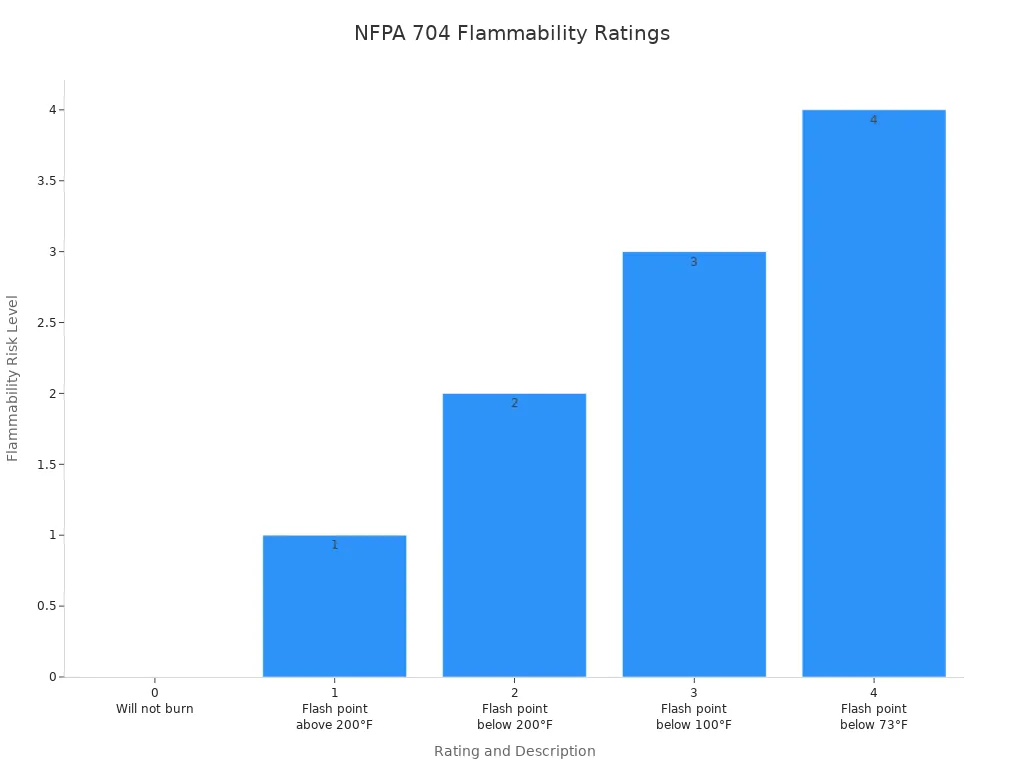
A parte vermelha mostra se algo pode pegar fogo. UM 0 significa que não vai queimar. UM 4 significa que pode pegar fogo muito facilmente. A gasolina muitas vezes recebe um 3 ou 4.
| Avaliação | Descrição |
|---|---|
| 0 | Não queimará em condições normais. |
| 1 | Ponto de inflamação acima de 200° F; precisa de pré-aquecimento para queimar. |
| 2 | Ponto de inflamação abaixo de 200° F; queima com aquecimento moderado. |
| 3 | Ponto de inflamação abaixo de 100° F; inflamável. |
| 4 | Ponto de inflamação abaixo de 73° F; altamente inflamável. |
Amarelo – Reatividade
A parte amarela mostra reatividade. UM 0 significa que o material é estável. UM 4 significa que é muito instável e pode explodir. O sódio é um bom exemplo de algo com alta reatividade.
| Classificação de reatividade | Descrição |
|---|---|
| 0 | Substâncias estáveis que não reagem em condições normais. |
| 4 | Substâncias altamente instáveis que podem explodir em condições normais. |
Branco – Riscos Especiais
A parte branca mostra perigos especiais. Esta parte utiliza símbolos ou letras para riscos não mostrados nas outras cores. Alguns símbolos comuns são:
- OX para oxidantes
- ÁCIDO para ácidos
- Símbolo de radiação para materiais radioativos
- SA para asfixiantes simples como dióxido de carbono
A seção branca ajuda as equipes de emergência a ver rapidamente perigos especiais. Estes símbolos informam aos ajudantes quais medidas de segurança devem ser tomadas.
Sinais de incêndio da NFPA em emergências
Avaliação rápida para respondentes
As equipes de emergência devem agir rapidamente em cenas perigosas. O diamante da NFPA fornece detalhes rápidos sobre os riscos. Cada cor e número indica quais perigos existem. O nfpa 704 sistema tem quatro tipos principais de perigo. Esses tipos ajudam os respondentes a saber o que fazer a seguir.
| Seção | Cor | Representa | Descrição |
|---|---|---|---|
| Vermelho | Vermelho | Inflamabilidade | Mostra risco de incêndio. Ajuda os socorristas a escolher a maneira certa de combater incêndios. |
| Azul | Azul | Considerações de saúde | Fala sobre riscos à saúde. Orienta os socorristas sobre que equipamento usar. |
| Amarelo | Amarelo | Reatividade | Alerta sobre reações. Ajuda os socorristas a evitar reações químicas perigosas. |
| Branco | Branco | Precauções Especiais | Lista perigos extras. Informa aos socorristas sobre etapas especiais ou equipamentos necessários. |
O Sinais de diamante NFPA forneça fatos simples para escolhas rápidas. Os socorristas verificam se devem evacuar ou iniciar medidas de emergência. O diamante de fogo ajuda os socorristas a escolher as melhores ferramentas e roupas. Esta verificação rápida pode salvar vidas e impedir mais danos.
Em uma emergência real, como um derramamento químico, os respondentes olham para o diamante da NFPA. Se a parte vermelha tiver um número alto, incêndio é um grande risco. Se a parte azul estiver alta, eles usam proteção extra para segurança. A parte amarela avisa se os produtos químicos podem explodir ou reagir com a água. A parte branca mostra perigos especiais, como radiação ou ácidos.
Segurança e Protocolos dos Funcionários
Funcionários que trabalham com materiais perigosos usam Sinais de diamante NFPA diariamente. Esses sinais os ajudam a conhecer os riscos antes de começar a trabalhar. O Nfpa 704 sinal mostra se um produto químico não é seguro ao toque, respirar, ou armazene perto do calor. Os trabalhadores usam isso para seguir as regras de segurança e usar o equipamento certo.
- Funcionários olham para o diamante da NFPA antes de usar produtos químicos.
- Eles usam as cores e os números para decidir se precisam de luvas, máscaras, ou ternos especiais.
- As placas os lembram de manter os produtos químicos longe de coisas que possam causar incêndio ou explosão.
- Trabalhadores verificam avisos especiais na parte branca, como “BOI” para oxidantes ou o símbolo de radiação.
Um exemplo real mostra por que esses sinais são importantes. Em um laboratório, um trabalhador vê um produto químico com um número azul alto e um símbolo especial na parte branca. O trabalhador usa uma capela e usa luvas. Isso os impede de respirar gases tóxicos.
Outro exemplo é um incêndio em um armazém. Equipes de emergência veem o diamante da NFPA na porta. O número amarelo alto alerta sobre produtos químicos instáveis no interior. Eles usam isso para planejar e evitar coisas que poderiam causar uma explosão.
O Diamante da NFPA e a NFPA 704 sistema ajuda socorristas e trabalhadores a permanecerem seguros. Eles dão claro, fatos rápidos sobre perigos químicos. Isso ajuda as pessoas a fazerem escolhas inteligentes durante emergências.
Sinais de diamante da NFPA: Colocação e visibilidade
Melhores práticas para exibição
Colocando Sinais de diamante NFPA nos lugares certos ajuda todos a verem os perigos. Esses sinais devem ficar nas portas principais, salas químicas, e em grandes contêineres. O diamante da NFPA deve ser fácil de ver de longe. Os números precisam ser maiores se as pessoas os lerem de longe. Por exemplo, se você leu de 10 pés de distância, os números deveriam ser 1 polegada de altura. As placas devem ser bem fixadas para que não caiam.
Dica: Coloque sinais onde as equipes de emergência e os trabalhadores os verão primeiro. Isso os ajuda a saber sobre saúde, fogo, e perigos químicos rapidamente.
O nfpa 704 diamante fornece fatos rápidos. Equipes de emergência usam o diamante de fogo para verificar se há perigo antes de entrar. Sinais claros ajudam todos a agir mais rapidamente em emergências.
Conformidade e regulamentos
As regras dizem às empresas como usar Sinais de diamante NFPA. O nfpa 704 regras e códigos de incêndio dizem quão grande, que cor, e onde colocar sinais. Os sinais devem ser pelo menos 6 polegadas de cada lado. Cada parte colorida deve ter pelo menos 3 polegadas de largura. Os números devem ser 1 polegada de altura e no meio. As linhas entre as cores devem ser pelo menos 1/8 polegada de espessura. Os sinais devem se destacar e ser fáceis de ler.
| Tipo de requisito | Detalhes |
|---|---|
| Dimensões de sinal | O tamanho mínimo do diamante é 6 polegadas por lado, com cada quadrante colorido pelo menos 3 polegadas de diâmetro. |
| Tamanho numérico | Classificações de perigo (0–4) deve ser pelo menos 1 polegada de altura e centralizado em cada quadrante. |
| Espessura da borda | As linhas que separam os quadrantes devem ter no mínimo 1⁄8 polegada de largura. |
| Diretrizes de colocação | Os sinais devem ser “facilmente perceptíveis” e instalados o mais próximo possível do perigo. |
| Requisitos de legibilidade | As letras devem ser dimensionadas para facilitar a leitura a partir da distância de visualização pretendida. |
| Codificação de cores | As cores de fundo e das letras devem contrastar nitidamente. |
As empresas devem verificar a sinalização a cada três meses com uma vistoria. Eles deveriam fazer uma verificação completa uma vez por ano. Isso mantém os sinais de diamante da NFPA corretos e mantém todos seguros.
Sinais de diamante NFPA ajudar a manter os trabalhadores seguros. Eles têm quatro partes coloridas. Cada parte mostra um perigo diferente. As cores falam sobre saúde, fogo, reatividade, e perigos especiais. Isso ajuda as equipes de emergência a saber o que fazer rapidamente. Eles podem fazer um bom plano para emergências.
- As placas usam a mesma forma para mostrar riscos.
- Os socorristas podem detectar perigos rapidamente.
- Usar esses sinais ajuda a prevenir acidentes ao longo do tempo.
Treinamento ensina aos trabalhadores o que significam os sinais. Isso os ajuda a seguir as regras de segurança. As empresas que usam esses sinais têm locais de trabalho mais seguros. Os trabalhadores também seguem melhor as regras de segurança.
Perguntas frequentes
O que significa cada cor do diamante da NFPA?
Cada cor representa um perigo diferente. Azul é para riscos à saúde. Vermelho é para riscos de incêndio. Amarelo significa que algo pode reagir. Branco é para perigos especiais como ácidos ou radiação.
Quem usa os sinais de diamante da NFPA?
Os bombeiros usam estes sinais. Os oficiais de segurança também os usam. Os trabalhadores também os usam. Esses sinais ajudam as pessoas a saber sobre os perigos. Eles são usados onde produtos químicos ou materiais perigosos são encontrados.
Onde os sinais de diamante da NFPA devem ser colocados?
Coloque sinais nas portas com materiais perigosos. Coloque-os em tanques e áreas de armazenamento também. Os sinais devem ser fáceis de ver pelos trabalhadores. Os socorristas também precisam vê-los facilmente.
Com que frequência os sinais de diamante da NFPA devem ser verificados?
Empresas precisam verificar sinalização a cada três meses. Eles deveriam fazer uma verificação completa uma vez por ano. Isso mantém os sinais corretos. Ajuda a manter todos seguros.