Legal disclaimer: This article provides general guidance on OSHA and MUTCD signage standards for informational purposes only. It does not constitute legal advice. Regulatory requirements vary by jurisdiction and project type. Consult a qualified safety professional or legal counsel for compliance decisions specific to your operation.
Every work zone your rental fleet supports is both a public roadway and a construction site. That means two federal frameworks apply at once. OSHA signage requirements under 29 CFR 1926.200 govern the construction environment. The MUTCD 11th Edition governs the roadway side. Both apply to the same signs, on the same job site, at the same time.
For rental companies, this overlap creates direct liability exposure. Customers depend on you to supply equipment that meets both standards. If your inventory falls short, your customers face citations — and depending on the circumstances, so can you as the supplier.
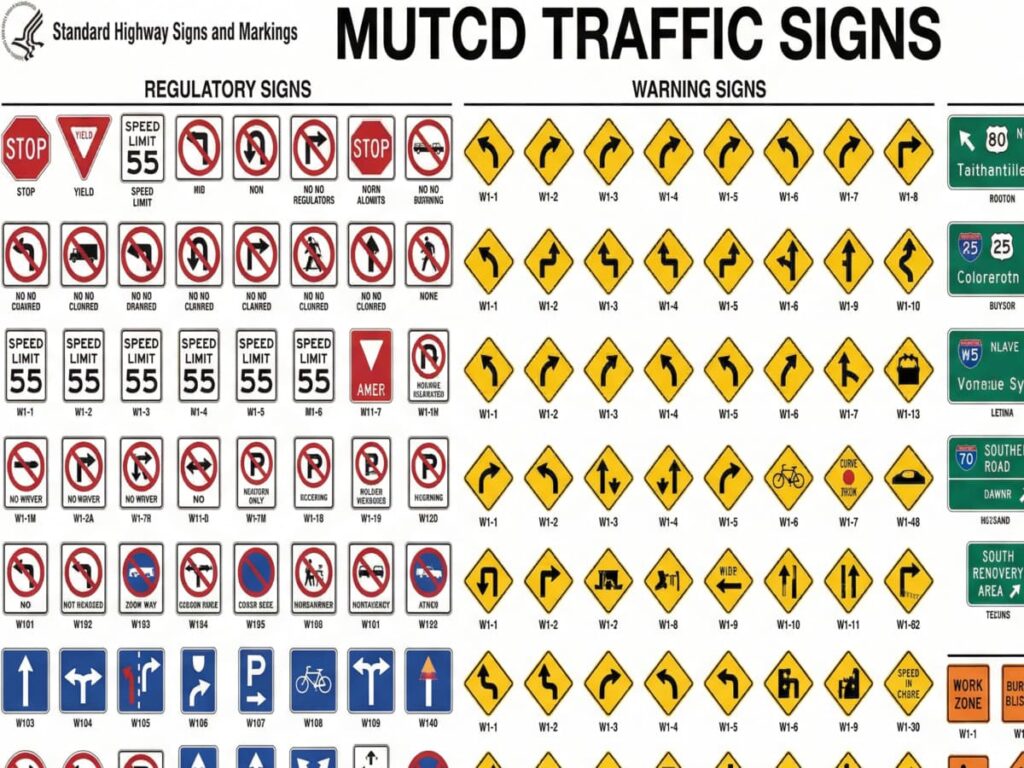
This guide breaks down exactly what OSHA requires, where it intersects with DOT standards, and what rental operators need to do to stay compliant. If you need to review your current inventory first, OPTRAFFIC’s MUTCD-compliant work zone signage is built to 11th Edition specifications — including Type III sheeting and correct dimensional standards.
OSHA Signage: The Regulatory Framework
Where the Rules Come From
OSHA’s construction signage requirements sit in 29 CFR Part 1926, Subpart G — Signs, Signals, and Barricades. Three sections are directly relevant to traffic control rental operations.
| CFR Section | What It Governs | Rental Relevance |
| 29 CFR 1926.200 | Accident prevention signs — design, color, condition | ✅ Core requirement |
| 29 CFR 1926.201 | Flagger signaling — MUTCD conformance | ✅ Where flaggers accompany packages |
| 29 CFR 1926.202 | Barricades — MUTCD conformance | ✅ Where barricades are rented with signs |
| 29 CFR 1926.203 | General provisions for signs and signals | ✅ Supplementary requirements |
The OSHA–MUTCD Bridge
Section 29 CFR 1926.200(g)(2) is the key provision for rental operators. It requires that traffic control signs used to protect construction workers conform to the current MUTCD.
That single clause links OSHA compliance directly to MUTCD compliance. Since the MUTCD 11th Edition took effect on January 18, 2024, OSHA’s reference now points to the 11th Edition standard.
The result: OSHA and DOT are not parallel tracks. They converge at every work zone where your signs are deployed.
| Regulation reference 29 CFR 1926.200(b): Sign design — conforms to ANSI Z35.1-1968.29 CFR 1926.200(c): Color coding — ANSI Z53.1-1967 / ANSI Z535.1-2006.29 CFR 1926.200(g)(2): Traffic control signs must conform to the current MUTCD. Source: osha.gov/laws-regs/regulations/standardnumber/1926/1926.200 |
OSHA Safety Signs: Types, Colors, and Design Standards
Danger Signs
Danger signs mark immediate hazards — situations with a risk of death or serious injury. OSHA requires red as the predominant color, with white and black contrast elements.
In a traffic control context, STOP and DO NOT ENTER signs fall into this category. They carry the strictest condition requirements. A faded STOP sign at a work zone entrance is simultaneously an OSHA violation and a MUTCD non-compliance.
Caution Signs
Caution signs warn against potential hazards and mark areas requiring special attention. OSHA mandates a yellow background with black lettering.
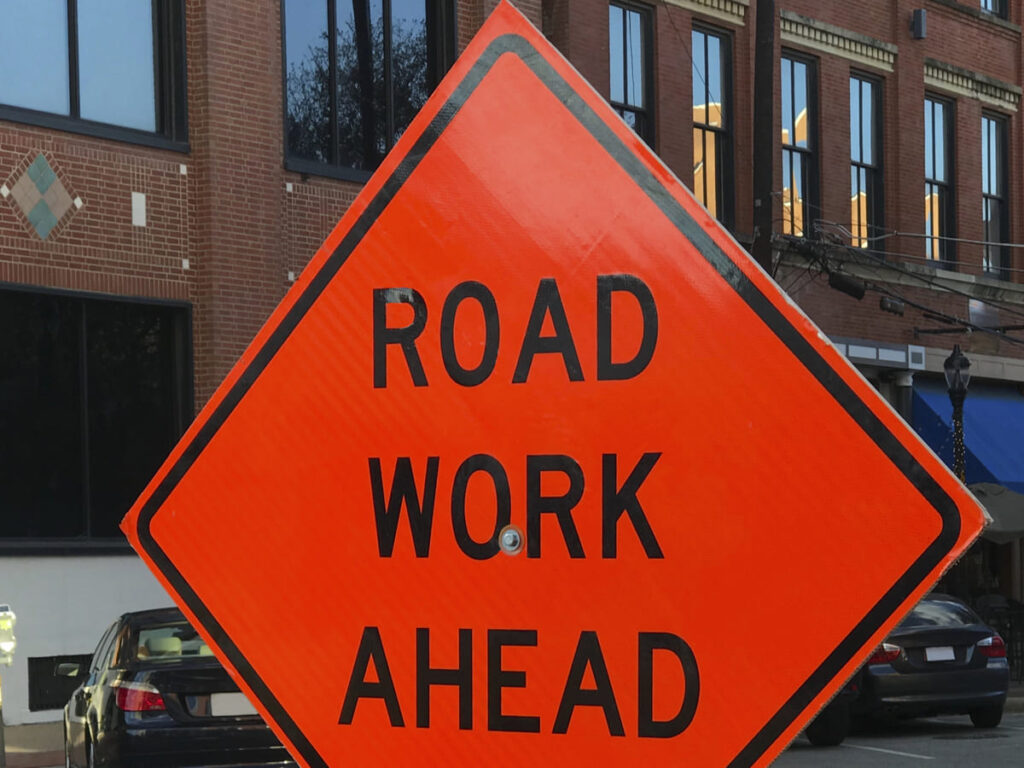
This aligns directly with MUTCD W-series warning sign standards. Work zone signs such as ROAD WORK AHEAD and FLAGGER AHEAD satisfy both OSHA and MUTCD requirements — provided they are correctly specified and maintained.
Traffic Control Signs
Traffic control signs protecting construction workers must conform to the MUTCD under 29 CFR 1926.200(g)(2). This is the direct bridge between OSHA and the DOT standard.
Every sign your customer deploys at a construction-adjacent work zone is subject to this provision. MUTCD compliance is therefore an OSHA obligation for rental companies — not just a DOT one.
DOT Traffic Signs Requirements: Where OSHA and MUTCD Overlap
Two Standards, One Sign
The most common misconception among rental operators is treating OSHA and DOT as entirely separate systems. They are not.
29 CFR 1926.200(g)(2) incorporates the MUTCD by reference. That means a single sign at a work zone must satisfy both sets of requirements at the same time.
What This Means in Practice
A sign that fails MUTCD retroreflectivity standards is simultaneously an OSHA violation. A sign that meets MUTCD dimensions but is physically damaged can still generate an OSHA citation independently. Meeting one standard does not substitute for meeting the other.
For rental companies, the practical answer is a unified compliance process. Combining MUTCD Section 2A.22 retroreflectivity management with OSHA 29 CFR 1926.200 condition documentation is more efficient than managing them separately.
For a full breakdown of MUTCD 11th Edition requirements, see our MUTCD traffic signs compliance guide for rental fleets.
Work Zone Signage Requirements: Presence, Condition, and Currency
Sign Presence — 29 CFR 1926.200(a)
OSHA requires signs to be visible at all times when work is being performed. Hazards must be clearly communicated to both workers and the public.
Critically, 29 CFR 1926.200(a) also requires that signs be removed or covered when the hazard no longer exists. This is an ongoing obligation during the rental period — not just at setup. If your rental contract does not assign removal responsibility to the customer, that ambiguity creates exposure for your operation.
Sign Condition
OSHA does not mandate specific sign materials. However, signs must be durable enough to maintain legibility throughout deployment.
Signs with faded legends, damaged faces, or delaminated sheeting do not meet the condition standard — even if their original specification was correct. For rental fleets, this means a documented pre-rental inspection process is essential. It demonstrates that you supplied compliant equipment when it left your facility.
Sign Currency
Because 29 CFR 1926.200(g)(2) requires conformance with the current MUTCD, every MUTCD update also updates the OSHA requirement.
Following the 11th Edition taking effect on January 18, 2024, inventory built to 10th Edition specifications no longer met the OSHA standard — not just the MUTCD. Fleet auditing is therefore an OSHA compliance activity, not only a DOT one.
Construction Site Traffic Signs: Placement and Sequencing
Advance Warning Sequence
MUTCD Part 6 requires a specific sign sequence for advance warning zones. It typically begins with ROAD WORK AHEAD, followed by condition-specific signs in a prescribed order.
Pre-packaged rental kits that do not follow this sequence may be non-compliant under both MUTCD and OSHA. If your kits were designed to 2009 Edition spacing tables, they likely need updating.
Speed Zone Spacing
Advance warning sign placement distances are tied to posted speed. A kit compliant at 35 mph is not automatically compliant at 55 mph. Spacing distances increase significantly with speed.
Review each of your standard kit configurations against Part 6 spacing tables for the speed zones you typically serve.
Night-Time Deployments
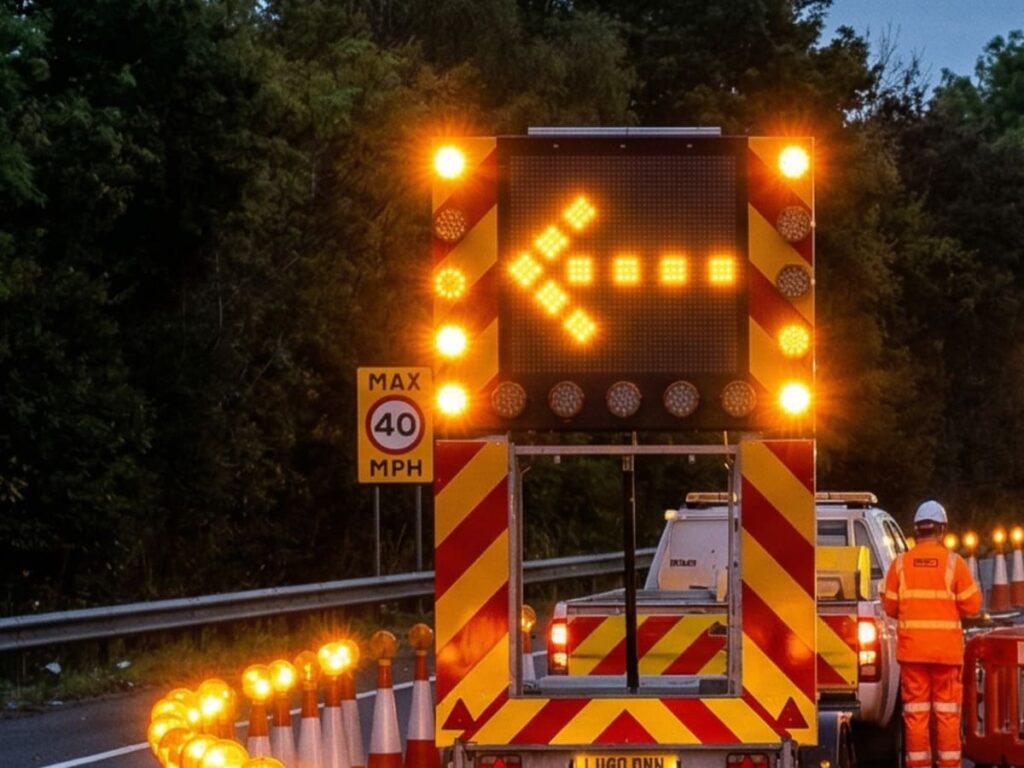
Both OSHA 29 CFR 1926.200 and MUTCD Part 6 place heightened visibility requirements on night-time work zones. This directly affects the sheeting grade requirements for any rental deployment that runs into evening or overnight hours.
If your fleet includes signs used for overnight work, confirm that sheeting grades meet the elevated thresholds in Part 6 for low-light conditions.
| Kit design implication Each pre-packaged kit design should be validated against MUTCD Part 6 for the speed zones you serve.A kit compliant under the 10th Edition may now have incorrect spacing or sequence under the 11th Edition.See our work zone sign package builder guide for a job-type-by-job-type breakdown. |
Traffic Control Signs and OSHA: Inspections and Penalty Exposure
What Inspectors Look For
When OSHA inspects a construction site involving temporary traffic control, inspectors evaluate three things under Subpart G: sign presence relative to active hazards, sign condition and legibility, and MUTCD conformance.
The most common citation triggers are:
- Missing required signs — absent advance warning or END ROAD WORK signs
- Damaged or faded signs — retroreflectivity below MUTCD Table 2A-5 minimums
- Wrong sign type — incorrect MUTCD code for the specific hazard
- Outdated signs — no longer conforming to the current MUTCD
- No documentation — no evidence of pre-deployment inspection
Pre-Rental Inspection Checklist — Minimum Documentation Standard
| Check Item | Method | Pass Threshold | Record |
|---|---|---|---|
| Retroreflectivity | Retroreflectometer or expected-life table | At or above MUTCD Table 2A-5 minimums | Reading + date |
| Physical condition | Visual inspection | No delamination, cracks, or bent substrate | Inspector initials |
| Legend legibility | Daytime visual at 50 ft | Fully legible, no fading | Pass / Fail |
| Sign dimensions | Tape measure or supplier spec sheet | Meets MUTCD 11th Ed. Section 2C / Table 6F-1 | SKU confirmed |
| Sheeting grade | Supplier certification document | ASTM D4956 Type III or higher | Doc on file |
This checklist satisfies the documentation requirements under MUTCD Section 2A.22 and OSHA 29 CFR 1926.200 simultaneously. Complete one record per sign unit or sign SKU batch before each rental cycle.
Penalty Exposure in 2026
As of January 15, 2025, OSHA’s maximum penalty for a Serious violation is $16,550 per violation. Willful or Repeated violations carry up to $165,514 per violation.
Source: OSHA Memo, January 7, 2025 — osha.gov/memos/2025-01-07/2025-annual-adjustments-osha-civil-penalties
A single non-compliant work zone can involve multiple signs. That means multiple simultaneous citations are possible. Signage violations are visible and documentable during a site walk. They are among the easiest citation targets for inspectors.
Pre-rental condition documentation is therefore a direct financial risk management tool — not just a compliance formality.
State Plan States
Twenty-two states operate OSHA-approved State Plans. These may exceed federal minimum requirements. California’s Cal/OSHA sets a higher serious violation maximum of $25,000 — compared to the federal $16,550.
If you operate across state lines, check each state plan’s requirements independently. For a state-by-state breakdown, see our state-by-state signage compliance guide.
Traffic Sign Rental Compliance: Where Your Liability Begins and Ends
The Core Question
Rental operators frequently ask: where does OSHA compliance responsibility end for us and begin for the customer? The answer depends on what your contract specifies and what condition your equipment was in at the time of rental.
Primary responsibility under 29 CFR 1926.200 rests with the employer controlling the construction site — typically the contractor or municipality renting your signs. However, three scenarios can draw a rental company into the liability picture.
Scenario 1 — Supplying Non-Compliant Equipment
Supplying signs that fail MUTCD or OSHA standards at the time of rental directly contributes to a compliance failure. In post-incident litigation, this creates a defensible argument that the rental company shares liability.
The solution is a documented pre-rental inspection process. It confirms each sign meets current standards before it leaves your facility.
Scenario 2 — No Documentation of Condition
Even compliant signs create exposure when you cannot prove their condition at the time of rental. Without inspection records, you cannot distinguish compliant inventory from potentially non-compliant equipment.
In the event of a work zone incident, OSHA investigators or insurers may request that evidence. No documentation is the same as no defense.
A common scenario in rental operations: a contractor returns a lane closure kit after a two-week road resurfacing project. Three of the orange TTC signs show visible sheeting delamination. Without a pre-rental inspection record, the rental company cannot prove the signs left the facility in compliant condition. In a post-incident investigation, the absence of that record is treated the same as evidence of non-compliance — regardless of what the signs actually looked like when they shipped.
Scenario 3 — Ambiguous Rental Contracts
Contracts that do not address compliance responsibilities leave the boundary undefined. Specifically, if your contract does not assign sign placement, sequencing, and removal obligations to the customer, a claim could be made that you — as the expert party — bore those responsibilities.
A clear compliance responsibility clause in rental agreements is a risk management step, not just a legal formality.
Sourcing tip: When replacing non-compliant inventory, specify ASTM D4956 Type III sheeting or higher and request written supplier certification. OPTRAFFIC’s MUTCD-compliant work zone signage includes supplier documentation for each SKU — making your compliance records traceable from purchase through pre-rental inspection.
Frequently Asked Questions: OSHA Signage Requirements for Rental Companies
Q1: Does OSHA 29 CFR 1926.200 apply to rental companies or only to contractors?
Primary responsibility rests with the employer controlling the construction site. However, rental companies that supply non-compliant equipment — or cannot document the condition of signs at rental time — face exposure in post-incident liability claims. Pre-rental inspection records and clear contract language are your primary protection.
Q2: What are the penalties for OSHA signage violations at a work zone?
As of January 15, 2025: Serious violations carry up to $16,550 per violation. Willful or Repeated violations carry up to $165,514 per violation. California’s Cal/OSHA sets a higher serious violation maximum of $25,000. A single non-compliant work zone can trigger multiple simultaneous citations. Source: OSHA Memo, January 7, 2025.
Q3: How does OSHA’s signage requirement connect to the MUTCD 11th Edition?
29 CFR 1926.200(g)(2) requires traffic control signs at construction sites to conform to the current MUTCD. Since the 11th Edition took effect on January 18, 2024, that is now the applicable standard. A sign that fails MUTCD retroreflectivity or dimension requirements is simultaneously an OSHA violation.
Q4: Do OSHA requirements apply to temporary rental signs or only permanent installations?
Yes — 29 CFR 1926.200 applies to all signs at construction sites, including temporary rental equipment. The standard makes no distinction between owned and rented signs. Placement, condition, and removal obligations apply throughout the rental period.
Q5: What documentation should rental companies maintain for OSHA compliance?
Maintain pre-rental inspection logs by sign unit — covering retroreflectivity status, physical condition, and legend legibility, dated and signed by the inspector. Supplement with ASTM D4956 supplier certifications per SKU, acquisition dates for expected-life tracking, and a written MUTCD Section 2A.22 management method. These records satisfy both OSHA 29 CFR 1926.200 and MUTCD 11th Edition requirements simultaneously.
Q6: Are there additional requirements in states with their own OSHA plans?
Yes. Twenty-two states operate State Plans that may exceed federal OSHA minimums. California, Washington, Oregon, and Michigan are among the states with additional requirements. Check each state plan independently if you operate across state lines.
The Bottom Line for Rental Operators
OSHA and MUTCD compliance are not two separate tasks. They are the same task, applied to the same equipment, at the same job site. A rental company that manages both standards together — through unified inspection records, compliant inventory, and clear contract terms — builds a defensible operation and a stronger commercial position with contractors who increasingly demand compliance documentation upfront.
The most effective starting point is a pre-rental inspection process that addresses MUTCD retroreflectivity, sign dimensions, and OSHA condition requirements in a single documented step. From there, fleet replacement cycles, kit design reviews, and contract updates follow naturally.
For further reading, the next article in this series covers state-by-state signage compliance variations — because federal compliance is the floor, not the ceiling, in 22 states.
Related articles in this series
- MUTCD Traffic Signs: 11th Edition Compliance Guide for Rental Fleets
- State-by-State Signage Compliance Variations for Rental Operators (A3)
- Traffic Sign Condition Grading & Replacement Cycle Guide (D2)
- Back to pillar: Traffic Signs for Rental Companies — Complete Fleet & Sourcing Guide