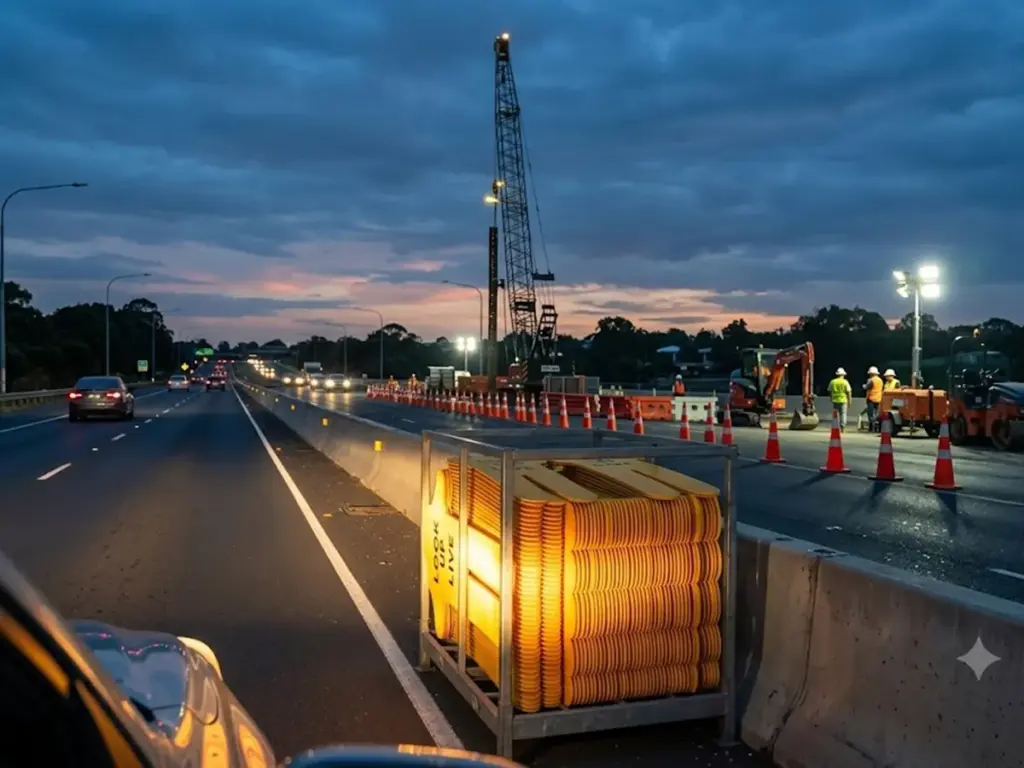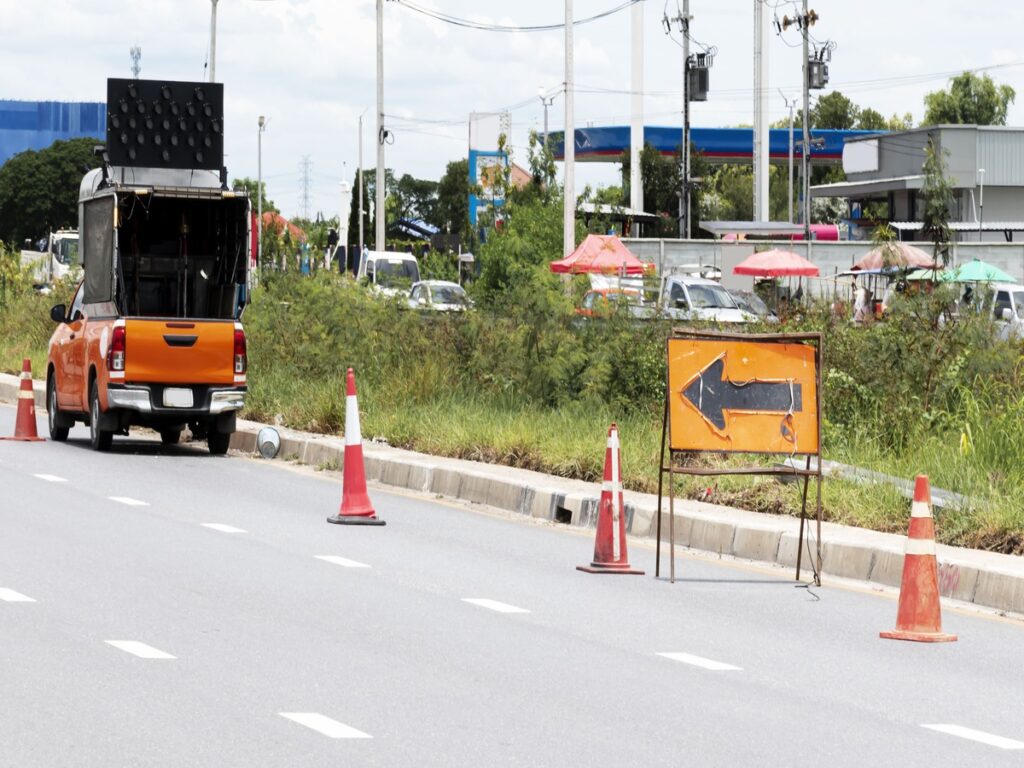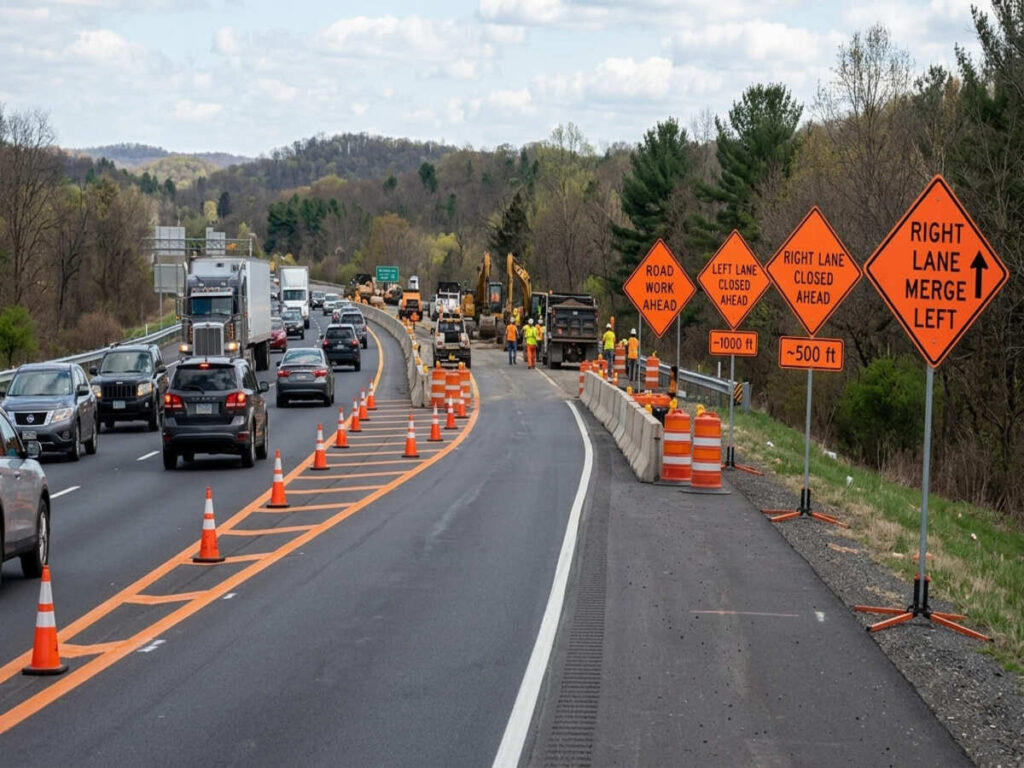
Every night shift supervisor knows the feeling. A near-miss report lands on their desk. A driver claims they “never saw the worker sign,” and by then, the reaction window had already closed. This single failure point — undetected signage — doesn’t just risk a WHS breach. It puts a name and a family behind every fatality statistic. Vehicle incidents already account for 42% of all Australian workplace deaths.
Being struck by a moving vehicle remains one of the most preventable causes of harm in a live work zone. Night shift supervisors and TGS designers cannot afford to guess. This guide answers directly: do corflute worker signs need reflective sheeting? It also covers exactly what AS/NZS 1906.1 demands before a night shift begins.
The Short Answer — Yes, Reflective Sheeting Is Non-Negotiable for Night Works
For any live work zone running between dusk and dawn, the answer is unambiguous. Corflute worker signs need reflective sheeting, full stop. Non-reflective corflute signage only suits daytime, low-risk, or fully controlled environments with consistent ambient light. The moment a shift crosses into low-light or night conditions, standard printed corflute becomes functionally invisible to approaching traffic. This isn’t best practice or supplier upsell. It’s a documented requirement embedded across AU road authority specifications and enforced under the WHS Act’s primary duty of care.
What PCBUs and TGS Designers Need to Know Before Sign-Off
Every PCBU (Person Conducting a Business or Undertaking) carries a non-delegable duty. Risks must be eliminated or minimised so far as is reasonably practicable. When a TGS designer signs off on a night works scheme, they certify that every control measure meets the applicable standard. This includes signage retroreflectivity. Asking whether corflute worker signs need reflective sheeting at the design stage is a cheap risk-control decision.
Deploying non-compliant signage directly breaches state-specific Traffic Management Codes of Practice and authorized Traffic Guidance Schemes (TGS). Under the WHS Act, ignoring these established technical control frameworks serves as prima facie evidence that a PCBU has failed to minimize workplace risks so far as is reasonably practicable, opening the organization to severe liability in the event of an incident.
Where This Sits Within AU WHS and Road Authority Frameworks
Reflective sheeting requirements sit across three regulatory layers. First is the model WHS Act and Regulations. Jurisdictional road authority manuals, such as Transport for NSW specifications, form the second layer. As/nzs 1906.1, the Australian Standard governing sheeting performance, rounds out the third. 一緒に, these frameworks confirm one thing clearly. Reflective sheeting is not optional signage decoration. It’s a core engineering control against Australia’s single largest cause of workplace fatality.
The Physics of Nighttime Detection: Why Standard Corflute Becomes a Visual Black Hole
Understanding why temporary signs need reflective sheeting starts with basic optical physics. しかし, TGS designers must first verify road authority specifications regarding the substrate itself: while corflute may be permitted in lower-speed, low-risk local road environments, high-speed or active multi-lane night works often mandate rigid aluminum or multi-mesh substrates to withstand wind thresholds and visual distortion.
How Vehicle Headlight Beam Angles Interact With Static Signage
A vehicle’s low-beam headlights project light in a narrow, forward-focused cone. Diffuse-reflective corflute scatters that light broadly instead of redirecting it to the source. Only a negligible percentage reaches the driver’s eyes. Retroreflective sheeting solves this through microprismatic or glass-bead technology. It redirects incoming light almost directly back along its original path. That path leads straight toward the headlight source, and the driver’s line of sight.
The “Silhouette Effect” — Why Human-Shaped Retroreflective Outlines Are Legally Required
The worker silhouette isn’t a design flourish. It’s a recognition tool. Human cognition processes familiar shapes — particularly human forms — faster than abstract symbols, 周辺視野でも. When a corflute worker sign lacks reflective sheeting, this silhouette advantage disappears at night. There’s simply no light returning to the eye to trigger shape recognition. This is why Australian temporary traffic management standards (として 1742.3 and AGTTM) mandate specific high-visibility worker symbolic signs (such as the T1-5 sign) 低照度条件用. The recognized silhouette symbol only triggers immediate driver deceleration if backed by compliant retroreflectivity.
Driver Reaction Time vs Detection Distance in Low-Light Conditions
At typical arterial road speeds, a driver needs several seconds of clear sightline to perceive, 決める, and physically react. Non-reflective corflute shortens this window to near zero at night. Detection distance collapses well inside the safe stopping distance. This is precisely why the question of whether corflute worker signs need reflective sheeting carries such serious real-world consequences. It directly multiplies the available driver reaction time.
When Reflective Sheeting Becomes Mandatory: Night Works, Dusk/Dawn, and Low-Light Environments

Supervisors don’t just ask whether corflute worker signs need reflective sheeting in principle. They need to know exactly when the trigger point kicks in operationally. 実際に, the answer ties to light levels, not the calendar.
Defined “Night Works” Windows Under AU Traffic Management Guidelines
Most state road authority guidelines define night work using a fixed time window. This commonly runs from one hour after sunset to one hour before sunrise, rather than subjective darkness. TGS documentation should reference the locally defined window explicitly. Don’t leave it to a supervisor’s visual judgement call on-site.
Dusk-to-Dawn Transition Periods and the Compliance Grey Zone
The most common compliance failure isn’t overnight shifts. It’s the transition period. A shift starting at 4:00 pm in winter can run well past sunset without a shift change. A site that begins as “daytime works” can silently drift past that threshold. It then needs reflective-grade signage for temporary signs for night works AU-wide. TGS designers should build in a mandatory sheeting-class review trigger. Tie it to the seasonal sunset table, not the shift roster.
High-Risk Low-Light Civil Environments (Tunnelling, 地下道, Bridge Soffits)
Some environments demand reflective sheeting regardless of the clock. トンネル, 地下道, bridge soffits, and heavily shaded civil corridors reduce ambient light to near-night conditions at any hour. These sites should be treated as permanent low-light zones in the TGS. Reflective-grade corflute should be the default specification, not the exception.
クラス 400 対クラス 100 Under AS/NZS 1906.1: Understanding the Retroreflectivity Hierarchy
This is the technical crux of the compliance question. It’s also the clearest proof that corflute worker signs need reflective sheeting engineered to a specific class. A generic reflective coating simply won’t do. As/nzs 1906.1 renamed the older “Class 1” そして “Class 2” nomenclature to Class 400 とクラス 100. The rename reflects minimum coefficient of retroreflection performance. Minimum RA values increase with each class, with Class 100 sitting at the lower-performance end while Class 400 is commonly used for stronger road-sign visibility.
What Changed — Class 1 to Class 400 とクラス 2 to Class 100 Nomenclature
Many long-serving supervisors still search using the legacy terms. That’s why the phrase Class 1 reflective corflute sign still appears constantly in procurement conversations. Functionally, a Class 1 reflective corflute sign and a Class 400 sign are the same product under current nomenclature. Road authorities such as Transport for NSW confirm this directly.
授業中 400 (以前のクラス 1) serves as the baseline entry standard for standard low-light traffic guidance, it is not a blanket solution. State road authorities frequently escalate this requirement, mandating Class 900 またはクラス 1100 microprismatic sheeting for high-risk, high-speed environments (such as freeways and motorways) where maximum observation angles and long-distance detection are critical.
なぜクラスなのか 100 (Formerly Class 2) Is Insufficient for Active Public Roadwork Zones
クラス 100 — sometimes called engineer grade — is commonly used for lower-risk applications such as parking signage rather than live public roadwork. Its performance falls well short of what night detection requires. A driver simply can’t detect a worker silhouette at a safe stopping distance. Specifying Class 100 for a night works sign is one of the most common false economies in TGS procurement — and one of the most dangerous.
Minimum Coefficient of Retroreflection Values Road Authorities Will Audit
| シーティングクラス | 通称 | 代表的な用途 | Night Roadwork Suitability |
| クラス 100 | エンジニアグレード | Parking signage, low-risk static signage | Not suitable for live night work zones |
| クラス 400 | 高強度プリズム | Active public roadwork, 夜勤, 一時的な交通規制 | Mandatory minimum for night works |
| クラス 900 / 1100 | Diamond/Wide-Angle Prismatic | High-risk motorway, complex geometry sites | Recommended for elevated-risk zones |
ソース: reflectivefabrications.com.au — Coefficient of Retroreflection: How RA Values Are Measured; rtl.co.nz — Sign Specifications & Road Sign Code Finder
Road authority auditors don’t just check the sheeting label. They check documented compliance against AS/NZS 1906.1 test geometry. Every TGS designer should retain supplier certification confirming Class 400 performance before sign-off. A verbal assurance isn’t good enough on its own — get it in writing.
TGS Compliance Obligations — What a Traffic Guidance Scheme Must Specify for Night Shifts
Documenting Sheeting Class on the TGS Sign-Off Sheet
A defensible TGS should explicitly record the reflective sheeting class for every worker sign on a night shift. Don’t just record the sign type or message. This single line item often decides the outcome of a post-incident WorkSafe review. It’s the difference between a documented trail and an unsupported claim.
PCBU Due Diligence Under the WHS Act for Night Shift Sign Selection
Due diligence under the WHS Act requires more than good intentions. It requires a verifiable process. A PCBU that can produce supplier certification, TGS documentation, and site audit records holds a far stronger position. Relying on assumption alone leaves the business exposed.
Common Non-Conformance Findings in WorkSafe Night Audits
The most frequent findings in night audits are consistent. Reflective sheeting class goes undocumented on the TGS. Signage shows visible edge delamination that reduces effective retroreflectivity. Daytime-rated signage stays in place after a shift extends past sunset. One consideration TGS designers must also account for is correct sign placement relative to approach speed and driver sightlines. For a detailed breakdown of sign spacing matrices and stopping sight distances across various AU speed zones, please refer to our practical guide on how far away corflute worker signs should be visible.
Manufacturing Quality — Why Substrate and Application Method Determine Sheeting Longevity
Even correctly specified Class 400 sheeting fails in the field if manufacturing is substandard. This is where whether corflute worker signs need reflective sheeting extends beyond spec sheets into build quality. A certified Class 400 rating on paper means nothing if the sheeting delaminates within months.
Industrial Roll-Application vs Hand-Applied Sheeting on Corflute Substrates
Hand-applied sheeting introduces air bubbles, inconsistent adhesive pressure, and uneven edge sealing. All of these compromise long-term retroreflective performance. Industrial roll-lamination applies sheeting under controlled, consistent pressure across the entire substrate. The resulting bond resists the vibration, ほこり, and thermal cycling typical of harsh AU civil sites.
UV-Stabilised Corflute as the Foundation for Reflective Adhesion
Retroreflective sheeting is only as durable as the substrate beneath it. Standard corflute degrades under sustained UV exposure, becoming brittle and prone to warping. These conditions accelerate sheeting delamination at the edges.
Industrial roll-lamination ensures that retroreflective sheeting stays perfectly flat and bonded despite the rough handling typical of night shifts. On active civil sites, signs are constantly tossed into transport vehicles and exposed to grit; mechanical application prevents edge-lifting, which would otherwise capture dirt and create localized retroreflective blind spots during a shift.
Diagnosing Edge-Peeling and Delamination on Harsh Civil Sites
Edge-peeling typically starts as a barely visible lift at the sign’s corners. It then progresses inward, creating pockets where dust and moisture accelerate failure. On a live night shift, a partially delaminated sign produces a distorted, patchy retroreflective response. It effectively reintroduces the same visual black hole that reflective sheeting was meant to eliminate. Regular site audits should treat any visible edge lift as an immediate replacement trigger, not a cosmetic issue to monitor.
Sourcing Compliant Signage: What Night-Shift Procurement Teams Should Verify Before Ordering
Procurement teams asking do corflute worker signs need reflective sheeting for an upcoming tender have a simple answer. Treat it as a fixed specification line, not a negotiable extra.
Checking Supplier Certification Against AS/NZS 1906.1 Test Data
大量注文の前に, request documented RA (再帰反射係数) test data referencing AS/NZS 1906.1. Don’t accept a class label on an invoice alone. Genuine certification specifies the test geometry — observation and entrance angles — behind the claimed performance figure.
Bulk Procurement Considerations for Multi-Site Night Work Programs
Programs running multiple concurrent night shifts across different sites benefit from standardising on one certified Class 400 product line. This simplifies both TGS documentation and stock rotation. It also reduces the risk of a lower-grade sign reaching a live night zone by mistake.
Why Factory-Direct Manufacturing Reduces Compliance Risk and Lead Times
For TGS designers and procurement teams managing rolling night shift programs, one decision matters most. Work with a full-link traffic sign manufacturer that controls everything in-house — from AS/NZS-compliant retroreflective sheeting application through to automated precision die-cutting. This removes the guesswork from compliance sign-off, and delivers factory-direct wholesale pricing across Australia.
Embedding Reflective Sheeting Requirements Within Your Broader Signage Compliance Strategy
Aligning Sheeting Class With Overall Worker Sign Design and Cutout Standards
Reflective sheeting class is one variable among several that determine whether a corflute worker sign meets Australian visibility standards. 標識の形状, colour standardisation, and mounting height all interact with retroreflectivity to determine real-world driver detection.
Building a Site-Wide Signage Audit Checklist for Mixed Day/Night Operations
Sites running mixed day and night operations should maintain a single audit checklist. Cover sheeting class, substrate condition, と配置, and review them at every shift handover, not just at project milestones.
Reflective sheeting is only one component of a broader compliance picture. That picture also covers sign shape, colour standardisation, そして取り付け高さ. For the full regulatory context, 私たちの comprehensive AU standard guide to cutout safety worker signs walks through these requirements in detail.
Frequently Asked Questions — Reflective Sheeting and Night Work Compliance
Do corflute worker signs need reflective sheeting for all night works, or only on public roads?
はい, in practical terms. Any live work zone operating in low-light or night conditions — public road or private civil site with vehicle movement — should specify reflective-grade corflute. This maintains driver detection and meets WHS due diligence expectations.
クラスの違いは何ですか 400 とクラス 100 反射シート?
クラス 400 (以前のクラス 1) delivers significantly higher retroreflective performance than Class 100 (以前のクラス 2). クラス 100 is generally reserved for lower-risk applications like parking signage rather than active night roadwork zones.
クラスを使用できますか 100 sheeting for short-duration night work or emergency call-outs?
いいえ. Retroreflective performance requirements under AS/NZS 1906.1 don’t scale down for shift duration. A short emergency call-out at night still exposes workers to the same detection risk as a planned multi-week night program.
How do WorkSafe auditors test retroreflectivity compliance on-site?
Auditors typically review TGS documentation for the specified sheeting class and request supplier certification data. They also conduct a visual inspection for delamination, フェード, または損傷. Any of these can reduce effective retroreflection below the certified value.
How often should reflective corflute signs be replaced due to sheeting degradation?
There’s no single fixed interval. Replacement should be triggered by visible conditions — edge-peeling, colour fade, substrate warping. Routine site audits should catch this, not a calendar date alone.
参照
- Safe Work Australia — Key Work Health and Safety Statistics Australia 2025
- Safe Work Australia — Behind the Numbers: What’s Causing Harm at Work (2025)
- Safe Work Australia — Key Work Health and Safety Statistics Australia 2025 Now Available
- Transport for NSW — Retro-reflective Sheeting Approved Materials
- Vicroads / Department of Transport (ヴィック) — Supplement to AS/NZS 1906.1:2017
- Reflective Fabrications of Australia — Coefficient of Retroreflection: How RA Values Are Measured