Australian councils manage more than roads. They manage risk, and every roundabout, school crossing, and temporary worksite carries legal exposure if the wrong equipment goes into the ground. Procurement teams searching for dependable Australian traffic management solutions need more than a supplier catalogue — they need a framework that connects national standards, state variations, and long-term asset performance into one defensible strategy.
This guide gives council procurement and project managers exactly that framework. It explains how the regulatory landscape works, how to build a resilient sourcing strategy, and how to vet suppliers who can deliver Australian traffic management solutions at scale without compromising compliance.
Why Strategic Traffic Management Matters for Australian Councils

Road trauma in Australia has not been trending in the right direction. の間 12 months ending November 2025, the country recorded 1,332 道路死, a 3.0% increase compared with the previous 12-month period, according to the Bureau of Infrastructure and Transport Research Economics (BITRE) (BITRE, 2025). The Australasian College of Road Safety confirms 1,314 deaths occurred in 2025 一人で, with tens of thousands more Australians seriously injured (ACRS, 2026). For a council, every one of those incidents represents a potential liability question: was the signage compliant, was the barrier certified, was the traffic guidance scheme properly executed?
Councils sit at the centre of this exposure because they own the roads, approve the works, and are frequently named in claims when equipment fails to meet AS1742 requirements. Selecting proven Australian traffic management solutions is therefore not a discretionary purchase — it is a core risk-management function.
The Cost of Non-Compliance: Legal and Safety Risks for Councils
Non-conforming devices expose councils to WHS breaches, insurance disputes, and reputational damage that can outlast any budget saving. A single incident involving an uncertified device can trigger a coronial inquiry, and regulators increasingly examine procurement records during these investigations.
The Council Procurement Landscape: Balancing Budget, コンプライアンス, and Longevity
Lowest-price tendering still dominates many council panels, yet it frequently produces equipment that fails early in harsh conditions. Forward-thinking procurement teams now weight total lifecycle cost alongside upfront price, treating durability as a measurable compliance factor rather than a bonus feature.
Understanding the Regulatory Framework: AS1742 and National Standards
Every credible traffic control program in Australia is anchored to the AS1742 series. Councils rely on this framework to determine what devices are legally permitted, how they must be positioned, and how compliance is demonstrated during an audit. Any conversation about traffic control products AS1742 compliance has to start here.
Decoding the AS1742 Series: What Council Managers Need to Know
AS1742 is divided into multiple parts covering permanent signage, traffic control at worksites, and general traffic device requirements. Councils generally focus on AS 1742.2:2022 (Traffic control devices for general use) for permanent signage guidance and AS 1742.3:2019 (Traffic control for works on roads) for worksite control. In any tendered contract, councils must enforce AS/NZS 1906.1:2023 retroreflective performance thresholds, specifically requiring Class 1100 (以前のクラス 1) material or higher for all high-speed and vulnerable environment signage to ensure legal compliance during post-incident audits.
State vs National Compliance: Navigating Jurisdictional Variations
National standards set the floor, but state road authorities add their own supplements — Transport for NSW, the Queensland Department of Transport and Main Roads, and equivalents in other states each publish additional requirements. Procurement managers must reconcile these layers before finalising a specification, especially for cross-border projects.
Certification and Auditing: Verifying Supplier Compliance Claims
Councils should request test certificates, compliance declarations, and manufacturing traceability for every device before signing a contract. Verifying these documents matters just as much as the price negotiation, and it protects the council if equipment performance is later questioned in an audit or legal proceeding.
Councils that want to strengthen this layer of governance benefit from ensuring jurisdiction-wide compliance when deploying certified traffic control devices for short-term road closures, a topic explored in depth in our dedicated guide on temporary community road checks.
The Temporary Traffic Management Standard: A Procurement Perspective
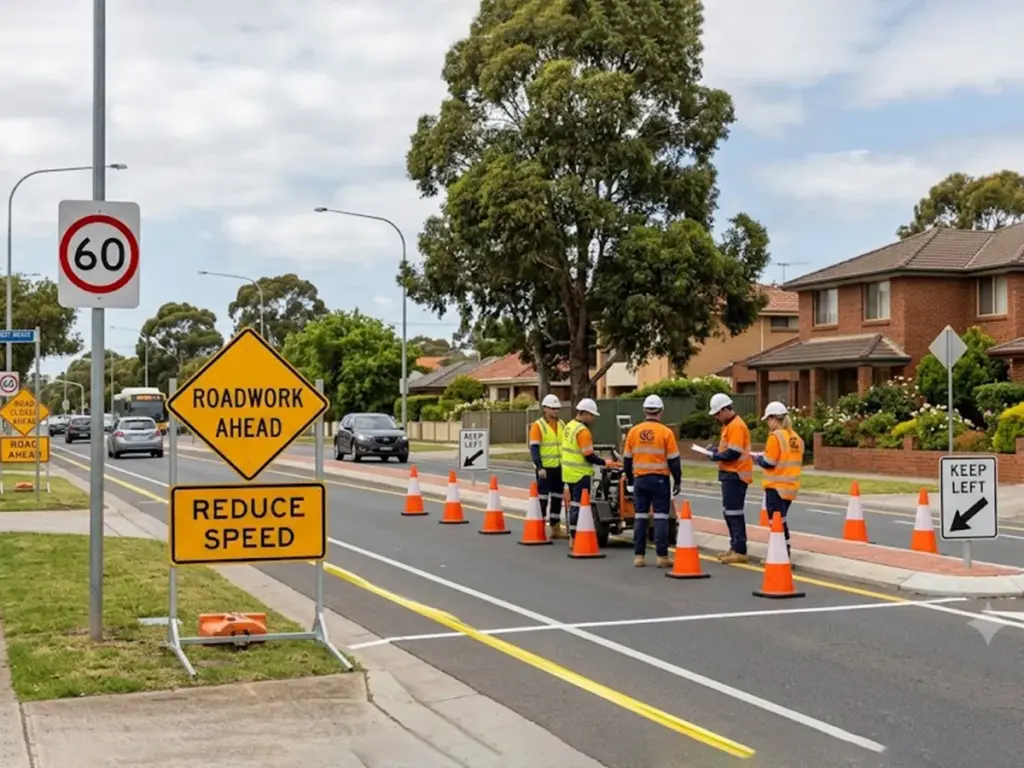
Beyond fixed signage, councils must plan for the temporary traffic management standard that governs every roadwork, event closure, および緊急対応. This standard shapes procurement decisions long before a single sign reaches the roadside.
What Councils Must Include in a Compliant Traffic Management Plan
A compliant plan references AS1742.3, nominates an accredited Traffic Guidance Scheme, and lists the specific devices approved for the job. Procurement teams should confirm that ordered equipment matches what the approved plan specifies, since mismatches are a common audit failure point.
Seasonal and Event-Based Considerations
Demand for equipment spikes around school terms, community events, and public holidays. Councils that fail to forecast these cycles often scramble for last-minute stock, which increases the risk of accepting non-compliant substitutes.
Common Compliance Gaps Councils Should Audit For
Expired retroreflective sheeting, mismatched device combinations, and outdated signage remain the most frequent gaps found during council audits. これを軽減するには, council audit protocols must establish a strict Pass/Fail criterion based on AS/NZS 1906.1 retention values: any static sign whose retroreflectivity has degraded below 80% of its initial specified performance value (measured using a calibrated retroreflectometer), or shows distinct delamination, should be flagged for immediate replacement within 14 days of inspection.
Reviewing these gaps annually keeps a fleet of Australian traffic management solutions genuinely field-ready rather than technically owned but practically unusable.
Councils managing multiple concurrent worksites often find that fragmented supply chains slow down compliance. Speak with our procurement team about consolidating sourcing under one certified manufacturer of Australian traffic management solutions.
Councils preparing for peak travel periods should also review our guide on sourcing durable roadside equipment built to withstand remote and coastal deployment conditions, which addresses seasonal surge planning in more detail.
Core Categories of Compliant Traffic Management Equipment
A functioning municipal program depends on several interlocking equipment categories. Council road safety supplies typically fall into four groups: static signage and mounting hardware, pedestrian infrastructure, temporary control devices, and highway-grade roadside safety hardware.
High-Visibility Signage and Mounting Hardware for Public Safety Campaigns
Councils running public safety campaigns need signage that meets retroreflectivity standards while surviving repeated installation cycles. Selecting robust mounting brackets reduces replacement frequency and keeps campaign messaging legible at night.
Pedestrian and School Zone Safety Infrastructure
School zones demand a distinct compliance category, since children are among the most vulnerable road users. ボラード, ラインマーキング, and parking control assets must meet both AS1742 and local speed-zone requirements simultaneously.
Temporary Control Devices for Short-Term and Emergency Road Works
Rapid deployment scenarios — community checks, incident response, and short-term closures — rely on certified cones and modular barriers that councils can mobilise within hours rather than days.
The table below maps common council scenarios to the relevant infrastructure category, standard baseline, and deep-dive resource.
| Council Scenario | Key Infrastructure Category | Primary Standard Baseline | Deep-Dive Solution Guide |
| National Road Safety Week / Temporary Campaigns | High-visibility static signage and high-stability mounting hardware | として 1742.2 & State campaign specs | Implementing high-visibility event signage and mounting brackets for community safety campaigns |
| Long-Term School Zone & Parking Lot Safety | Pedestrian safety bollards & compliant parking layout assets | として 1742.13 (駐車場) & Local speed zone limits | Selecting pedestrian bollards and school zone parking supplies that meet child-safety compliance thresholds |
| 短期 / Emergency Community Road Checks | Certified retroreflective traffic cones and modular barrier systems | として 1742.3 (Traffic control for works on roads) | Deploying certified traffic cones and barriers for temporary community road checks |
| Remote & Coastal Highways Holiday Traffic Surges | Weather-resilient roadside safety hardware & high-grade retroreflective assets | として 1742.2 (Rural/high-speed environments) | Sourcing durable roadside equipment built to withstand remote and coastal deployment conditions |
ソース: Standard baselines summarised from Standards Australia AS1742 series overview referenced by state road authorities.
Building a Resilient Procurement Strategy: Beyond the Lowest Bid
Councils that chase the lowest unit price often pay more over a five-to-ten-year cycle through repeated replacements. A resilient strategy for Australian traffic management solutions treats price as one input among several, not the deciding factor.
総所有コスト: Why Durability Reduces Long-Term Council Spend
Lifecycle cost modelling accounts for replacement frequency, traffic control labor costs for reinstallation, and downtime during non-compliance periods. According to standard local government infrastructure evaluation frameworks, the labor and road-occupancy permitting costs to replace a premature sign failure often exceed the hardware’s initial purchase price by 300% に 500%. Durable hardware certified to withstand Australian wind load configurations (per AS/NZS 1170.2:2021) consistently wins this comparison, delivering a lower true cost per year over the asset’s lifetime.
The Case for Single-Source, End-to-End Manufacturing Partnerships
Consolidating suppliers reduces coordination overhead and shortens lead times for urgent orders. 例えば, in a recent multi-zone regional council rollout, transitioning from a fragmented vendor model to an end-to-end manufacturing partner reduced administrative procurement touchpoints by 40% and trimmed urgent inventory lead times from 14 business days down to 48 時間. A single accountable manufacturer also simplifies compliance audits by providing unified batch-testing certificates linked straight to the council’s asset management registry.
Managing Council-Wide Rollouts: Volume Ordering and Standardisation
Standardising signage and hardware specifications across an entire local government area reduces the chance that a field crew installs the wrong device by mistake. Volume ordering under one contract also improves pricing predictability for future budget cycles.
As a full-link, end-to-end traffic sign manufacturer, this business produces custom brackets and high-volume static signage in-house — giving councils a single accountable partner for jurisdiction-wide rollouts. Request a council procurement consultation.
Seasonal and Event-Driven Deployment Planning
Demand for traffic control products AS1742 compliance rarely stays flat throughout the year. Councils that plan procurement calendars around predictable spikes avoid the compliance gaps that emerge during last-minute ordering.
Forecasting Equipment Needs for National Road Safety Week and Community Events
National Road Safety Week runs from 17 に 24 5月 2026 の下 “Pledge to Drive so Others Survive” テーマ, coordinated nationally by the SARAH Group and supported by Transport for NSW (National Road Safety Week, 2026). Ordering signage and mounting hardware well ahead of this period avoids the freight delays that typically occur closer to the date.
Preparing for Holiday and Peak-Season Traffic Surges
Regional and remote roads carry a disproportionate risk during peak travel periods. BITRE’s 2024 annual data shows per-capita death rates in remote areas run 10 に 15 times higher than in major cities, largely due to higher speeds and longer response times (BITRE, 2025). Coastal and remote councils should stock weather-resilient hardware well before school holiday periods begin.
Emergency and Reactive Procurement: Rapid-Response Supplier Relationships
Incidents do not wait for a tender cycle. Councils benefit from a standing relationship with a manufacturer who can turn around urgent replacement stock without a fresh procurement process each time.
Vendor Due Diligence: What to Look for in a Traffic Management Supplier
Selecting the right partner for Australian traffic management solutions determines whether a council’s compliance position holds up under scrutiny years after installation.
Manufacturing Credentials and Quality Assurance Processes
Councils should request evidence of a documented quality management system and material test certificates before signing any contract. Suppliers unwilling to share this documentation deserve extra scrutiny, particularly when tendering for large-scale Australian traffic management solutions 契約書.
Local Manufacturing vs Imported Equipment: サプライチェーンの信頼性
Australia’s climate punishes weak materials. High-UV exposure and salt spray along coastal and remote corridors accelerate corrosion and fade retroreflective sheeting far faster than in milder climates. Certified marine-grade 5052 or 3003-alloy aluminium-composite static signage, combined with hot-dip galvanized structural brackets (AS/NZSに準拠 4680), delivers a proven zero-maintenance lifespan exceeding 10 に 12 years in high-UV and ISO 9223 Category C5 (Vicious/Coastal) corrosive environments.
対照的に、, lifecycle asset audits across municipal jurisdictions indicate that active electronic/digital alternatives (such as VMS trailers or solar speed signs) incur an annual maintenance overhead of 12% に 18% of their initial capital cost due to lithium-ion battery degradation under extreme Australian temperatures, regular firmware security patching, and telemetry failures. Over a 10-year deployment cycle, static structurally-engineered hardware reduces total operational expenditure (OPEX) by up to 65% compared to digital signage, making it the more legally resilient and fiscally sound choice for remote corridors.
Over a decade of exposure to Australian conditions, this difference compounds: councils replace static aluminium signage far less often than digital units requiring servicing, バッテリー, or firmware updates. That gap in maintenance burden is precisely why static, structurally engineered Australian traffic management solutions remain the more legally resilient and cost-effective choice for remote and coastal deployment.
アフターサポート, 保証, and Replacement Logistics
Damaged or stolen equipment is a routine field reality. Councils should confirm warranty terms and replacement lead times before an emergency forces the question.
Frequently Asked Questions from Council Procurement Managers
What AS1742 compliance documentation should councils request from a traffic management supplier before awarding a tender?
Councils should request current test certificates, a signed compliance declaration referencing the relevant AS1742 part, and evidence of the manufacturer’s quality management process.
How long does it typically take to receive custom signage and bracket orders for a council-wide rollout in Australia?
Timelines vary by order volume and customisation level, but councils working with an end-to-end manufacturer generally secure a faster turnaround than those coordinating multiple separate suppliers.
Can one supplier manage both permanent signage and temporary traffic control equipment for a council?
はい. A full-link manufacturer capable of producing static signage, custom brackets, and temporary control devices under one quality system reduces coordination overhead significantly, making it easier to standardise Australian traffic management solutions across multiple work zones.
What is the difference between state road authority requirements and the national AS1742 standard for council projects?
AS1742 sets the national baseline, while state authorities such as Transport for NSW or Queensland’s Department of Transport and Main Roads add jurisdiction-specific supplements that councils must also satisfy.
How should councils budget for seasonal traffic management equipment replacement after holiday periods or storm damage?
Councils should build a recurring line item for hardware inspection and replacement tied to peak-season deployment, rather than treating replacement as an unplanned emergency cost.
Partnering for Long-Term Road Safety Compliance: Next Steps for Council Procurement Teams
Building a compliant traffic management program is an ongoing discipline, not a one-time purchase. This guide has walked through the regulatory backbone, the procurement strategy, and the vendor vetting questions that keep a council’s Australian traffic management solutions defensible over time.
Recap: 準拠の構築, Resilient Traffic Management Program
Regulation sets the baseline, procurement strategy determines long-term cost, and vendor selection determines whether that compliance actually holds up in the field.
Why Councils Choose an End-to-End Manufacturing Partner
One accountable manufacturer, custom production capability, and proven scale give councils confidence that every rollout meets AS1742 and state-level requirements without the coordination risk of multiple vendors.
Ready to simplify compliance across an entire road network? As Australia’s end-to-end traffic sign manufacturer, this business delivers AS1742-compliant signage, ブラケット, and roadside safety hardware at council scale — from single-zone rollouts to jurisdiction-wide contracts. Request a tailored council procurement consultation today.
参照
Bureau of Infrastructure and Transport Research Economics (BITRE). Road Deaths Australia – November 2025 Monthly Bulletin.
Australasian College of Road Safety (ACRS). Australian Road Safety Week 2026 Highlights Need for Stronger Action as Road Trauma Rises.
Bureau of Infrastructure and Transport Research Economics (BITRE). Road Trauma Australia 2024 Annual Summary.
National Road Safety Data Hub. Monthly Road Deaths Progress Reporting.