परिचय: The Strategic Importance of Road Work Signs Sequencing
ए की प्रभावशीलता road work sign is not merely determined by its brightness or physical size. It is determined by its placement within a logical, cognitive sequence. In high-speed environments, drivers have only seconds to perceive, प्रक्रिया, and react to a warning. अगर सड़क निर्माण संकेत are placed haphazardly, the driver’s brain becomes overwhelmed. This leads to delayed reactions or erratic maneuvers that put workers at risk.
Strategic sequencing ensures that your safety equipment moves beyond being simple visual markers. It becomes a mandatory communication system. उपयोग करके “Cognitive Sequencing,” we can guide motorists through a work zone with precision. This reduces site risks and ensures that every आगे सड़क निर्माण का संकेत commands the attention it deserves.
For a step-by-step, field-ready system to build that cognitive sequence—advance warning, टेपर, buffers, and termination—using MUTCD-aligned placement principles, पढ़ना कार्य क्षेत्र सेटअप 101: निर्माण सड़क चिन्हों के प्लेसमेंट के लिए आवश्यक मार्गदर्शिका.
The Cognitive Sequence: Warn, Regulate, and Guide
To prevent “Information Overload,” professional traffic management relies on a three-stage psychological transition. This ensures that various सड़क कार्य संकेत provide the right information at the right time.
1. Stage One: चेतावनी (Advance Signaling)
- उद्देश्य: The goal is to prime the driver’s brain for an upcoming change in the road environment.
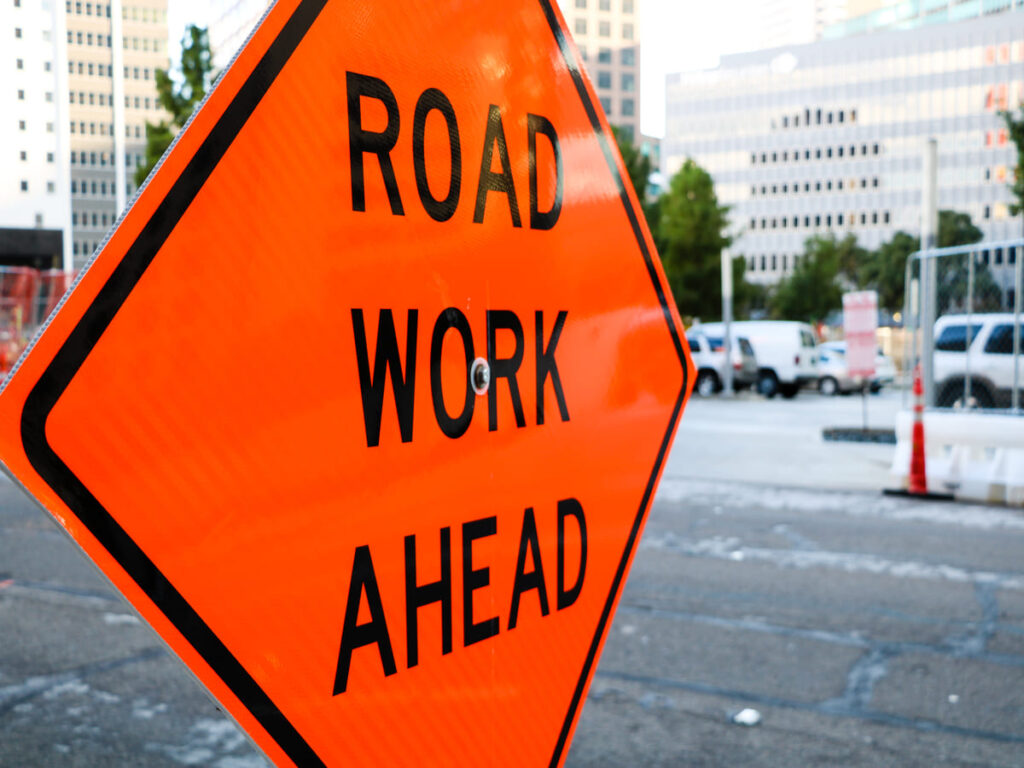
- प्लेसमेंट: The first marker encountered is usually a आगे सड़क कार्य का संकेत.
- प्रभाव: This initial आगे सड़क निर्माण का संकेत must be positioned far enough in advance to account for reaction time. It ensures the driver is alert before reaching any physical hazards.
For the exact placement logic, MUTCD-based spacing considerations, and field-proven setups for different roadway speeds and conditions, पढ़ना सड़क कार्य आगे साइन गाइड.
2. Stage Two: The Regulation (Mandatory Directives)
- उद्देश्य: Once the driver is alert, the next set of सड़क कार्य संकेत must establish the new rules of the road.
- प्लेसमेंट: This stage includes speed limit reductions and mandatory lane-use instructions.
- प्रभाव: By sequencing these directives after a आगे सड़क कार्य का संकेत, drivers are more likely to comply. The “चेतावनी” stage has already justified the need for “Regulation.”
3. Stage Three: The Guidance (Navigation Through the Zone)
- उद्देश्य: This final stage provides clear instructions for navigating through or exiting the work zone.
- प्लेसमेंट: Directional arrows and the end road work sign इस श्रेणी में आते हैं.
- प्रभाव: Clear guidance from these सड़क निर्माण संकेत reduces panic-induced maneuvers. The end road work sign provides a logical conclusion to the temporary traffic pattern.
Breaking Through Visual Noise: Road Work Signs in Urban Environments
In dense urban areas, ए road work sign must compete with neon advertisements, ट्रैफ़िक लाइट, and crowded storefronts. यह “दृश्य शोर” can render standard safety markings nearly invisible if not managed correctly.
- The Contrast Factor: The high-visibility orange used in सड़क कार्य संकेत is designed to provide maximum contrast against grey asphalt and concrete. शहरों में, तथापि, we must position these signs away from similarly colored commercial banners to ensure the orange remains a “disturbing” element that captures the eye.
- Spacing for Clarity: To prevent visual clutter, individual सड़क कार्य संकेत should be separated by enough “empty space.” This allows the driver’s brain to reset and process each instruction individually rather than seeing a blur of orange.
- Lateral Offsets and Height: By varying the lateral distance from the curb or slightly adjusting the mounting height, ए road work sign can break the established visual pattern of the street, making it more likely to be noticed by a distracted driver.
Solving “Visual Saturation”: Preventing Driver Desensitization
In long-term projects, drivers often begin to ignore सड़क कार्य संकेत. This phenomenon is known as “visual saturation” or habituation. If too many सड़क निर्माण संकेत are set in a short distance, the driver’s cognitive system “shuts off.” To maintain alertness, the density of signs must match the speed and reaction time of the road.
Current safety recommendations suggest that a single आगे सड़क कार्य का संकेत should not exceed three to five word groups. Complex descriptions force drivers to lose focus on the road. इसके अतिरिक्त, maintaining a sense of urgency is vital. If work is inactive, failing to cover a आगे सड़क कार्य का संकेत leads to a loss of credibility. When a project is finished, the immediate installation of an end road work sign helps maintain the integrity of the warning system.
Technical Precision: Calculating Buffer Spaces and Tapers
Effective traffic management requires more than just placing a road construction ahead sign; it demands a precise engineering of the “बफर स्पेस.” This lateral and longitudinal empty zone acts as a secondary safety net between the first road work signs and the actual work activity.
The length of the taper—the strategic line of channelizing devices—must be mathematically proportional to the posted speed limit. हाई-स्पीड जोन के लिए, a road work ahead sign requires a significantly extended buffer. This accounts for the increased braking distance of heavy freight vehicles. By maintaining these scientific margins, site managers ensure safety even if a driver late-reacts to the initial road construction signs. They have sufficient “recovery space” to avoid entering the active work area.
Site Configuration Analysis: The Blind Curve Challenge
Standard buffer calculations work well on straight roads. तथापि, complex geometries require different strategies. Winding coastal routes often suffer from “Sight-Distance Deficiency.” Standard spacing fails here. Topography often obstructs the driver’s view.
The Operational Failure Mode Consider a high-speed blind curve scenario. Placing a आगे सड़क निर्माण का संकेत at minimum distance often fails. At the curve’s apex, steering demands full attention. Drivers ignore warnings presented at this critical moment. This leads to late reactions.
को क्रियान्वित करना “Extended Advance” रणनीति Traffic managers must use an “Extended Advance Warning” protocol. This separates reading tasks from steering tasks.
- Pre-Curve Priming: इसे रखो आगे सड़क कार्य का संकेत 300–500 meters upstream. This primes the driver on the straight approach.
- Mid-Curve Reinforcement: Mount a secondary आगे सड़क निर्माण का संकेत on the outer radius. This maintains awareness.
- Safe Termination Logic: Push the end road work sign 50 meters past the exit. Drivers must clear the hazard before accelerating.
Qualitative Outcome This configuration creates a predictable environment. It reduces “panic braking” mid-curve. Traffic flow remains stable despite limited sightlines.
रखरखाव और निरीक्षण: Ensuring Continuous Compliance
The visual hierarchy of a construction site is a living system. It requires constant maintenance to remain compliant. Environmental factors such as high winds or heavy rain can easily shift a आगे सड़क निर्माण का संकेत out of its optimal viewing angle. To mitigate this, site supervisors should implement specific audit protocols:
- Daily Drive-Through: Supervisors must verify that the sequence remains unbroken. It must be clearly visible from the driver’s perspective, from the first आगे सड़क कार्य का संकेत to the final end road work sign.
- Night-time Inspection: Dust or road grime can compromise the retroreflective performance of your सड़क निर्माण संकेत. Regular cleaning ensures high visibility.
- Position Verification: Ensure no signs have drifted into the buffer zone. A single displaced sign can break the entire cognitive chain and increase legal liability.
To keep sites compliant, crews need a clear reference point. अमेरिका में।, MUTCD sets the temporary traffic control framework for sign selection, प्लेसमेंट तर्क, and sequence continuity. OSHA reinforces the duty to warn and protect workers through effective hazard communication on and around the jobsite.
Compliance basis: MUTCD and OSHA provide the primary regulatory baseline for how construction signage must perform in the field; for the detailed requirements and how to apply them step-by-step, पढ़ना विनियामक अनुपालन और निर्माण स्थल साइनेज: MUTCD और OSHA मानकों को समझना.
निष्कर्ष: Engineering Safety Through Professional Roadwork Signage
Effective traffic control is a precise engineering of information flow. By using scientific sequencing and visual optimization, road work signs can achieve their maximum warning potential.
Implementing a high-standard visual hierarchy with the correct road work ahead sign placement significantly improves site safety. From the initial road construction ahead sign to the final end road work sign, every element plays a role in reducing accidents. When every sign is in its correct place, the work zone becomes efficient and safe.
Achieving this level of visual precision requires equipment that withstands the elements. ऑप्टट्रैफ़िक supplies verified, high-grade road work signs designed to maintain maximum retroreflectivity in dust, बारिश, and harsh sunlight. From the first warning to the end road work sign, विश्वास ऑप्टट्रैफ़िक to equip your fleet with tools that reduce replacement costs and enhance site safety. Explore our full range of metal and corflute signage solutions अब.
अक्सर पूछे जाने वाले प्रश्न
Traffic managers must follow a “Warn, Regulate, मार्गदर्शक” sequence. पहला, position the road work ahead sign to alert drivers. अगला, place regulatory signs like speed limits. अंत में, use directional arrows to guide traffic through the taper.
In high-speed zones, place the initial road construction ahead sign 300–500 meters upstream. This distance accounts for the stopping sight distance of heavy trucks. It ensures drivers react before reaching the transition area.
Urban environments create “दृश्य शोर” that hides safety equipment. इसे ठीक करने के लिए, increase the lateral offset from the curb. भी, leave “empty space” between individual road construction signs. This separates the warning from commercial advertisements.