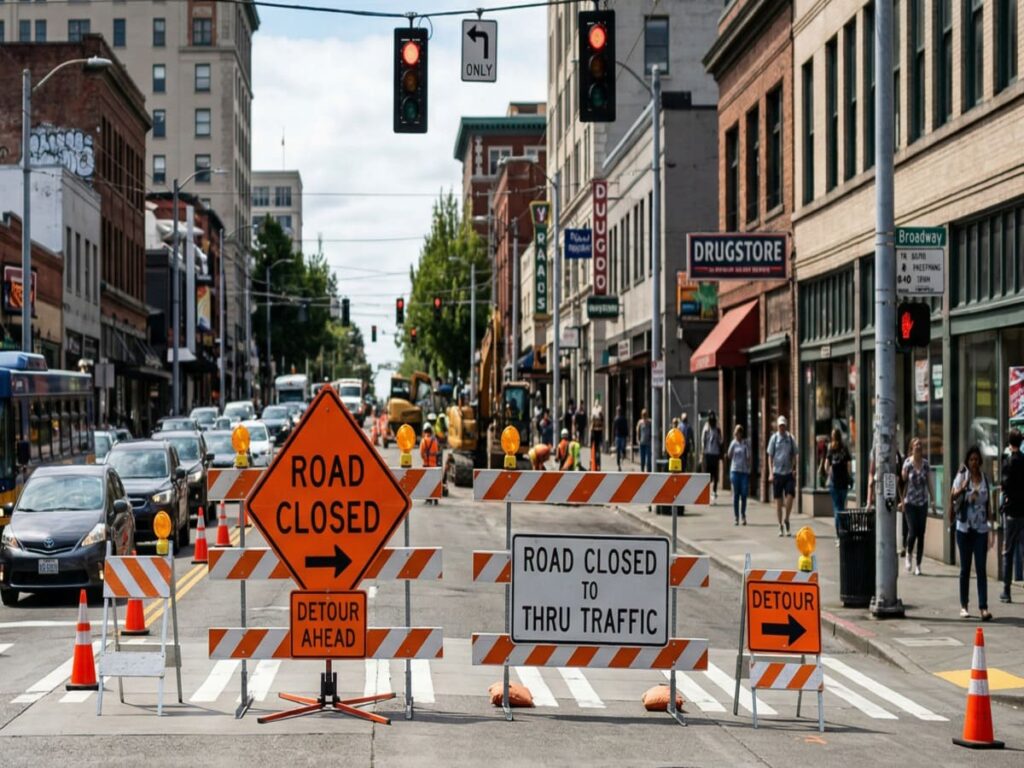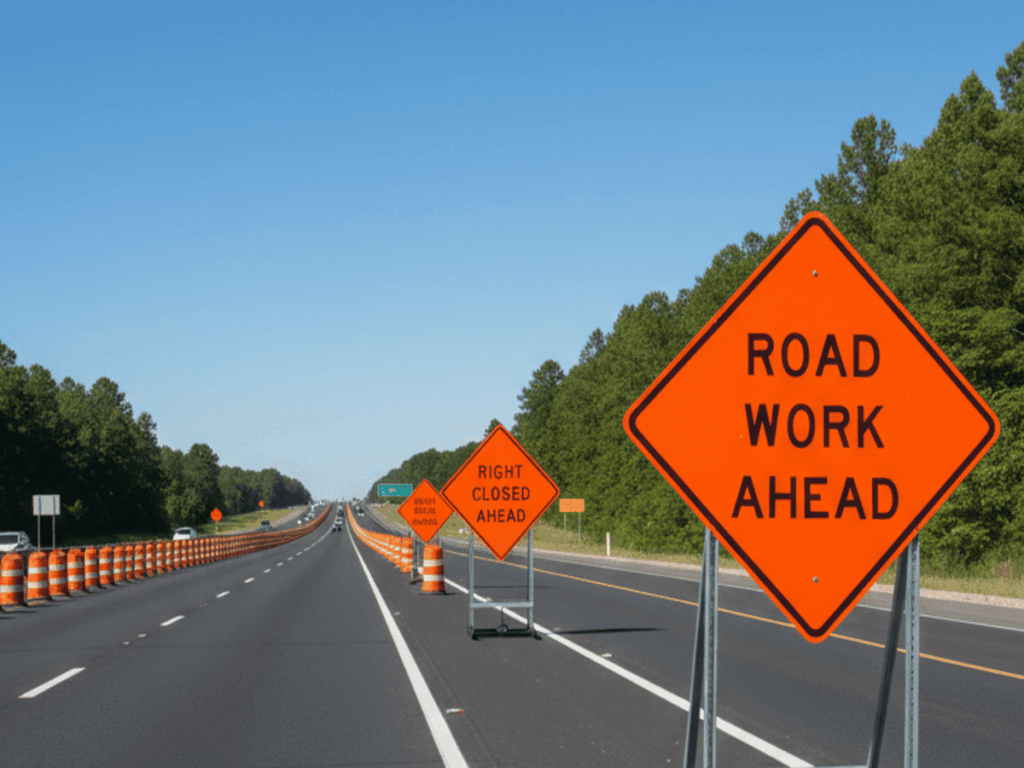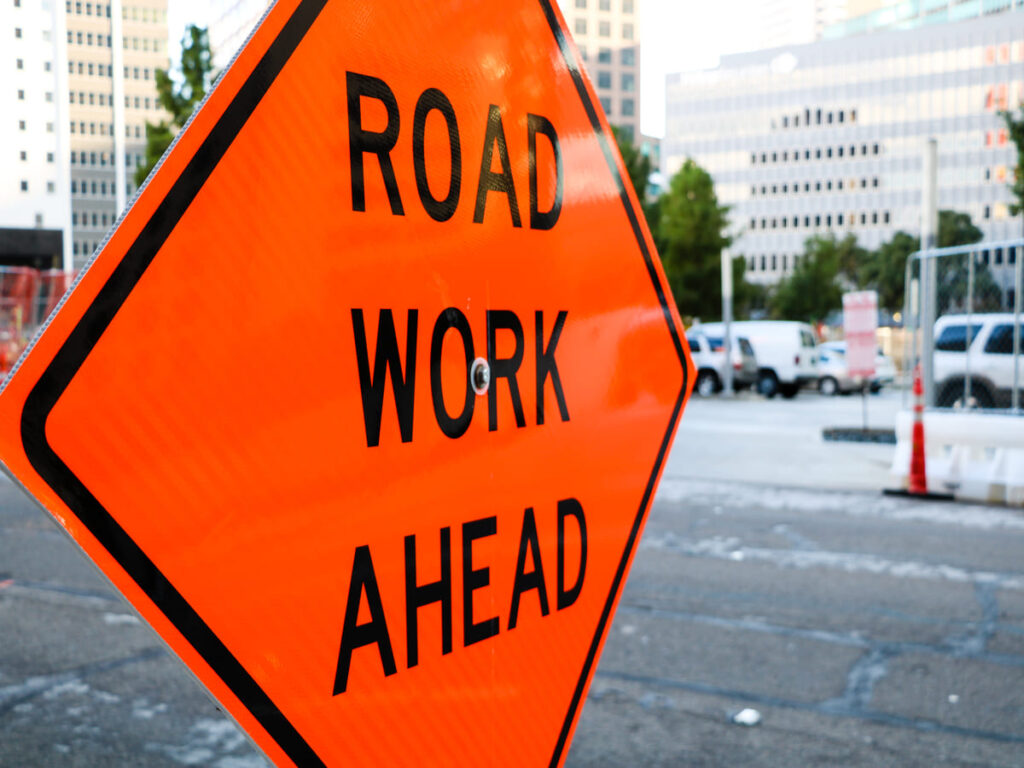
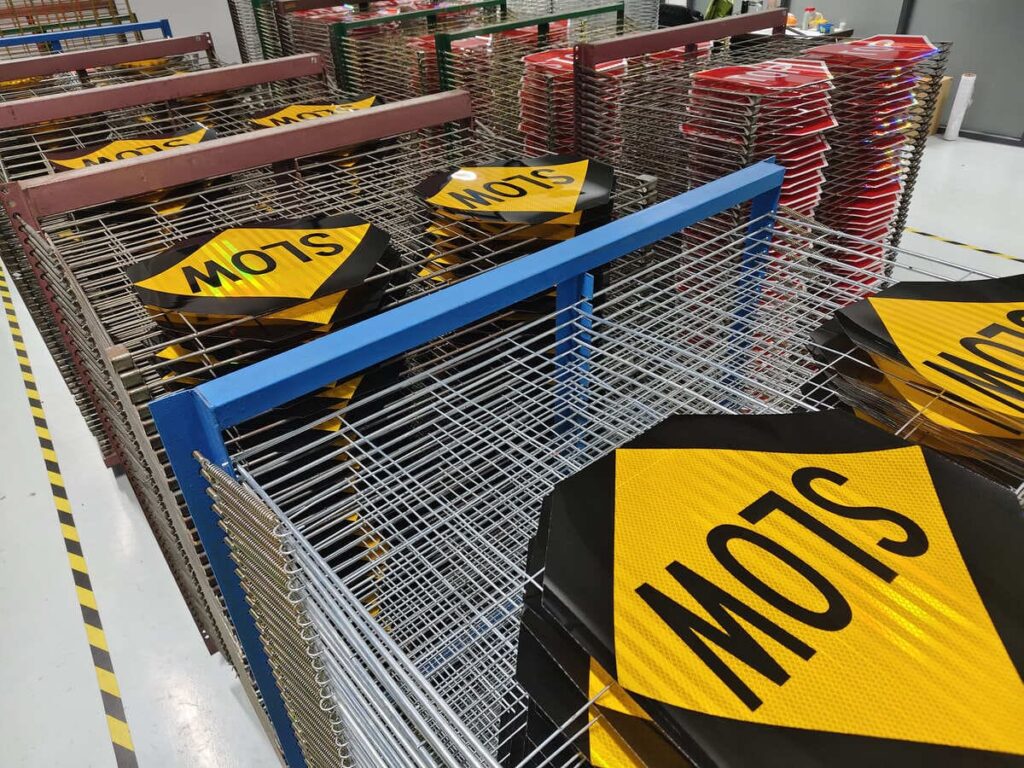
Work zones become most unstable when two directions are forced to share a single lane. Drivers cannot safely “negotiate” that constraint on their own because the conflict is not gradual—it is binary. Either one direction is released and the segment stays clear, or opposing vehicles meet inside a narrow section with limited escape space.
That is the core reason यातायात नियंत्रण धीमी गति के संकेत रोकें are used for one-lane operations. On a construction site, a STOP/SLOW device is not just a message; it functions as a controlled gate that regulates when vehicles may enter the constrained segment and when they must hold. When the operation is run with consistent timing and clear upstream warning, alternating flow becomes predictable for drivers and far safer for crews working inside the activity area.
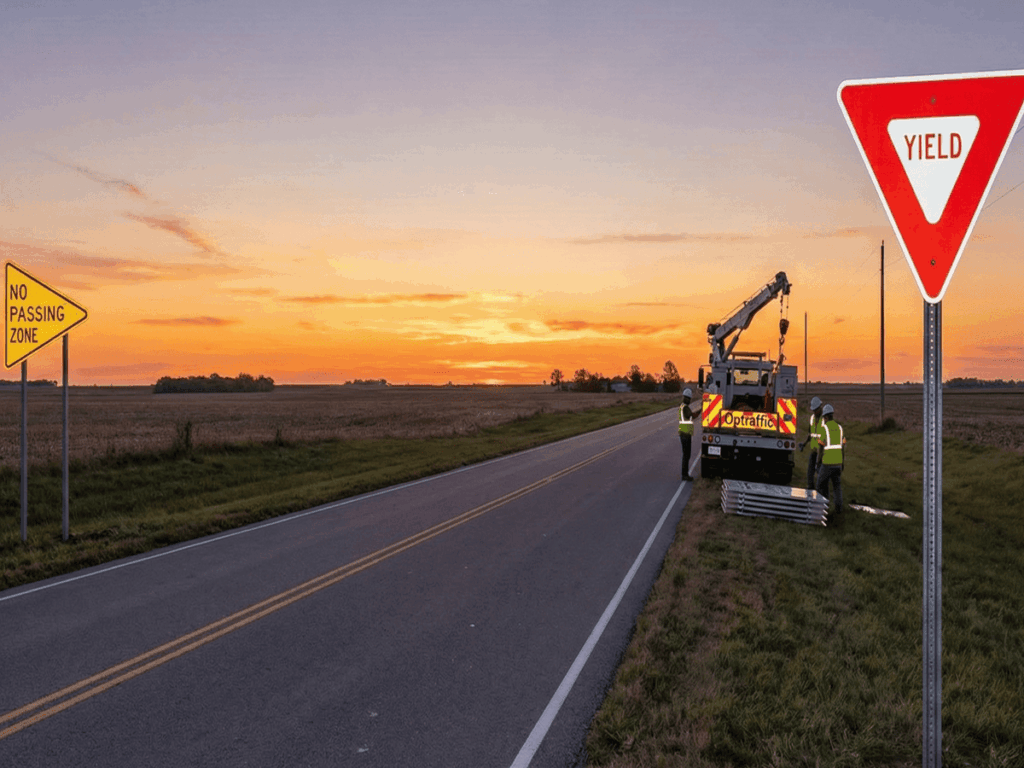
One-lane control depends on clear devices crews handle all day. ऑप्टट्रैफ़िक manufactures high-quality रुकने/धीमे संकेत. The signs use high-visibility faces. The build supports daily jobsite use for construction companies and contractors.
Why one-lane traffic control requires active right-of-way control
In a standard lane closure with a clear merge, most driver behavior can be shaped with warning and guidance: गति को कम करें, merge early, follow channelization, and continue. एक लेन, two-way conditions are different. The work zone has created a temporary geometry where only one movement can occupy the segment at a time.
Construction teams typically see the same failure pattern when active control is missing or weak: one driver enters because the segment “looks open,” an opposing driver does the same from the other end, and both commit into a space that is too narrow to pass. Even when drivers avoid a direct conflict, they brake abruptly, reverse, or pull into unsafe edges—behaviors that increase worker exposure and create stop-work interruptions.
A one-lane operation therefore needs a method that replaces informal driver judgment with a single, decisive right-of-way instruction. That is precisely what यातायात नियंत्रण धीमी गति के संकेत रोकें are designed to do.
What traffic control stop slow signs actually control in a one-lane setup
Traffic control stop slow signs perform three control functions that warning signs cannot.
Entry into the constrained segment
The STOP/SLOW point acts like a gate. When the device displays STOP, vehicles are held outside the conflict area. When it displays SLOW, vehicles are released into the segment under controlled conditions. This entry control is the fundamental safety mechanism: it prevents the “two directions meet in the middle” scenario that drives most serious one-lane failures.
Separation in time
One-lane traffic control is not about “finding space.” It is about creating time separation between opposing movements. The stop/slow method enforces that separation by releasing one direction, allowing the segment to clear, then releasing the opposite direction. Without disciplined separation in time, the segment becomes a negotiation zone—and negotiation zones are where drivers make unpredictable decisions.
Short hazard windows inside the work area
Many one-lane operations are not static. Equipment may back into the lane, trucks may enter or exit, and crews may work near the open path. In those moments, the correct instruction can change quickly. A stop/slow control point can hold traffic immediately during short hazard windows and release it as soon as the path is clear—something a stand-mounted warning sign cannot do.
For a broader explanation of the stop slow sign meaning beyond one-lane setups—why STOP/SLOW functions as active right-of-way control in many work zones—see “What a Stop Slow Sign Means in Road Construction.”
How a one-lane stop/slow operation works on active shifts
A stable one-lane operation depends less on “more devices” and more on consistent sequence. Construction companies that run these setups smoothly tend to follow the same operational rhythm: prepare drivers early, control entry decisively, and switch directions only after the segment is confirmed clear.
Upstream warning that makes the gate effective
The stop/slow point performs best when drivers arrive ready to stop. Clear work-zone warning and guidance upstream creates that readiness and prevents the control point from surprising drivers. Surprise leads drivers to brake late, compress queues abruptly, और नियंत्रण बिंदु पर भीड़ लगाएं. That behavior raises risk for everyone near the lane edge.
For construction supervision, the operational goal is simple: drivers should reach the stop/slow point at a reduced, controlled speed with enough spacing to stop smoothly. When that goal is met, compliance improves and releases become more predictable.
Control point placement that prioritizes recognition and stopping distance
One-lane stop/slow control succeeds or fails on the approach. If drivers cannot see the control point early enough, the setup triggers hard braking and unstable queues. Poor placement makes the problem worse. Crest curves, sharp horizontal curves, and visual clutter reduce sight distance. Drivers lose a clear instruction window, and compliance becomes inconsistent.
Construction teams typically evaluate placement by asking whether an approaching driver has enough distance to: recognize the condition, interpret STOP vs SLOW, and stop smoothly without emergency braking. If that chain breaks, the control point becomes a hazard rather than a control tool.
One flagger versus two ends of control
एक लेन में, two-way operations, crews must maintain visibility and control continuously. When a single station cannot maintain clear visibility and effective control, crews typically place control at each end of the constrained section. One-lane traffic control guidance states this logic directly: if one station cannot maintain good visibility and control, a flagger should control traffic from each end of the section.
This is a practical rule for construction: if the segment is long, curved, or visually obstructed, the operation needs coordinated control at both ends to prevent opposing vehicles from entering simultaneously.
Release discipline and clearance time
The most common operational mistake in one-lane control is switching directions too early. The fix is not complicated, but it must be consistent: releases should be long enough to move a stable group of vehicles, and switches should occur only after the segment is allowed to clear.
Clearance time is the buffer that prevents opposing vehicles from meeting inside the constrained section. Construction teams usually treat clearance as a non-negotiable step—especially when heavy trucks are in the queue, because truck acceleration and spacing requirements extend the time needed for the segment to fully clear.
Standards context that supports stop/slow control
For construction companies operating in the U.S., STOP/SLOW control is not merely tradition; it is tied to recognized work-zone control practice.
OSHA’s construction signaling standard states that signaling by flaggers and the use of flaggers must conform to Part 6 MUTCD का. MUTCD guidance emphasizes that the STOP/SLOW paddle should be the primary and preferred hand-signaling device, and that flags should be limited to emergency situations.
For one-lane operations in particular, MUTCD भाग 6 addresses Automated Flagger Assistance Devices (अफाड्स) and sets a strict operating rule: a trained flagger must operate the AFAD from a position near it and within line of sight, and the flagger must not leave it unattended while it is in use. This rule reinforces a key concept in one-lane control: the method relies on active operation and real-time decisions at the gate.
Common failure modes in one-lane stop/slow operations
Construction leadership often improves one-lane performance fastest by identifying the specific failure mode occurring on site and correcting the operational cause.
Switching too early and creating an inside-segment conflict
This typically occurs when the operation switches directions before the last released vehicle clears the constrained section. The outcome can be an opposing meet, abrupt braking, or drivers attempting unsafe pull-offs. Preventing this failure is primarily a discipline issue: clearance time and confirmation must be treated as mandatory, वैकल्पिक नहीं.
Releasing too aggressively and encouraging speed through the segment
If drivers perceive “SLOW” as permission to accelerate to recover time, speeds rise inside the work zone. That behavior increases stopping distance inside a constrained space and raises the severity of any intrusion. Stable operations reinforce that SLOW is a controlled release into a work zone, not a suggestion to “make up time.”
Control point crowding and unstable queues
When upstream warning is weak or placement is poor, drivers arrive too fast and too close together. The queue compresses, tempers rise, and the control point becomes chaotic. This is where aggressive lane changes, tailgating, and “queue jumping” attempts become more common—behaviors that force crews to pause work and re-stabilize traffic flow.
Access conflicts from driveways and side streets
One-lane operations often interact with local access points. When access vehicles are allowed to enter without fitting into the release rhythm, the segment can be occupied unexpectedly when the opposite direction is released. Stable operations treat access as a managed input into the cycle, not an exception that overrides it.
What drivers should do when they encounter one-lane stop/slow control
Construction companies benefit when driver expectations are simple and consistent. The safest operations are those where drivers experience the same rule set every time.
When the device shows STOP, drivers should stop where directed and remain stopped until released. Creeping forward into the constrained segment undermines the gate function and increases conflict risk.
When the device shows SLOW, drivers should proceed at a controlled speed, अंतर बनाए रखें, follow the channelization, and remain prepared to stop again. In one-lane operations, SLOW is a controlled release into an abnormal roadway condition, not a return to normal driving.
निष्कर्ष
One-lane traffic control works best when crews treat it as an operating method, not a collection of signs. Traffic control stop slow signs provide the core function these setups require. The STOP/SLOW point creates a controlled gate, regulates entry, and enforces separation in time. It also prevents opposing movements from meeting inside the constrained segment.
Clear upstream warning prepares drivers. Proper placement gives drivers time to recognize the instruction and stop safely. Disciplined switching happens only after the segment clears. These habits stabilize flow, reduce near-misses, and cut stop-work interruptions.
अक्सर पूछे जाने वाले प्रश्न
What are traffic control stop slow signs used for in one-lane work zones?
They are used to control right-of-way and regulate entry into a constrained segment so opposing movements do not occupy the same space at the same time.
Why are warning signs alone not enough for one-lane, दोतरफा यातायात नियंत्रण?
Warning signs can prepare drivers, but they cannot assign real-time right-of-way. One-lane conditions require separation in time and a controlled gate to prevent opposing vehicles from meeting inside the segment.
What is the most common cause of failures in one-lane stop/slow operations?
Switching directions too early is one of the most frequent causes. Clearance time and confirmation that the segment is clear are essential to prevent inside-segment conflicts.