UN traffic control truck setup decides how fast a crew can open a work zone and how safely it can leave one. A missing sign stand delays the first taper. A cone stack piled too high hides the rear warning sign. A loose sign blows off the tray at highway speed. These are setup problems, not equipment problems. This guide shows how to load each vehicle type and secure the load under US and Australian rules. It also shows how to spec one complete kit for a whole fleet.
The stakes keep rising. Missouri recorded 50 crashes involving truck-mounted attenuators (TMA) dans 2025. By early September 2026, MoDOT had counted 31 plus, according to KY3’s report on the I-44 Doolittle crash. MoDOT tracks these protective-vehicle crashes as a formal performance measure. Every truck that enters a live lane needs a setup that works the first time.
Principaux à retenir
- One-supplier truck kit: Optraffic matches signs, stands, cones and warning devices to each vehicle, so fleets avoid mismatched parts.
- Custom tray and frame: Optraffic builds tray layouts around the customer’s vehicle, so rear signs stay visible when fully loaded.
- In-cab controller: Optraffic offers in-cab control for truck-mounted boards, so operators change messages without leaving the cab.
- Free Web System: Optraffic Web System tracks truck-mounted boards at no subscription cost, so rental fleets cut monitoring overhead.
- MUTCD and AS/NZS builds: Optraffic configures each truck to the target market’s rules, so one order serves US or Australian fleets.
What a Traffic Control Truck Setup Includes
Chaque traffic control truck setup combines four equipment layers. Each layer does a different job. Missing one layer breaks the whole work zone.
| Couche | Ce qu'il fait | Typical Items |
|---|---|---|
| Vehicle-mounted warning | Warns approaching drivers before they reach the crew | Truck-mounted arrow board or message sign, balises orange, rear lamps |
| Canaliser les appareils | Builds the taper and guides traffic past the work area | Cônes de signalisation, barreaux, bollards, canaliseurs |
| Signs and stands | Gives advance warning and regulatory instructions | Panneaux de zone de travail temporaire, Signer les cadres, arrêter/ralentir les palettes |
| Crew and site safety | Protects workers inside the zone | Safety flags, bunting lines, LED wands, work basket for elevated tasks |
Notre work zone traffic control packages guide matches these layers to each closure type. This article matches them to each vehicle type instead. The two views work together. Closure type sets the device count. Vehicle type sets how that count fits on board.
Traffic Control Truck Setup by Vehicle Type
Vehicle class changes three things: payload, mounting height and road speed. UN pickup truck traffic control setup suits short urban jobs. UN tray truck carries a full lane-closure kit. UN TMA truck shields the crew on high-speed roads.
| Vehicle | Meilleure utilisation | Warning Device | Load Focus | Main Setup Risk |
|---|---|---|---|---|
| Ramasser / ute | Short-duration urban work, braquage, inspections | Compact arrow board, roof beacons | Cônes pliables, panneaux enroulables, pagaies | Overloading a small bed |
| Tray / flatbed truck | Fermetures de voies, cone deployment, multi-day jobs | Full-size arrow board on a raised frame | Full cone sets, rigid signs, stands, bunting | Load stacked above sign height |
| TMA / shadow truck | Mobile and high-speed operations | Large arrow board or message sign above the attenuator | Minimal cargo, warning focus | Weak advance warning upstream |
Pickup and Ute Setups
Pickups and utes run most short-duration jobs. Payload is tight, so every item must earn its space. Collapsible cones and roll-up signs save bed room. A bed-rail or rack mount keeps the arrow board above the cab line.
Australian crews call this vehicle a ute. Le NTC Load Restraint Guide for Light Vehicles covers vehicles up to 4.5 tonnes. Most utes fall under it.
Tray Truck Setups
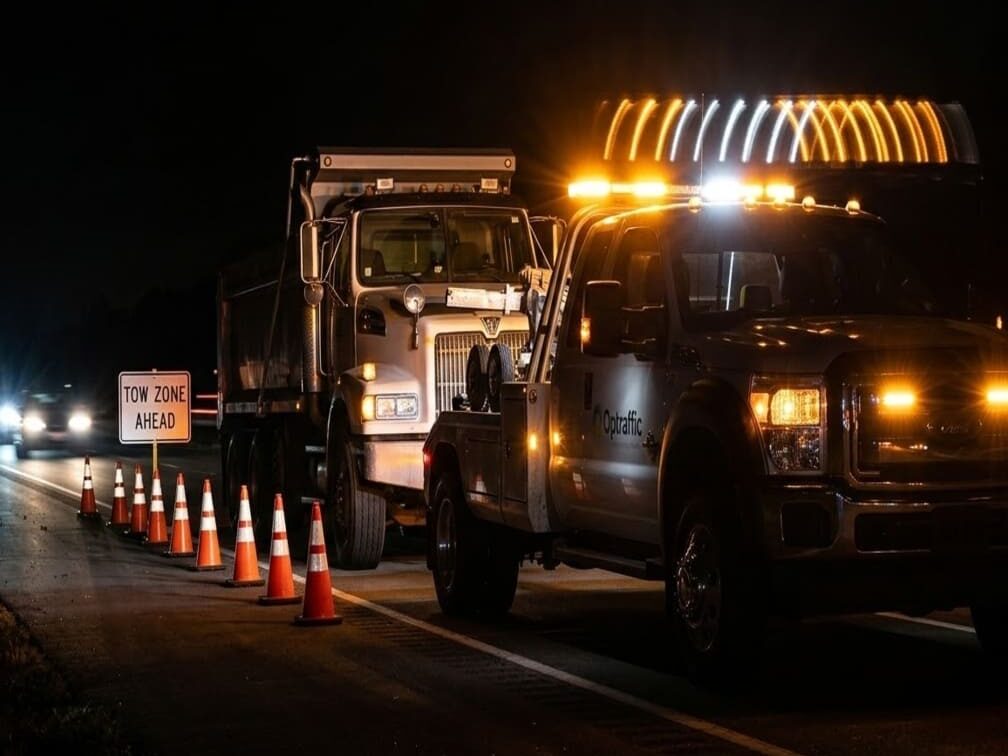
The tray truck is the workhorse of a traffic control truck setup. It carries the full kit for a lane closure. A custom tray with side rails, a cone rack and a sign compartment keeps each item in a fixed slot. Crews then load and unload in the same order every day.
Tray trucks also deploy cones directly into the lane. Our guide to camions à cône de circulation explains cone deployment from the rear platform.
TMA and Shadow Truck Setups
A TMA truck rarely carries much cargo. Its job is protection. The Kansas Turnpike Authority runs mobile work with at least three vehicles, as its safety coordinator explained in April 2026. These are a shoulder shadow truck, a lane shadow truck and a work vehicle. The lane shadow truck carries the arrow board and crash attenuator. The work vehicle carries the crew and equipment.
This split matters for loading. The TMA keeps its rear face clear. The work vehicle carries the cones and signs.
Loading Layout: Where Each Item Goes on the Tray
A good layout follows one rule: the first item out goes on last. Advance warning signs come out first, so they sit closest to the tailgate. Cones for the taper come next. Site items for the activity area go deepest.
| Tray Zone | Items | Why It Goes Here |
|---|---|---|
| Rear (hayon) | Panneaux d'avertissement à l'avance, supports de signalisation | Crews place these first, furthest upstream |
| Rear-middle | Taper cones on a cone rack or cone bar | Fast deployment in a steady line |
| Milieu | Canaliseurs, bollards, spare cones | Used for the tangent and buffer |
| Front (behind cab) | Bunting, drapeaux de sécurité, pagaies, LED wands, outils | Used inside the activity area |
| Raised frame | Arrow board or message sign | Must stay visible above the load |
The MUTCD sets a hard rule here. Panneaux montés sur véhicule must not be obscured by equipment or supplies. Sign legends must also be covered or turned away when work is not in progress. This rule appears in Partie MUTCD 11e édition 6. The current FHWA version is the 11th Edition with Revision 1, daté de décembre 2025.
En pratique, crews break this rule by stacking cones too high. A raised arrow board frame solves it. UN truck-mounted arrow board with a tilt mount also folds flat when the truck travels between sites. Voir le Optraffic truck mount arrow board for mounting options by vehicle.
Securing the Load: US and Australian Rules
A loose sign at 60 mph becomes a projectile. Both markets set clear load-securement rules. Both also set rules for the signs carried on the vehicle.
| Exigence | États-Unis | Australie |
|---|---|---|
| Work zone device rules | Mutcd 11e édition, Partie 6 | COMME 1742.3 and Austroads AGTTM |
| Panneaux montés sur véhicule | Must not be obscured; cover or turn when idle | COMME 1742.3 Section 4.14, vehicle-mounted signs and devices |
| Load restraint (light vehicles) | 49 Partie CFR 393, Subpart I | NTC Load Restraint Guide for Light Vehicles |
| Load restraint (véhicules lourds) | 49 Partie CFR 393, Subpart I | NHVR Load Restraint Guide |
Aux États-Unis, 49 Partie CFR 393, Subpart I protects against shifting and falling cargo on commercial trucks. En Australie, COMME 1742.3 covers vehicle-mounted warning devices and flashing arrow signs in Section 4.14. The Northern Territory also publishes guidelines for cone trucks on NTG roads. These set speed limits and lateral clearance for cone deployment.
Fixed slots beat straps alone. A cone rack, a sign compartment and lockable stand holders stop items from sliding. Straps then act as a second layer, not the only one.
Traffic Control Truck Checklist: Before the Truck Leaves the Yard
A written traffic control truck checklist stops most setup failures. Run it at the yard, not at the site.
| Vérifier | Pass Standard |
|---|---|
| Arrow board / message sign | Powers on, all lamps lit, correct mode loaded |
| Beacons and rear lamps | All flashing, lenses clean |
| Cone count | Matches the traffic control plan, plus spares |
| Sign set | Every sign in the plan is on board and clean |
| Sign stands | One stand per sign, legs and pins present |
| Load restraint | Racks locked, straps tensioned, nothing above sign height |
| Crew items | Pagaies, drapeaux, wands, bunting on board |
| Rear visibility | Rear warning sign fully visible from behind |
Use this list alongside our work zone sign kit guide for Australian roads. That guide details the AU sign set itself.
Common Setup Mistakes That Cost Rental Fleets Money
Rental fleets and system integrators see the same problems across many trucks. Each one costs crew hours or a failed inspection.
- Mismatched parts from many vendors. Signes, stands and racks from different suppliers rarely fit together. One matched traffic control truck equipment order removes this risk. Optraffic supplies signs, stands, cônes, bollards, bunting and warning devices as one coordinated kit.
- Rear signs hidden by cargo. This breaks the MUTCD rule above. A custom tray with a raised board frame fixes it. Optraffic designs the tray and frame around the customer’s vehicle model.
- Operators leaving the cab to change messages. Every exit into traffic adds exposure. An in-cab controller lets the driver switch arrow modes from the seat. Controller options for each board are listed on the product page.
- No view of fleet status. Managers cannot see which board failed until a crew reports it. Optraffic Web System monitors connected boards remotely and costs nothing extra. Many competitors charge a subscription for the same view.
- Wrong cones for the vehicle. Full-size rigid cones waste space in a ute. Collapsible cones suit small beds. Notre traffic cones range covers both formats.
How to Spec a Complete Truck Kit in One Order
Buyers save the most time by sending one complete brief. These five inputs let a supplier quote the whole traffic control truck setup immédiatement.
- Vehicle model and tray size. These set the frame, rack and board size.
- Operation type. Short urban jobs, lane closures and mobile work need different kits.
- Market standard. MUTCD for the US, COMME 1742.3 pour l'Australie.
- Trucks in the fleet. Kit quantity scales with fleet size.
- Message needs. Arrow-only work suits an arrow board. Detours and incidents may need a truck-mounted message board.
Our Team configures each traffic control truck to MUTCD, AS/NZS and other local regulations. Optraffic produces in an ISO 9001-certified factory. As an end-to-end manufacturer, Optraffic ships the signs, devices and tray parts in one consolidated order. That removes third-party markups and cross-vendor fit problems.
This guide covers setup logic, not product specifications. For board sizes, lamp options, controllers and mounting kits, see each product page linked above.
Conclusion
A strong traffic control truck setup starts with the vehicle. Pickups and utes need compact, collapsible kits. Tray trucks need fixed slots and a raised board frame. TMA trucks need a clear rear face and strong advance warning. Every vehicle needs a traffic control truck checklist and a load-restraint plan that meets local rules.
Fleets get the best result from one matched kit. Optraffic supplies the panneaux de signalisation, stands, cones and warning devices for each truck, configured to your market’s standards. Send our Team your vehicle model and operation type for a complete truck kit quote.
FAQ
What equipment goes on a traffic control truck?
Une norme traffic control truck setup carries four layers. These are vehicle-mounted warning devices, dispositifs de canalisation, signs with stands, and crew safety items. The exact count comes from the traffic control plan.
What is the difference between a traffic control truck and a TMA truck?
A traffic control truck carries the equipment for a work zone. UN TMA truck carries a crash attenuator and shields the crew from errant vehicles. Mobile operations often use both.
How should cones be loaded on a traffic control truck?
Load taper cones near the tailgate on a cone rack or cone bar. Keep the stack below the rear warning sign. Lock the rack before the truck leaves the yard.
Can a ute be used as a traffic control vehicle in Australia?
Oui, for short-duration work. The ute must carry compliant vehicle-mounted warning devices under AS 1742.3. Its load must also meet the NTC Load Restraint Guide for Light Vehicles.
Do vehicle-mounted signs need to be covered when not working?
Oui, aux États-Unis. The MUTCD requires legends on panneaux montés sur véhicule to be covered or turned from view when work is not in progress.
How often should a traffic control truck checklist be completed?
Complete the traffic control truck checklist before every shift. Run it at the yard, so crews fix gaps before reaching the site.
Can Optraffic supply a complete traffic control truck kit for my vehicle?
Oui. Optraffic configures each kit to the vehicle model, operation type and market standard. Signes, stands, cones and warning devices ship together in one order. Send our Team your vehicle details for a quote.
Where can I find product specifications for truck-mounted boards?
Each product page lists sizes, controller options and mounting kits. This guide covers setup logic only. Visit the truck mount arrow board and truck-mounted message board pages for full specifications.