_1795568206_WNo_1600d900.jpg)
UN no parking left arrow sign is a regulatory parking sign that identifies the direction in which a parking restriction applies. The left-pointing arrow generally tells drivers that parking is prohibited along the curb to the left of the sign, helping define the restricted section of a street, allée, or parking area. The exact boundary depends on the sign location, panneaux à proximité, and applicable local traffic regulations.
This guide explains what a no parking left arrow sign means, how to interpret its direction, where to place it, and how it relates to MUTCD requirements. It also compares left-arrow signs with right-arrow and double-arrow signs and outlines the materials, Propriétés réfléchissantes, and design details to consider when selecting parking restriction signs for public roads and private properties.
Quick Navigation
- What Is a No Parking Left Arrow Sign?
- What Does a Left Arrow Mean on a No Parking Sign?
- Left Arrow vs. Right Arrow vs. Double Arrow
- How to Read a No Parking Left Arrow Sign
- MUTCD Rules for No Parking Signs with Arrows
- Where Should a No Parking Left Arrow Sign Be Installed?
- Common Applications of No Parking Left Arrow Signs
- Materials and Key Features to Consider
- How to Choose the Right No Parking Left Arrow Sign
- FAQs About No Parking Left Arrow Signs
- Conclusion
What Is a No Parking Left Arrow Sign?
Definition and Basic Purpose
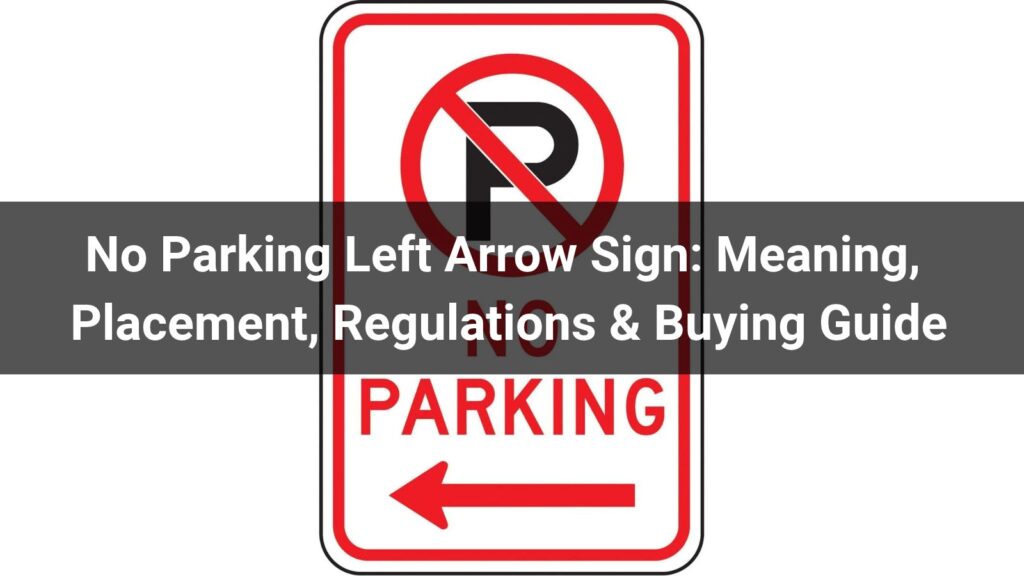
UN no parking left arrow sign is a parking restriction sign that combines a no-parking message with a left-pointing directional arrow. It informs drivers that parking is prohibited in the direction indicated by the arrow, generally along the curb or roadside area to the left of the sign.
Unlike a basic NO PARKING sign, which communicates the restriction but may not independently identify its full extent, an arrow sign helps define the direction in which the rule applies. This is particularly useful on streets where parking is permitted in some sections but prohibited in others.
The main purposes of a no parking left arrow sign include:
- Defining restriction direction: Shows drivers which direction along the curb is subject to the no-parking rule.
- Clarifying parking boundaries: Helps distinguish restricted curb sections from nearby areas where parking may be allowed.
- Supporting traffic flow: Keeps selected curbside areas clear for vehicle movement, accéder, and other operational needs.
- Improving road safety: Helps prevent vehicles from obstructing intersections, allées, zones de chargement, and other important locations.
- Supporting enforcement: Provides a visible directional reference for drivers, parking enforcement personnel, et gestionnaires immobiliers.
The arrow should always be interpreted together with the complete sign message and the surrounding parking regulations. A left arrow does not automatically mean that parking is prohibited throughout an entire street or block.
Typical Design of a No Parking Left Arrow Sign
A typical no parking left arrow sign uses a rectangular panel with a white background, frontière rouge, and red lettering. The message may read NO PARKING ANY TIME, PARKING INTERDIT, or another locally approved restriction. A single left-pointing arrow is commonly displayed below the main message.
Par exemple, the MUTCD R7-1 sign design is identified as NO PARKING ANY TIME with a left-pointing arrow. This is an important reference for understanding the relationship between the parking prohibition and the directional arrow. Actual sign layouts and permitted variations should be checked against the applicable MUTCD edition and local standards.
Common design elements include:
- Fond blanc: Provides contrast for the regulatory message.
- Red border and legend: Identifies the sign as a parking prohibition rather than a permissive parking sign.
- NO PARKING message: Communicates the basic restriction.
- Left-pointing arrow: Indicates the direction in which the restriction applies.
- Feuille de réflexion: Helps make the sign visible when illuminated by vehicle headlights at night.
The exact wording, dimensions, arrow layout, and reflective material should be selected according to the intended installation and relevant traffic control requirements.
What Does a Left Arrow Mean on a No Parking Sign?
A left-pointing arrow on a no parking sign generally means that the parking restriction applies to the left of the sign. Drivers should look in the direction of the arrow and identify the curb section covered by the prohibition.
The Restriction Applies to the Left of the Sign
When a driver approaches a sign displaying NO PARKING with a left-pointing arrow, the arrow indicates that the restricted area extends in the leftward direction along the relevant curb or roadway edge.
Par exemple, imagine a sign installed beside a curb with the arrow pointing toward the nearest intersection. The restriction generally applies along the curb in that direction, subject to the designated zone boundary and any additional signs or local rules.
Drivers should not assume that the restriction always ends at the next driveway, intersection, or block boundary. The actual endpoint must be determined from the posted signs, supplemental messages, marquages de bordure, et réglementations locales applicables.
A Left Arrow Does Not Always Mean the Entire Block Is Restricted
The arrow communicates direction, not necessarily the total length of the restriction. A short restricted section may extend only to a nearby driveway or designated boundary, while a longer zone may continue toward another regulatory sign.
Consider the following example:
- A no parking sign is installed near a building entrance.
- The arrow points left along the curb.
- The restricted section extends toward the next posted boundary or the endpoint established by local regulations.
- Parking beyond that boundary may be permitted if no other restriction applies.
This is why sign placement and arrow orientation must be planned together. A correctly designed sign can still create confusion if it is installed at the wrong location or points away from the intended restricted section.
Check the Complete Message Before Parking
A left arrow is only one part of the sign. Drivers should also read any time restrictions, day restrictions, loading-zone information, exemptions, and tow-away messages.
Par exemple, a sign that reads NO PARKING 8 SUIS–6 PM with a left arrow indicates a directional parking restriction during the posted hours. The parking rule outside those hours may be different, depending on local regulations and other signs in the area.
For a broader explanation of directional parking signs, see OPTSIGNS' guide to the role of arrows on parking signs.
Left Arrow vs. Right Arrow vs. Double Arrow
No parking signs may use a left arrow, right arrow, or double-headed arrow to communicate the direction of a restriction. Although the sign messages may be similar, the arrow configuration changes how the restricted area is identified.
| Type de flèche | General Meaning | Application typique |
|---|---|---|
| Left Arrow (←) | Indicates that the parking restriction applies to the left of the sign. | At the end of a restricted curb section when the prohibited area extends leftward. |
| Right Arrow (→) | Indicates that the parking restriction applies to the right of the sign. | At the end of a restricted curb section when the prohibited area extends rightward. |
| Double Arrow (↔) | Indicates that the restriction applies in both directions from the sign. | At an intermediate point within a continuous restricted zone. |
| Separate Left and Right Arrows | Can identify different restrictions applying in opposite directions. | At a transition point where two parking zones meet and have different rules. |
The arrow should correspond to the physical direction of the restricted curb section. A sign with the wrong arrow may mislead drivers and create disputes about where parking is prohibited.
When Should You Use a Left Arrow?
A left arrow is generally appropriate when the sign is positioned at the right-hand boundary of a restricted section and the prohibited area extends to the left from that point.
Par exemple, a municipality may install a sign near the end of a no-parking zone, with the arrow pointing back along the restricted curb. The sign helps drivers approaching from either direction understand which section is covered, provided that its orientation and placement follow the local sign plan.
When Is a Double Arrow More Appropriate?
A double-headed arrow is generally used when the sign is installed at an intermediate point within a restricted parking zone. It communicates that the prohibition extends in both directions from the sign.
Using a double arrow at the end of a restricted zone can create an inaccurate impression that the restriction continues beyond the actual boundary. The sign configuration should therefore match the physical layout of the zone.
For more details about two-direction restrictions, read the OPTSIGNS article on no parking double arrow sign placement and zone boundaries.
How to Read a No Parking Left Arrow Sign
Reading a no parking left arrow sign correctly requires checking the restriction, time period, applicable days, directional arrow, and any supplementary messages. These elements work together to communicate the parking rule.
Read the Main Parking Restriction
Start with the main message. NO PARKING means that vehicles cannot be parked in the designated area, although brief stops for passenger loading or unloading may be allowed under applicable laws. It should not be confused with NO STANDING or NO STOPPING, which impose different restrictions.
Some signs include additional wording, such as NO PARKING ANY TIME, Pas de zone de chargement de stationnement, or NO PARKING DURING STREET CLEANING. The wording determines the type and scope of the restriction.
Check the Posted Hours and Days
If a parking restriction does not apply at all times, the sign should display the relevant hours or days according to the applicable traffic control requirements. Par exemple, a sign may prohibit parking from 7 Je suis à 6 PM on weekdays but allow parking outside those hours, subject to other restrictions.
Always check the complete time information rather than assuming that a left-arrow restriction applies around the clock. A directional arrow identifies where the rule applies, while the time and day information identifies when it applies.
Follow the Direction of the Arrow
After reading the main message and time restrictions, follow the arrow to identify the restricted direction. A left arrow generally points toward the curb section where parking is prohibited.
Look for other signs, marquage au sol, marquages de bordure, allées, and intersections that may identify the endpoint of the zone. If two signs appear to give conflicting information, follow the applicable local rules and seek clarification from the relevant authority rather than guessing.
Understand Additional Messages and Exceptions
Some no parking signs include supplementary information such as loading restrictions, permit exemptions, tow-away notices, or special event conditions. These messages can change how the basic prohibition applies.
| Sign Information | What It Communicates |
|---|---|
| Pas de parking à tout moment | Parking is prohibited at all times within the designated area. |
| PARKING INTERDIT 8 SUIS–6 PM | The restriction applies during the posted hours. |
| MON–FRI | Identifies the days when the restriction is in effect. |
| ZONE DE CHARGEMENT | Identifies a designated loading area subject to the posted restrictions. |
| ZONE DE REMORQUAGE | Warns that unauthorized vehicles may be subject to towing under applicable rules. |
| LEFT ARROW (←) | Identifies the direction in which the parking restriction applies. |
The MUTCD provides guidance on the order in which parking information should appear on regulatory signs. En général, the restriction comes first, followed by applicable times, jours, supplementary information, exemptions, and tow-away messages.
MUTCD Rules for No Parking Signs with Arrows
Aux États-Unis, le Manuel sur les dispositifs de contrôle de la circulation uniformes (Mutcd) provides national standards and guidance for traffic control devices used on public roads. Its parking sign provisions explain how regulatory messages, couleurs, flèches, and supplementary information should be presented.
Parking Sign Design and Color
Sous le mutcd, parking prohibition signs generally use a white background with red legends and borders. The red color distinguishes parking restrictions from permissive parking signs, which generally use green legends and borders on a white background.
The R7 series includes parking, debout, and stopping signs. The R7-1 design is identified as NO PARKING ANY TIME with a left-pointing arrow. Other designs use different messages, time restrictions, or arrow configurations according to the intended application.
For official design references, consult the FHWA MUTCD 11th Edition with Revision 1, Chapitre 2B, particularly the parking sign provisions and Figure 2B-25.
Arrow Direction and Parking Zone Boundaries
MUTCD Section 2B.53 addresses the use of arrows and supplementary plaques to show the limits of parking regulations. The directional configuration should correspond to the position of the sign within the restricted zone.
| Sign Position | Arrow Configuration | But |
|---|---|---|
| At the end of a parking zone | A single-headed arrow pointing in the direction the restriction applies, or no arrow where appropriate. | Identifies the direction of the restricted section from its boundary. |
| At an intermediate point in a restricted zone | Double-headed arrow pointing in both directions. | Indicates that the restriction applies on both sides of the sign. |
| At the transition between two parking zones | A right arrow and a left arrow indicating the direction of the respective restrictions. | Distinguishes two adjoining areas with different parking regulations. |
The MUTCD also identifies alternative word messages that may be used to clarify restriction boundaries, including BEGIN, FIN, Ici pour se coincer, HERE TO ALLEY, and THIS SIDE OF SIGN. The appropriate option depends on the road layout and the local traffic control plan.
Time and Day Restrictions
When a parking restriction is not in effect at all times or on all days, the applicable hours and days should be displayed. This allows drivers to determine when the prohibition applies without having to infer the schedule from the arrow.
Par exemple, a sign may indicate NO PARKING 7 SUIS–9 AM MON–FRI with a left-pointing arrow. The arrow identifies the direction of the restricted area, while the text identifies the time period and days when the rule is active.
Local Regulations and State MUTCD Supplements
Although the national MUTCD establishes a common framework, states and local authorities may adopt their own supplements or additional requirements. Municipal regulations can also determine parking restrictions, enforcement periods, sign locations, and special curbside uses.
Pour cette raison, a sign that follows a general MUTCD design should not automatically be assumed to satisfy every local installation requirement. Public-road projects should be reviewed against the current state MUTCD, local traffic engineering standards, and the approved parking regulation.
_1795568398_WNo_1600d900.png)
Where Should a No Parking Left Arrow Sign Be Installed?
Correct placement is essential for a no parking left arrow sign to communicate the restriction clearly. The sign should be positioned so that drivers can recognize the message, understand the arrow direction, and identify the restricted curb section before deciding where to park.
At the Boundary of a Restricted Curb Section
A left-arrow sign may be installed at the right-hand boundary of a restricted section when the prohibited area extends leftward from the sign. This arrangement helps communicate the direction of the restriction at the end of the zone.
The sign location should correspond to the actual boundary established by the parking regulation. If the restriction ends at a driveway, alley, intersection, or another designated point, the sign layout should make that endpoint clear.
Near Driveways and Building Entrances
Driveways and building entrances often require clear access for vehicles, livraisons, et services d'urgence. A no parking left arrow sign can help identify the direction of a restricted curb section near these access points.
For commercial properties, the sign should be positioned where approaching drivers can see it before entering the restricted area. The message should also be consistent with any driveway markings, access-control signs, and property parking rules.
Along Loading and Service Areas
Zones de chargement, delivery entrances, and service access lanes may need designated no-parking areas to prevent unauthorized vehicles from blocking operational space. Directional signs can help define the restricted section and distinguish it from nearby parking spaces.
Where a loading restriction is intended, the sign should use the appropriate loading-zone wording and any required time or vehicle restrictions. A general NO PARKING sign should not be used as a substitute for a more specific regulatory message when the application requires one.
At Intersections and Curbside Transitions
Intersections, crosswalk approaches, and curbside transitions often involve several different parking rules. A left-arrow sign can identify the direction of a restricted section, but it should be coordinated with adjacent signs so that drivers do not receive conflicting instructions.
Where two parking zones meet, the sign plan should clearly identify the restriction on each side. Depending on the arrangement, separate directional arrows or supplementary plaques may be necessary.
Consider Visibility and Mounting Conditions
A sign should be visible to approaching drivers and should not be obscured by trees, véhicules stationnés, utility equipment, or other roadside objects. Its mounting position should also provide a clear view of the message and arrow.
- Position the sign where drivers have sufficient time to recognize the restriction.
- Keep the panel clear of visual obstructions.
- Orient the sign so the arrow is easy to interpret in relation to the curb.
- Use suitable posts, supports, and mounting hardware for the installation environment.
- Follow applicable mounting-height, lateral-clearance, and accessibility requirements.
There is no single sign spacing or mounting arrangement that applies to every street. Installation plans should consider road speed, curb length, distance de vue, lisibilité des signes, normes locales, and the number of parking zones involved.
Common Applications of No Parking Left Arrow Signs
No parking left arrow signs are used wherever a parking prohibition needs a clear directional reference. They are suitable for public-road parking control as well as selected private-property and commercial traffic management applications.
Public Streets and Municipal Parking Control
Municipal authorities use parking restriction signs to manage curbside space, maintain traffic flow, and prevent vehicles from obstructing important road features. A left-arrow sign can identify the direction of a no-parking zone along a street.
Typical applications include:
- Keeping selected curb sections clear near intersections.
- Defining restrictions around public facilities and municipal buildings.
- Maintaining access to pedestrian crossings and traffic-control equipment.
- Identifying the boundaries of time-restricted parking areas.
Commercial Properties and Business Entrances
Centres commerciaux, office buildings, hôtels, and commercial properties often need to keep selected curbside areas free from parked vehicles. These areas may be reserved for customer drop-off, delivery access, service vehicles, or building operations.
A directional no parking sign helps property managers communicate where a restriction begins and which direction it covers. The sign should be coordinated with the property's parking plan and any local requirements that apply to private roads or public access areas.
Loading Docks and Delivery Areas
Loading docks and delivery entrances need sufficient space for trucks to approach, maneuver, and unload goods. Unauthorized parking along the curb can interfere with vehicle movement and create operational delays.
No parking signs with directional arrows can help identify the restricted curb section around a loading area. Where the restriction applies only during specific delivery periods, the sign should also display the appropriate time information.
Fire Access Routes and Emergency Facilities
Fire access routes and emergency service areas must remain clear according to applicable fire codes and local regulations. Parking restriction signs can help communicate areas where unauthorized vehicles are not permitted.
For fire lanes and emergency access routes, use the sign wording, mise en page, and supplementary information required by the relevant authority. A generic left-arrow sign should not replace a designated fire lane sign when a specific regulatory design is required.
Construction and Temporary Traffic Management
Construction de routes, travaux publics, and maintenance projects may require temporary parking restrictions to keep work areas accessible. Directional signs can help identify the section of curb or roadside space that must remain clear during the project.
Temporary restrictions should display the applicable dates, heures, and other conditions where required. Signs should be installed and removed according to the approved temporary traffic control plan and local authority instructions.
Materials and Key Features to Consider
A no parking left arrow sign needs to remain readable in outdoor conditions. Sélection des matériaux, performance réflexive, printing quality, and mounting construction all influence how well the sign performs over time.
Aluminum Sign Panels
Aluminum is commonly used for permanent outdoor traffic and parking signs because it is relatively lightweight, résistant à la corrosion, and suitable for reflective sheeting. It can be fabricated into different panel dimensions and shapes according to the required sign design.
When evaluating an aluminum sign, Considérez ce qui suit:
- Panel thickness: Select a suitable gauge based on panel size, méthode de montage, and expected environmental exposure.
- Platitude: The panel should maintain a consistent surface without excessive warping or deformation.
- Qualité des bords: Properly finished edges help reduce handling risks and improve installation quality.
- Résistance à la corrosion: The panel should be suitable for the expected outdoor environment.
Reflective Sheeting for Day and Night Visibility
Reflective sheeting helps a parking sign remain visible when vehicle headlights illuminate it at night. The appropriate sheeting grade depends on the road environment, applicable requirements, distance de visualisation, et spécifications du projet.
Common reflective sheeting categories include:
| Grade de réflexion | Caractéristiques générales | Considérations de sélection |
|---|---|---|
| Grade d'ingénieur | A basic reflective option for suitable low-speed or controlled environments. | Check whether the grade meets the applicable project requirements. |
| Prismatique de haute intensité | Provides higher retroreflective performance than basic engineer-grade sheeting. | Consider for installations requiring stronger nighttime visibility. |
| Grade de diamant | A high-performance prismatic reflective option. | Evaluate for demanding visibility conditions and project-specific specifications. |
These categories are general material references rather than a substitute for regulatory specifications. Always confirm the required retroreflective performance and applicable sheeting standard for the sign's intended location.
Legible Text and Arrow Graphics
The sign message and arrow should be easy to recognize at the expected viewing distance. Letter height, fonte, espacement, arrow proportions, and panel dimensions all affect readability.
For a directional parking restriction sign, the arrow should be clearly distinguishable from the main text. Avoid unnecessary decorative elements or excessive supplementary wording that could make the regulatory message difficult to read.
Résistance aux intempéries et durabilité
Outdoor parking signs may be exposed to rain, soleil, changements de température, vent, poussière, and repeated cleaning. The sign panel, film réfléchissant, impression, and mounting hardware should be suitable for the expected environment.
When reviewing a supplier's product, considérer:
- Resistance to corrosion and surface deterioration.
- UV resistance and color stability.
- Adhesion and durability of reflective sheeting.
- Resistance to peeling, craquage, and edge lifting.
- Compatibility with the selected mounting hardware and post system.
_1795568324_WNo_1600d900.png)
How to Choose the Right No Parking Left Arrow Sign
Selecting a no parking left arrow sign requires more than choosing a panel with the correct message. The sign should match the restriction boundary, environnement d'installation, applicable standards, and expected visibility conditions.
Confirm the Parking Restriction and Arrow Direction
D'abord, identify the exact area where parking must be prohibited. Determine where the restricted zone begins and ends, and confirm whether the sign should use a left arrow, right arrow, double arrow, or supplementary wording.
Par exemple, if the sign is located at the right-hand boundary of a restricted curb section and the restriction extends to the left, a left-arrow configuration may be appropriate. The final arrangement should follow the approved parking regulation and local sign plan.
Check MUTCD and Local Requirements
For public-road installations in the United States, verify the applicable MUTCD edition and state or local supplements. Confirm the required sign designation, message, arrow layout, dimensions, couleur, disposition de montage, et des propriétés réfléchissantes.
Private properties may have different purchasing and installation arrangements, but signs used in public-access areas should still be reviewed against relevant local requirements. A supplier's general statement that a product is MUTCD-compliant should be supported by the applicable product specifications.
Select the Appropriate Sign Size
Sign size affects how easily drivers can read the message and identify the arrow. The required dimensions depend on the sign designation, road classification, Emplacement d'installation, and applicable standards.
When selecting a panel, Considérez les facteurs suivants:
- Expected viewing distance and approach speed.
- Available space on the signpost or mounting structure.
- Required text and arrow dimensions.
- Applicable MUTCD sign-size tables and local supplements.
- Whether the sign is intended for a public road, private lot, or internal facility road.
Do not assume that one standard panel size is suitable for every application. Confirm the exact dimensions against the relevant sign designation and project requirements.
Evaluate Materials and Reflective Performance
Choose a panel material and reflective sheeting grade that match the expected service conditions. Aluminum is a common choice for permanent outdoor signs, while reflective sheeting helps maintain visibility in low-light conditions.
Ask the supplier to identify the panel alloy or material, épaisseur, reflective sheeting manufacturer and grade, printing process, and relevant test documentation. These details make it easier to compare products from different manufacturers.
Review Customization and Manufacturing Options
Some projects require customized sign messages, dimensions, disposition, or supplementary information. If customization is needed, confirm that the supplier can produce the required arrow orientation and wording without changing the meaning of the regulatory message.
Important customization details include:
- Custom panel dimensions and shapes.
- Left-arrow, right-arrow, and double-arrow layouts.
- Additional time, jour, or loading-zone messages.
- Reflective sheeting grade and color specifications.
- Trous de montage, supports, and post compatibility.
- Bulk order quantities, conditionnement, and delivery requirements.
Request Samples and Product Documentation
Before placing a large order, review a sample or production proof to confirm the message, direction de la flèche, couleur, panel finish, and reflective appearance. For public-road projects, request the relevant technical specifications and supporting compliance documentation.
A clear quotation should identify the sign size, matériel, reflective grade, méthode d'impression, mounting details, quantité, délai de mise en œuvre, and shipping terms. This reduces the risk of receiving a product that differs from the approved specification.
FAQs About No Parking Left Arrow Signs
1. What does a no parking left arrow sign mean?
A no parking left arrow sign generally indicates that parking is prohibited in the direction to the left of the sign. The arrow helps identify the restricted curb section, while the exact boundary depends on the sign location, panneaux à proximité, et réglementations locales applicables.
2. Does a left arrow mean no parking behind the sign?
A left arrow generally points toward the direction in which the parking restriction applies. Whether that area is described as behind or ahead of the sign depends on the driver's viewing position and the sign's orientation. Drivers should follow the arrow along the relevant curb and check nearby boundary signs.
3. What is the difference between a left-arrow and right-arrow no parking sign?
A left-arrow sign generally indicates that the restriction applies to the left of the sign, while a right-arrow sign indicates that it applies to the right. Both use a single directional arrow to identify the restricted section. The correct configuration depends on the sign's position and the intended parking-zone boundary.
4. What does a double arrow mean on a no parking sign?
A double-headed arrow generally indicates that the parking restriction applies in both directions from the sign. Under MUTCD guidance, this configuration is used when a sign is positioned at an intermediate point within a restricted parking zone.
5. Is a no parking left arrow sign an MUTCD sign?
The MUTCD includes parking prohibition sign designs with directional arrows. Par exemple, the R7-1 sign is identified as NO PARKING ANY TIME with a left-pointing arrow. Buyers should consult the current MUTCD edition and applicable state or local standards to confirm the correct sign design for a particular project.
6. Where should a no parking left arrow sign be installed?
It may be installed at the boundary of a restricted curb section where the prohibition extends leftward. Common locations include public streets, driveway approaches, commercial entrances, zones de chargement, and selected facility access routes. The installation must match the approved parking regulation and local sign plan.
7. Does a no parking sign with a left arrow apply all day?
Pas nécessairement. The arrow indicates the direction of the restriction, not its operating schedule. If the sign includes specific hours or days, the restriction applies according to the posted schedule. If it says NO PARKING ANY TIME, the prohibition is intended to apply continuously within the designated zone, subject to applicable rules.
8. What materials are commonly used for no parking left arrow signs?
Aluminum is commonly used for permanent outdoor parking signs because it is lightweight and corrosion-resistant. Reflective sheeting is often applied to improve nighttime visibility. The appropriate panel thickness and sheeting grade should be selected according to the installation environment and applicable specifications.
9. Can I order a custom no parking left arrow sign?
Custom signs may be available with different panel dimensions, arrow layouts, time restrictions, supplementary wording, et matériaux réfléchissants. For regulatory applications, customization should preserve the required sign message and comply with the applicable traffic control standards.
Conclusion
A no parking left arrow sign identifies the direction in which a parking restriction applies and helps define the boundaries of a restricted curb section. Its effectiveness depends on more than the arrow itself. The main message, time restrictions, sign location, panneaux à proximité, and local parking regulations must work together to provide clear instructions to drivers.
When selecting a sign, vérifier le required arrow configuration, MUTCD and local requirements, dimensions du panneau, aluminum construction, feuille de réflexion, and mounting details. A properly specified and installed parking sign can help Améliorer la visibilité, réduire la confusion, and support more organized traffic and parking management.
SIGNES OPTIQUES provides traffic and parking sign solutions for different road, commercial, and property management applications. You can also explore its guides to parking signs with arrows et MUTCD parking sign times and restrictions to learn more about sign selection and regulatory messages. For customized parking sign requirements, review the available custom aluminum traffic sign solutions.