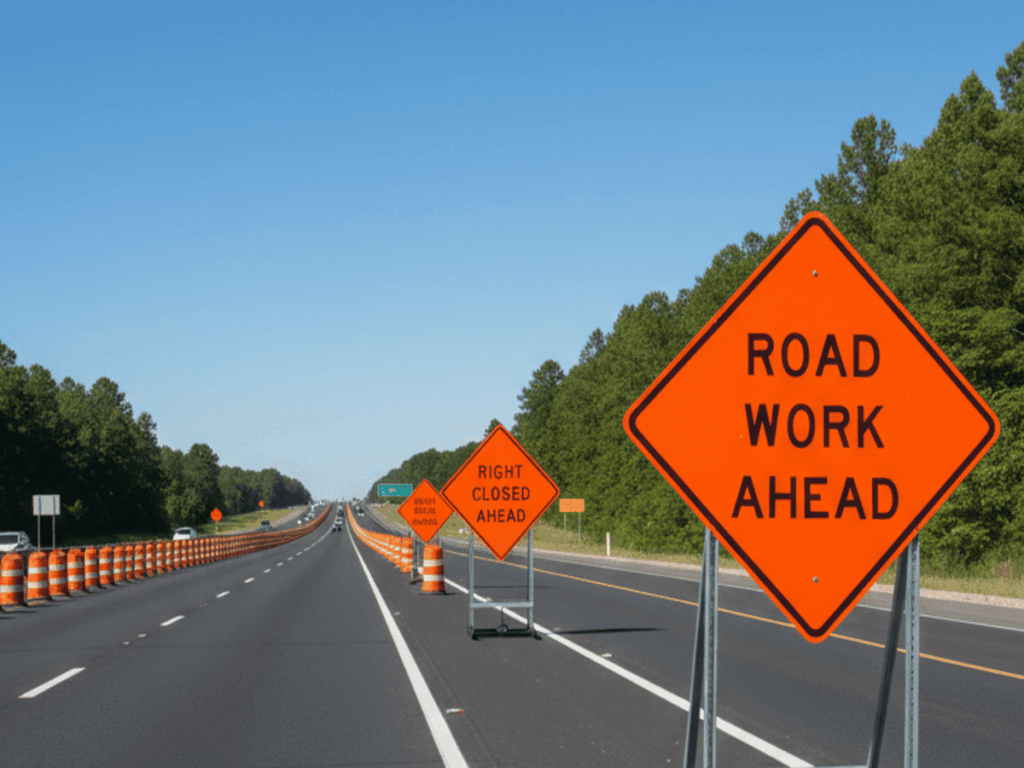
Introducción: The Importance of Lane Closure Signs
ForcForcing high-speed traffic to merge is dangerous. Drivers often react late to lane reductions. To prevent chaos, site managers must deploy a precise sequence of señales de cierre de carril. These static warnings create a “visual funnel.” They guide drivers out of the closed lane long before they reach the cones.
This setup relies on the standard “Four Component Areas” of a temporary traffic control zone.
Master the Basics: Before planning a specific closure, review the four core zones in our Configuración de la zona de trabajo 101 Guía.
Sin embargo, if you must block a travel lane, you need the full “Área de advertencia anticipada” configuración. This requires specific lane closed ahead signs placed at exact intervals.
Selecting the Correct Lane Closed Ahead Sign
In a single lane closure, specificity saves lives. You cannot use a generic message. You must tell drivers exactly which side is blocked using the specific lane closed ahead sign.
Placing the Right Lane Closed Ahead Sign
Most merging accidents happen here. Drivers in the right lane must merge left into faster traffic.
- Firmar: Utilice el Right Lane Closed Ahead sign (W20-5R).
- Colocación: Place this sign as the “B” warning in your three-step sequence.
- Acción: This forces traffic to merge left early. It prevents last-minute cutting.
Placing the Left Lane Closed Ahead Sign
El “fast lane” presents high-speed risks. Drivers expect a clear path.
- Firmar: Utilice el Left Lane Closed Ahead sign (W20-5L).
- Flujo de tráfico: This forces fast traffic to merge right.
- Visibilidad: Asegúrese de su señales de cierre de carril are visible from a greater distance. High-speed drivers need more reaction time.
Never swap these signs. A “Left Closed” sign on a “Right Closed” project causes catastrophic confusion.
Señales de cierre de carril & Taper Formula
You must position your señales de cierre de carril to support the “Merging Taper.” This is the critical difference from shoulder work. You are forcing traffic out of a live lane.
- The Full L Rule: Use the formula L = Width x Speed.
- Ejemplo: en un 60 mph road with 12-foot lanes, the taper must be 720 pies de largo.
- Sign Support: Place your final lane closed ahead sign well before the taper begins.
This creates a long, gradual path. It guides drivers away from the closed lane safely.
Señales de cierre de carril & El “Full L” Taper Formula
The placement of your señales de cierre de carril dictates the success of the merge. Sin embargo, the signs only warn the driver. The physical “Merging Taper” actually moves the traffic.
Crucial Difference: Unlike a shoulder closure which only uses a short “1/3 L” afilar, a lane closure requires the Full Taper Length (L).
Need the “1/3 L” Regla? If you are only closing the edge, do not use this formula. Read our Shoulder Work Setup Guide instead.
For a lane closure, a short taper forces aggressive merging. This causes side-swipe accidents. You must use the full length.
Calculating “L” Based on Speed
MUTCD defines specific formulas for “L” Dependiendo del límite de velocidad (S) and lane width (W).
- Alta velocidad (45 mph o más): Use the formula L = W x S.
- Ejemplo: For a 12-ft lane at 60 mph: 12 incógnita 60 = 720 pies.
- Baja velocidad (40 mph o menos): Use the formula L = (W x S²) / 60.
- Ejemplo: For a 10-ft lane at 30 mph: (10 incógnita 900) / 60 = 150 pies.
Aligning Signs with the Taper
Your lane closed ahead signs must align with this calculated distance.
- Buffer Space: Do not start the work area immediately after the taper. Leave a longitudinal buffer space.
- Espaciado de letreros: Ensure the final lane closed ahead sign (Symbol W4-2) is placed well before the taper starts.
Positioning Lane Closure Signs (Área de advertencia anticipada)
You must give drivers enough time to read the lane closed signs and react. The spacing depends strictly on the speed limit. MUTCD Table 6C-1 defines these “Advertencia anticipada” intervals.
Urban Low-Speed Roads (A, B, C Spacing)
En las calles de la ciudad (35 mph o menos), space your signs closer together. Long gaps confuse drivers here because of intersections and driveways.
- First Sign: Place the Road Work Ahead sign 100 feet from the next sign.
- Second Sign: Place the specific Lane Closed Ahead sign 100 feet from the taper.
- Meta: Keep the message immediate and clear.
Carretera & Freeway Spacing
High speeds require much longer gaps. Drivers need seconds, not feet, to make decisions.
- Espaciado: Increase the distance between each lane closure sign a 1,000 pies, 1,500 pies, o incluso 2,640 pies (0.5 millas) on freeways.
- Visibilidad: Asegurar el Left/Right Lane Closed Ahead sign is not blocked by trucks or vegetation.
- Tiempo de reacción: This extended zone allows drivers to merge safely without panic braking.
Channelizer Spacing (El “1-to-1” Regla)
Lane closure signs have done their job. They have warned the driver of the upcoming merge. Ahora, physical devices must take over. As the driver passes the final lane closed ahead sign, they enter the “Transition Area.”
Aquí, you must switch from information to guidance. You need a continuous line of channelizers (cones or drums) to physically push traffic out of the closed lane.
Building the “Visual Wall” (Taper Spacing)
In the taper, spacing is critical. If gaps are too wide, drivers might think the lane is still open. They might try to cut back in. You must create a “Visual Wall” that looks like a solid barrier from a distance.
- The Rule: The maximum distance between devices (in feet) equals the speed limit (in mph).
- The Formula: Spacing = 1.0 x Speed Limit.
- Ejemplo: en un 60 mph highway, place a road cone every 60 pies.
- Urban Context: en un 25 mph street, space them every 25 pies.
Maintaining the Boundary (Tangent Spacing)
Once the taper ends, el “Tangente” begins. This is the straight line alongside the active work area. Drivers are already in the open lane, so you can relax the spacing.
- The Rule: You may double the spacing distance here.
- The Formula: Spacing = 2.0 x Speed Limit.
- Ejemplo: On that same 60 mph highway, you can space cones every 120 pies past the taper.
Para la punta: On high-speed freeways, standard 28-inch traffic cones often fail to command respect. Use 42-inch channelizers or drums. Their larger profile reinforces the message of your señales de cierre de carril and protects the workspace more effectively.
Conclusión: Compliance Starts with Correct Signage
A single lane closure is a high-risk operation. It demands precise calculation, no conjeturas. You must calculate the “Full L” taper based on speed. You must select the specific Right or Left Lane Closed Ahead sign. Finalmente, you must space these warnings correctly to give drivers time to react.
Safety depends on visibility. Using a generic señal de trabajo por delante or incorrect spacing creates liability. It puts your crew and the public at risk.
Equip Your Fleet with Optraffic
Ensure your team has the right tools for the job. tráfico opt supplies MUTCD-compliant letreros de construcción and heavy-duty stands. We design our señales de cierre de carril for high-visibility performance in both urban and highway environments.
Contáctenos hoy to secure your bulk order of compliant safety equipment.
Preguntas frecuentes: Señales de cierre de carril & Configuración
En carreteras de alta velocidad (45+ mph), you need strictly defined gaps. Place the Road Work Ahead sign 1,000 pies a 1 mile upstream. Place the specific Lane Closed Ahead sign 1,500 feet beyond that. This gives drivers roughly 1 minute of reaction time at highway speeds.
No. You must be specific. A Left Lane Closed Ahead sign forces traffic right. Using it for a right-lane closure directs traffic into the work zone. This causes immediate accidents. Always match the text (Left/Right) to the actual blockage.
For speeds of 45 mph o más, use the formula L = Width x Speed. For a standard 12-foot lane at 60 mph, your taper must be 720 pies de largo. Do not shorten this distance.
Sí. You do not need multiple vendors. Optraffic acts as your one-stop manufacturer for the entire setup. We supply MUTCD-compliant lane closure signs, heavy-duty sign stands, and high-visibility channelizers (drums and cones). This ensures your entire work zone maintains consistent quality and reflectivity levels.