Two traffic cones can both stand 28 inches tall and still bind when stacked together. The base determines how much space the stack needs, while the body profile and contact points affect how easily the cones separate. Before placing a bulk replenishment order, fleet managers should test representative new cones alongside the models and truck racks their crews already use. UC Davis AHMCT cone handling research
What Determines Traffic Cone Stacking Compatibility?
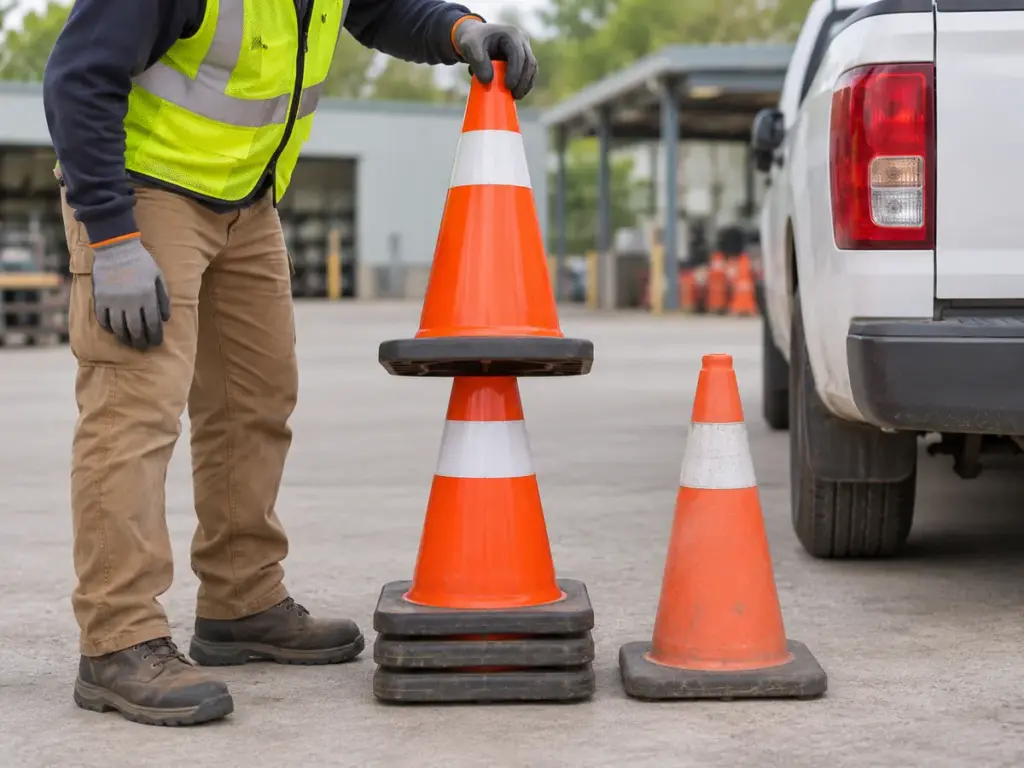
Traffic cone stacking compatibility depends on three things: how the cones nest, how they separate, and how the full stack fits into the existing carrier. A cone that stacks easily with its own model may behave differently when crews mix it with another model.
Base Dimensions and Carrier Fit
Measure the widest part of the base and note features such as rounded corners or projecting feet. Then compare the loaded stack with the carrier opening and usable space. Two models can nest well on the shop floor, yet one base can catch at the rack opening or interfere with the retainer.
Body Profile and Where the Cones Touch
The body taper and clearance inside the upper cone affect how far it slides over the one below. Check where the weight rests in the stack. If one model presses against the other model’s reflective collar, repeated stacking and removal can rub the collar. Test both stacking orders because the same two models can have different contact points depending on which cone sits on top.
For more on cone sizes and designs, check out our blog “Complete Guide to Traffic Cones: Everything You Need to Know.”
How to Test Replacement Traffic Cones Before a Bulk Order
Use serviceable cones from the existing fleet as the reference. Start with a stack of that model alone. Then compare it with a stack of new samples and a mixed stack. Include each existing model that crews are likely to mix with the new batch.
Test Both Stacking Orders and Repeat the Handling Cycle
Place a new cone over an existing cone. Reverse the order and repeat the test. Then build a mixed stack at the cone count crews normally carry and within the carrier’s rated limits. Have a crew member wearing their usual work gloves load and remove the cones several times in a controlled yard or shop. Watch for binding, a second cone lifting with the first, and fresh rub marks on reflective collars.
For guidance on evaluating sample quality, check out our blog “Why You Should Request a Free Sample of Bulk Traffic Cones Before Your Next Purchase.”
Check the Loaded Stack in the Actual Truck Rack
Measure the full mixed stack and compare it with a same-count stack of existing cones. With the truck parked, check that the stack clears the rack opening, the retainer closes as designed, and crews can remove cones without forcing them past the rack. If the fleet uses several carrier designs, record the result for each one.
| What to check | What to record |
|---|---|
| Mixed stack in both stacking orders | Which model sits on top when binding or uneven nesting occurs |
| Full stack at the usual cone count | Stack dimensions and clearance at the rack opening |
| Repeated removal | Whether the upper cone comes away cleanly and where rubbing occurs |
| Carrier and retainer fit | Which truck or rack model accepts the stack with the retainer fully engaged |
For automated deployment or retrieval systems, confirm the equipment manufacturer’s supported cone models and follow its sample validation procedure. UC Davis research for Caltrans documented variation in cone base dimensions and body geometry when evaluating automated handling. UC Davis AHMCT cone handling research
How Fleet Fit Affects a Replenishment Order
What a DOT Specification Can Tell Buyers
Caltrans includes stacking compatibility in its authorization criteria for 28-inch, three-band traffic cones. Section 1.9 requires compatibility with existing Caltrans stock and separation under gravity without binding. For other fleets, the operational reference is their own inventory and equipment. The buyer should also verify any applicable project specification or approved products list for the proposed cone model. Caltrans authorization criteria, Section 1.9
When to Mix Models and When to Assign Separate Stock
If a mixed stack fits the existing racks and crews can remove the cones cleanly, document the tested models and carry that specification into the purchase order. If the cones fit the racks but bind when mixed, a fleet may be able to assign the new model to specific trucks that carry uniform stacks. That approach works best when the depot can keep the two models separate during loading, returns, and transfers.
Once the model and quantity are set, importers can plan shipment capacity and packaging. For that step, check out our blog “Traffic Cone Container Loading: How to Plan Bulk Orders and Reduce Freight Cost.”
Conclusion
A successful bulk replenishment order gives crews cones they can handle with the equipment already on their trucks. Before reordering, confirm how new samples nest with existing cones, check that they separate cleanly, and verify the full stack in the carrier.
For bulk replenishment, buyers can share their current cone model, base dimensions, rack clearance, and estimated quantity with OPTRAFFIC to discuss replacement options and sample evaluation. Contact OPTRAFFIC
FAQs
Will two 28-inch traffic cones from different manufacturers stack together?
They may. The nominal height describes a single cone. The base shape, body taper, and internal clearance determine how two models nest and separate. Test the pair in both stacking orders.
Is a two-cone test enough before ordering in bulk?
A two-cone test helps identify binding at the contact points. A full stack at the usual load count shows how the mixed models affect rack clearance and removal. Run both checks with representative samples.
What if the new cones fit the truck rack but bind with the old cones?
If the project permits both models, crews can use separate stacks or assign one model to specific trucks. The depot needs a practical way to keep stock separate when crews return or transfer equipment.
Can cones that stack by hand work in an automatic cone truck?
Hand stacking only confirms manual handling. Check the equipment manufacturer’s cone specifications and validate the proposed model through its approved process. UC Davis AHMCT cone handling research