construction sign programs shape daily decisions on active sites, therefore Construction Sign Applications deserve a full “use-case map” that crews can follow. Construction teams use signs to prove compliance, guide deliveries, control traffic, protect pedestrians, support marketing, and run cleaner operations. For a full foundation on construction signage strategy—covering safety, efficiency, and compliance—read The Comprehensive Guide to Construction Signage.
OPTRAFFIC supports these Construction Sign Applications with durable, high-visibility construction signs built for real jobsite conditions, helping contractors keep messaging consistent from the entrance to the work zone.
Regulatory and Compliance Uses for Construction Signs
Compliance signage protects the project during inspections, claims, and audits. It also reduces friction with neighbors and authorities.
Construction permit signs and permit boards at the entrance
A permit board translates “permission to build” into a visible, verifiable notice. It typically sits near the public-facing entrance, where inspectors and the public can see it.
Practical functions:
- Confirms the project holds valid permits and approvals.
- Publishes responsible parties and contact routes.
- Reduces inspection delays caused by missing site information.
Common content blocks:
- Permit identifiers and issuing authority.
- Contractor or operator information.
- Emergency contact details and after-hours contacts.
- Project description and approved scope summary.
Mandatory site postings for worker rights and EEO notices
Workplace posting requirements do not stop at the office. Many employers must display required labor and rights notices in a conspicuous place, where workers can see them.
A high-functioning posting zone includes:
- A single “mandatory site postings” board in the break area or site office.
- A clean layout with labeled sections for each notice.
- Controlled updates, so expired posters do not stay on the wall.
For U.S. contexts, the U.S. Department of Labor provides guidance and free electronic copies of required posters, and it points employers to the Poster Advisor to confirm which notices apply.
OSHA notice boards and the OSHA “It’s the Law” poster
OSHA expects covered employers to display the “Job Safety and Health: It’s the Law” poster in a conspicuous place.
A practical approach:
- Place the OSHA notice board near daily foot traffic.
- Keep it readable, uncluttered, and protected from weather.
- Align the board with toolbox talk sign-in and safety communications.
EEO “Know Your Rights” posting alignment
Equal employment opportunity notices often sit with the same compliance board. The EEOC’s “Know Your Rights: Workplace Discrimination is Illegal” poster summarizes key protections and complaint paths.
Teams reduce risk when they:
- Post current versions only.
- Provide language access where needed.
- Avoid “miscellaneous” clutter on the same board.
Environmental postings and stormwater permit coverage signs
Environmental compliance often requires more than a plan. Some permits also require visible notice on site.
For example, a construction stormwater permit can require a sign near the project entrance. It can require public readability from the right-of-way. It can also require permit identifiers and contact information for SWPPP requests or questions.
High-impact environmental sign use cases:
- Dust-control reminders near haul roads and cutting areas.
- Spill-response signage near fueling and chemical storage.
- Protected-area warnings near wetlands, drains, and outfalls.
Audit-ready proof of posting
A compliance sign only helps when it stays current. Strong teams treat postings like controlled documents.
Simple proof methods:
- Weekly photo log of the compliance board.
- Revision date labels on each posted notice.
- A single owner for posting updates and removals.
Jobsite Logistics and Wayfinding Uses
Wayfinding signage cuts miscommunication. It also lowers congestion. It protects schedule discipline when conditions change.
Site entrance signage for segregated traffic flows
Site entrance signage reduces conflict points by separating:
- Visitor entry
- Worker entry
- Heavy equipment entry
Clear entrance signs support:
- Faster check-in.
- Cleaner security control.
- Fewer wrong turns near active equipment.
Keyword fit: site entrance signage stays most effective when it appears before the first decision point.
Construction delivery signs for accurate drop-offs
Wrong deliveries burn time. They also create unsafe reversing and repositioning. Therefore, construction delivery signs should guide trucks through a step-by-step route.
A robust delivery sign path uses:
- A “Delivery Entrance” confirmation sign.
- A route arrow sign at each fork.
- A “Staging / Wait Here” sign before the unloading zone.
- A “Do Not Enter” sign for restricted corridors.
Job site wayfinding to temporary facilities
On active sites, people search for three things fast:
- Site office
- First aid
- Assembly point
Job site wayfinding signs reduce verbal directions and repeated interruptions. They also help new workers and visitors stay safe.
Minimum wayfinding set:
- “Site Office →”
- “First Aid →”
- “Assembly Point →”
- “Restrooms →”
Wayfinding for changing conditions
Sites change daily. Therefore, wayfinding must update quickly.
Effective tactics:
- Use “Today’s Access Route” signs during major shifts.
- Add “Route Closed” signs where old paths remain visible.
- Add “You Are Here” maps at large multi-gate sites.
Support evidence: research on construction productivity often highlights communication and task clarity as major drivers, and poor structure can contribute to productivity loss.
Temporary Traffic Control Uses and Road Interface
TTC signage shows professional capability in public space. It also protects workers and drivers during transitions.
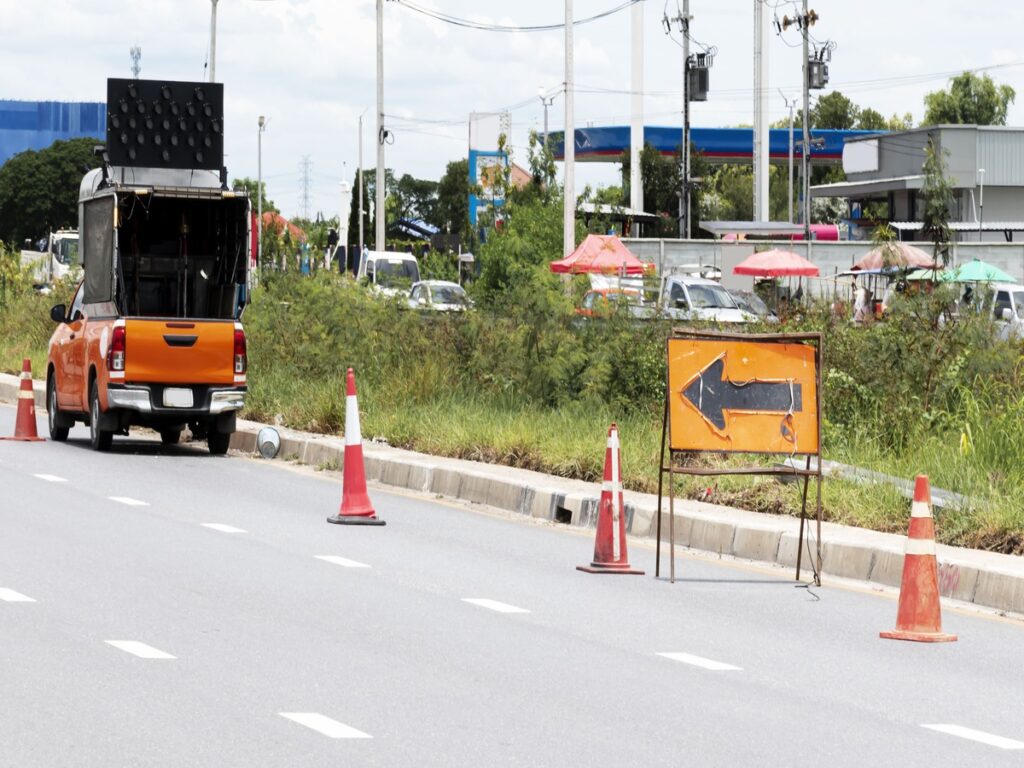
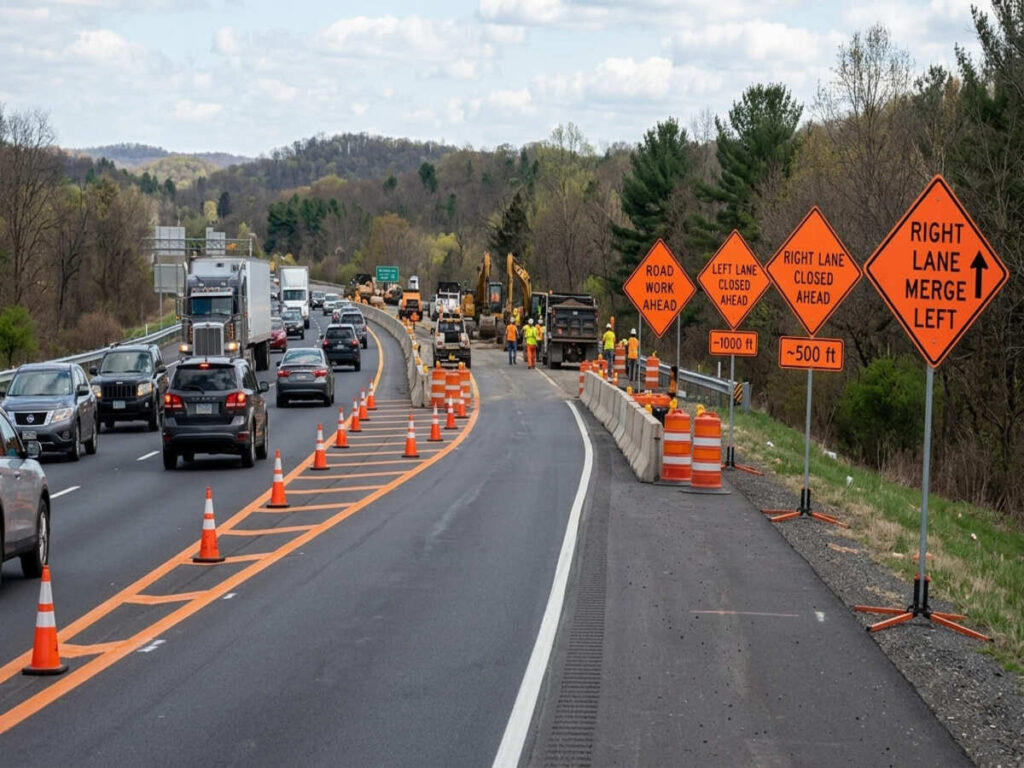
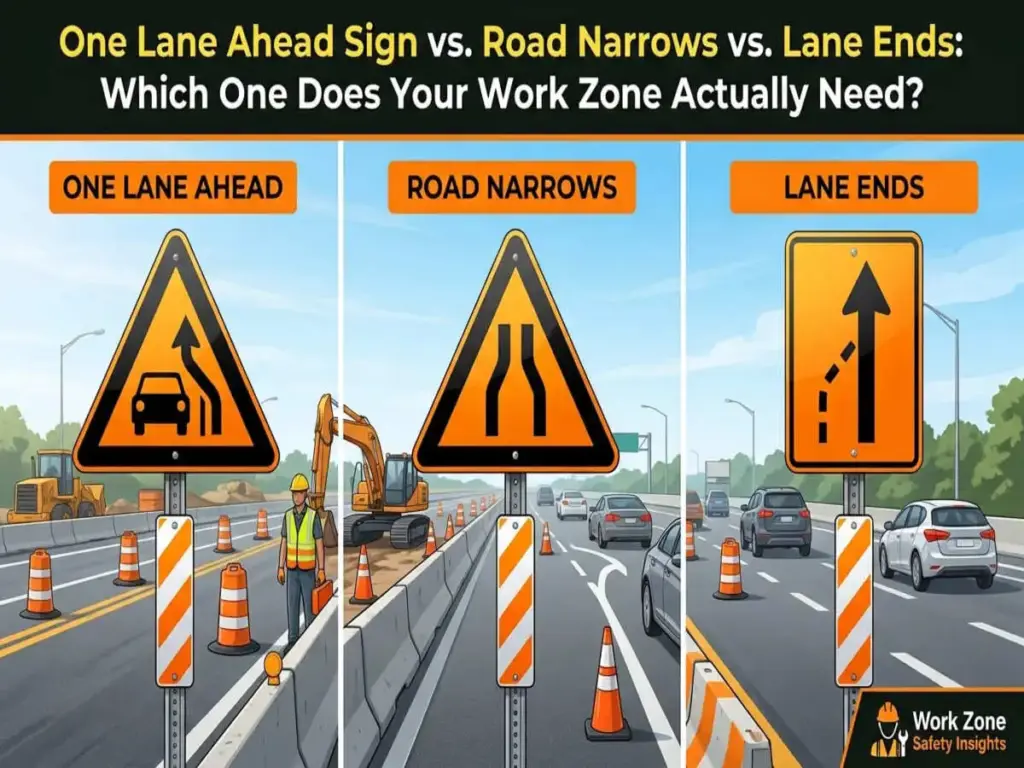
Road work signs for advance warning
Advance-warning signs reduce surprise. They set driver expectations early. As a result, they reduce abrupt braking and late merges.
Teams usually deploy:
- “Road Work Ahead”
- “Be Prepared to Stop”
- “Flagger Ahead” where applicable
MUTCD compliant signs for lane shifts and detours
MUTCD alignment matters on roads open to the public. The FHWA identifies the current MUTCD as the 11th Edition (dated December 2023).
It also notes the Final Rule adoption and the January 18, 2024 effective date.
Detour sign systems work best when they include:
- A detour decision sign before the turn.
- A reassurance sign after the turn.
- A “Detour Ends” sign when the route returns.
Detours fail when messages change mid-route or crews leave old signs in place. For step-by-step field control—covering decision points, reassurance signs, and sign removal discipline—see A Guide to Effective Detour Sign Management on Construction Sites.
Temporary Traffic Control (TTC) signs at the jobsite boundary
The boundary between public roadway and jobsite access creates the highest friction. Therefore, TTC signs must control speed, merging, and priority.
Common boundary controls:
- Temporary speed limit signs.
- Stop or yield control at haul road exits.
- “Trucks Entering / Exiting” warnings.
Teams that want to move from basic compliance to measurable efficiency gains can continue with How to Improve Traffic Management Efficiency in Construction Zones with Construction Work Signs and Delineators.
Pedestrian control signs for temporary walkways
Pedestrian routing needs continuity. It also needs clarity.
High-performance pedestrian sign sets include:
- “Sidewalk Closed Ahead”
- “Pedestrians →” with arrows
- “Use Other Side”
- “Temporary Crossing”
Why TTC signage matters right now
Work zone safety remains a live public issue. FHWA reported 899 deaths in work zone crashes in 2023.
FHWA also tracks trends and published work zone facts and statistics for ongoing reference.
Therefore, clear road work signs and consistent TTC messaging support safety outcomes and public trust.
Safety and Hazard Communication Uses for Construction Signs
Safety-focused construction sign placement works when it targets the exact moment a worker or visitor faces risk. Clear safety messaging reduces hesitation, prevents wrong entry, and supports faster incident response across active areas.
PPE Requirement Signs at High-Risk Access Points
PPE signs control behavior at the entry point, before exposure begins. They work best at gates, stair towers, lift access, scaffold approaches, and transitions into active work areas.
High-impact PPE sign messages include:
- Hard Hat Required
- Safety Glasses Required
- High-Visibility Clothing Required
- Hearing Protection Required
- Cut-Resistant Gloves Required
This section also supports compliance expectations. OSHA highlights employer responsibilities around personal protective equipment in its PPE standards and guidance.
Hazard Warning Signs for Hot Work, Electrical, and Confined Spaces
Hazard signs reduce exposure by warning early and by defining boundaries. They should appear before the hazard area, not inside it. Crews rely on these signs when noise, low light, or time pressure reduces verbal communication.
Common hazard sign applications:
- Hot Work Area: Welding, cutting, grinding zones
- High Voltage: Temporary power, panels, and distribution points
- Overhead Work: Falling-object risk zones
- Confined Space: Permit-required entry areas, restricted entry rules
OSHA provides specific regulatory frameworks for hazard communication, electrical safety, and confined spaces, which makes consistent, readable hazard signage a practical control on site.
Restricted Area Signs to Prevent Unauthorized Entry
Restricted area signage protects workers, visitors, and the public. It also reduces theft and vandalism risk by clarifying boundaries. These signs work best when they appear at every natural entry point, including gaps in fencing, service corridors, and temporary access routes.
Typical restricted-area sign messages:
- Authorized Personnel Only
- No Unauthorized Entry
- Danger: Construction Area
- Keep Out
- Do Not Enter
Emergency Response Signs for First Aid, Eyewash, and Assembly Points
Emergency signs must stay simple and location-specific. In an incident, people follow the fastest visible cue. Therefore, emergency signage should guide responders and bystanders without requiring radio calls.
Core emergency sign locations:
- First Aid Station and trauma kit locations
- Eyewash and safety shower points
- AED locations, where applicable
- Emergency exit routes inside enclosed work zones
- Assembly Point locations for evacuation accountability
OSHA’s emergency action plan guidance emphasizes clear procedures and communication for emergencies, and strong signage supports that communication in the field.
Safety signs deliver results only when crews place them correctly and keep messages consistent across the site. For a deeper, field-ready approach to compliance, placement strategy, and site behavior, read Guide to Construction Safety Signs: Compliance, Strategy, and Site Culture.
Branding and Project Marketing Uses for Construction Signage
Marketing signage turns perimeter space into controlled messaging. It also reduces rumor-driven complaints by sharing clear information.
Building hoarding graphics for the project story
Hoarding graphics often serve two tasks:
- Show future-state visuals and project identity.
- Communicate timeline and community benefits.
Best-use patterns:
- Place the hero rendering where foot traffic concentrates.
- Keep text short and scannable.
- Add a simple contact or info route for concerns.
Construction fence wraps for high-visibility perimeter messaging
Construction fence wraps can unify a messy perimeter. They can also reduce visual clutter when multiple trades post ad-hoc signs.
Strong fence wrap systems include:
- Repeating brand blocks with consistent spacing.
- Clear “Site Entry” cues at gates.
- A small set of rules, like “No Trespassing” and “PPE Required.”
Project marketing signs and “Coming Soon” leasing signs
Leasing and pre-sales signs convert attention into leads.
High-conversion sign elements:
- One primary call-to-action.
- A readable phone number.
- A QR code that loads fast.
- A simple “Coming Soon” promise without overspecifying.
Marketing also intersects with security. Jobsite theft creates major losses. ENR cited an estimate of $400 million to $1 billion in annual losses from construction site theft. Therefore, perimeter messaging can support deterrence and awareness.
Internal Organization and Site Management Uses
Internal signs reduce waste and downtime. They also protect assets and keep crews aligned.
Trade-specific zone signs for workflow control
Zone signs create order where multiple trades overlap. They reduce conflicts. They also reduce “search time” for materials.
Useful zone labels:
- “Electrical Staging”
- “MEP Materials”
- “Carpentry Tools”
- “Hot Work Area”
Waste and recycling signs to prevent contamination
Waste stream contamination raises hauling costs and compliance risk. Clear signs prevent wrong disposal.
A practical set includes:
- “General Waste”
- “Recycling”
- “Hazardous Waste”
- “Concrete / Masonry Only” where needed
Asset ID signs for tracking and theft deterrence
Asset ID signage supports:
- Inventory checks
- Rental reconciliation
- Loss prevention
Teams often use:
- Large, visible equipment numbers.
- QR codes tied to asset logs.
- “Property of Site / Contractor” identification.
Visual management boards for daily operational clarity
A visual board acts as a “single source of truth” on site. It supports:
- Daily access route changes
- Safety alerts
- Location-specific instructions
Common Construction Sign Application Failures and Field Fixes
Failure: outdated compliance board
Fix:
- Assign a poster owner.
- Add revision dates.
- Remove expired notices weekly.
Failure: delivery signage starts too late
Fix:
- Start routing signs before the gate.
- Add confirmations after each turn.
- Add a staging sign before the unloading zone.
Failure: detour messages conflict
Fix:
- Use one detour name only.
- Repeat it consistently.
- Remove old signs immediately.
Failure: perimeter marketing reduces readability
Fix:
- Keep large text for primary messages.
- Move detailed text to a QR landing page.
- Separate safety messages from promotional graphics.
Quick Mapping Table
| Use area | What the signs control | Typical sign families |
|---|---|---|
| Compliance | Proof, notice, audit readiness | Construction permit signs, mandatory site postings, OSHA notice boards |
| Logistics | Routing, arrivals, facility access | Job site wayfinding, construction delivery signs, site entrance signage |
| Road interface | Driver behavior, transitions, pedestrian safety | Temporary Traffic Control (TTC) signs, road work signs, MUTCD compliant signs |
| Marketing | Public narrative, leasing conversion | Construction fence wraps, building hoarding graphics, project marketing signs |
| Internal ops | Zones, waste streams, assets | Zone labels, recycling signs, asset ID tags |
Next Step for Site Managers: Understanding where signs go is only half the battle. To ensure long-term efficiency and cost-control, it’s essential to plan when to deploy them. Read our deep dive into the Phased Application of Construction Signage to build a timeline-based signage strategy.
FAQ
What makes TTC signage “MUTCD compliant” in practice?
Teams align sign type, message, placement intent, and consistency with the MUTCD and local adoption rules. The 11th Edition (December 2023) sits as the current national reference.
Where do construction permit signs and permit boards work best?
They work best near the public-facing entrance, where inspectors and the public can see them. They also need a stable mounting and readable layout.
Which notices belong on OSHA notice boards and mandatory site postings?
Covered employers generally need the OSHA “It’s the Law” poster displayed prominently, and other notices depend on the employer and workforce. DOL provides a Poster Advisor and free poster resources to confirm requirements.
How do construction delivery signs reduce schedule loss?
They reduce wrong drops, reduce reversing, and reduce on-radio corrections. They also keep trucks out of pedestrian areas.
When do environmental postings require public-facing signs?
Permit conditions can require a posted notice near the site entrance with permit identifiers and contact information. One example appears in construction stormwater permit language.